Skip to content
A wage claim in Texas lives or dies on timing and paper trail. Texas workers have only 180 days from the date wages were originally due to file with the Texas Workforce Commission, and missing that window can end the administrative case before anyone looks at the merits (Texas Payday Law). In practice, that means the difference between recovery and silence often comes down to whether the worker can document the amount owed, the pay period, and the employer's identity with enough clarity to survive the first review.
Understanding Wage Theft in Texas
Rutgers researchers estimate that more than 3 million workers in Texas experienced a minimum wage violation between 2009 and 2022, which equals about 3% of all workers and 11% of low-wage workers (Rutgers University). That same research estimates the losses at nearly $4,000 per affected worker per year and over $12 billion in total over the period studied. Those numbers matter because they show wage theft isn't an edge case. It's a recurring problem that can drain family budgets fast.
Texas workers usually face two paths. One is the Texas Workforce Commission wage-claim process, which is the state's main administrative route for unpaid wages. The other is a lawsuit in court, which may fit better when the claim is too complex for the agency process or when the worker needs a different kind of remedy.
Why the numbers push people to act quickly
The hard truth is that a strong claim still loses if it sits too long. The Texas Payday Law deadline is short, and the TWC process is built around evidence, not frustration. A worker who says, “My boss never paid me,” is not yet in a good filing position. A worker who can show the pay period, the agreed rate, the missing hours, and the exact amount due is much closer to moving a claim forward.
Practical rule: treat every unpaid shift, commission dispute, final paycheck issue, or bonus dispute like a record-keeping problem first and a legal problem second.
That mindset helps families too, especially when a loved one is handling payroll, caregiving, or a household budget under stress. The same discipline that supports a strong wage claim also supports other Texas legal processes, including guardianship planning, where courts and agencies expect clear proof, not general complaints. For readers who are also organizing family legal matters, related resources like Guardianship, Probate, and Estate Planning often help families understand how documentation shapes outcomes.
A good wage claim Texas file doesn't start with anger. It starts with paper, dates, and a clean calculation.
Types of Wage Claims and Critical Deadlines
The Texas Payday Law covers the kinds of pay disputes workers run into most often, including unpaid regular wages, overtime, commissions, bonuses, and final paychecks (Texas Payday Law). The key point is simple. If the compensation was earned and should have been paid, it may belong in a wage claim. If the dispute is really about a broader workplace issue, it may need a different legal path.
The deadline starts when the wages were due
The TWC deadline is 180 days from the date the wages were originally due, not from when the worker finally notices the error or leaves the job (Texas Payday Law). That detail trips people up all the time. A final paycheck withheld in January can become untouchable administratively well before summer if the worker waits to act.
The safest way to think about it is this. Each unpaid item has its own clock. If a commission was supposed to be paid on a specific date, that date matters. If the employer promised a final paycheck after termination, that due date matters too.
What does not fit neatly inside the same box
Not every workplace dispute is a wage claim. Some complaints are really about scheduling, discipline, discrimination, or misclassification questions that need a different strategy. Sending the wrong issue to the TWC wastes time, and time is the one thing Texas wage claimants do not have in abundance.
A quick example helps. A worker who is shorted on overtime for several pay periods likely has a wage claim. A worker who believes the employer changed job duties to avoid overtime rules may need a deeper legal review before filing anywhere. The distinction matters because an incomplete filing can fail even when the worker feels absolutely right about the underlying problem.

The strongest deadline strategy is to identify the due date first, then work backward with the pay records.
That approach keeps the claim tied to facts instead of memory. In wage disputes, memory fades. Payroll records, time records, and contract terms usually decide the fight.
Building Your Evidence Package
The TWC's process is evidence-driven and front-loaded, which means a claim has to be more than a complaint. The Commission's tutorials require a user ID, a completed online or paper form, and supporting documents uploaded or faxed or mailed with the cover page. The paper instructions also call for a recent payroll stub and a breakdown of days and hours worked (TWC wage claims instructions).
What the TWC expects to see
TWC instructions require claimants to identify the employer's business name, address, phone number, and worksite address, along with the amount of unpaid wages and how that amount was calculated (TWC online wage claim form instructions). That calculation piece is where many claims weaken. If the filing says $1,200 is owed, but the math behind that number is missing or messy, the agency has less to work with.
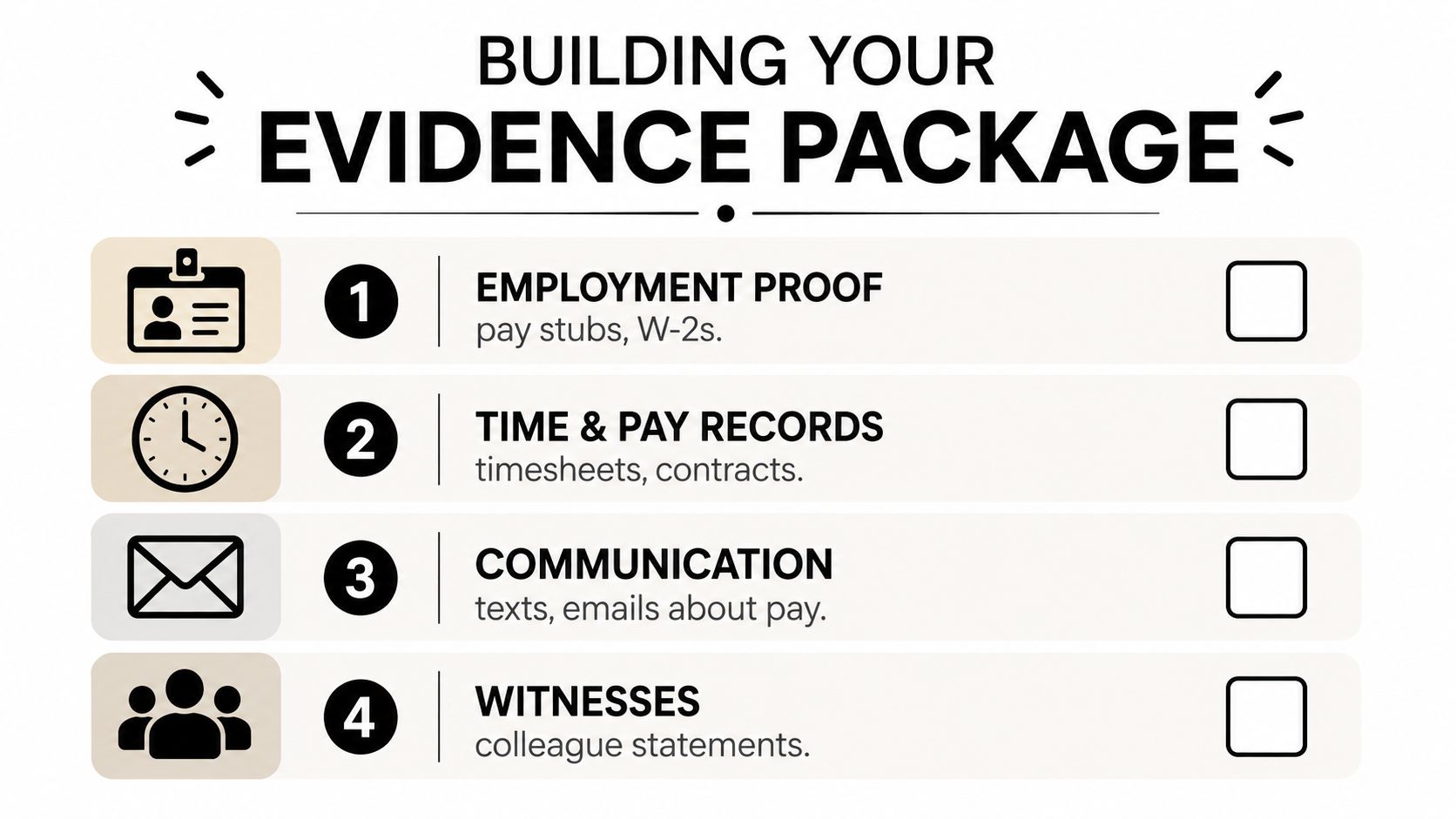
The best evidence package usually includes:
- Pay stubs and wage records, because they show what was paid and what was missing.
- Time records or schedules, because they help prove hours worked.
- Written pay terms, like offers, agreements, or commission plans.
- Messages about pay, because texts and emails can confirm what the employer acknowledged.
Practical rule: if a number is in the claim, there should be a document that helps explain that number.
That rule matters even more in disputes over commissions or final checks, where the employer may argue about when the money became due. The claim is stronger when the filing identifies the wage type and then shows the math step by step. A vague statement that wages are “owed” usually doesn't travel far.
Why documentation beats emotion
Claimants often focus on proving they were treated unfairly. The TWC cares more about proving the amount owed. That shift can feel cold, especially when someone is already stressed about rent, groceries, or childcare. Still, it's the right strategy if the goal is recovery.
For families balancing other legal needs, that same discipline shows up elsewhere. If a relative is sorting out incapacity, health care access, or day-to-day support, a related resource like Less Restrictive Alternatives to Guardianship in Texas can help explain why Texas courts must consider alternatives before granting guardianship. Documentation matters there too, because Texas decision-makers want the least intrusive workable solution.
Filing Your Claim with the Texas Workforce Commission
Texas allows wage claims to be filed in person, by mail, by fax, or electronically in the manner designated by rule (Texas Labor Code Section 61.051). The online route starts with creating a user ID, starting a new wage claim, and printing a cover page if supporting documents still need to be sent separately. The process is straightforward on paper, but it rewards careful preparation more than speed.
What happens after the filing goes in
Once the TWC receives the claim, the employer usually has 14 days from notice to answer (TWC wage claims procedures). After that, the claim moves into investigation and may later proceed to appeal. That response window is a big reason the initial filing has to be clean. If the employer gets the first look at a weak file, the case can start from a disadvantage.
A worker filing alone should expect the TWC to focus on details, not sympathy. The agency wants to know what was promised, what was worked, what was paid, and how the unpaid balance was calculated. A missing timesheet or incomplete pay-period breakdown can slow things down or weaken the claim before the merits are ever discussed.
Choosing the filing method that fits the evidence
The method matters less than the package. A worker with a neat set of scanned records may prefer the online system. A worker with paper payroll records or hard-to-scan documents may do better mailing or faxing the evidence with the cover page. In either case, the filing should read like a proof packet, not a story.
Keep the claim file organized as if someone else will need to understand it in one sitting.
That advice is especially useful when the claim involves multiple employers. TWC instructs workers to file a separate claim for each employer if more than one employer is involved (Texas Payday Law). Mixing employers in one filing can create confusion the agency doesn't need.
For workers who want help assembling records, a Texas lawyer, a payroll professional, or a support service can make the difference between a rough draft and a usable file. In some situations, outside help is the fastest way to clean up the timeline before the employer's response window closes. If you're also comparing family-law support services, an informational page on wage-and-hour paralegal support can be useful for understanding how nonlawyer case support fits into document preparation.
Pursuing Litigation When Administrative Claims Fall Short
When a TWC claim doesn't fit, the next move is usually court. The right forum depends on how much is owed, how hard the facts are to prove, and whether the worker wants to push forward alone or with counsel. Small claims court can work for simpler disputes, while civil litigation makes more sense when the case is larger, legally messy, or tied to other claims.
Small claims court versus civil litigation
Small claims court is usually the simpler path. It is built for lower-conflict disputes, and workers often like it because the procedure is less formal. Civil litigation is more demanding. It can handle broader disputes, but it also brings more procedure, more motion practice, and more time.
The trade-off is practical, not theoretical. If the unpaid wages are relatively straightforward and the employer is still reachable, a smaller court case may be enough to move the dispute. If the amount owed is tied up in contract language, misclassification arguments, or multiple pay periods with inconsistent records, civil litigation may be the better vehicle.
A decision framework that keeps the case grounded
A worker should weigh three questions. First, is the amount owed worth the time and filing effort? Second, can the employer pay if a judgment is won? Third, does the worker want to handle service, deadlines, and courtroom rules personally?
For people who want a court-collection overview after judgment, Omni Tax Help's wage garnishment guide is a useful resource on how collection concepts work after a court order. That matters because winning a judgment and collecting the money are not the same thing.
One realistic example is a former employee with a small final paycheck dispute. If the paperwork is clear, small claims may be enough. Another example is a worker whose unpaid commissions span several months and depend on disputed sales records. That case may need civil litigation, especially if the employer starts disputing the underlying numbers.
Texas families often face the same kind of choice in guardianship cases, whether they're trying to establish authority, challenge an existing order, or protect a vulnerable relative. A firm that handles Law Office of Bryan Fagan, PLLC matters can also help families think through documentation, deadlines, and courtroom strategy in a way that matches the facts of the case.
Protecting Yourself from Retaliation and Knowing When to Hire an Attorney
Retaliation is a real concern after a wage complaint, and workers shouldn't ignore it. If an employer cuts hours, threatens discipline, or punishes someone for asserting wage rights, the worker should document the conduct immediately and keep every message, schedule change, and pay stub. The cleaner the record, the easier it is to show what happened and when.
When legal help becomes the smart move
A lawyer becomes especially useful when the case involves multiple employers, disputed employment status, a larger amount at stake, or overlapping claims such as discrimination or retaliation. Those cases tend to have more moving parts, and a mistake in one part can weaken the whole file. A first consultation should focus on the wage records, the due dates, and the employer's likely defenses.
That's also where professional support can save time. A lawyer, and sometimes well-trained case support staff, can help sort payroll records, track the deadline, and turn a pile of documents into a coherent claim package. If a family is already dealing with guardianship, probate, or other urgent responsibilities, outsourcing the administrative burden can matter as much as the legal advice itself.
A strong consultation starts with documents, not a speech.
Bring the pay stubs, time records, offer letters, commission plans, and any emails or texts about pay. If the worker has already been retaliated against, include that timeline too. The attorney's job is easier when the facts are organized before the meeting starts.
For families juggling work losses, caregiving, and legal stress, the right help is often about stability, not drama. A wage claim can be filed alone in some situations, but once the dispute becomes disputed, layered, or time-sensitive, legal help usually pays for itself in clarity even before any recovery is won.
If you're dealing with unpaid wages, a missed final paycheck, or a TWC filing that needs to be cleaned up before the deadline runs, the Law Office of Bryan Fagan, PLLC can help you organize the evidence and understand your options under Texas law. Visit Law Office of Bryan Fagan, PLLC to schedule a free consultation and get guidance for your specific situation.