A hospital social worker calls because a patient can't safely sign discharge papers, has no money, and nobody can find a spouse, child, sibling, or even a reliable friend. The chart shows confusion, the apartment is gone, the phone numbers are dead ends, and the facility needs a lawful decision fast. In Texas, that isn't a family problem anymore, it's a public guardianship problem, and the law has a narrow path for exactly these cases.
Texas treats indigent public guardianship as a safety net, not a convenience. The person has to be incapacitated under Texas law, meaning the person's ability to receive and evaluate information or make decisions is so impaired that the person cannot provide for basic needs like food, clothing, shelter, health, or safety without help, and the court still has to apply the clear-and-convincing evidence standard found in Title 3, Subtitle G of the Estates Code. Even when nobody objects, the court does not skip proof.
That's why these cases matter to hospital teams, Adult Protective Services workers, county staff, and private attorneys who get the tough referrals. They sit at the intersection of medical decision-making, placement, benefits, and court oversight. For a practical look at a related housing issue when an adult has nowhere stable to go, the 2026 affordable housing guide can be a useful starting point for case planning outside the courtroom.
When an Adult Has No Family and No Assets in Texas
A man shows up at a Houston hospital after a fall. He is confused, cannot say where he lived, has no usable ID, and the social worker cannot reach any relative after repeated calls. He may need placement, medication decisions, and help getting basic benefits, but there is no one available to sign paperwork or supervise the next step. At that point, Texas guardianship law stops being a theory and becomes a discharge issue with real deadlines.
Texas separates guardianship of the person from guardianship of the estate. If the adult needs help with care, placement, or medical decisions, a person-only guardianship may be enough. If there is little or nothing to manage, opening the estate can add fees, filings, and oversight without solving the problem in front of the court.
Why Texas treats these cases differently
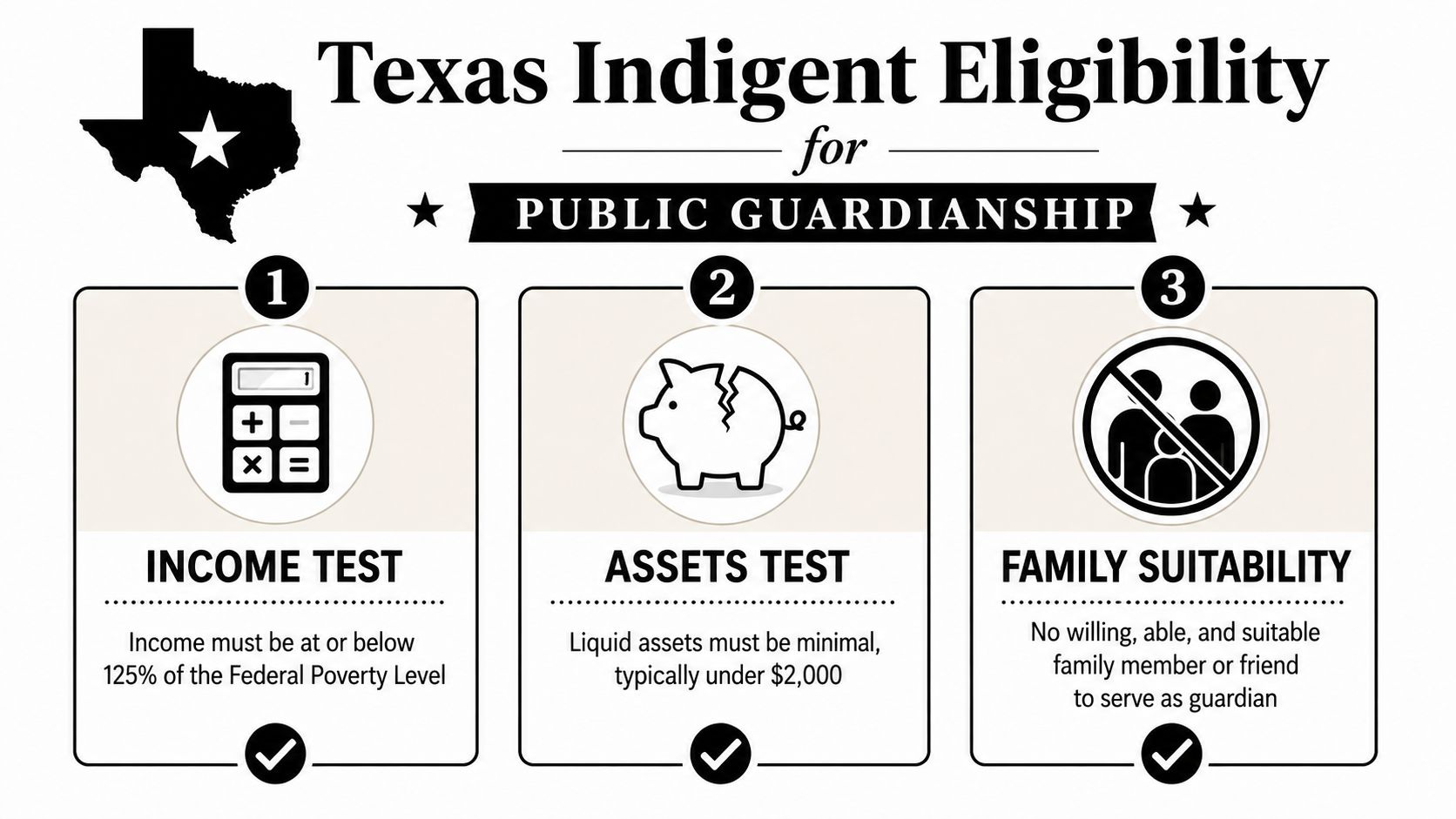
Texas public guardianship is designed for people who are both incapacitated and indigent, and that combination matters. The state's public guardianship materials describe indigent adults as people with no appropriate person to serve, no ability to obtain privately provided guardianship services, and annual gross income at or below 125% of the federal poverty level Public Guardianship After 25 Years. The focus is on the isolated person, not just someone whose relatives refuse to help.
Practical rule: if the problem is access to care or placement, do not assume the estate must be opened too. The court still has to match the order to the actual need.
For caseworkers, the first question is not “Who can serve?” It is “What authority does the court need, and what can be handled another way?” A narrower filing, or a referral to a public guardian, can keep the case moving without asking for more court power than the facts support.
The support picture still matters, including where the person will go next. A guardianship petition without a discharge plan often leaves the same crisis in place. When the adult has no assets and no backup, housing planning and legal planning have to move together, and the 2026 affordable housing guide can help with the placement side of that work.
Who Counts as Indigent for Public Guardianship
Texas public guardianship starts with two practical questions. Is there a willing, suitable family member or friend who can serve? Can the person pay for a private guardian or privately provided guardianship services with the income and resources they have? If the answer is no on both, the case starts to fit the public guardianship model.
The Texas indigence screen is broader than “no money in the bank”
A small Social Security check can affect the analysis, but it does not end it. Texas guidance looks at income, assets, and whether the person can realistically obtain privately provided guardianship services, so a caseworker should never stop at a single bank balance printout. The central question is whether the person can pay for help and whether anyone appropriate is available to do the job.
That matters because public guardianship in Texas is a last-resort structure for people who are alone, medically vulnerable, and unable to hire assistance. Public guardianship program materials and related research describe a system aimed at people with very limited means, and the general pattern is consistent with that purpose Public Guardianship After 25 Years.
If a family member is fighting over who should serve, the Contesting a Guardianship in Texas page is a useful reference because disputes usually turn on capacity, suitability, or the scope of authority. That kind of challenge is different from the public guardianship question, but in real cases the issues often overlap.
Texas does not have one automatic statewide public guardian for every county. Availability depends on local capacity, which is why the eligibility test and the referral path both matter.
That county-by-county reality explains why two similarly situated adults can end up in very different places. One county may have a guardianship program with room to take the case. Another may push the matter toward a private filing, a different agency, or a narrower order. For researchers trying to locate the right person in a missing-family case, tools like tracing agents in the UK show how much effort can go into finding relatives before the court treats the person as without support.
Filing the Petition When There Is No Family to Notify
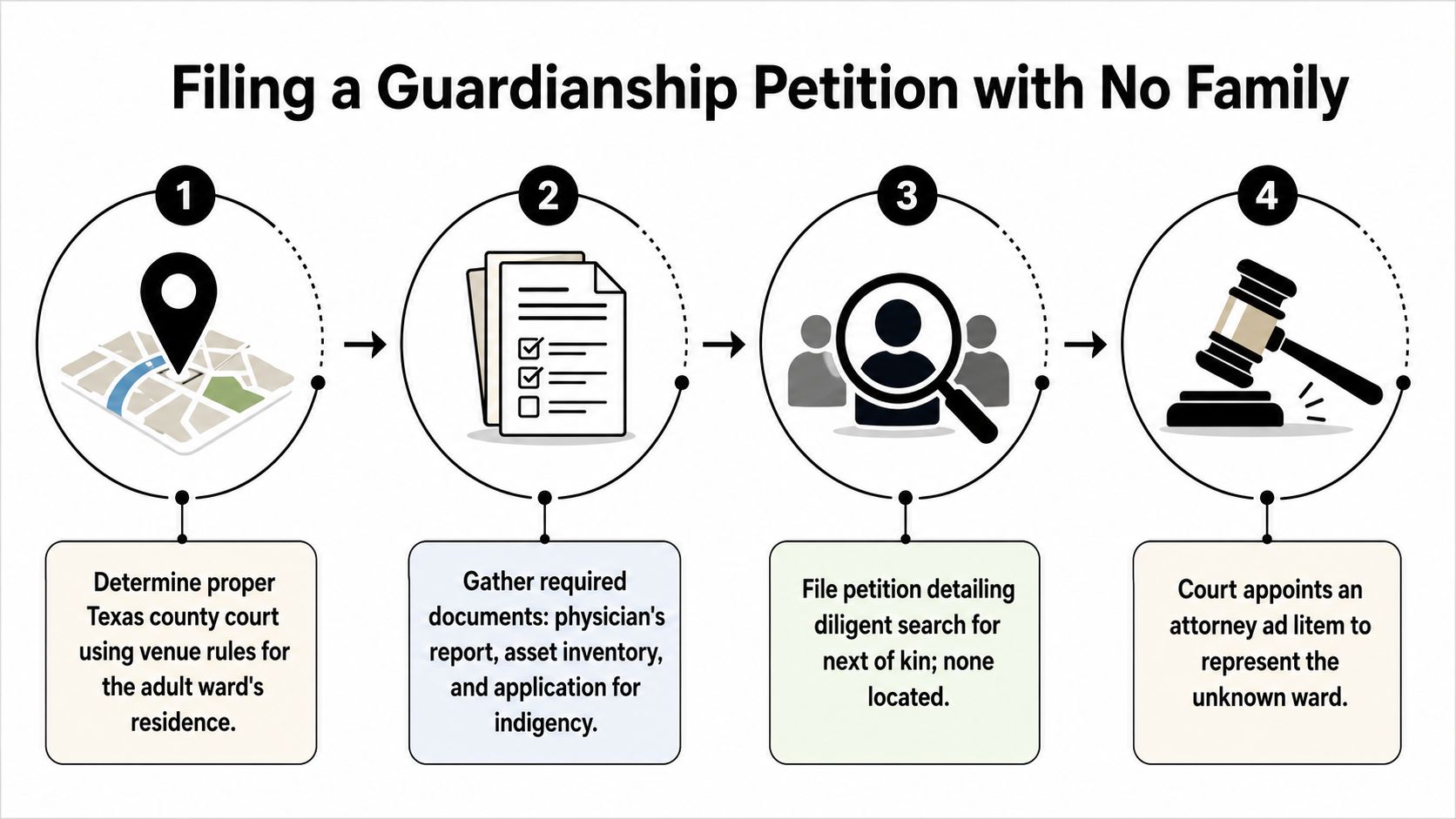
The filing starts in the proper county court. For an adult, venue is generally the county where the proposed ward lives, where the ward is located when the application is filed, or where the principal estate is located Texas Bar Guardianship Information. If the adult is in a hospital in Harris County, that often means the case belongs in Harris County Probate Court, but the exact venue still has to be checked.
What has to go into the application
The application to appoint a guardian should identify the proposed ward, the nature of the alleged incapacity, the need for guardianship, and the requested powers. It also needs the physician's certificate of medical examination, because the court relies on medical proof to evaluate incapacity and necessity. If the certificate is thin, vague, or silent about supports and services that might avoid guardianship, the court may question whether the requested authority is too broad.
When no next of kin can be found, service becomes a real issue. Courts deal with that through the tools the Estates Code allows, including service by posting in appropriate cases and appointing an attorney ad litem or guardian ad litem so the proposed ward still has representation. That protection matters even when the adult appears to have nobody left in the world to notify.
A practical search for relatives can take more work than people expect. If you need a private tracing tool for a hard-to-locate family tree, tracing agents in the UK is an example of the kind of outside resource some teams use when the search turns international or falls outside normal local records.
Temporary relief when the hospital cannot wait
Emergency or temporary guardianship exists for cases that cannot sit in a queue. Harris County practice materials describe temporary guardianships as moving quickly, with a hearing about 10 days after the initial request and a temporary order lasting no more than 60 days Frank Chen MD guardianship materials. Those timelines matter when a discharge delay could leave a person stranded or unsafe.
A rushed filing with missing proof usually creates more delay, not less. The court wants the same basics, medical evidence, notice, and a clear reason the order is needed, even when the schedule is urgent.
In a no-family case, the biggest mistake is assuming the court will fill in the blanks. It won't. The petition has to show the search was real, the need is real, and the requested authority is narrow enough to fit the facts.
Filing Fees, Bonds, and Who Pays When the Ward Cannot
The first fear in these cases is usually money. Who pays the filing fee, who pays the investigator, and what happens if the proposed ward has nothing? Texas counties handle filing fees differently, so the clerk's office should always confirm the local amount and the procedure for an indigent affidavit.
The fee-shifting rule families often miss
Grimes County court guidance explains a practical rule that matters statewide: if the guardianship estate or management trust cannot cover the court investigator or guardian ad litem costs, a non-indigent applicant must pay them instead of the county treasury under Estates Code § 1155.151 Grimes County guardianship guidance. That rule gives the court a way to keep the case moving without leaving the public to absorb every expense.
That doesn't mean every indigent ward generates the same bill, or that every county handles the front-end costs identically. It does mean applicants should ask early who the court will look to for payment if the ward has no assets. The wrong assumption can stall a case after the petition is already on file.
Bonds, letters, and acting with authority
If the guardian is being appointed over the estate, a bond may be required. In an indigent, no-assets case, the bond can sometimes be waived or set at zero if there's nothing at risk, but that decision belongs to the court. After appointment, the guardian still has to take the oath and obtain Letters of Guardianship from the clerk before acting.
That sequence is easy to miss in urgent cases. A guardian who starts making decisions before the letters are issued may be acting without authority. The safer approach is to confirm the order, the bond status, the oath, and the letters before relying on the appointment.
For families comparing court costs and practical payment options, the page on Texas guardianship filing fees and court costs is a useful companion. It helps frame who usually pays, when costs can shift, and why local rules still matter.
A resource like browse Equal Access To Justice can also be helpful when a case involves the bigger access-to-court question, especially for lower-resource applicants who need to understand fee relief and court access before filing.
Working With APS and County Public Guardianship Programs
A case like this rarely stays in one office. If the adult may be abused, neglected, or exploited, Adult Protective Services may get involved. If the local county has a guardianship program, the court or counsel may refer the matter there, but the referral still depends on what the county can take on.

Public guardianship is local, not uniform
Texas does not run one statewide public guardianship program. County practice varies, so Harris County, Travis County, Bexar County, and Dallas County can handle the same fact pattern in different ways. In one county, the guardianship program may triage indigent cases first. In another, a private attorney may need to file and ask the court to appoint a disinterested third party.
The court can appoint a disinterested person, a bank or financial institution, a guardianship program, or another qualified third party, but it still has to choose what is in the ward's best interest and, when possible, respect the ward's stated preference if the person is not disqualified Texas Guardianship Association qualification guidance. That puts a real limit on how the judge can proceed. No family member available does not mean the court can ignore the ward's wishes.
Texas also treats APS involvement differently from a full public guardianship arrangement. APS may step in to address immediate safety concerns or investigate abuse and neglect, but that does not automatically create a long-term guardianship. A full public guardianship is the ongoing court-appointed decision-making structure.
Local program capacity can be the difference between a fast referral and a stalled case. Before filing, know whether the county has a guardianship program, whether it is accepting new matters, and what level of proof it wants.
For a closer look at how these county programs are supposed to work, the overview at public guardianship programs in Texas is a useful companion. It helps frame the practical differences between a referral, a court appointment, and a program that may already be stretched thin.
A detail that gets overlooked is registration. Texas guidance says all guardianships must be registered with the Judicial Branch Certification Commission Texas Guardianship Association qualification guidance. Even experienced filers miss that step, and a missing compliance item can create avoidable problems later.
The practical lesson is simple. APS, the court, and the county program may all touch the same adult, but they are not the same thing. Each one has a different job, and the case moves best when those roles are clear from the beginning.
Less Restrictive Alternatives Texas Courts Must Consider
The hardest question in many no-family cases is whether guardianship is even necessary. Texas courts have to consider alternatives, and that obligation matters even when the person is clearly vulnerable. If the person can still make some choices, the better order may be narrower than a full guardianship.
What courts look at before taking away authority
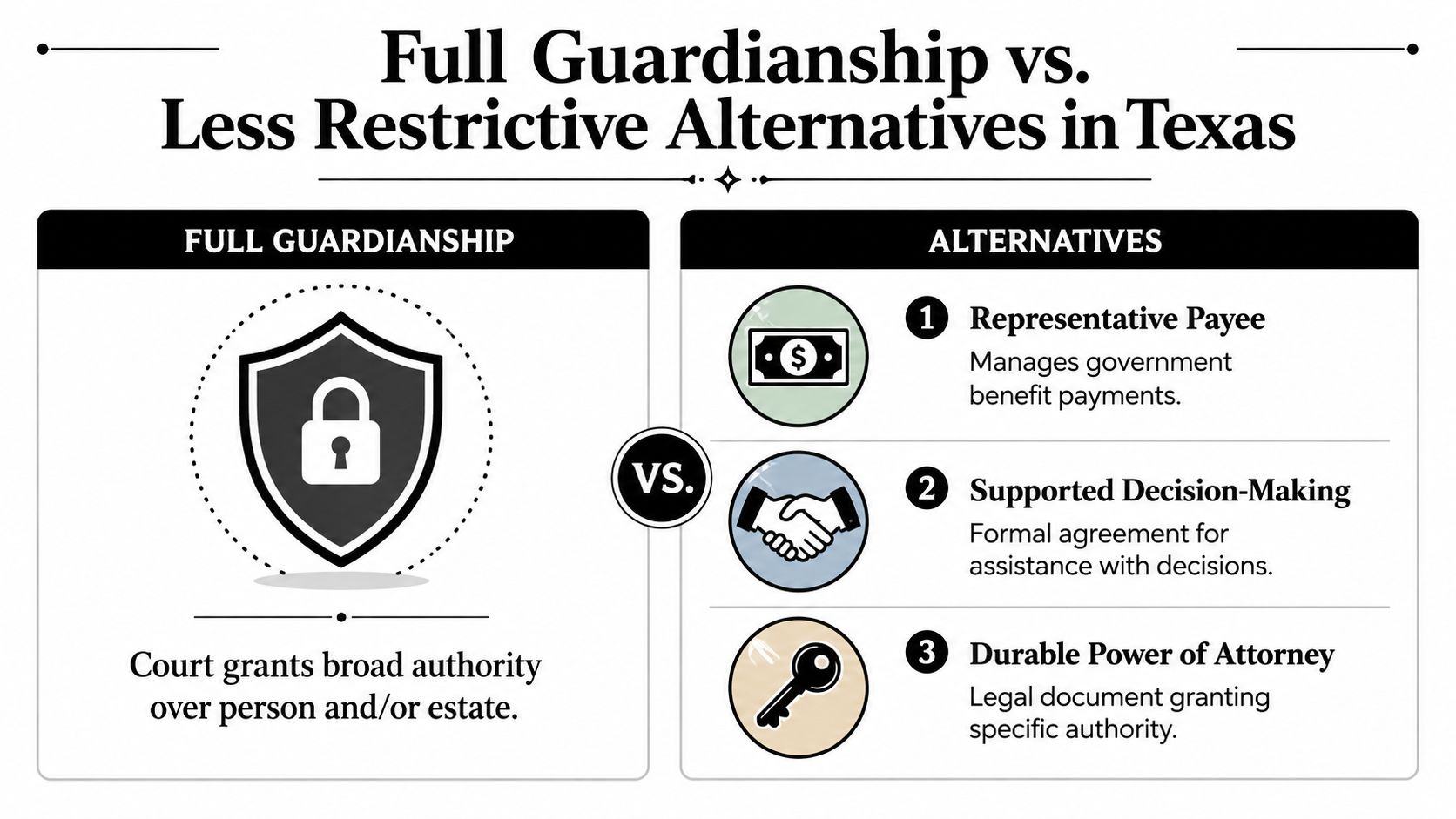
A representative payee can manage government benefits without a full guardianship when the main issue is payment handling. Supported decision-making lets the adult keep decision-making power while naming trusted helpers to assist. A durable power of attorney can avoid guardianship altogether if it was signed while the person still had capacity. Texas guidance also notes that a guardianship of the estate is often unnecessary when there are little to no assets or income to manage Texas HHS guardianship introduction.
That means the court should ask a practical question, not just a legal one. Does the person need someone to make decisions, or does the person need help understanding options and carrying out tasks? If the answer is the second one, the lawyer or caseworker should think carefully before asking for broad authority.
The supported decision-making agreements in Texas explained page is a good fit when the adult can participate but needs structured support. It's one of the clearest alternatives when the goal is to preserve independence as much as possible.
I've seen situations where a person-only guardianship solved the immediate placement problem without opening an estate that had nothing in it. I've also seen cases where the person could have used benefits help and a supported decision-making plan instead of a full guardianship. The right answer depends on what the adult can still do, not just on how worried everyone feels.
Realistic Timelines and Common Delays to Plan Around
Temporary guardianship can move quickly, but a full case usually doesn't. Once the petition is filed, the court has to handle service, review the medical proof, check any indigency issues, and decide whether a guardian is needed and who should serve. After appointment, the oath and Letters of Guardianship still have to be completed before the guardian can act.
The delays are usually predictable. A weak physician certificate slows the file. Missing financial documents slow the indigency review. Difficulty locating or serving unknown relatives slows notice. County program capacity can slow the referral itself.
What to do early so the file doesn't sit
Build the record before you file. A complete packet is faster than a rushed one that needs correction.
That means gathering the medical certificate, a basic financial picture, any search efforts for family, and a narrow list of powers the court is being asked to grant. It also means checking the county's local practice before assuming the program can take the case right away.
Texas already carries a heavy guardianship oversight load, including tens of thousands of active guardianships and documented compliance concerns, so courts are not in the business of guessing Texas Senate briefing on guardianship oversight. The cleaner the filing, the less likely it is to get buried in a backlog or sent back for missing proof.
For deeper context on the adult process, the page on Guardianship of an Incapacitated Adult in Texas explains the court's role in establishing authority for an adult who can't manage their affairs. That's often the next place to look when a caseworker knows guardianship is likely but needs the legal roadmap to fit the facts.
If your case involves an adult with no family, no assets, and no clear decision-maker, the Law Office of Bryan Fagan, PLLC can help you sort out whether a full guardianship, a limited appointment, or a less restrictive alternative makes the most sense. Schedule a free consultation through Law Office of Bryan Fagan, PLLC so you can get a practical plan before the court deadline starts working against you.