A daughter in Houston often learns the hard way that caregiving and legal authority are two different things. She can drive her dad to his appointments, manage his meals, keep track of medications, and sit with him in the emergency room, but still be unable to sign a consent form or get clear answers from the hospital without the right legal document.
That gap causes stress fast. Treatment gets delayed, siblings disagree, and a well-meaning caregiver can feel shut out at the exact moment the family needs calm, clear decisions. In Texas, caregiver legal rights are not one single rule, they come from several tools that work differently depending on whether the issue is medical care, money, records, visitation, work leave, or guardianship in a probate court.
Texas families usually need the same core answers. Who can decide? Who can see records? Who can leave work without losing a job? Who can be paid for care without creating a legal mess? The safest path starts with understanding which tool fits which problem, then documenting authority before the crisis gets bigger.
Introduction with a Family Scenario
A common Texas scene starts in a hospital hallway, not a courtroom. A daughter in Houston has been helping her father with bills and doctor visits for months, but when his condition worsens, the nurse asks for a legal decision-maker. She finds out that being the person who shows up every day is not the same as having authority under the law.
That's the heart of caregiver legal rights. Families often assume care and power go together, but Texas law separates daily help from formal authority. If you don't have the right paperwork, you may still be excluded from medical decisions, record access, or financial management, even when everyone knows you're the one providing care.
Texas guardianship law gives families several ways to solve that problem, including alternatives to guardianship and court-supervised guardianship when no lesser tool is enough. The practical questions are simple, even if the legal answers aren't. What can a caregiver do without a court order, what requires a power of attorney, and when does a judge in Harris County Probate Court have to step in?
The answer depends on the task. Medical care, finances, visitation, leave from work, and compensation each have their own rules, and families usually need more than one tool. A little planning now can prevent treatment delays, family conflict, and unnecessary court fights later.
Understanding Caregiver Authority and Responsibilities
In the United States, caregiving is now a major part of family life. As of 2025, about 63 million Americans served as family caregivers, nearly one in four adults, and they provided an estimated 49.5 billion hours of care in 2024 with an economic value of about $1.01 trillion, or roughly 3.6% of U.S. GDP. Those numbers show why legal systems keep moving toward leave rules, workplace protections, and anti-discrimination measures for caregivers, even though unpaid care still has limited formal recognition under federal law. Human Rights Research
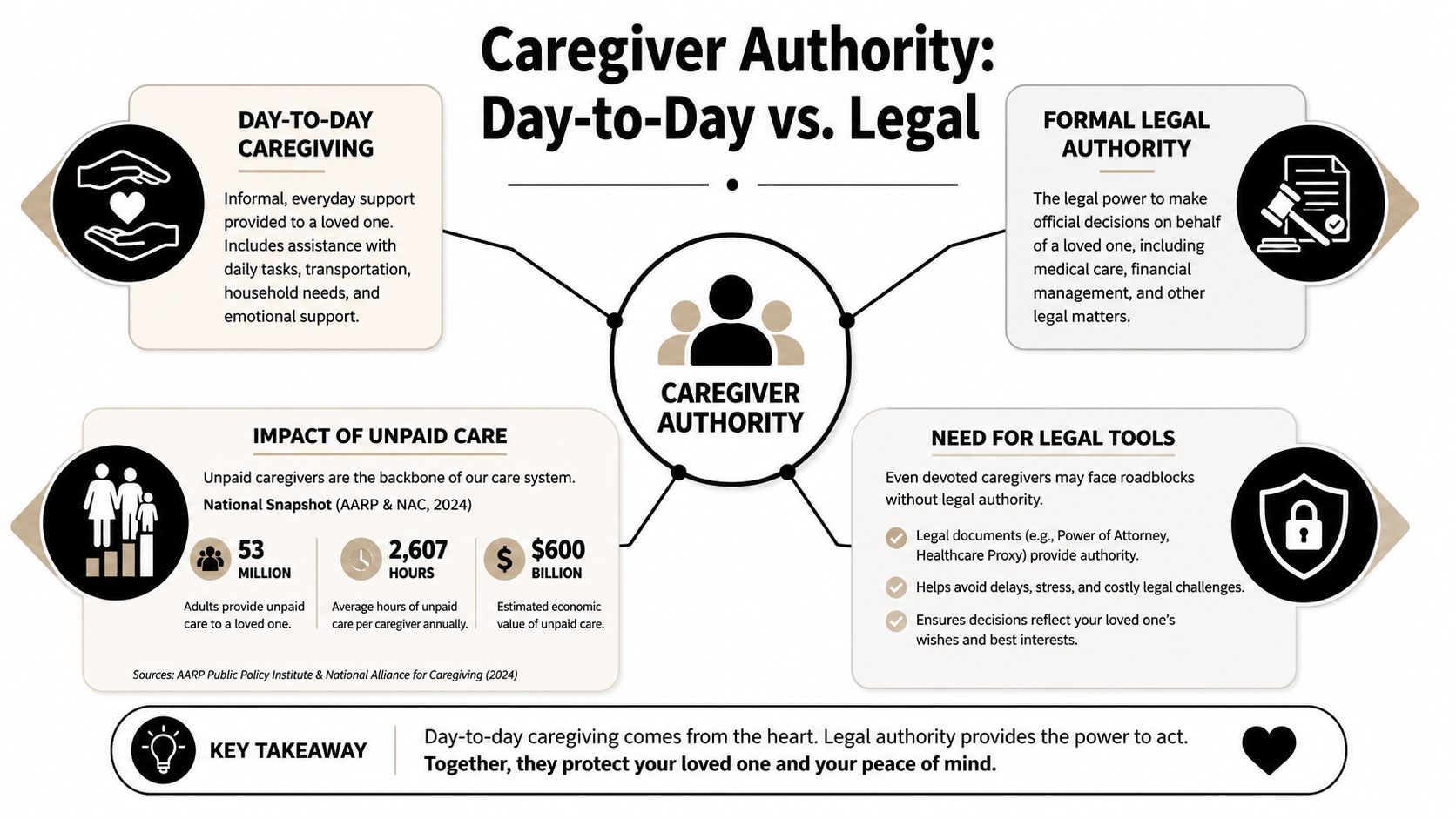
Day-to-day care is not the same as legal power
Think of caregiving like being the project manager on a family emergency. You can organize the schedule, keep everyone moving, and catch problems early, but you still need formal sign-off before you can approve the budget or make final decisions. The law works the same way.
Texas does not give an informal caregiver automatic authority to sign medical consent forms, access bank accounts, or make placement decisions. Legal authority usually comes from a durable power of attorney, a health-care proxy, an employment contract, a court appointment like guardianship, or another legally recognized instrument. The National Academies notes there is no single law that establishes the full rights of family caregivers in the United States, and Texas families have to work through a patchwork of federal, state, and local rules. National Academies summary
Why paperwork matters before a crisis
When families skip documentation, the result can be delayed treatment, disputed decision-making, and fiduciary exposure. That risk grows when a child, spouse, or sibling assumes the hospital or bank will automatically “know” who should speak for the patient. In reality, legal authority often turns on whether there is a valid document on file.
Texas Estates Code Title 3, Subtitle G is where guardianship rules live, and it becomes important when no lesser tool will work. For families in Dallas, Travis, or Bexar County, that means the legal path may start with a power of attorney, but it sometimes ends in probate court. The key is knowing which tool fits the actual problem, not the one you hope will fit.
Practical rule: if you can solve the problem with signed authority on paper, do that before you need a judge.
Pathways to Medical and Financial Decision Authority
A daughter may be allowed to speak with the nurse, yet still be unable to sign a consent form. A son may be trusted to pay the bills, yet still be blocked from getting into a parent's account. Texas families run into these gaps often, because day-to-day caregiving and legal authority are separate things.
The main tools families use
A durable power of attorney for healthcare lets the chosen agent make medical decisions if the person cannot make them. A durable power of attorney for financial matters covers money, bills, and property. A HIPAA personal representative arrangement can open access to protected health information when the legal conditions are satisfied, but it does not automatically make someone the decision-maker. A supported decision-making agreement lets a person with a disability keep making their own choices with help from trusted supporters.
HIPAA does not give caregivers a blanket right to medical information. Under the Privacy Rule, a provider may share information with a spouse, family member, friend, or other person involved in care or payment when the patient agrees, does not object under professional judgment, or disclosure is in the patient's best interests, and a caregiver who is the patient's personal representative can access information under applicable state law. HIPAA Privacy Rule summary
When guardianship becomes the right answer
Guardianship under Texas Estates Code §§ 1101 to 1156 is the court-appointed path when a person lacks capacity and no less restrictive option can do the job. Texas lawyers often start with alternatives because guardianship adds court oversight, public filings, and ongoing supervision. Guardianship vs. Power of Attorney in Texas explains why a power of attorney can avoid guardianship in some families, and that matters when a signed document can solve a problem faster than a court order. You can also read more about power of attorney vs. guardianship in Texas and which is better.
If the family only needs permission to talk with the doctor, HIPAA and a medical proxy may be enough. If the family needs authority over assets, bills, or placement decisions, the question is broader.
The financial side works the same way. A trusted adult may know exactly how to pay a bill, but a bank may still refuse access without a valid instrument or court order. Texas families should treat legal authority like the right key for the right lock, because the hospital, the bank, and the court do not all open with the same document.
Managing Visitation and Records Access
Visitation and record access get confusing because hospitals and facilities follow their own rules, but those rules still have to fit within legal limits. If a parent is in the hospital in Houston or a rehab center in Harris County, the first question is often simple. Has the facility recorded the caregiver properly?
Use the CARE Act when discharge is coming
Texas families can lean on the CARE Act, which has been enacted in 36 states, the District of Columbia, Puerto Rico, and the U.S. Virgin Islands. The law requires hospitals to record a family caregiver in the medical record, notify that caregiver at discharge, and provide instruction on the medical tasks needed at home. CARE Act overview
That helps when a family is trying to get a loved one home safely. If the hospital knows who the caregiver is, discharge teaching is less likely to be rushed or missed. It also gives the family a concrete paper trail if the facility later claims it never knew who to contact.
Ask for records in writing
Texas Health and Safety Code Chapter 181 supports privacy and access rules, but families should still make requests in writing and keep copies. A simple request can say, “Please provide the patient's designated representative with copies of the medical record and confirm the name of the person currently authorized to receive discharge instructions.” If the hospital pushes back, ask for the privacy officer, patient advocate, or medical records department, then escalate inside the facility before assuming the answer is final.
Texas Children's Hospital and UT Health both have internal patient relations or medical records pathways, and the right contact usually depends on the facility and the type of record. If the patient is competent, have the patient sign the authorization. If not, make sure the legal basis for the request is clear.
Practical rule: if a nurse says “we can't release that,” ask what document they need, who reviews denials, and how to appeal the decision internally.
A caregiver in Harris County Probate Court proceedings should also keep the court's order, discharge paperwork, and any hospital designation forms together. Those papers often become the difference between a smooth transition home and another week of confusion.
Securing Employment Protections and Leave Rights
Working caregivers live with a second set of pressures. They have to help a parent, spouse, or child and still keep a job. The federal baseline is the Family and Medical Leave Act, which gives eligible employees protected leave to care for an immediate family member with a serious health condition. WorkLife Law caregiver protections
What to check before you miss work
FMLA eligibility depends on several pieces lining up. The employee has to meet the federal rules, the employer has to be covered, and the family member has to fit the law's definition. If the leave is foreseeable, the worker should usually give 30 days' notice, and if it's not foreseeable, notice should be given as soon as practicable.
Texas does not have a general state-mandated paid sick leave system for private workers, so company policy matters a lot. Some employers have their own accommodation process, and some local ordinances may apply in limited situations. A good first step is to ask HR for the leave policy in writing, then compare that policy with FMLA rights.
If you need a plain-language resource for broader leave issues, your rights for dependants leave can help frame the questions you should ask your employer before the crisis gets worse.
Put the request in order
A strong leave request should do three things. It should identify the family member, state the expected need for leave, and attach whatever medical certification the employer asks for. Keep a copy of every email, text, and form, because employer pushback often starts with confusion about whether the leave is protected or just “time off.”
When an employer is slow to respond, a Texas caregiver can also use an internal accommodation request form, especially if the issue is not full leave but a modified schedule. ADA accommodations request form is a useful reference point for the kind of written process that helps preserve rights. For families balancing work and caregiving, the safest approach is to assume that if it isn't documented, it may not be protected.
Exploring Compensation Options and Fiduciary Duties
Families often feel awkward about paying one relative for caregiving, but the question comes up all the time. If a daughter quits work to care for an aging mother in Dallas County, the family may want to compensate her through a written care agreement, a guardianship estate, or another lawful reimbursement method. The legal problem is not the payment itself, it's doing it without records or authority.
Payment and duty have to match
A family may use a caregiver contract, Medicaid-related planning tools, veterans benefits such as Aid and Attendance, or direct payment from a guardianship estate when a court allows it. Those options can reduce resentment because the arrangement is clearer up front. The key is to make the payment method fit the legal authority already in place, not the other way around.
Once someone acts as guardian or agent, fiduciary duties kick in. They have to act in the best interests of the person they serve, keep clean records, and be ready to explain spending. Texas Estates Code reporting and accounting duties matter because courts can ask for proof that money went where it was supposed to go.
Documentation protects everybody
If a sibling caregiver is paid through a probate court order in Dallas County, every receipt, mileage log, invoice, and bank statement should be kept together. Gaps in powers of attorney or guardianship orders are a common cause of delayed treatment, disputed decision-making, and fiduciary exposure. American Bar Association review
Best practice: treat caregiving money like a ledger, not a favor.
That means no informal cash handoffs unless the court or written agreement clearly allows them, and no guessing about what a guardianship estate can cover. If the family ever has to answer a judge's questions, the paper trail should tell the story without needing guesses.
Step-by-Step Guide to Securing and Enforcing Your Rights
The cleanest way to protect caregiver legal rights is to start with the facts, then move in order. Families in Texas usually need to gather records, choose the right document, file in the proper county probate court, and then keep enforcing the order after the hearing ends. If you want a practical drafting tool while you organize the file, a legal document generator can help with form preparation, but it should never replace legal review for a guardianship or power-of-attorney issue.
Start with the documents and evidence
Gather the medical records, medication list, insurance cards, recent doctor notes, and any evaluation showing whether the person has capacity. If you are considering guardianship, look at Texas Estates Code Title 3, Subtitle G and identify whether the need is for the person, the estate, or both. Then decide whether a power of attorney, supported decision-making agreement, or court petition is the better starting point.
If the family already has a power of attorney, review the wording before relying on it. If the document is old, incomplete, or unclear, that's where problems begin. How to file for guardianship in Texas is the kind of guide that helps families see how filing works before they step into probate court.
File, serve, and prepare for the hearing
A guardianship application is filed in county probate court, then notice has to be served on the required people. The court may require medical evidence, witness testimony, and proof that less restrictive alternatives won't work. Harris County Probate Court, like other Texas probate courts, expects the case file to be organized, because the judge has to decide not only whether incapacity exists, but also whether the proposed guardian is suitable.
Before the hearing, prepare a short list of facts. Who needs help, what decisions are at issue, what powers are requested, and what alternatives were tried? That list keeps the testimony focused and helps the judge see the actual family need.
Enforce the order after the court acts
Once an order is signed, the work doesn't stop. Guardians may have reporting duties, and families should calendar those deadlines right away. If a facility refuses visitation or an employer ignores leave rights, the next step may be an internal appeal, an administrative complaint, or a court motion, depending on the problem. The point is to keep using the paper trail you built, because enforcement becomes much easier when the record is organized from the start.
Conclusion and Call to Action
A caregiver in Texas often does the work before the law catches up. You may already be managing medications, fielding calls from doctors, and keeping track of bills, yet still find that a hospital, employer, or bank will not accept your word alone. Caregiver legal rights fill that gap by matching the right authority to the right task, whether the issue is medical decision-making, visitation, records access, leave from work, or compensation. Families who put the right paper in place early usually avoid the hardest delays later.
If you are sorting out guardianship, probate, or estate planning, clear documents can save your family stress when the next decision comes up. Start with guidance before a crisis, ask questions early, and keep each step in writing so there is a record if someone later challenges what happened. For related reading, see our pages on Guardianship, Probate, and Estate Planning. Schedule a free consultation so you can get personalized direction for your loved one's situation.
The Law Office of Bryan Fagan, PLLC helps Texas families work through guardianship, probate, and estate planning with clear next steps and practical legal support. If you need help securing caregiver authority, contesting a guardianship issue, or putting the right documents in place before a crisis, visit Law Office of Bryan Fagan, PLLC to schedule a free consultation and get guidance specific to your family's needs.