Skip to content
A parent in Houston watches an adult son miss a medication dose, then sees a stack of unpaid bills, a pharmacy refusing to talk without authority, and a doctor's office asking for paperwork no one has. That's usually the moment families start searching for an attorney for disabled person, not because they want a lawsuit, but because they need a clear path through a confusing system.
In Texas, that search is rarely about one problem. It may touch medical decisions, money, school records, housing, or public benefits. The hard part is figuring out which legal tool fits, because guardianship is only one option, and it's not always the right first move.
If you're worried about a disabled loved one, start with the question that matters most, what problem needs fixing right now? The answer may lead to guardianship, or it may lead to a power of attorney, supported decision-making, or a benefits appeal instead. For a plain-English guide on when families need a guardianship lawyer and when they don't, see when you need a guardianship attorney and when you don't.
When a Texas Family First Reaches Out for Help
A lot of Texas families reach out after something practical starts falling apart. A bill goes unpaid. A hospital asks who can consent. A caregiver gets turned away because no one has legal authority to speak. By then, the family is usually tired, worried, and already trying to catch up.
That is usually the moment someone starts looking for an attorney for a disabled person. The need is often simple to state, even if the fix is not. One relative may need help with medical consent, another may need help with bank access, and another may need both.
The first job of an attorney for a disabled person is to slow the moment down and separate the legal problem from the panic. A son with autism may need help handling finances and still be able to make personal choices. A mother with dementia may need urgent medical authority, but not a full transfer of every right.
Families often say, “We need a lawyer for my brother,” when what they really mean is, “We need someone who can help with medical consent and bank access.” Those are different issues. The right lawyer helps you sort out whether the problem belongs in guardianship, benefits work, estate planning, or civil-rights work.
Texas law gives families more than one path. Guardianship sits inside the Estates Code, but it is only one tool, and sometimes it is the wrong first tool. A power of attorney, supported decision-making, a benefits appeal, or another limited document may solve the problem with less court involvement and fewer lost rights.
Start with the least invasive tool that can solve the problem. If that tool is not enough, then move up to guardianship with a clear reason why.
For families who want a simple visual of how guardianship cases move through the court process, the following graphic helps make the path less intimidating.
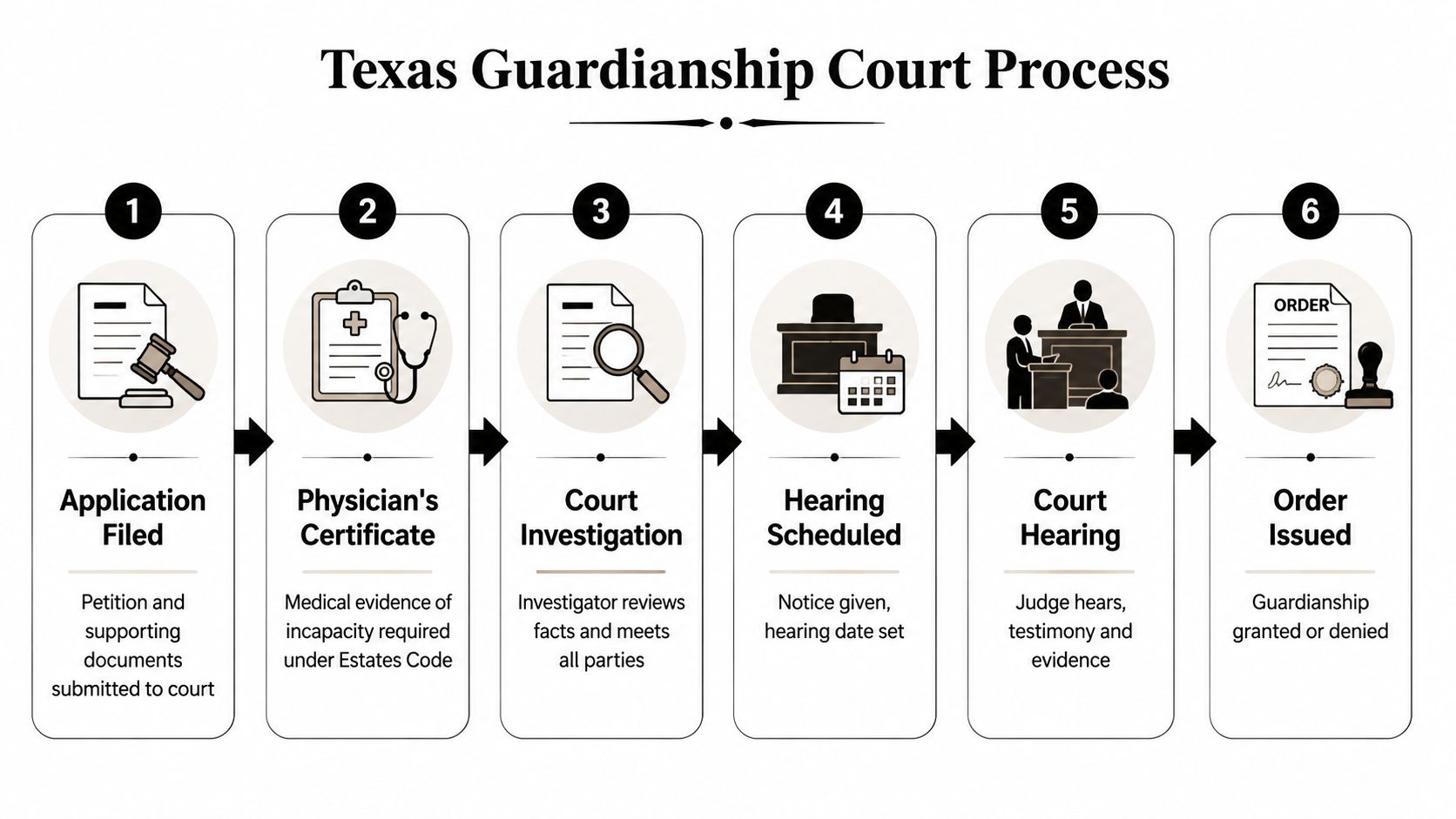
The sequence matters because guardianship is not just one form. It is a court process with steps, and the same basic questions show up whether the case is in Harris County Probate Court, Travis County, or a smaller Texas county.
For families who are also dealing with communication barriers, assistive technology for deaf can help make medical visits and family meetings clearer when a loved one needs better access to spoken information.
One practical split comes up all the time in Texas. Guardian of the Person vs. Guardian of the Estate marks the difference between authority over care and authority over money. Families who do not understand that split often ask for too much authority in one area, or not enough in the other.
A careful consultation should answer a plain question first, what decision needs legal authority right now? In some cases, the answer points to a narrow guardianship request under the Texas Estates Code. In others, it points to a different tool that keeps more rights with the person and still gives the family room to help.
What an Attorney for a Disabled Person Really Does
A good attorney for a disabled person starts by sorting out the problem in front of the family, then choosing the right legal lane. In practice, that means listening to the doctors, the family, the social worker, and the financial picture so the legal plan fits the person's real life, not just the paperwork.
Four common legal lanes
In Texas, families usually need help in one of four lanes.
- Guardianship of the person or estate. This is the court process under Texas Estates Code Title 3, Subtitle G for deciding who can make personal or financial decisions.
- Benefits work. Many families need help with disability benefits, such as Social Security or Medicaid paperwork, appeals, or deadlines.
- Special-needs planning. This can include trusts, letters of intent, and other planning tools that protect support without taking away more rights than necessary.
- Civil-rights issues. Disability-related problems can also show up in housing, employment, public accommodations, or education.
Those lanes are not interchangeable. A lawyer who handles benefits appeals may know the deadlines inside and out, but may not draft a guardianship application with the court's capacity rules in mind. An estate planner may understand trusts, but may not be the right person for the courtroom side of incapacity. Matching the lawyer to the problem saves time and keeps the family from paying for the wrong kind of help.
The right lawyer first identifies the legal lane, then builds the case around the person's daily reality.
Guardianship is the lane many families hear about first, but it is only one tool. Texas law treats guardianship as a court-controlled remedy, so the legal test and the paperwork matter more than a quick signature or a family disagreement. Under Texas Estates Code Title 3, Subtitle G, the court is deciding whether authority should shift, and if so, how much.
Families also run into communication barriers that can change how a case unfolds. If a disabled person is deaf or hard of hearing, meetings, hearings, and medical appointments can become confusing unless the family plans ahead. In those cases, assistive technology for deaf may help make spoken information clearer while the legal team works through the next steps.
The point is simple. The right attorney does more than “handle disability cases.” The right attorney helps a Texas family choose the correct tool, then uses that tool carefully so the legal solution matches the person's needs.
How Texas Guardianship Cases Move Through Court
Texas guardianship cases follow a sequence that feels formal because the court is deciding whether to limit another person's rights. Under Texas Estates Code Title 3, Subtitle G, families usually start with an application that explains why guardianship is needed and why a less restrictive option won't do the job. That filing begins the court case, but it does not end the conversation.
What the court wants to see
In a typical case, the court looks for medical evidence, usually a physician's certificate or similar capacity evidence, plus facts showing what decisions the proposed ward can and cannot make safely. The county court or probate court may also involve an investigator, and the proposed ward gets notice of the case. In a Houston matter, that might mean a family working with the court system while a parent with dementia is still in the hospital, waiting for a judge to decide whether limited authority is enough.
The lawyer's role at each step is practical. The attorney gathers records, helps frame the request, prepares the family for testimony, and keeps the filing aligned with what the evidence supports. If the evidence shows the person only needs help with medical decisions, the court may not approve broader control over finances. If the request is too broad, the judge can narrow it.
What families should expect
The timeline depends on conflict, evidence, and court scheduling. An uncontested matter can move faster than a contested one, but the issue is accuracy, not speed. Families need to know what they are asking the judge to remove, what they are asking the judge to preserve, and who will help after the order is entered.
A clean process helps the family avoid second-guessing later. That matters because guardianship orders can shape medical access, financial control, and day-to-day support for a long time.
If the case is contested, the lawyer also becomes the translator between the family's fears and the court's standards. Probate judges do not just want to hear that a loved one is “struggling.” They want evidence, specifics, and a plan.
Guardianship and the Alternatives Worth Considering First
Guardianship is serious because it can take away the person's power to decide for themselves. That's why Texas disability advocates and courts treat it as a last resort, not the first answer. A thoughtful lawyer should ask whether a less restrictive tool can solve the problem before moving to court.
Comparing the main options
| Option | Decisions Covered | Court Involvement | Reversibility |
|---|---|---|---|
| Guardianship | Personal, financial, or both, depending on the order | High | Can be modified or ended if circumstances change |
| Durable power of attorney | Financial decisions, if validly signed | Usually none once signed | Can be revoked if the person has capacity |
| Healthcare proxy or medical power of attorney | Medical decisions | Usually none once signed | Can be changed if the person has capacity |
| Advance directives | End-of-life or care preferences | Usually none once signed | Can be updated if the person has capacity |
| Supported decision-making | Helps the person make their own choices | Usually none | Can be changed as needs change |
The big idea is autonomy. If a person can still participate in decisions, even with help, supported decision-making may preserve dignity better than a guardianship order. Texas families often want protection, but they also want their loved one to keep as much control as possible.
For a practical checklist before signing authority documents, the family legal preparedness checklist is a useful way to think through who should handle which decisions, and whether the paperwork is current.
Why the alternative matters
A well-drafted power of attorney can prevent a guardianship fight entirely. That's because banks, providers, and family members already have a document they can rely on. If the document is old, missing, or too narrow, the attorney may recommend updating it before the family goes to court.
Supported decision-making deserves special attention in Texas because it keeps the disabled person at the center of the process. The attorney helps structure support, not replace the person's voice. For a deeper Texas-specific explanation, see supported decision-making agreements in Texas explained.
If the person can still make some choices safely, don't remove more rights than you need to.
That approach saves families from avoidable conflict. It also helps reduce the chance that a future court has to undo an overbroad order.
Temporary and Emergency Guardianships in Texas
Sometimes the family cannot wait for a regular guardianship case. A loved one may be in a hospital bed, being pressured by someone else, or living in conditions that are plainly unsafe. In those moments, Texas law allows emergency-style relief so the court can act quickly.
A temporary guardianship is designed for short-term protection while the permanent case moves forward. It is not the same as a full guardianship, and it should not be used just because the family is frustrated. The judge still wants real facts showing immediate danger, harm, or a need for urgent authority.
When the urgent path makes sense
A common example is an adult child whose parent is hospitalized and can't consent to needed treatment. If no valid health-care document exists, the family may need a lawyer to ask the probate court for temporary authority so doctors can move forward safely. Another example is suspected financial exploitation, where someone is draining accounts before the regular case can be heard.
The attorney's job is to coordinate fast, but carefully. That means lining up medical records, explaining the emergency to the court, and tying the request to the permanent guardianship case if one is coming. The court is not punishing the disabled person. It is trying to stop harm before it gets worse.
Families are often relieved to hear that emergency filings are built for speed. They still need evidence, though. A judge won't rely on panic alone, and that is a good thing. Fast court action should still be grounded in facts, especially when the order may affect someone's rights.
Temporary relief is usually limited in time, so the family needs a follow-up plan. The permanent case, if needed, still has to be handled the right way.
Costs, Fees, and Ways to Pay for a Guardianship Case
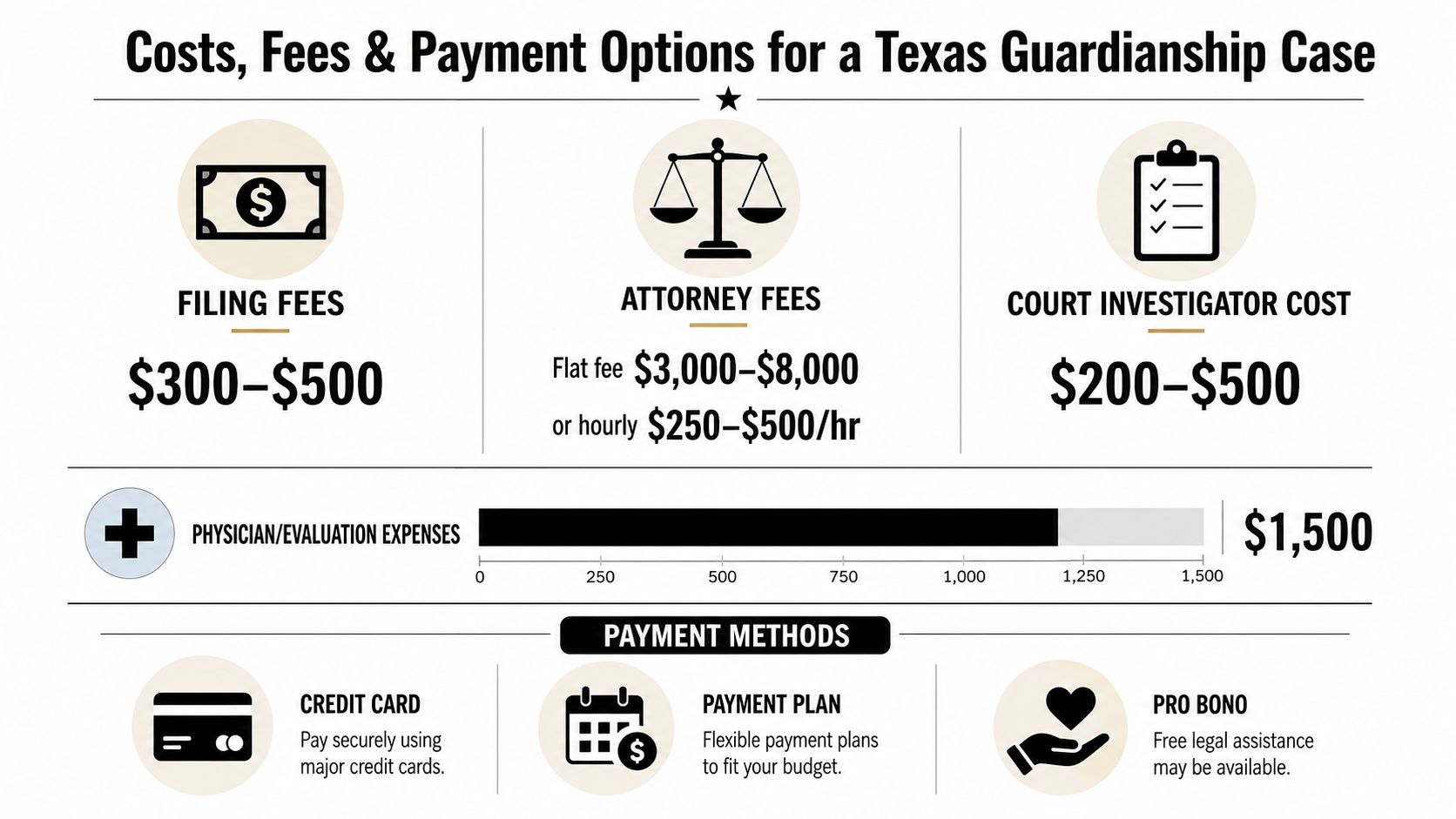
Money is one of the biggest reasons families hesitate. They know they need help, but they don't know what they're buying or what the case will trigger later. A transparent lawyer should talk about fees early, because surprises only make a hard situation worse.
For Texas families comparing options, the cost picture often includes court filing expenses, attorney fees, court investigator costs, and sometimes physician or evaluation expenses. Billing structures can vary. Some lawyers use a flat fee for uncontested matters, while contested cases are more likely to involve hourly work because the case can expand quickly.
How families usually fund the work
The best funding path depends on the disabled person's resources and the family's broader plan. In some cases, a pooled special-needs trust or an ABLE account may be part of the larger financial picture. Medicaid planning can also matter if the family needs to protect access to benefits while arranging care. Some firms also offer limited-scope representation, which means the attorney handles only part of the matter.
The INTELLI tag on attorney costs is useful if you want a broader look at how families think about legal billing, fee structures, and planning for professional help. That kind of background can make a consultation more productive because you'll know which numbers to ask about.
If you want a Texas-specific discussion of what can affect the total, review how much guardianship costs in Texas. The main lesson is that price depends on conflict, complexity, and how much authority the court is being asked to grant.
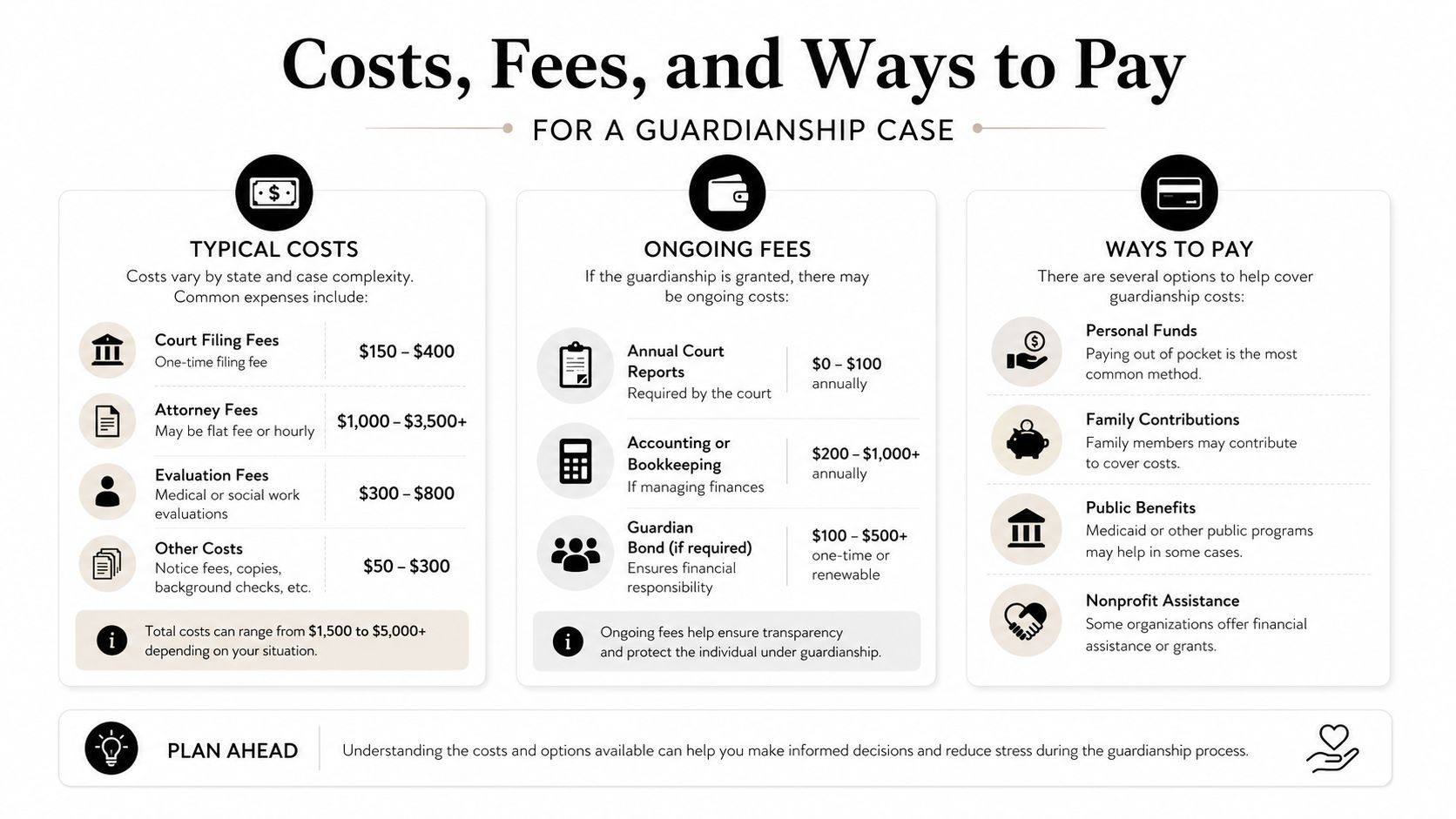
Families should also ask whether a case can be narrowed. Sometimes the cheapest path is not full guardianship at all, but a smaller legal solution that meets the essential need. That's especially true when the person can still handle some decisions on their own.
A careful fee conversation should also include what happens after the order is signed. Ongoing court duties can create continuing work, and those duties matter just as much as the first hearing.
Questions Worth Asking in a Free Consultation
A first meeting should feel like an interview, not a sales pitch. You're hiring someone to help protect a vulnerable person, so it's fair to ask direct questions about experience, process, and cost. A good lawyer won't mind.
A short checklist for the meeting
- What Texas Estates Code guardianship cases have you handled? Ask whether the lawyer regularly works under Title 3, Subtitle G and whether they understand the local probate court process.
- How do you decide if guardianship is really needed? You want to hear a real discussion of alternatives, not a rush to file.
- What happens if the case is contested? Some families need a lawyer who can handle disputes, not just routine filings.
- How do you coordinate capacity evidence? The attorney should explain how records, physician certificates, and testimony fit together.
- What will I owe, and when? Fee clarity matters from the start.
- What reporting or accounting duties will we have after appointment? The answer tells you whether the lawyer is thinking beyond the hearing.
- How do you handle emergencies? This is important if your loved one's condition is changing quickly.
The answers should sound specific, not vague. If someone guarantees a result, brushes off less restrictive alternatives, or won't explain fees clearly, that's a warning sign. The same is true if the lawyer ignores the ongoing duties that follow appointment.
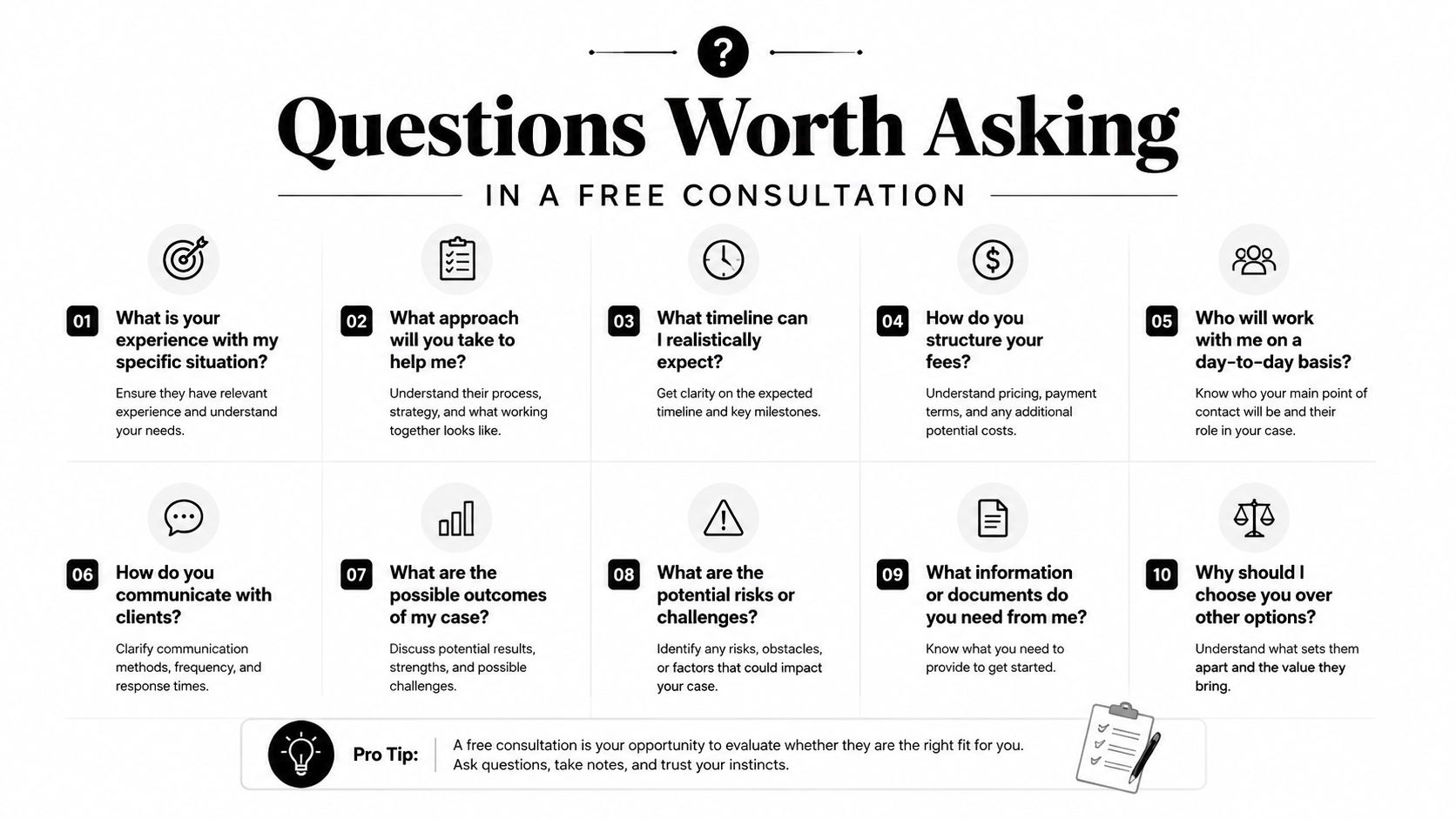
A solid consultation should leave you with a plan, not just anxiety. You should know whether the case belongs in guardianship, whether a lesser tool will work, and what the next month of paperwork looks like.
Next Steps for Texas Families
Start with the basics. Gather medical records, financial statements, current powers of attorney, and any letters or care plans that show what decisions are getting stuck. Then write down the exact problem, such as hospital consent, unpaid bills, unsafe spending, or the need for a narrower decision-making plan.
After that, ask whether guardianship is the right tool. If a durable power of attorney, healthcare document, or supported decision-making arrangement can solve the issue, that may protect your loved one without taking away more rights than necessary. If guardianship is still needed, the family should understand that it is not a one-time order, it is an ongoing fiduciary role with reporting and accounting duties.
Local process matters too. A case in Harris County Probate Court may feel different from one in another Texas county, but the core questions stay the same, capacity, necessity, and the least restrictive way to protect the person. The right lawyer should help you prepare for the hearing and for the responsibilities that come after it.
If you're trying to protect a parent, adult child, or other loved one, don't wait until the paperwork is already overdue. Schedule a consultation, bring your documents, and get a legal plan that fits the person in front of you, not just the form in front of you.
Law Office of Bryan Fagan, PLLC helps Texas families with guardianship, probate, and estate planning matters tied to disability and incapacity. If you need guidance on the right next step for a loved one, visit Law Office of Bryan Fagan, PLLC to schedule a free consultation and get a plan that fits your family's situation.