You're asleep, the house is quiet, and the truck is still in the driveway. By morning, it's gone. In Texas, that kind of surprise can happen fast, and it leaves families with questions about what the lender can do, what the repo company can't do, and how much time you have to respond.
The rules on repossession laws in texas are strict in some places and surprisingly fast in others. Texas follows a self-help repossession system for motor vehicles, which means a lender may take the car without filing a lawsuit and without advance notice if the borrower is in default, so long as the repossession does not involve a breach of the peace. The Texas Comptroller's repossession guide explains that this framework ties the lender's right to seize collateral to default, not to a court judgment, and consumer guidance notes that repossession can begin after a missed payment, sometimes even when the payment is only about a week late. For a plain-English overview of related lending rules, Texas lending regulations can be a helpful starting point, and families looking at a parent's finances may also need to think about how to take control of an elderly parent's finances in Texas legally.
Why Your Car Can Disappear Without Warning in Texas
A family can do everything right, then wake up to an empty driveway. The child seat is still on the porch, the keys are on the counter, and the lender has already sent the car away. That shock is legal under Texas's self-help repossession model, which allows a secured lender to repossess a vehicle without a lawsuit and without advance notice if the loan is in default and the repossession stays peaceful. According to the Texas Comptroller's repossession guidance, that means the lender's power comes from the security agreement and the default, not from a judge's order.
Default can happen sooner than many people expect
For many borrowers, the surprise is how quickly default can trigger action. Consumer guidance in Texas says repossession can begin after a missed payment, and one Texas source explains that a vehicle may be repossessed even if the payment is only about a week late. That does not mean every late payment leads to a tow truck, but it does mean there is no built-in grace period once the account falls behind.
The practical takeaway is simple. If you know you're behind, don't assume the lender has to warn you first. In Texas, the legal system gives the lender a fast remedy, and your best protection is to act before the account reaches that point.
Practical rule: the safest time to call the lender is before the account is in default, not after the car is already gone.
Families dealing with an aging parent's bills often run into the same fear, just in a different setting. If a car note is tied up with other money-management questions, the right next step may involve Less Restrictive Alternatives to Guardianship in Texas, because Texas courts must consider alternatives before granting guardianship.
How Self-Help Repossession Works Under Texas Law
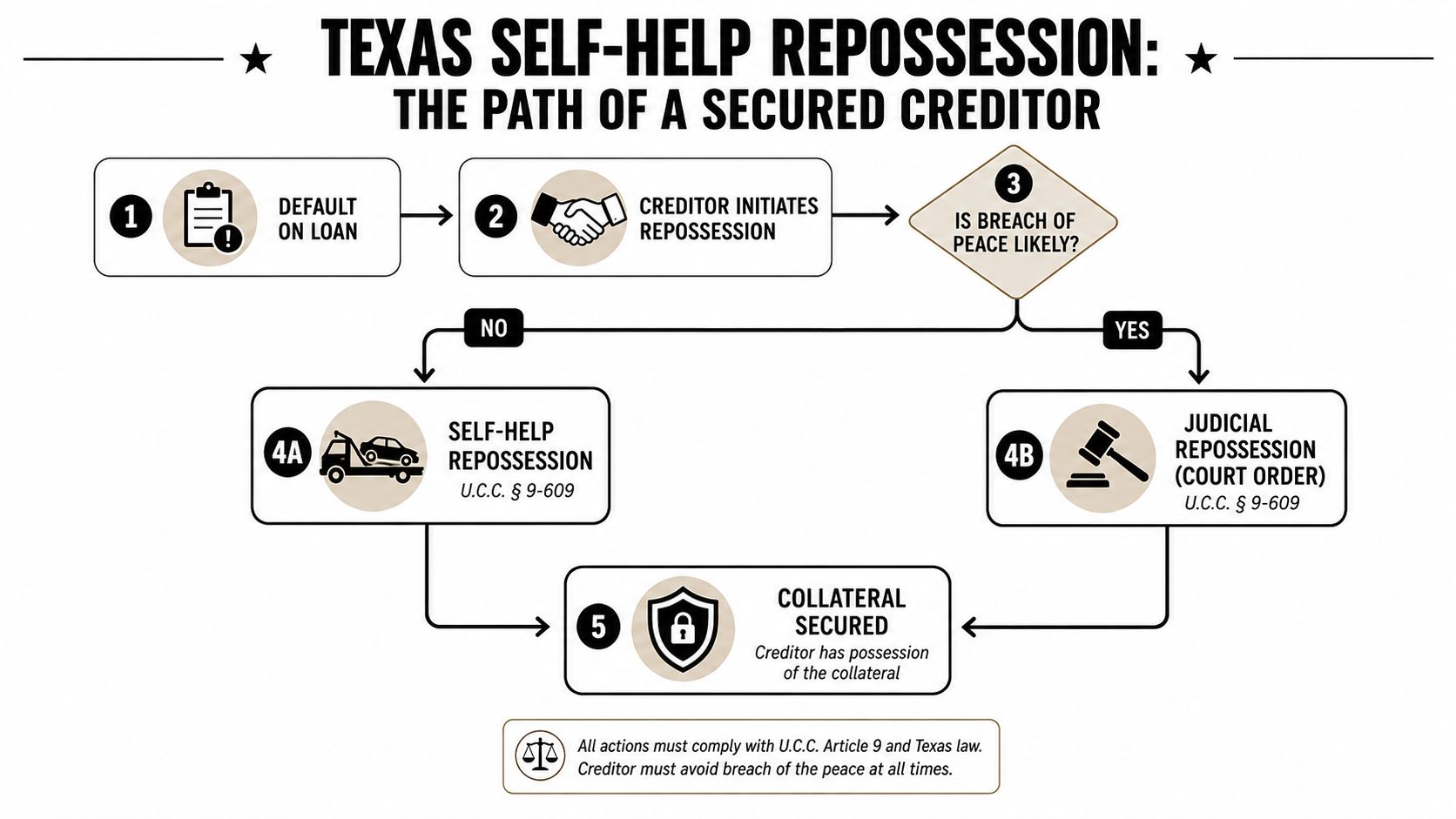
Texas follows U.C.C. Article 9 for secured lending. That means a lender can take collateral after default without filing suit or getting a court order, but only if the repossession stays within the law's peaceable boundaries. Under Texas Business and Commerce Code § 9.609, the lender's agent can't treat the vehicle like an open invitation to force, threats, or trespass.
What the repossession agent usually does
A lawful repossession often happens without fanfare. The agent may hook the car from a public street, an open lot, or a driveway that doesn't require breaking a barrier. Texas legal guidance says the agent cannot use force, cannot enter a locked area, and cannot keep going after the debtor objects while present, because that starts to cross the line from self-help into unlawful conduct. A useful consumer guide on this point is vehicle repossession laws in Texas protecting your car.
That said, no court order does not mean no limits. It means the lender is acting on the contract and the security interest, but only while staying peaceful. If the agent decides to take the car from a public place late at night, that can still be lawful if there is no confrontation and no breach of the peace.
A repo company does not need your permission to tow an unprotected vehicle. It does need to stop if the situation turns into a confrontation or a locked-entry situation.
Texas families also ask whether there are gentler legal paths before a crisis becomes a seizure. In many planning conversations, attorneys compare repossession fallout with power of attorney vs guardianship in Texas, because the right legal tool can reduce confusion before finances unravel.
Understanding the Breach of the Peace Rule
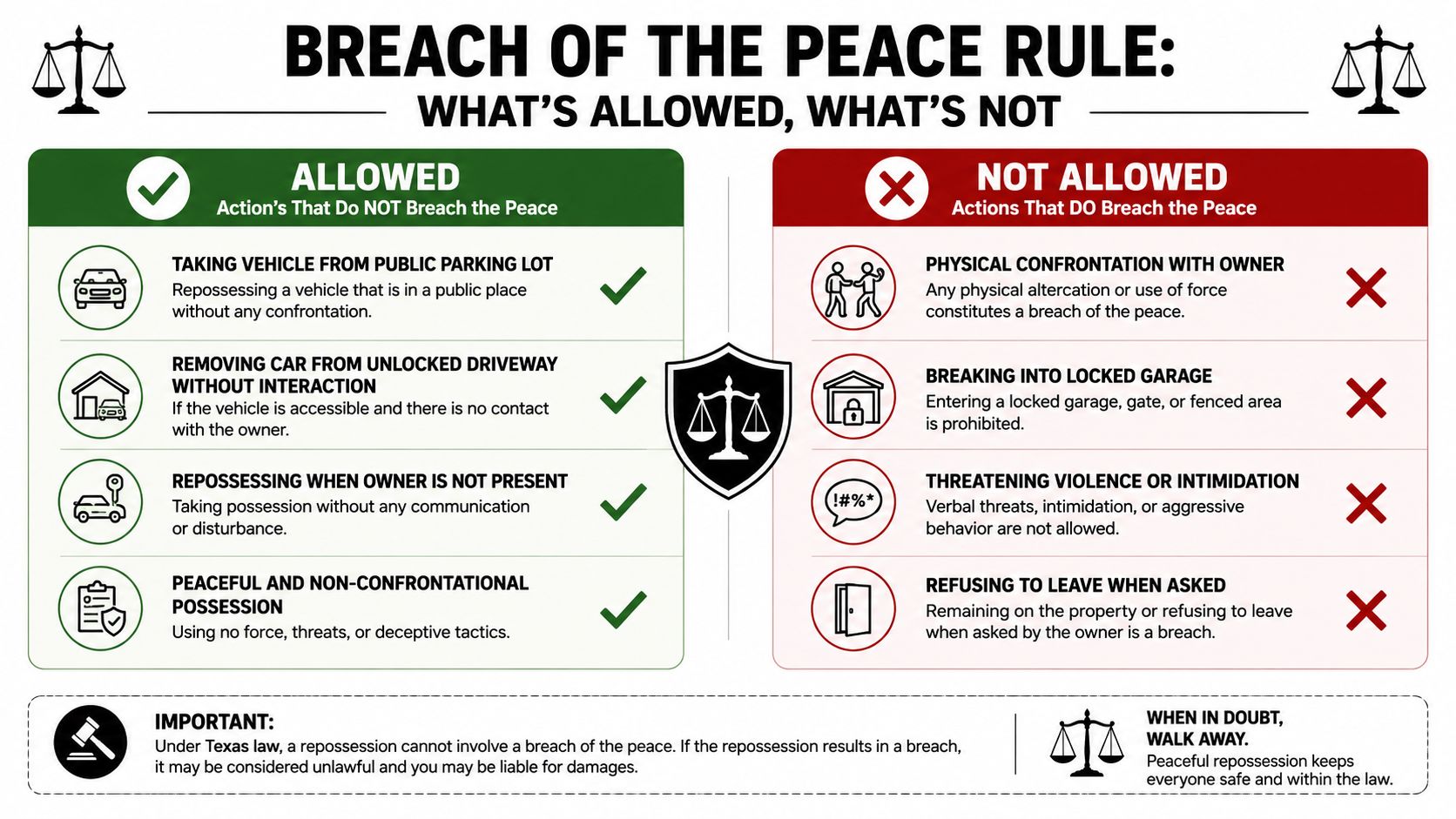
The phrase breach of the peace is the line that matters most in a Texas repossession. If the lender stays peaceful, the repo may be lawful. If the repossession turns into force, intimidation, or a locked-gate problem, the lender may have crossed into unlawful conduct. Texas legal guidance says a breach occurs when the repossessor uses force, impersonates law enforcement, or continues after the debtor objects while present, and that makes the repossession unlawful and exposes the lender to damages.
What crosses the line
A repo agent who shouts threats, flashes anything that looks like police authority, or keeps working after the owner says no can create a legal problem for the lender. So can physical contact or trying to get into a locked garage or other secured area. Those facts matter because Texas does not just ask whether the car was taken, it asks how it was taken.
If you're trying to preserve your rights, document what happened as soon as you safely can. Save photos of tire tracks, broken locks, video clips, text messages, and the names of any witnesses. If you were present, write down the time, the place, what was said, and whether the agent left only after you objected.
The goal is not to escalate. The goal is to preserve evidence while staying out of harm's way.
If the confrontation happened in a local neighborhood, the county court won't care how stressful the morning was unless the facts are clear. A clean record helps whether the dispute later lands in Harris County Probate Court for a broader family issue or in a civil claim tied to the repo itself.
Your Rights After Repossession and Critical Deadlines
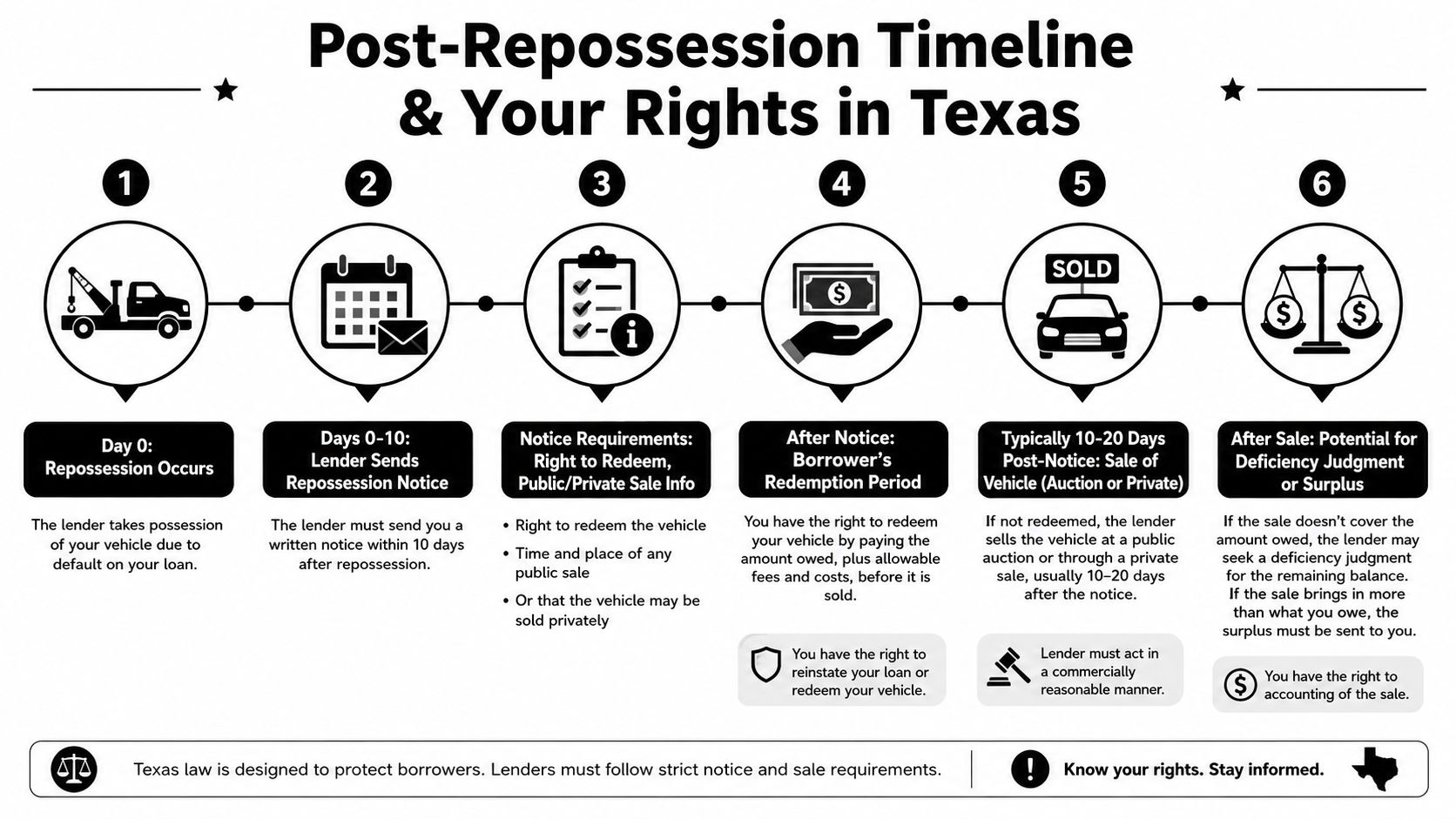
Once the tow truck leaves, the clock starts running. Texas guidance says consumers may have 10 days after receiving auction notice to redeem, reinstate, or file Chapter 13 bankruptcy to stop the sale. That window is short enough that many people lose options because they wait to open the mail. The same repossession guidance from the Texas Comptroller explains that a repossession typically stays on a consumer's credit report for seven years from the date of original delinquency.
Personal property is a separate issue
The car and the contents of the car are not treated the same. Texas Finance Code rules require the lender, after discovering unsecured items in the vehicle, to mail or deliver written notice to the buyer's last known address within 15 days, and the buyer then has until the 31st day after notice to identify and claim the property at reasonable times. If the belongings go missing or the notice is late, that can turn a routine repo into a statutory dispute.
Texas Law Help explains that the creditor cannot keep property left in the vehicle and must use reasonable care to prevent others from removing it. If the items are not returned, the borrower may seek recovery in small claims court. For families trying to track what was left behind, a practical reference on damage repossessed car records can help frame the questions to ask, even though the legal issue is still about notice, care, and proof.
The tax side can surprise people too. The Texas Comptroller notes that once a lienholder repossesses a vehicle and completes the required TxDMV documents, a taxable transaction can arise if the former owner later buys the vehicle back from the lender. That can add another cost on top of the stress of getting transportation back.
Title Loans Versus Standard Auto Loans
Not every repossession starts from the same kind of loan. A standard auto loan is usually secured by the vehicle itself, while a title loan often uses the car title as collateral in a very different consumer-credit setting. Texas has been a major market for title-loan repossessions, and that matters because the risks after repossession can look different from a plain auto-note default.
The Texas Office of Consumer Credit Commissioner reported that motor-vehicle repossessions in the CAB title-loan market have historically averaged about 9,700 per quarter, equal to roughly 4.2% of active title loans, and repossessions spiked to around 13,100 in Q1 2020. A 2013 analysis cited in American Banker reported that Texas had the highest repossession rate at 9.94% among the states studied for auto title loans, while the Consumer Financial Protection Bureau found that one in five borrowers using short-term auto title loans had their vehicle seized for nonpayment. Those figures help explain why Texas title-loan repossessions draw so much attention.
Why deficiency balances matter so much
The hidden trap is what happens after the car is sold. In many ordinary auto-loan cases, borrowers understand that a balance may still be owed if the sale doesn't cover the debt. Title-loan policy debates in Texas raise a different question, because legislative materials show proposals to restrict a credit access business from collecting a deficiency after repossessing a vehicle taken as title-loan collateral unless the consumer damaged the vehicle or made it unavailable. That means the loan type can change the financial fallout in a major way.
People often assume “repossession” means the same thing no matter what. It doesn't. If you're sorting through a title-loan problem and a vehicle loss at the same time, a legal planning conversation about how an asset protection attorney safeguards your family's future in Texas can help you see how the vehicle debt fits into the rest of the family's finances.
Practical Steps to Protect Yourself Before and After Repossession
The best move is still the one you make before the tow truck arrives. If you're falling behind, call the lender early, ask whether a payment arrangement exists, and get every answer in writing. If the car is already at risk, think about whether you can redeem it, whether the lender will reinstate the loan, or whether another legal solution, including bankruptcy, needs immediate review.
A simple checklist for the next 24 hours
- Find the notice fast: open every letter, email, and text from the lender, because the sale clock can move quickly after notice.
- List what was in the car: child items, work tools, electronics, and paperwork should all go on one inventory.
- Photograph proof of ownership for belongings: receipts, serial numbers, and photos can help if property goes missing.
- Ask about storage and redemption terms: get the payoff demand in writing before you promise money you can't deliver.
- Save the credit reports: the repossession can stay on your report for seven years from original delinquency, so you'll want a baseline before rebuilding.
If you're still trying to avoid a repo, a conversation about voluntary surrender may also make sense. It doesn't erase the debt, but it can reduce some of the chaos that comes with a surprise tow. Families also use this moment to compare financial authority tools, and one plain-English resource is Guardianship of an Incapacitated Adult in Texas, especially when a parent's declining capacity is part of the problem.
A borrower who acts early usually has more choices than a borrower who waits for the auction date.
When to Consult a Texas Consumer Rights Attorney
You should talk to a lawyer fast if the repo involved threats, force, a locked garage, or an argument that continued after you objected. You should also get help if the lender's notice looks wrong, the property left in the vehicle was not returned, or the lender is demanding a deficiency balance in a title-loan case. Those are the kinds of details that can change the legal outcome.
An attorney can review the loan documents, check whether the lender followed Texas repossession law, and push back before the vehicle is sold. In some cases, that early intervention matters more than anything else, because once the sale happens, your options narrow quickly. If the facts are muddy, a lawyer can help you separate a true default problem from an unlawful repossession problem.
If your car has been repossessed or you're worried it could happen soon, the Law Office of Bryan Fagan, PLLC can help you sort through the notice, the deadlines, and the next legal step. Visit Law Office of Bryan Fagan, PLLC to schedule a free consultation and get personalized guidance for your situation.