Skip to content
A phone call from a hospital, a sudden fall, a stroke, a parent with advancing dementia, or the death of both parents of a minor child can force a family into a question they never expected to answer so fast. Who is legally allowed to step in now? In many Texas families, the answer isn’t clear. One sibling lives out of state. Another can’t manage the responsibility. A relative wants to help but has health or financial problems of their own. Sometimes no one agrees. Sometimes no one is available at all.
When that happens, Texas law does not pause and wait for the family to get organized. A probate court moves to protect the person who needs help, whether that is an incapacitated adult or a child left without a legal caregiver. That process is structured, court-supervised, and often far more intrusive than families expect.
If you're searching for What Happens If No One Steps Up as Guardian in Texas?, the short answer is this: the court will fill the gap. The longer answer matters, because the state’s default plan may not be the plan your family would have chosen.
The Unsettling Silence When No One Can Step Up
A common family conversation starts with good intentions and ends with silence.
An aging father can no longer manage medications, bills, or safe living at home. Everyone sees the problem. No one feels able to take legal responsibility. One adult child is caring for young children. Another has a demanding job in another county. A niece offers help with errands, but not formal court duties. The family keeps hoping a temporary crisis will pass. It often doesn’t.
The same silence can follow a tragedy involving minor children. Parents may assume relatives will “work it out” if something happens. But grief, distance, old family tensions, and practical limits can keep anyone from stepping forward quickly. When there is no valid will, declaration, or ready applicant, the legal system takes over.
Why waiting creates risk
Texas guardianship law is built around protection, not convenience. Courts applying Texas Estates Code Title 3, Subtitle G focus on whether a proposed ward needs a guardian and, if so, who is qualified to serve. If no suitable person appears, the court doesn’t just leave things unresolved. It looks for another lawful option.
That sounds reassuring in theory. In practice, families often feel shocked by how formal the process becomes. Private medical issues, financial records, living arrangements, and family disagreements can all end up under court review. The judge’s job is to protect the vulnerable person, not preserve family comfort.
Practical rule: If nobody has legal authority, banks, doctors, care facilities, and schools usually won't rely on family consensus alone.
The emotional weight families carry
Families in this position often feel guilt from every direction. A spouse may feel they should do more. Adult children may worry they’re failing a parent. Relatives of a child may want to help but fear they cannot meet the court’s standards or the child’s daily needs.
Those feelings are real. So are the trade-offs.
A guardianship case can protect a loved one from neglect, exploitation, or chaos. But when no one steps up early, the court may appoint someone the family didn’t choose. For some families, that means a professional guardian, a public program, or another court-approved person making decisions about housing, care, and money.
That is why advance planning matters so much in Texas. A family usually has far more control before a crisis than after one. Once a guardianship case begins, the question is no longer “What would we prefer?” It becomes “What option will the court approve under the law?”
How Texas Courts Respond to a Guardianship Void
A guardianship case usually starts after a crisis. A parent is discharged from the hospital and cannot make safe decisions. An adult child realizes the bills are unpaid and no one can access the account. A facility needs consent for care, but no one has legal authority to give it.
At that point, the court does not wait for the family to sort things out privately. The probate court steps in to protect the proposed ward and put a legal decision-maker in place.
In counties such as Harris County Probate Court, that process often begins when a hospital, social worker, relative, or another interested person files an application to determine incapacity and appoint a guardian. Adult cases generally proceed under Texas Estates Code Chapters 1101 through 1105 and related provisions in Title 3, Subtitle G. Families are often surprised by how structured this becomes. The court is not looking for the most comfortable family arrangement. It is looking for a lawful, workable one.

The first steps the court takes
Before a judge appoints a permanent guardian, the court usually requires several formal steps:
- A guardianship application is filed and reviewed. The application must identify the proposed ward, explain why guardianship is requested, and state whether the case involves the person, the estate, or both.
- Notice goes out to relatives and other required parties. Even family members who have stayed out of the situation may receive notice and a chance to participate or object.
- An attorney ad litem is appointed for the proposed ward. That lawyer investigates, meets with the proposed ward, reviews the facts, and reports to the court.
- Medical or other evidence is presented. In adult guardianship cases, the court usually expects a physician's certificate or other proof addressing incapacity.
- The judge examines less restrictive options. Powers of attorney, supported decision-making, trusts, representative payees, and other alternatives may be considered before full guardianship is approved.
That sequence matters. It explains why families lose time once a case is filed. It also explains why planning early gives a family more room to choose the right arrangement before the court has to impose one.
How the court looks for a guardian
Texas does not start with strangers. The court first checks whether a legally preferred person is available and qualified.
Under Texas Estates Code § 1104.051, the judge generally considers close family members first. For an adult, that often means a spouse, then next of kin, then another qualified person. But priority is not entitlement. A relative can be passed over for several practical reasons: the person does not want the job, lives too far away, has a conflict of interest, has a disqualifying history, or just cannot handle the reporting and decision-making the role requires.
The court also looks at whether the proposed guardian can effectively do the work. Can this person manage medical decisions, communicate with providers, keep records, file annual reports, protect assets, and follow court orders? In my experience, families often focus on who loves the person most. Judges have to focus on who can legally and practically serve.
Texas courts also see appointments break down after the case begins. According to Texas guardianship qualification guidance, Texas courts often see guardianship failures or disputes, leading to court interventions in over 20% of cases annually. In 2024 alone, 2,300 guardianship removal petitions were filed statewide. For a broader explanation of the court's role, this article on when Texas courts step in from independence to oversight adds helpful context.
If no qualified person appears
If no family member or other preferred person qualifies, the court does not dismiss the problem. It keeps working through the lawful options until someone can be appointed.
That may include a certified private guardian, a local program, or another court-approved candidate. In some cases, the court may separate responsibilities and appoint one person for care decisions and another for financial management. The goal is protection, not family preference.
This is the point where many families realize what inaction costs. Once the court has to build a guardianship plan from scratch, the family usually has less control over who serves, how decisions are made, and how much the process will cost.
The Reality of a Court-Appointed Guardian
A family can go from disagreement to loss of control fast. No one files. No one qualifies. No one wants the responsibility. The court still has to put someone in place to make medical, placement, or financial decisions, and that person may be someone the family has never met.
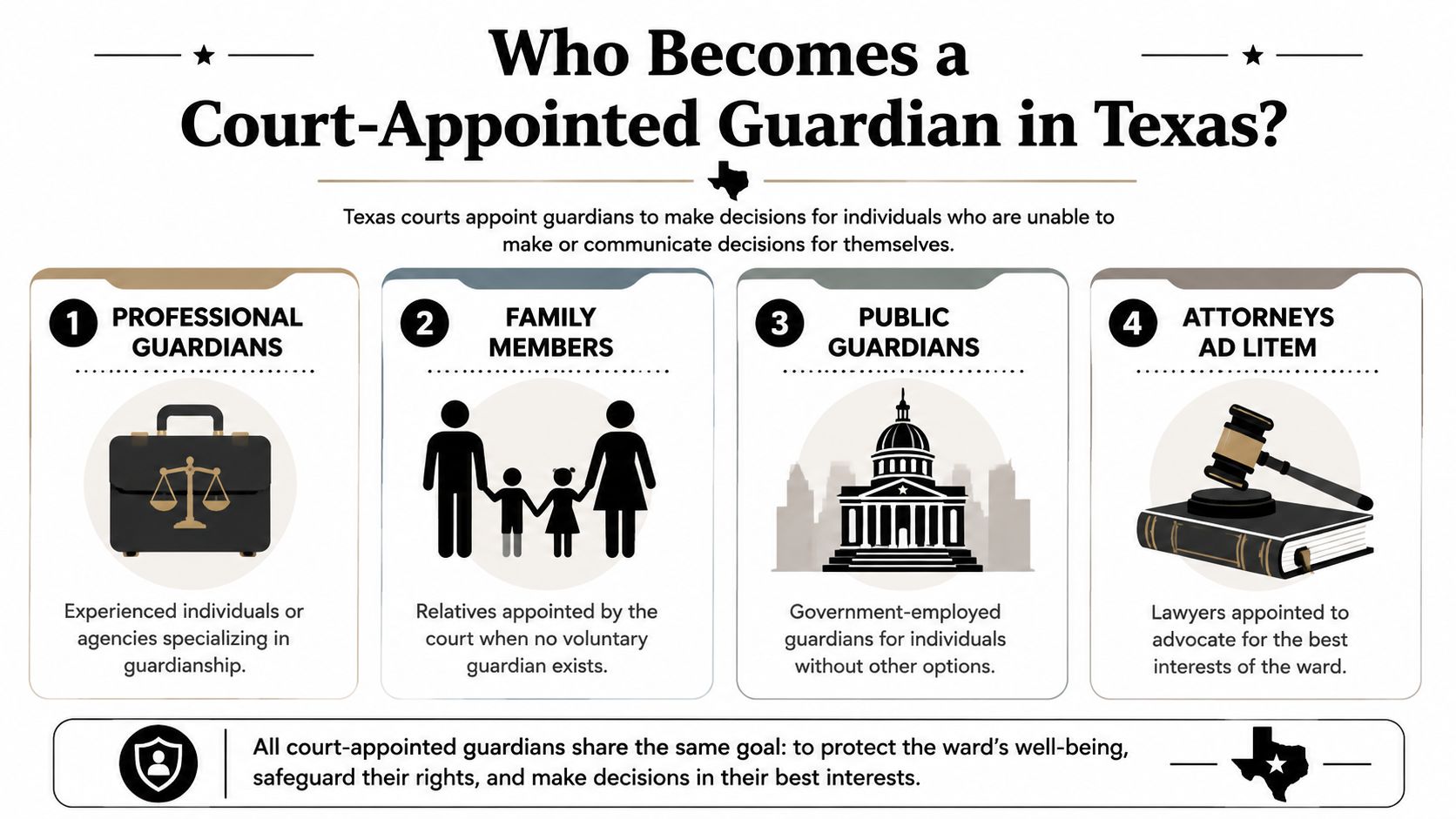
By this stage, the court is no longer asking who the family would have picked in a perfect world. It is asking who is available, legally eligible, and able to follow court orders from day one. That shift matters. It usually means less family influence, more formal oversight, and more expense charged to the ward or the ward’s estate.
Who the court may appoint
In practice, Texas courts usually end up appointing one of several types of guardians:
- A relative who did not step forward at first but later agrees to serve and meets the legal requirements.
- A private professional guardian who takes appointments as paid work and handles care, reporting, and compliance.
- A public guardian or local program if no suitable private person is available.
- A financial institution or other estate manager in cases where property management is the central issue.
The court can also divide the job. One person may handle the ward’s person, such as living arrangements and medical consent, while another handles the estate. Families often do not expect that kind of split authority, but it is common when no single person can do both jobs well.
What changes once a stranger is appointed
A court-appointed guardian has duties to the ward and the court. That guardian does not take direction from siblings, adult children, or family friends who believe they know best. The judge expects inventories, accountings, care decisions, and compliance with the terms of the appointment.
That can be a relief in a high-conflict family. It can also feel very impersonal.
A professional guardian may be organized, responsive to the court, and experienced with doctors, facilities, and benefits. At the same time, that guardian may not know the person’s routines, religious preferences, long-standing family tensions, or the small details that shape good day-to-day decisions. Families feel that difference quickly.
Comparison of common guardian types
| Attribute | Family Guardian | Professional Guardian | Public/State Guardian |
|---|---|---|---|
| Relationship to the ward | Personal and usually longstanding | Usually no prior personal relationship | Often no prior personal relationship |
| Decision-making style | May reflect family values and history | Guided by professional practice and court duties | Guided by agency structure and court duties |
| Cost to the estate | May still involve court costs and compliance expenses | Ongoing professional fees are common | May involve administrative control with limited family choice |
| Court accountability | Yes | Yes | Yes |
| Family control | Usually highest | Usually reduced | Often most limited |
| Best fit | When a willing, qualified relative can serve | When no relative can serve or conflict is high | When no private option is workable |
A court-appointed guardian answers to the judge, files required reports, and follows the scope of the court order even when relatives object.
The trade-offs families live with
The hardest part is rarely the title on the order. It is what follows.
The guardian may decide where your loved one lives. The guardian may control access to funds. The guardian may limit who receives updates or participates in care discussions. If the family has been disorganized, hostile, or absent during the case, the court-appointed guardian may keep decision-making tight for safety and recordkeeping reasons.
Cost is also a factor. Professional guardians are paid for their time, and the estate often bears that burden along with attorney’s fees, bond premiums, court costs, annual reporting expenses, and possible care-management charges. Families who waited because they hoped the problem would resolve itself are often surprised by how expensive court-built solutions become.
The same loss of control can affect children as well. Families dealing with that risk should review who steps in for a minor guardianship in Texas when parents cannot.
In plain terms, once the court has to supply the guardian, the family is reacting instead of deciding. That is the true consequence of inaction.
What Happens to Minor Children Without a Guardian
A child can lose both stability and legal protection in the same week. If both parents die or become unable to care for the child, and no one has been formally named to step in, Texas does not pause while the family figures it out. The court has to act, often before relatives are ready.

The court decides based on the child's best interest
Texas courts start with the child’s best interest. Under Texas Estates Code § 1104.051, the judge gives preference to certain relatives, but that does not mean a grandparent or aunt automatically gets custody the same day. Someone still has to file the proper case, prove they are qualified, and show the placement is appropriate.
If no suitable adult is ready to serve, the child may end up in temporary care while the court sorts out who can legally take over. That is the part families often underestimate. Love for the child matters, but the court still needs a legally recognized adult with authority to consent to medical care, enroll the child in school, manage benefits, and provide day-to-day supervision.
A Texas discussion of guardian eligibility and foster care risk explains how children can enter the system when no guardian has been pre-designated after a parent’s death or incapacity. See who can serve as a guardian in Texas.
What the first days often look like
In a true emergency, there may be no smooth handoff. A hospital, school, or state agency may ask a simple question no grieving relative can answer yet. Who has legal authority for this child right now?
If the answer is no one, Child Protective Services may become involved while the court reviews placement options. Relatives may be calling each other, traveling to Texas, disagreeing about where the child should go, or trying to locate important documents. Meanwhile, the child may be sleeping in a temporary setting with adults they did not expect to depend on.
That short period can shape the whole case. The relative who is loving but disorganized may lose ground to the person who files first, has stable housing, and can pass the court’s review.
Families who want a closer explanation of that process should read this guide on minor guardianship in Texas and who steps in when parents cannot.
Why advance planning changes the outcome
Texas law gives parents a way to guide the court before a crisis happens. A will or a valid declaration under Texas Estates Code § 1104.202 does not guarantee zero court involvement, but it gives the judge a clear starting point and gives the family a much stronger position.
That matters in practical ways. A written designation can reduce fights between relatives. It can shorten the time the child spends in uncertainty. It can also help preserve school placement, medical continuity, and relationships with familiar caregivers.
I often tell families the same thing. The court can build a plan after an emergency, but court-built plans are slower, more expensive, and less personal than the one parents could have made themselves.
Families under stress often need support beyond the legal issues. A free anxiety education hub may help during the waiting and uncertainty that these cases create.
The Financial and Emotional Costs of Inaction
A guardianship case gets expensive fast, and the hardest part is that families rarely see the full price at the start.
In Texas, the cost is not limited to one filing fee or one hearing. It often includes court costs, attorney's fees, ad litem fees, medical evaluations, bond premiums in some cases, annual reporting duties, and the practical cost of taking time off work to deal with hearings, records, banks, doctors, schools, and care facilities. Once the court is involved, many of those expenses are built into the process. The part families can often avoid is the scramble that happens when no one planned ahead.
Delay creates costs that spread in several directions
For minor children, hesitation can change the entire path of the case. As explained in Texas guidance on what happens when you die without naming a guardian for minor children, if no family member steps in quickly, CPS may become involved, short delays can expand the state's role, and court backlogs can leave children in limbo for months. That usually means more hearings, more disruption, and more expense for everyone involved.
For incapacitated adults, the financial pressure looks different but can be just as serious. Mortgage payments still come due. Facility admissions still require signatures. Insurance issues still need attention. If no one has legal authority, a son, daughter, or spouse may spend weeks calling institutions that cannot legally talk to them or act on their requests.
That delay can also damage the person's property, care, and stability before the court ever signs an order.
The emotional toll is often worse than the invoice
Families usually feel four losses at once.
- Privacy shrinks because sensitive medical and financial information may be reviewed in a court case.
- Decision-making slows because urgent choices have to wait until someone has legal authority.
- Family conflict grows because relatives start questioning who should have acted sooner, or who should serve now.
- Control shifts away from the family if the court has to rely on a professional or other third party.
I have seen families spend more energy fighting uncertainty than solving the underlying problem. Grief, guilt, and caregiver burnout tend to rise together in these cases. Some people need support outside the legal system while the case is pending. A free anxiety education hub can help families understand stress reactions during a crisis.
Court supervision usually costs more than planning ahead
Many families treat guardianship as the default backup plan. In practice, it is often the more public, slower, and more expensive route. Even where the judge reaches a sound result, the family may spend months and substantial money getting authority they could have addressed earlier with proper planning.
For a closer look at the likely expenses, read this guide on the costs associated with guardianship in Texas and what to expect.
How to Prevent a Guardianship Crisis Before It Starts
A guardianship crisis usually starts with a phone call no family wants. A parent is in the hospital. An adult child with disabilities turns 18. A caregiver dies unexpectedly. Everyone assumes someone else has authority to act, then learns no one does.
That gap is where families lose time and control. In Texas, the better course is to put the right documents in place before a judge has to choose for you.

Use the tools that keep decisions out of court
Texas law gives families several ways to reduce the chance of a full guardianship, or at least guide the court if one later becomes necessary. The right plan depends on the person’s age, capacity, health, and family situation.
For many adults, these documents do most of the work:
- Durable Power of Attorney. This lets you name an agent to handle financial matters during incapacity. A properly drafted document can allow someone to pay bills, manage accounts, deal with property, and handle routine financial issues without filing a guardianship case first.
- Medical Power of Attorney. This names the person who can make health care decisions if you cannot give informed consent yourself.
- Declaration of Guardian Before Need. Texas law allows an adult to state who should serve if a guardianship is ever needed. If a future court case becomes unavoidable, that declaration gives the judge clear guidance. For adults planning ahead, Texas Estates Code § 1104.201 matters.
- Declaration of Guardian for Minor Children. Parents can identify who should care for their children if both parents die or become incapacitated. That does not eliminate every court step, but it gives the court a clear starting point and reduces the risk of family conflict.
- Supported Decision-Making Agreement. Some adults with disabilities need help making choices but do not need a full guardianship. This option can preserve more independence while still giving structure and support.
These documents serve different jobs. A will takes effect after death. A power of attorney works during life. A guardian declaration helps if the family ends up in court anyway. In strong planning, those pieces work together.
Match the document to the problem
Families often lose ground when they rely on informal arrangements. Being listed on one bank account does not give authority over all assets. Being a spouse or adult child does not automatically let someone sign every medical or financial document. Verbal instructions also tend to collapse under pressure, especially when hospitals, banks, and other relatives want written authority.
Use the tool that fits the risk:
| Concern | Better planning tool |
|---|---|
| Paying bills and managing finances during incapacity | Durable Power of Attorney |
| Medical treatment decisions | Medical Power of Attorney |
| Naming who should serve if guardianship is ever needed | Declaration of Guardian |
| Protecting minor children after parental death or incapacity | Will plus guardian designation |
| Preserving autonomy where full guardianship may be excessive | Supported Decision-Making Agreement |
Good planning is specific. It gives enough authority to solve the problem without handing over more control than necessary.
If the crisis has already started
Families can still improve the outcome, even after capacity is lost or an emergency is underway. Speed matters.
Start by gathering the records the court and counsel will ask for first. That usually includes medical information about capacity, a list of close relatives, basic financial information, and a practical care plan. Then identify the strongest guardian candidate early. The best candidate is not always the loudest relative. Courts look at reliability, suitability, conflicts, and willingness to follow reporting rules after appointment.
If a guardianship case must be filed, the family should be ready for what comes next. Texas courts may appoint an attorney ad litem, require medical evidence, set a hearing, and expect the proposed guardian to qualify, post bond in some cases, and complete ongoing reporting. Planning ahead can prevent that process. If prevention is no longer possible, preparation can still keep the court from defaulting to a less personal option.
This short video gives a useful overview of planning issues families often face:
When legal help makes the biggest difference
Legal help is often most useful before anyone is in immediate danger, because that is when families still have options. A lawyer can review whether guardianship is likely to be necessary, prepare powers of attorney and declarations that fit the family’s circumstances, and spot gaps that people commonly miss.
Once a case is active, the work changes. Then the focus turns to whether a temporary guardianship is needed, whether a less restrictive alternative is still available, who should serve, and what the court will require after appointment.
Guardianship, probate, and estate planning often overlap in the same family crisis. The Law Office of Bryan Fagan, PLLC helps Texas families prepare guardianship applications, address disputes, evaluate alternatives, and put planning documents in place before a court battle starts.
Frequently Asked Questions About Texas Guardianship
Can a Texas court force me to become a guardian
No. A court can appoint a qualified guardian, but it generally cannot force an unwilling person to serve in that role. If no family member is willing or suitable, the court may look to a professional or public option.
Does the proposed ward get a voice in the case
Yes. In adult guardianship cases, the court appoints an attorney ad litem to represent the proposed ward’s interests. The ward can object, present evidence, and in many situations attend the hearing.
Can guardianship be temporary in an emergency
Yes. Texas courts can create temporary solutions in urgent situations when immediate protection is needed. Those orders are limited and court-supervised, but they can help bridge the gap while a full hearing is pending.
What if the appointed guardian is doing a poor job
The court keeps supervisory authority over the guardian. If there is neglect, financial misconduct, or another serious problem, an interested person can ask the court to investigate and remove the guardian.
Is guardianship always required when an adult becomes incapacitated
No. If valid planning documents exist, or if a less restrictive option works, the court may not need to impose a full guardianship. Texas law favors using only the level of intervention that the person needs.
What duties does a guardian have after appointment
A guardian must follow court orders, act in the ward’s best interest, protect assets when managing an estate, and complete required reports and accountings. Guardianship is not a one-time appointment. It carries continuing legal duties.
Can a guardianship end
Yes. A guardianship can be modified or terminated if the ward regains capacity, if the arrangement is no longer necessary, or if another legal change makes the guardianship inappropriate. The court must approve that change.
If your family is facing uncertainty about who can legally step in, or you want to prevent the court from making that choice for you later, schedule a free consultation with Law Office of Bryan Fagan, PLLC. A personalized review can help you understand your options for guardianship, emergency relief, estate planning, and the practical steps needed to protect your loved one under Texas law.