Skip to content
When families first call about guardianship, the story often starts the same way. A parent forgot to pay the mortgage, gave money to someone they barely know, wandered from home, or began refusing needed medical care. Everyone in the family feels the danger. No one feels ready for court.
That's a painful place to be. You're trying to protect someone you love, and at the same time you may worry that asking for guardianship will take away that person's independence. Both feelings are real.
Texas courts understand that tension. A guardianship case isn't supposed to be a shortcut for family stress, and it isn't meant to punish a person for aging, illness, or poor judgment. The court's job is to protect the proposed ward while preserving as much freedom as possible. That's why judges don't decide these cases based on worry alone. They look for proof.
What judges really look for in a Texas guardianship case is often more practical than families expect. The judge wants reliable medical evidence. The judge wants to know whether a less restrictive option could work. The judge wants to know whether the person asking to serve is able to fulfill the legal duties. In a disputed case, the judge also wants credible facts about family conflict, finances, and daily care.
Texas guardianship law sits in Title 3, Subtitle G of the Texas Estates Code, and the court process is structured for a reason. It's designed to protect vulnerable people from neglect, exploitation, and overreach. In courts such as Harris County Probate Court, Dallas County probate courts, and similar courts across Texas, judges follow that framework carefully.
Understanding the Guardianship Journey in Texas
A daughter notices her father has stopped opening mail. His lights are shut off once. Then again. He insists everything is fine, but his checkbook is missing, and a neighbor mentions a stranger has been visiting often. The daughter thinks, “He needs help.” In court, that concern matters. But it won't be enough by itself.
A Texas guardianship case begins with a hard truth. Love explains why the family filed the case, but evidence is what allows the judge to act. That can be frustrating for families who are already overwhelmed. It can also be protective, because a guardianship can remove important rights from the person at the center of the case.
What the court is trying to protect
Under the Texas Estates Code, the court is balancing several goals at once:
- Safety: The judge wants to know whether the person is at real risk without court intervention.
- Dignity: The court tries to preserve independence where possible.
- Property protection: If money or assets are involved, the court looks closely at whether those assets are at risk.
- Fair process: The proposed ward still has rights, and the court must respect them.
That balance is why the process can feel detailed. Petitions, medical paperwork, notice, hearings, and ongoing reporting aren't just paperwork. They are safeguards.
Practical rule: A guardianship case is strongest when the family can show specific problems, specific risks, and specific reasons the court's help is necessary.
Guardianship is not one-size-fits-all
Families also get confused about what guardianship covers. Some cases focus on personal decisions, such as medical care or living arrangements. Others focus on financial management. Some involve both. Temporary or emergency guardianship may come up when the risk is immediate, but even then the court expects a legal basis and focused proof.
A good filing usually answers questions a judge is already thinking about:
- What can the proposed ward still do on their own?
- What decisions are causing danger right now?
- Is the request specific to the actual problem?
- Who will serve, and can that person handle fiduciary duties?
- Is there a better option short of guardianship?
Families who understand those questions early are better prepared, whether they're filing in Harris County, Travis County, Bexar County, or another Texas court.
The First Hurdle Proving Incapacity with Clear Evidence
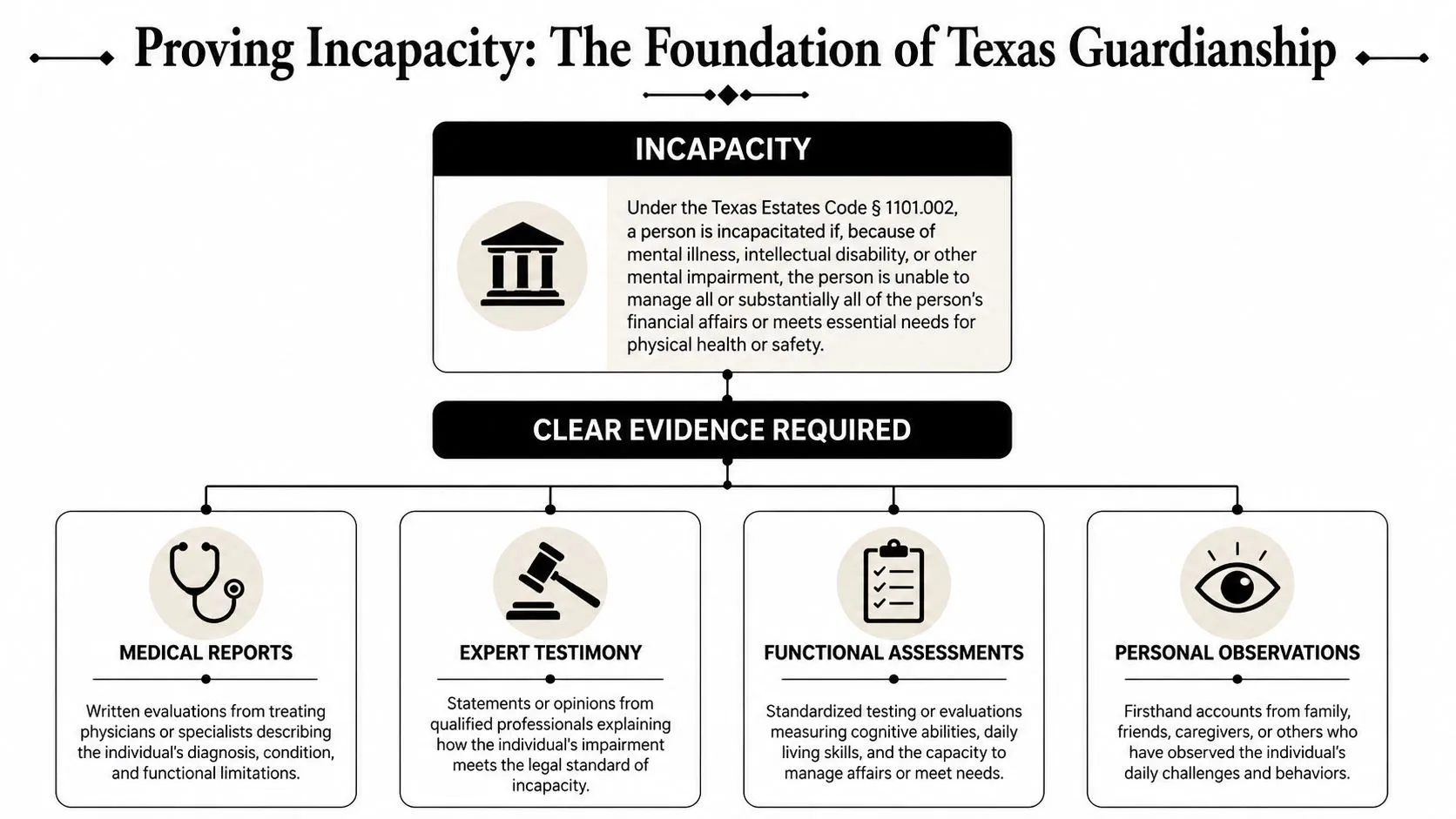
The first major issue is incapacity. In plain English, that means the court needs proof that the proposed ward cannot manage personal needs, finances, or both in a way that creates real risk. A diagnosis alone usually doesn't answer that question. The judge is looking for function, not labels.
Texas judges must find clear and convincing evidence that the proposed ward is incapacitated, that guardianship is in the ward's best interest, and that the ward's rights or property will be protected. The judge must also make a separate preponderance-of-the-evidence finding that venue and court authority are proper, as explained in this Texas guardianship FAQ discussing the proof required in court.
Two proof standards that families often mix up
These two standards matter because they apply to different parts of the case.
- Clear and convincing evidence: This is the heavier burden. It applies to the core guardianship findings.
- Preponderance of the evidence: This applies to procedural questions such as whether the court is the proper court to hear the case.
If you remember one thing, remember this: the court needs more than general concern. “Mom is forgetful” is not the same as proof that she can't safely manage medicine, money, or daily needs.
The medical certificate matters because details matter
In many cases, the most important early document is the physician or psychologist evidence supporting incapacity. Judges pay close attention to whether that evidence is current, specific, and tied to actual limitations. If the report says only that a person has dementia, stroke history, or mental illness, the judge may still want more. The stronger reports describe what the person can and cannot do.
For families trying to understand that paperwork, this explanation of the physician certificate for guardianship in Texas can help clarify what courts expect. The same practical point appears in The Certificate of Medical Examination in Texas Guardianship, which focuses on why a guardianship case starts with documented incapacity.
A useful outside comparison is this guide to Ontario capacity assessors, not because Ontario law controls Texas cases, but because it helps families understand the broader difference between a diagnosis and a functional capacity assessment.
Vague claims about aging, confusion, or bad decisions give a judge room to narrow the request, delay the case, or deny it.
What stronger proof looks like
A stronger incapacity showing usually includes concrete examples such as:
- Daily living failures: missed medication, unsafe wandering, inability to prepare food, or refusal of necessary care without understanding the consequences.
- Financial breakdown: unpaid bills, unusual withdrawals, repeated scams, or inability to understand basic transactions.
- Timing: evidence that reflects the proposed ward's condition at the time of filing, not just months or years earlier.
- Narrow tailoring: a request that asks only for the authority needed.
That last point matters more than many families realize. If the petition asks for full guardianship when the evidence supports something narrower, the court may limit or modify what's requested.
Is Guardianship the Least Restrictive Option
A judge doesn't stop after deciding a person needs help. The next question is just as important. Does this person need guardianship, or would a less restrictive option solve the problem?
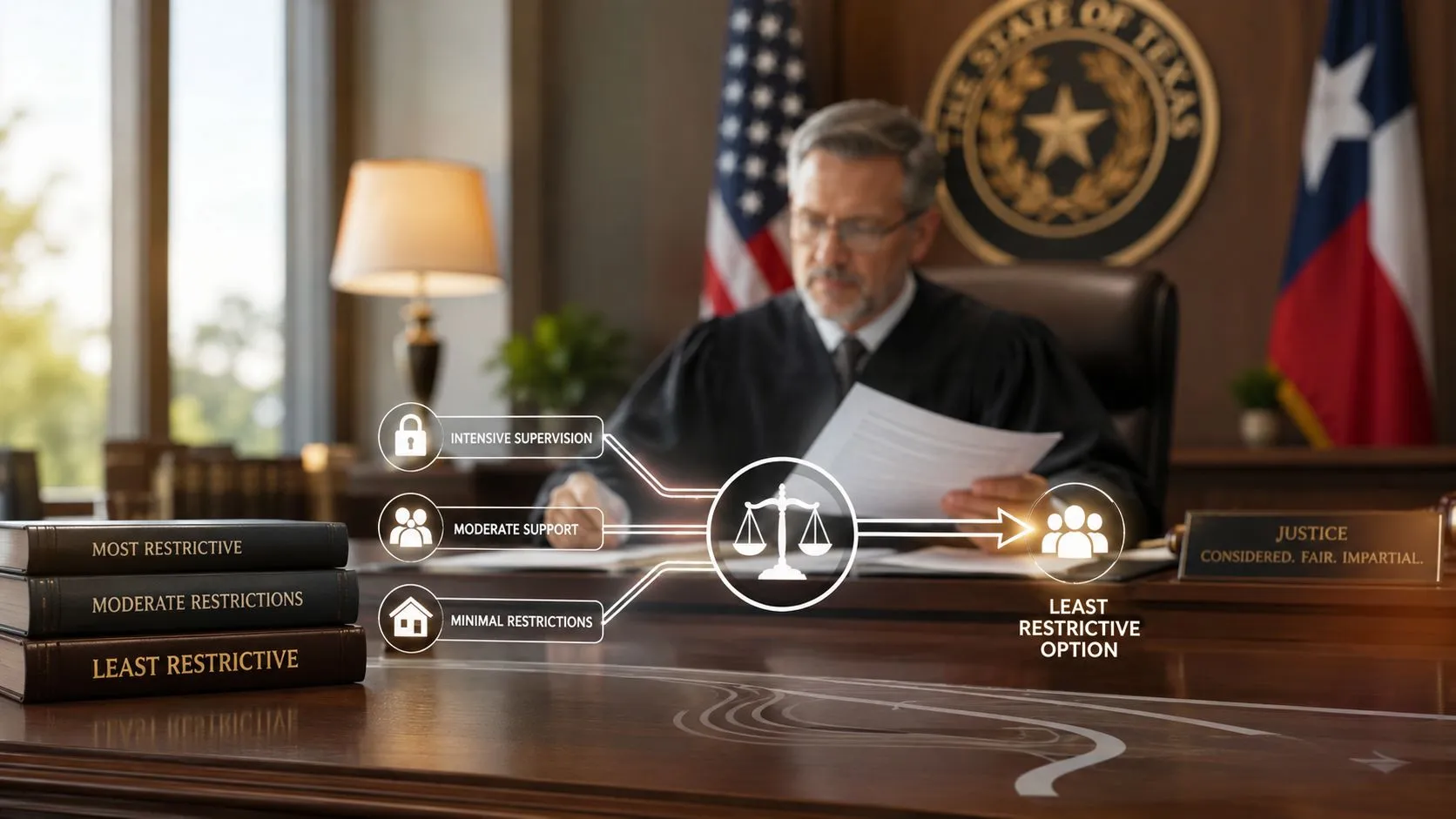
Texas guidance emphasizes that courts require clear and convincing evidence of incapacity, but also look at whether alternatives such as updated legal documents and trusted agents could avoid guardianship. A strong petition needs to address why a power of attorney, supported decision-making, or family caregiving is insufficient, as discussed in this Texas resource on avoiding and preparing for guardianship.
Why judges ask this question
Guardianship can remove rights. Because of that, Texas courts under Title 3, Subtitle G are supposed to use the least restrictive approach that still protects the person. Families sometimes think this slows things down. In reality, it helps the court avoid giving someone more control than the facts justify.
A common example is an aging parent who can still make some choices but can't manage complex finances. That may point toward a limited solution rather than a broad order covering every part of life. Another example is an adult with developmental disabilities who can make many day-to-day decisions with support. In that situation, a court may want to know whether a narrower legal arrangement would preserve more autonomy.
For a closer look at this issue, many families find it helpful to read about whether guardianship is too extreme and how less restrictive options work.
The court wants to know why other tools failed
Saying “we considered alternatives” isn't enough. The judge will want the reason those alternatives don't protect the proposed ward.
Examples help:
- A durable power of attorney doesn't solve the problem if the person no longer had capacity to sign one.
- A medical power of attorney may help with treatment decisions, but it doesn't automatically fix financial abuse.
- Family caregiving may be loving and consistent, but it may not provide legal authority to stop asset transfers or sign required documents.
- Supported Decision-Making Agreements in Texas are the 2015 alternative that preserves a person's decision-making rights, but they may not work when the person can no longer understand choices well enough to direct support.
A short video can help families think through the court's balancing process:
The most persuasive families don't treat alternatives as a box to check. They explain why those tools are inadequate in this specific life, with this specific person, right now.
Scrutinizing the Proposed Guardian's Fitness
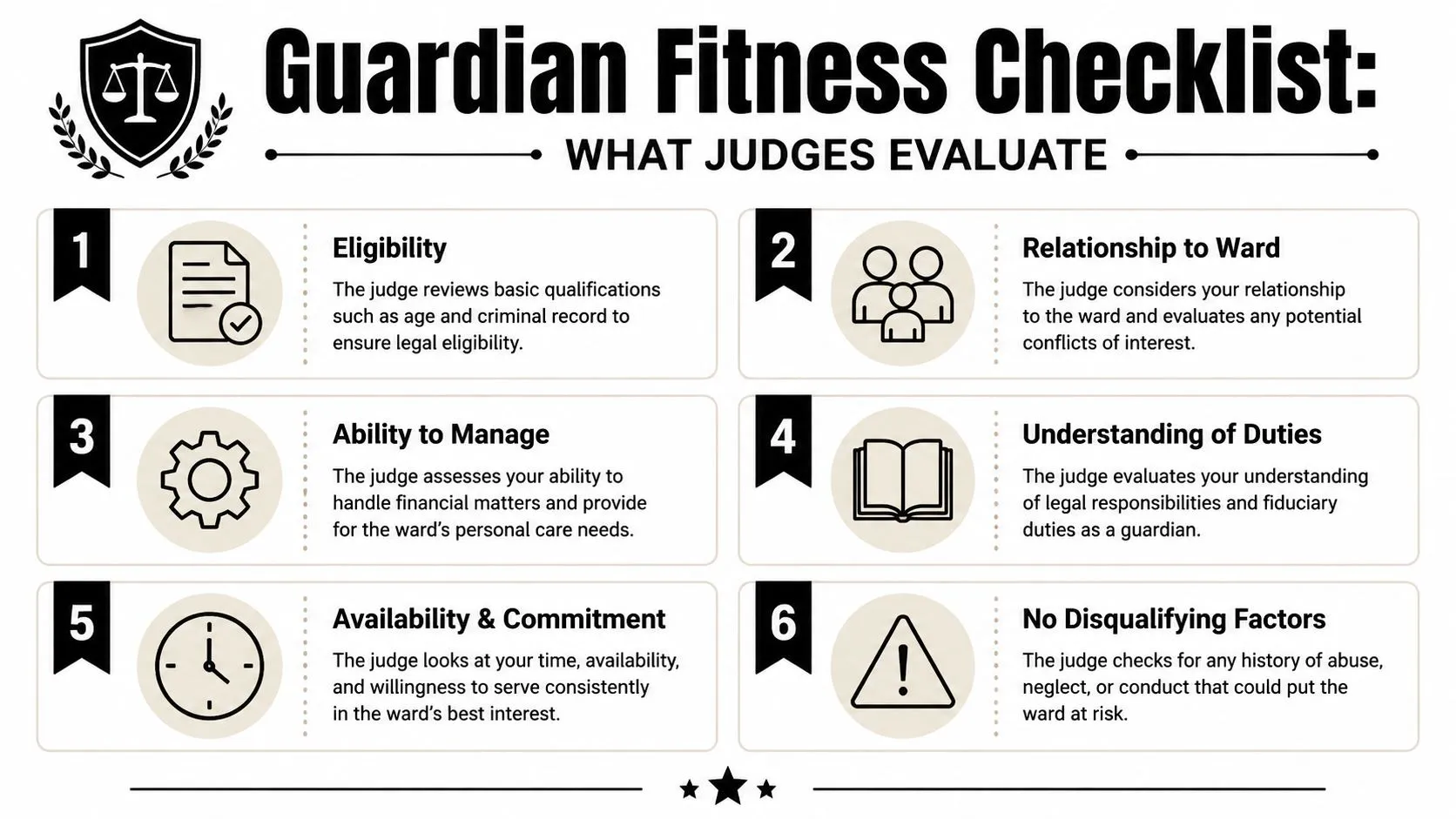
Even if the judge agrees guardianship is necessary, that doesn't mean the person who filed the case will automatically be appointed. Judges in places like Harris County Probate Court or Dallas County probate courts look closely at the proposed guardian's fitness.
That's because a Texas guardian is a fiduciary. This is not just a caregiving label. It's a legal role that requires honesty, recordkeeping, and compliance with court orders.
Texas sources describe judicial review of issues such as criminal history, prior misconduct, financial stability, and past mismanagement, and they note that Texas guardianship procedures involve oversight through oath, bond, letters that expire after 16 months, and recurring reporting duties in this discussion of how Texas courts decide who becomes a guardian.
What the judge may examine closely
The court often looks beyond family status. Being the oldest child, the nearest relative, or the most outspoken sibling doesn't guarantee appointment.
A judge may focus on:
- Background concerns: prior criminal issues, dishonesty, abuse allegations, or other conduct that raises trust concerns.
- Money management habits: whether the applicant appears organized, financially stable, and able to keep clear records.
- Conflicts of interest: whether the proposed guardian stands to gain from control over the ward's property.
- Availability: whether the person has the time and consistency to perform the role.
- Compliance mindset: whether the applicant understands court reporting, deadlines, and fiduciary duties.
Why post-appointment duties affect the appointment decision
Judges often think ahead. If a person is appointed, can they perform the job without creating more problems?
That includes the ability to:
- Take the oath and qualify properly
- Handle bond requirements if ordered
- Track expenses and keep funds separate
- Meet filing deadlines
- Respond to continuing court supervision
Families often underestimate this part. A kind and devoted relative can still be a poor fit if they mix accounts, ignore paperwork, or can't explain basic financial decisions. In disputed estate cases, judges often prefer a person who can document transactions and follow procedure.
Courtroom reality: A judge may see a weak recordkeeping system as a risk to the ward, even when the applicant's intentions are good.
If concerns already exist about a proposed appointee, this discussion of how to prove a guardian is unfit in Texas gives helpful context on the kinds of issues that can matter. Families who want a fuller picture of the filing sequence can also review How to Get Guardianship in Texas: The Process, which outlines the step-by-step court process for establishing a guardianship.
Showing Why Simpler Tools Are Not Enough
A common courtroom moment goes like this. A daughter tells the judge, "We need guardianship because Mom cannot manage anymore." The judge's next question is often the one families least expect. "What other options have you tried, and why are they not enough?"
That question sits at the center of a Texas guardianship case. Guardianship removes rights, so the court wants proof that a less restrictive tool will not adequately protect the proposed ward. In plain English, the judge is asking whether there is a smaller key that opens the door before the court uses the biggest one.
Guardianship vs alternatives in Texas
| Tool | What It Does | Key Limitation |
|---|---|---|
| Durable Power of Attorney | Lets an agent handle financial matters for the principal | It may not exist, may be outdated, or may fail if the named agent is unavailable, unwilling, or abusing the role |
| Medical Power of Attorney | Lets an agent make certain medical decisions | It does not automatically give authority over housing, daily supervision, or broad financial issues |
| Supported Decision-Making Agreement | Lets the adult keep decision-making rights while receiving help understanding choices | It works only if the person can still take part in decisions in a meaningful way |
| Guardianship | Gives court-supervised authority over personal decisions, financial decisions, or both | It is intrusive and brings continuing court oversight, reporting duties, and limits on the person's rights |
The label on the document is never enough by itself. Judges look for practical proof.
For example, a family may bring in an old durable power of attorney and assume that ends the discussion. It usually starts one. Who is named as agent? Is that person available? Has a bank refused to honor it? Is the document too narrow for the problem in front of the family? Has the agent already misused access to money? A paper tool that cannot be used in real life does not solve the problem.
The same is true with supported decision-making. It can be a good fit for someone who understands choices with guidance, much like a person using reading glasses instead of needing someone else to read the entire page. But if the adult can no longer understand the options, remember the discussion, or recognize obvious danger, that tool may not protect them.
What judges want to see
Families are often strongest here when they stop speaking in conclusions and start speaking in examples.
Helpful proof may include:
- Copies of existing documents: powers of attorney, directives, trusts, designations, or care agreements
- Specific failed attempts to use them: a bank rejection, a hospital refusing instructions, or a facility requiring authority no one has
- A clear description of the gap: medical consent, placement, access to funds for bills, protection from exploitation, or daily safety
- A narrower request if possible: authority limited to the areas where the evidence shows a real need
A short, concrete explanation carries more weight than a broad statement that "nothing else will work." For instance: "Dad signed a power of attorney ten years ago naming my brother. My brother has not paid Dad's bills for three months, the utility notices are here, and the assisted living facility will not accept my signature for admission." That gives the judge something solid to evaluate.
Temporary danger does not erase the least restrictive test
Urgent cases still require focus. If a loved one is being financially exploited, refusing necessary care because they no longer understand the risk, or living in conditions that threaten immediate harm, the court may consider temporary relief. Even then, the judge usually wants the request tied closely to the danger that needs to be addressed now.
That matters because overreaching requests can hurt credibility. If the immediate problem is stopping access to a bank account or getting consent for treatment, a carefully limited request often sounds more responsible than asking for every possible power at once.
The goal is not to ask for the most authority. The goal is to show why the authority requested matches the problem, and why a simpler legal tool will not keep the person safe.
The Judge's View in a Contested Guardianship
When family members disagree, the case changes. The judge becomes a fact-finder in the middle of grief, suspicion, and often old family wounds. One sibling may say, “Mom is being manipulated.” Another may say, “You only want control of the money.” The court has to sort through that without guessing.
Texas hearing guidance shows that judges probe practical issues in contested cases, including who should be appointed, whether the petitioner has taken property, how often family members help, and whether the proposed ward is being exploited or neglected. It also highlights the importance of financial records, care plans, reports, and ongoing reporting duties in the court's decision-making, as described in this overview of what to expect in a Texas guardianship hearing.

What evidence carries weight when the family is fighting
In a contested hearing, general accusations often don't help much. Documents and neutral testimony matter more.
The court may pay close attention to:
- Bank and financial records: These can show unusual transfers, missing funds, or who has been paying legitimate expenses.
- Care logs and calendars: These help show who is helping with appointments, meals, medicine, and supervision.
- Texts, emails, and notes: Sometimes these reveal whether someone was excluded, threatened, or asked for help.
- Neutral witnesses: Caregivers, neighbors, doctors, or facility staff can provide less biased observations.
The judge is testing credibility
A contested case is not just about whether the proposed ward has limitations. It is also about whether the people around that person are credible.
If one sibling says she has been providing daily care, the judge may want details. Which appointments did she attend? What prescriptions does she manage? Where are the records? If another sibling accuses her of taking money, the judge may want account statements, receipts, or testimony that ties the claim to actual facts.
In contested guardianship cases, the strongest story is usually the one with the best paper trail.
This is why preparation matters so much. Families often walk into these hearings thinking the truth will be obvious. In court, truth needs structure. It needs exhibits, testimony, timelines, and a coherent explanation of why the requested appointment serves the proposed ward's best interest.
Partnering with an Attorney to Build Your Case
A lot of families call a lawyer after a hard moment. A hospital discharge is coming. Bills are going unpaid. A parent is trusting the wrong person. Everyone feels urgency, but court does not act on urgency alone. The judge needs a clear, organized showing of what is happening, why lesser options will not protect your loved one, and why the person asking to serve can be trusted with that role.
That is where legal help often changes the quality of the case. A guardianship case works a lot like building a file for a careful reviewer. Good intentions matter, but proof matters more. An attorney can help turn scattered worry into something a court can evaluate, with records, witness testimony, timelines, and a request that fits the actual problem instead of asking for more control than the facts support.
A lawyer also helps families avoid a common mistake. They assume the case is only about proving incapacity. In practice, many hearings turn on practical proof. Has anyone tried powers of attorney, supported decision-making, direct bill pay, home health, or other less restrictive options? If those tools failed, why did they fail? Is the proposed guardian organized, financially responsible, and able to work under court supervision? Those are often the questions that decide whether a judge feels comfortable granting the application.
Legal guidance may help with work such as:
- Choosing the right request: deciding whether the facts support a full guardianship, a limited guardianship, a temporary guardianship, or a different legal tool.
- Matching proof to the legal standard: gathering physician documentation, medical records, financial records, care notes, and witness testimony that address the court's actual concerns.
- Showing why lesser options are not enough: identifying what alternatives were tried, what gaps remained, and what specific risks still need protection.
- Narrowing the powers requested: asking only for the authority the proposed ward needs help with, which often makes the petition more credible.
- Preparing the proposed guardian: explaining reporting duties, fiduciary rules, court oversight, and the day-to-day responsibilities that continue after appointment.
- Addressing related legal issues: handling overlapping probate or estate planning questions that can affect how the guardianship is presented.
For some families, it helps to work with one Texas firm that handles guardianship matters along with probate and estate planning issues, because the facts often overlap. Law Office of Bryan Fagan, PLLC handles guardianship applications, contested matters, temporary requests, and related probate and planning concerns for Texas families.
If your family is facing questions about incapacity, emergency protection, a contested guardianship, alternatives to guardianship, or ongoing compliance after appointment, schedule a free consultation with Law Office of Bryan Fagan, PLLC. We can help you understand the Texas Estates Code process, assess the proof your case may need, and develop a plan specific to your loved one's situation with clarity and care.