Skip to content
A guardian was supposed to protect your loved one. Instead, you may be seeing unpaid bills, missed doctor visits, sudden isolation, or a home that no longer feels safe. That kind of discovery can leave families angry, confused, and unsure what to do next.
In Texas, those concerns matter, but suspicion alone won't remove a guardian. How to Prove a Guardian Is Unfit in Texas is ultimately a court question. The probate court wants proof tied to duties, records, and the ward's best interests. It is not enough to say the guardian is difficult, dismissive, or making choices the family dislikes.
Texas guardianship law starts from a formal legal process. Under the Texas Estates Code, a proposed ward must be examined by a physician, the doctor must certify incapacity before a guardianship can be granted, and the proposed ward must be personally served with notice of the case, as explained by Texas Law Help's guardianship guide. That structure matters later. If you believe the guardian should be removed, the court expects the same kind of seriousness on the way out that it required on the way in.
Families in Harris County Probate Court, Dallas County probate courts, and courts across Texas face the same hard truth. To protect a vulnerable adult or child, you have to move from worry to evidence.
When Trust Is Broken: Challenging an Unfit Guardian in Texas
A common pattern often begins subtly. An adult daughter visits her father and notices he has lost weight. His refrigerator is nearly empty. His medications are disorganized. The guardian says everything is under control, but the house tells a different story.
That moment feels personal because it is personal. Still, the court won't treat it as a simple family argument. Texas judges look for facts that show the guardian is failing legal duties, ignoring court rules, misusing authority, or harming the ward.
What makes these cases different
Guardianship cases sit inside a court-supervised system. The guardian doesn't just answer to relatives. The guardian answers to the probate court that granted authority in the first place.
That means your concern needs to be translated into evidence the judge can act on, such as:
- Medical neglect: missed appointments, untreated conditions, or medication problems reflected in records
- Financial abuse: withdrawals, transfers, or spending that don't benefit the ward
- Unsafe conditions: photos, inspection reports, or witness testimony showing the ward isn't being cared for
- Court noncompliance: missing reports, incomplete accountings, or disobedience of court orders
Practical rule: Courts usually respond to records, dates, and witnesses. They rarely act on family frustration by itself.
The question the court is really asking
The issue is not whether the guardian is well liked. The issue is whether the guardian is acting in the ward's best interests and meeting fiduciary obligations under Texas law.
That's why these cases often turn on documents. The strongest challenges usually include accountings, medical records, communications, and testimony from people with firsthand knowledge. If you're trying to protect a parent, grandparent, child, or disabled adult, a careful paper trail can do far more than repeated complaints.
Families often feel guilty for taking legal action. They shouldn't. When a guardian's conduct no longer serves the ward's interests, court review is part of the system Texas created for protection.
What 'Unfit' Means Under Texas Guardianship Law
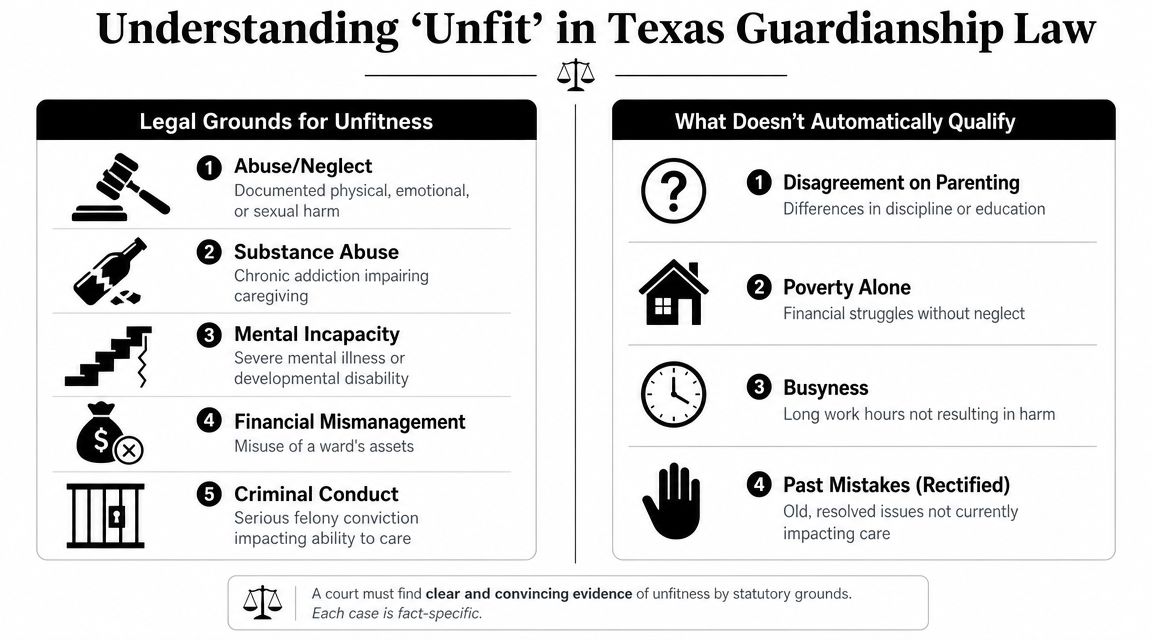
“Unfit” sounds broad, but Texas courts don't use it as a catchall insult. In practice, the focus is whether the guardian has breached fiduciary duties, failed to follow court orders, neglected the ward, abused authority, or mishandled the ward's person or estate under Title 3, Subtitle G of the Texas Estates Code. Removal issues are commonly addressed through the court's power to supervise, limit, modify, or remove a guardian when the ward's interests require it.
Conduct that can support removal
A guardian may be legally unfit if the evidence shows conduct like this:
| Problem | Why it matters in court |
|---|---|
| Using the ward's funds for personal expenses | This can show self-dealing and breach of fiduciary duty |
| Ignoring basic care needs | This can show neglect of the ward's health, safety, or welfare |
| Acting outside the powers granted by the court | A guardian only has the authority the court actually gave |
| Failing to file required reports or accountings | Guardians must stay in compliance with reporting duties |
| Abusive conduct | Physical, emotional, or financial abuse can justify court intervention |
A good way to think about it is this. Bad judgment is not always legal unfitness. Breach of duty is.
For example, if a guardian uses the ward's income to make the guardian's own car payment, that is the kind of conduct that can support removal. If the guardian chooses a different care facility than the family would have chosen, but the facility is appropriate and the ward is being cared for, that may not be enough.
What usually does not work
Many removal requests fail because the complaint stays too general.
These are weak starting points unless tied to real harm or a concrete legal violation:
- “She doesn't listen to us.”
- “He's rude and secretive.”
- “I would do a better job.”
- “Our family disagrees with the plan.”
The court isn't choosing the most agreeable relative. It is deciding whether the current guardian can lawfully and safely continue.
For a closer look at examples of conduct that can trigger court scrutiny, review this discussion of guardian misconduct in Texas.
The stronger claim is usually the narrower one. Judges respond better to “the guardian failed to file required reports and used ward funds for personal expenses” than to “the guardian is terrible.”
Keep the statute in mind
When families prepare for a removal request, they should also review the original guardianship order and the sections of the Estates Code governing guardianship duties, reporting, and court supervision. That includes the provisions in Title 3, Subtitle G dealing with guardians of the person, guardians of the estate, annual reporting, and removal-related procedure.
The legal question is concrete. Did the guardian fail the ward in a way the court can recognize and remedy?
Gathering the Proof: Evidence That Convinces a Texas Court
A removal case is usually won or lost before the hearing starts. Families often come in with a strong sense that something is wrong. What persuades the probate court is a record that ties those concerns to specific duties the guardian failed to perform.
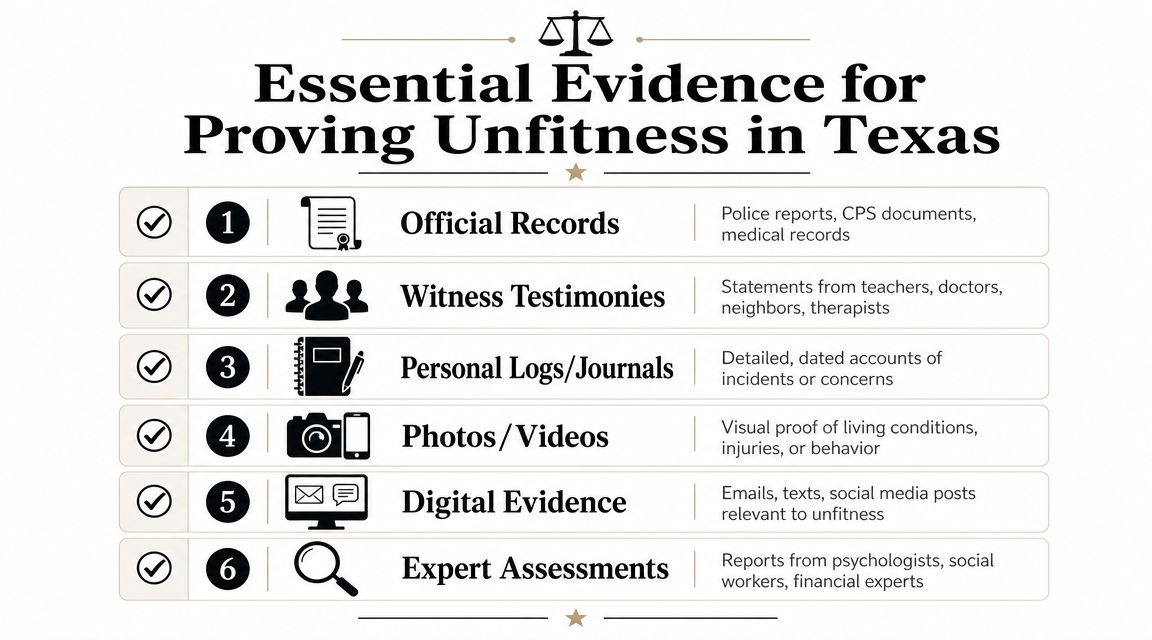
According to ElderLawAnswers on how courts decide a guardian is unfit, courts tend to focus on records that can be checked and compared over time, such as court orders, bank records, receipts, communications, photographs, medical records, and proof that required reports were not filed.
The evidence judges tend to trust
Start with the papers that created the guardianship. The order appointing the guardian, the letters of guardianship, and any later orders define the guardian's authority and limits. Without those documents, it is harder to show whether the problem is poor judgment, a direct violation of the court's order, or a failure to perform a required duty.
Then build a file that matches the kind of guardianship involved.
- Court records: the appointment order, letters of guardianship, annual reports, accountings, compliance notices, and docket entries
- Financial documents: bank statements, withdrawals, receipts, unpaid bills, benefit records, and transfers that do not appear to benefit the ward
- Medical and care records: treatment notes, discharge papers, medication lists, appointment history, and care plans
- Living-condition proof: dated photographs, videos, inspection notices, repair requests, or reports showing unsafe or unsanitary conditions
- Communications: text messages, emails, letters, voicemail messages, and written instructions that show neglect, concealment, or refusal to act
- Witness testimony: facility staff, caregivers, neighbors, relatives, social workers, or other people with firsthand knowledge
The right evidence depends on the job the guardian was appointed to do. If the case involves a guardian of the estate, follow the money. If it involves a guardian of the person, focus on care, safety, medical decisions, placement, and day-to-day supervision. Some of the strongest cases show problems in both areas.
For a more specific discussion of the proof courts look for, see guardianship contests in Texas and what evidence matters.
Here is a helpful video introduction to the broader issue:
What to do before you file anything
Evidence has to be useful and lawfully obtained. A concerned relative can damage a good case by logging into accounts without permission, taking original records, or disrupting care in an effort to prove neglect. Judges notice that.
A better approach is disciplined and boring. That is often what makes it credible.
- Create a timeline. List each incident by date, identify who was involved, and note what document or witness supports it.
- Request records through proper channels. Ask what can be released to an interested person, what requires consent, and what may need a subpoena or court order.
- Preserve original material. Save screenshots, emails, photographs, and voicemails in a way that keeps the date and source intact.
- Check for missed filings. Late or missing annual reports and accountings can matter because they show noncompliance with court supervision.
- Identify neutral witnesses early. A nurse, caseworker, banker, or facility employee often carries more weight than a relative involved in a family dispute.
Firsthand proof usually beats family commentary. If a witness did not personally see the condition, hear the statement, or review the record, the testimony may have limited value.
The proof checklist families often miss
The most persuasive pattern is often repetition. One missed doctor visit may be explainable. Six months of missed follow-up care, unpaid facility bills, unexplained withdrawals, and ignored court deadlines tell a much clearer story.
That trade-off matters. Families sometimes want to include every grievance because the situation feels personal and urgent. In court, a narrower file built around documented neglect, financial misuse, unsafe living conditions, or reporting failures is usually stronger than a longer file filled with anger and suspicion.
Law Office of Bryan Fagan, PLLC handles Texas guardianship disputes, including evidence review, probate filings, and hearings involving fiduciary misconduct and compliance failures.
Filing the Motion and Navigating the Court Process
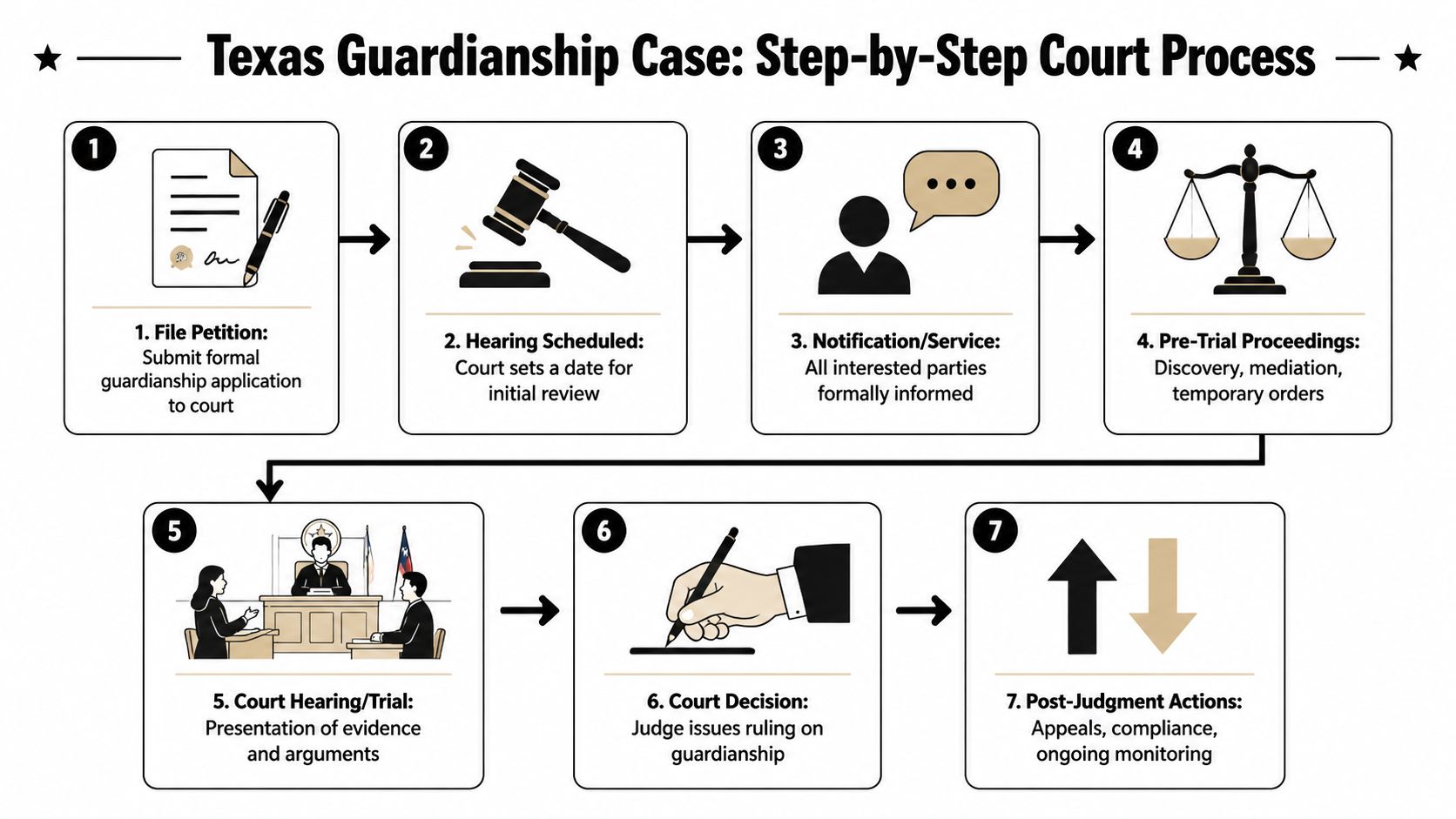
Once the record is strong enough, the next step is formal court action in the probate court handling the guardianship. In places like Harris County Probate Court or Dallas County probate courts, that usually means filing a motion or petition that asks the judge to remove the guardian, modify the guardianship, or enter temporary protective orders if immediate risk exists.
What the filing needs to say
The petition should do more than accuse. It should connect facts to legal grounds and ask for specific relief.
A solid filing often includes:
- The relationship to the ward: why you have standing to bring the issue to the court
- The core allegations: what the guardian did or failed to do
- The supporting facts: dates, records, witnesses, and missed duties
- The requested remedy: removal, limitation of powers, emergency protection, new guardian, or other relief
- The best-interest explanation: why the requested change protects the ward
Texas-focused guidance stresses that courts look for concrete evidence such as police reports, medical records, witness statements, correspondence, recordings, and proof of unsafe or unstable conditions, not just allegations or hearsay. That same guidance also notes a timing issue families often miss. In modification disputes, the court may focus only on conduct occurring after the most recent order, as discussed in this overview of proving unfitness in Texas proceedings.
What happens after filing
After filing, the guardian must be served. A hearing is set. The court may appoint an investigator or another court-appointed professional if the allegations appear credible and the judge wants an independent review.
The process often unfolds like this:
| Stage | What it usually involves |
|---|---|
| Filing | Petition or motion submitted to the probate court |
| Service | Guardian and required parties receive legal notice |
| Temporary issues | Requests for urgent protection if the ward faces immediate harm |
| Investigation | Court may seek additional facts through appointed professionals |
| Hearing or trial | Evidence, witness testimony, and legal argument |
| Ruling | Court keeps, limits, modifies, or removes the guardian |
You can read more about that procedure in this guide to removing a guardian in Texas.
If the ward is in immediate danger, waiting to “see if things improve” can backfire. Emergency relief may be available, but it still requires proof.
Alternatives the court may consider
Not every case ends in complete removal. The court may decide a less restrictive fix works better, especially if the problem can be corrected quickly.
Possible alternatives include:
- ordering compliance with overdue reports
- limiting the guardian's powers
- requiring more court supervision
- appointing a different person for the estate or the person
- terminating the guardianship if it is no longer needed
Families should be ready for that range of outcomes from the start.
Presenting Your Case and Preparing for Possible Outcomes
By the time the hearing arrives, the work should already be done. Court is where you present the file clearly and tie every exhibit and witness back to one point: the current arrangement no longer protects the ward.
How a persuasive hearing usually looks
Good presentation matters. A judge should be able to follow the story without guessing.
That usually means:
- A clean timeline: when the trouble started and what happened next
- Focused witnesses: people with direct knowledge, not a parade of angry relatives
- Organized exhibits: financial records, care records, photos, messages, and court filings in a logical order
- Clear requests: exactly what you want the court to do by the end of the hearing
Some witnesses explain care failures. Others explain money. Sometimes a family member starts the case, but a doctor, facility worker, bookkeeper, or neutral observer gives the testimony that carries the most weight.
The court usually wants a better plan, not just criticism
Many challengers often stumble. It's not enough to prove the guardian has problems. The court often expects a comparative best-interest showing.
According to this discussion of proving a custodian or guardian is unfit and seeking custody or transfer, the recommended approach is to present evidence that the current custodian is presently unfit and that transfer or termination is in the ward's best interests. The practical benchmark is ongoing, documented misconduct or incapacity plus a safer, more stable alternative placement.
That means you should be prepared to answer practical questions such as:
- Where will the ward live?
- Who will manage medications and appointments?
- Who can handle money responsibly?
- Is the proposed successor willing and qualified?
- Is there a less restrictive alternative to full guardianship?
Courts are more willing to remove a guardian when the challenger brings both proof of danger and a workable care plan.
Possible outcomes after the hearing
A Texas probate judge has options. The result may be narrower or broader than what either side requested.
The court may:
- Deny the request if the evidence doesn't meet the burden.
- Order corrective action if the guardian can remain in place under stricter oversight.
- Limit authority by reducing the guardian's powers.
- Remove the guardian and appoint a successor.
- Terminate the guardianship if it is no longer necessary and the ward's rights should be restored.
That range can be frustrating, but it reflects the court's core job. The judge is trying to protect the ward with the least disruption consistent with safety and lawful care.
Protecting Your Loved One: Your Next Steps
These cases are emotionally draining because they combine family history, court procedure, money, and urgent concern for someone who may not be able to protect themselves. Still, the path forward is clearer than many families expect.
In Texas, the issue is decided by the probate court through evidence, not by the complainant alone. As noted in Texas practitioner guidance on contested guardianships, the challenger must present documentary evidence and witnesses to show that the guardian is unfit or that the guardianship should change, and the court then decides whether the guardian should continue or whether someone new should be appointed.
What to do now
If you're worried about a current guardian, start with careful documentation and a realistic legal review.
- Review the existing order: learn what authority the guardian has
- Preserve records: gather photos, account statements, care records, and messages
- Focus on recent conduct: courts often care most about current, provable problems
- Think ahead: identify a safe alternative, whether that is a successor guardian or another lawful arrangement
- Consider related planning: disputes often overlap with Guardianship, Probate, and Estate Planning
If your loved one is facing immediate harm, don't wait for the situation to become undeniable. The court can only act on what is properly presented.
If you need help evaluating a guardian's conduct, gathering proof, or filing in a Texas probate court, schedule a free consultation with Law Office of Bryan Fagan, PLLC. We help families across Texas understand their options, prepare evidence, and pursue practical solutions to protect vulnerable loved ones.