Yes, a Texas guardian can consent to or refuse a DNR for the ward, but only within Texas Health and Safety Code Chapter 166 and the guardian's statutory authority. That authority is real, but it isn't unlimited, and the paperwork has to match the law.
A family usually reaches this question in a hospital room, not in a law office. One day you're trying to understand a stroke, a traumatic brain injury, or a sudden decline, and the next day the medical team is asking whether your loved one should have a Do Not Resuscitate order. That question carries grief, urgency, and fear all at once, especially when you're already serving as guardian or are trying to figure out whether guardianship is even the right tool.
When a Family Faces the DNR Question
The first thing most families want is a straight answer. In Texas, the answer is yes, a guardian can consent to or refuse a DNR for a ward, but only inside the framework set by Texas Health and Safety Code Chapter 166, the guardian's court authority, and the form rules that control whether the order is valid.
A common example is an adult child who was appointed guardian of a parent after dementia or a serious stroke. The hospital wants to know whether CPR should be attempted if the parent's heart stops, and the child is trying to balance medical advice, the parent's past wishes, and the pressure of making a decision that feels permanent.
What makes this different from an ordinary medical choice
A DNR is not the same as deciding whether to give a medication or schedule a test. It is a decision about whether emergency staff or hospital clinicians should start CPR and related resuscitation measures, which is why Texas treats it as a formal legal and medical act under Chapter 166 and the DSHS form rules. Texas law also separates out-of-hospital DNRs from facility-based DNR decisions, so the setting matters as much as the document itself. The step-by-step court process for establishing a guardianship becomes important when there is no clear authority yet, or when the family needs the court to define the guardian's role before a serious medical decision is made.
Practical rule: if the guardianship order, the DNR form, and the patient's own prior wishes all point in the same direction, the decision is usually much easier to carry out.
Families also need to know that advance directives can change the result. Under Texas law, if a DNR conflicts with a later valid treatment decision or advance directive, the later-in-time document controls. That means the legal answer may turn on dates, signatures, capacity, and whether the ward had already expressed a different wish before the guardian entered the picture.
Understanding the Types of Texas Guardianships
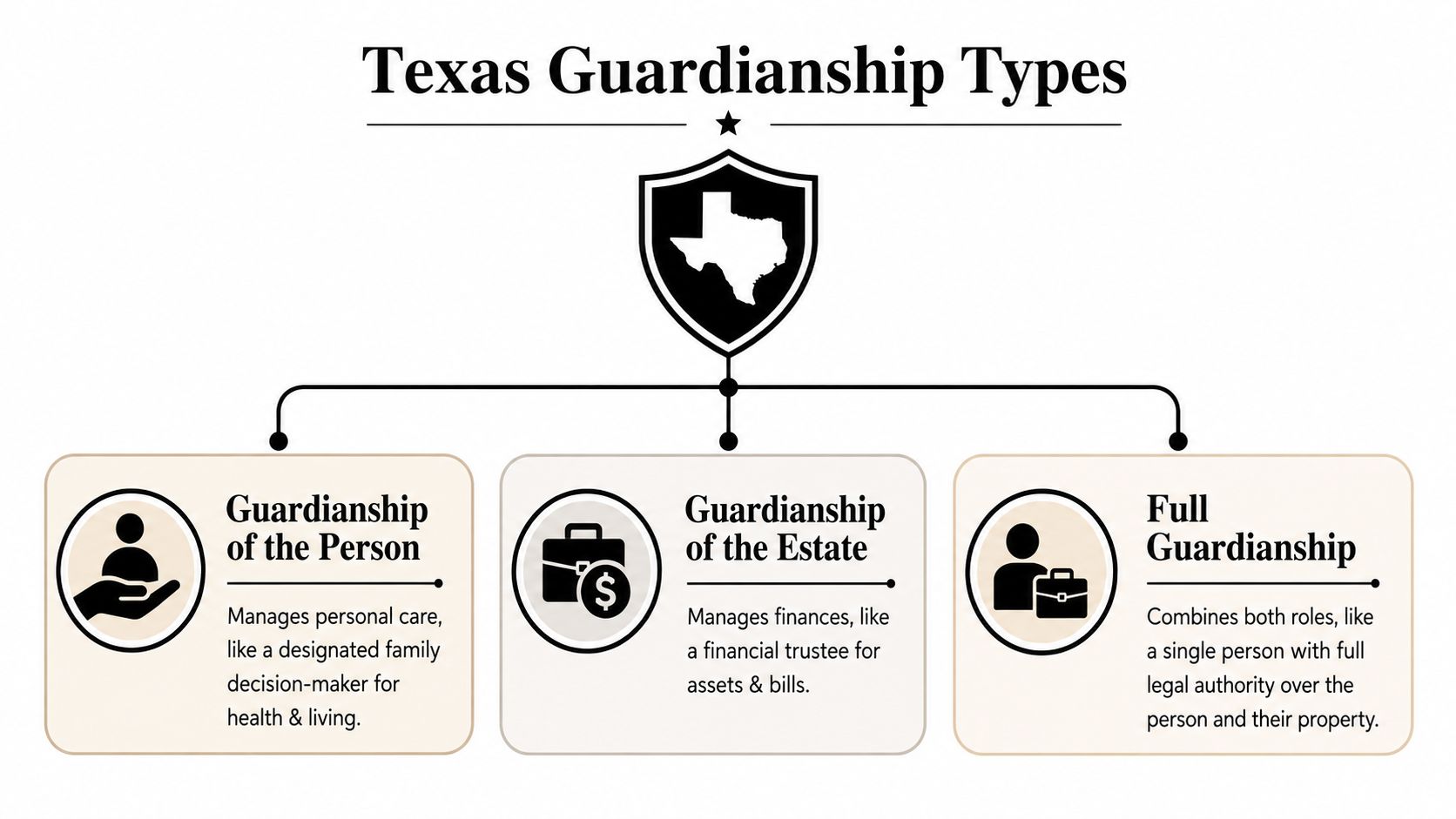
Texas guardianship law starts with a basic split. Guardianship of the person covers personal and medical decisions, while guardianship of the estate covers money, property, and bills. A full guardianship combines both, but courts still expect the guardian to stay inside the limits of the order and the Estates Code.
Think of it this way. The guardian of the person is the personal-care captain, the one who helps decide where the ward lives, what care the ward receives, and how medical decisions are handled. The guardian of the estate is the financial steward, responsible for assets, accounts, and the paperwork that protects the ward's property.
Why the type of guardianship matters for a DNR
A DNR question almost always sits on the medical side, so the guardian of the person is usually the decision-maker whose authority matters most. That lines up with the Texas Supreme Court's minimum standards, which require the guardian to let the ward exercise decision-making to the greatest extent possible, use the same information the ward would have received if competent, and make a good-faith effort to follow the ward's known preferences unless that would harm the ward. Those duties are part of the larger framework in Texas Estates Code Title 3, Subtitle G, which is where Texas sets out guardianship rules, powers, and oversight.
Temporary or emergency guardianships can matter too. If a ward is in crisis and the court has only given short-term authority, the guardian may need to move quickly on a DNR issue before the case turns into a full guardianship. The legal point is simple, even if the family situation is not. The scope of the guardianship order controls the scope of the decision.
The court order matters as much as the family relationship. A spouse may feel closest to the ward, but the guardian named by the court is the person with legal authority unless a statute or a later valid directive says otherwise.
For families still working through the setup, the guardianship hearing, the supporting medical evidence, and the exact wording of the order can all affect what happens later in the hospital. That's why Texas families often need the guardianship case to be drafted with medical decision-making in mind, not just financial control.
Texas Law on Guardians and DNR Orders
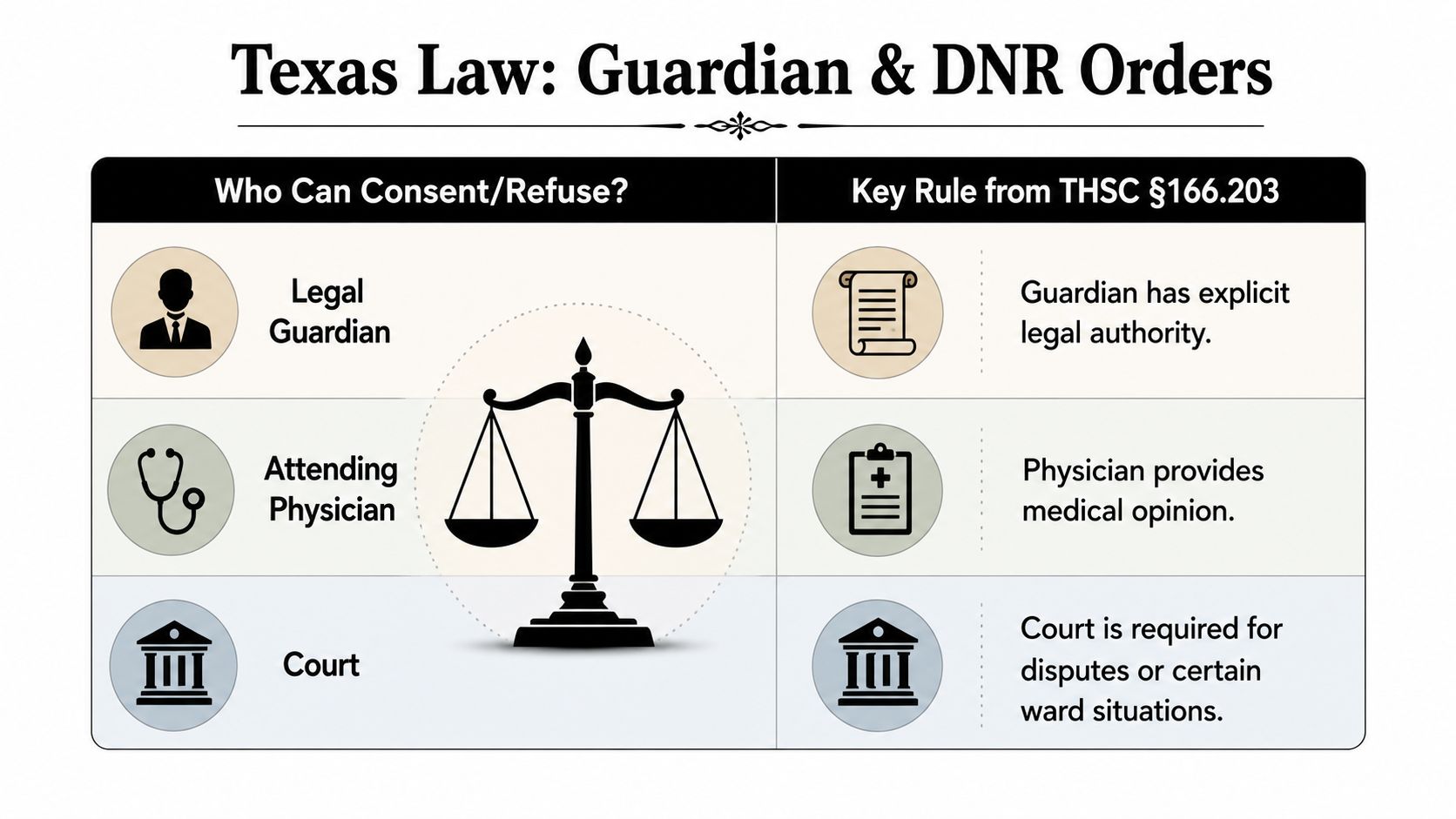
Texas Health and Safety Code Section 166.203 is the starting point because it recognizes a valid DNR based on directions from a patient's legal guardian, a medical power of attorney agent, or a designated proxy. That same statutory framework is why a guardian's authority is meaningful, but not boundless.
For an out-of-hospital DNR, the Texas DSHS form says the order becomes effective when executed and stays in effect until death or revocation. The form also requires two competent adult witnesses, and when an adult is incompetent or otherwise unable to communicate, the guardian may sign in Section B. If there is no guardian, agent, or proxy, a qualified relative may sign instead, which shows how carefully Texas layers decision-making authority. The form and the statute are built around formal execution, not informal family consensus.
In-hospital and out-of-hospital are not the same
Texas law treats the two settings differently. An out-of-hospital DNR is the form emergency personnel can honor outside the hospital, while in-hospital DNR decisions are handled inside the facility as physician orders, with legal decision-maker involvement and clinician sign-off. That distinction is why families sometimes feel the rules are inconsistent, even though the law is really just treating different settings in different ways.
The DSHS form and Texas surrogate rules also show who steps in if there is no guardian. TexasLawHelp explains that, when a patient cannot communicate, decision-makers are considered in a priority order that includes a spouse, adult children, parents, a previously designated decision-maker, and then the nearest living relative or clergy, with a probate judge resolving disagreements. That priority structure matters when a family assumes “next of kin” automatically means “decision-maker.” It doesn't.
Practical rule: a guardian can authorize or refuse a DNR only if the order is properly signed, dated, and consistent with Chapter 166. A later valid advance directive can override an earlier DNR choice.
Texas formalized part of this structure through legislation that became effective January 15, 2018, after lawmakers noted that earlier Texas law was silent on hospital DNR authorization and revocation requirements. For a plain-English overview of how the legal pieces fit together, see this internal resource on guardianship and medical decision authority in Texas. The big takeaway is that a guardian's authority is real, but it still lives inside a rule-based system.
Getting Court Approval When It Is Required
Not every DNR question needs a judge, but the disputed ones often do. If the family disagrees, if the physician won't sign, or if the decision affects life-sustaining treatment in a contested way, the probate court may need to define the guardian's authority before anyone acts. Under Texas Estates Code Title 3, Subtitle G, that court oversight is part of the protection the law builds into guardianship.
A guardian usually does not need a separate court order for a routine in-hospital DNR when the attending physician and legally authorized decision-maker are on the same page. The hard cases are different. If one family member wants treatment continued and another wants a DNR, or if the medical team thinks the guardian is acting outside the ward's known wishes, the court can become the place where the conflict gets sorted out.
A simple court path families can follow
The process usually starts with an application in the probate court, such as Harris County Probate Court or another county court in Dallas, Travis, Bexar, or a smaller Texas county. The filing should explain the guardianship, the medical issue, the ward's condition, and the exact authority the guardian is asking for. A capacity evaluation may be needed, and interested parties should be notified so they can object or support the request.
A short sample of petition language might read: “Petitioner requests authority to consent to or refuse a Do Not Resuscitate order on behalf of the Ward pursuant to Texas Health and Safety Code Chapter 166 and Texas Estates Code Title 3, Subtitle G.” That kind of language keeps the request focused and gives the judge a clean issue to decide.
For families trying to understand what may happen to other obligations tied to a death, such as debts and estate administration, this overview on what happens to debt when you die can help frame the broader planning picture. And if the court case needs to go beyond the original guardianship order, the issue may overlap with requests like expanding guardian authority in Texas.
What judges usually want to see
The hearing is often about evidence, not emotion alone. Judges want the ward's prior wishes, medical facts, the current prognosis, and proof that the guardian is acting in good faith rather than under pressure from family conflict. If the ward has any remaining ability to communicate, the court may want that voice heard too.
How DNRs Interact With Advance Directives and Medical Power of Attorney
Texas families often keep three documents in the same mental drawer, even though they do different jobs. A medical power of attorney names the decision-maker. An advance directive states treatment wishes. A DNR is the specific order about CPR and resuscitation.
That separation matters when a ward becomes incapacitated. If the ward signed a valid advance directive before losing capacity, the guardian generally should not try to erase it just because the guardian disagrees with the choice. Texas law gives weight to the ward's own later valid choices, and the guardian's role is to carry out substituted decision-making, not replace the ward's voice with a personal preference.
How the documents work together
If a valid medical power of attorney exists, the named agent often steps in first for healthcare decisions. If there is no agent, or the agent is unavailable, the guardian may become the practical decision-maker under the guardianship order and Chapter 166. If the ward is still capable, the ward's own decision controls, which is why capacity is always the first question.
The safest way to think about it is this. The medical power of attorney identifies who speaks, the advance directive explains what the ward wanted, and the DNR carries that choice into a resuscitation setting. When those documents match, the hospital usually has a much easier time following them. For related planning, families often review Texas medical power of attorney alongside the DNR paperwork so the legal authority and the treatment wishes line up.
If the papers conflict, dates matter. The later valid document usually carries more legal weight under Chapter 166.
A guardian may challenge an old directive only in limited circumstances, such as when there is strong evidence it no longer reflects the ward's wishes or would harm the ward if followed. That is a high bar, and for good reason. Texas law tries to protect the ward's autonomy even after incapacity sets in.
Real Scenarios Families Encounter
One family comes to the hospital with an elderly ward who has advanced dementia, no prior advance directive, and a guardian of the person already appointed by the probate court. The attending physician explains that CPR would likely be traumatic and ineffective, and the guardian agrees that comfort-focused care makes sense. In that setting, the legal path is usually straightforward, because the guardian, the physician, and the ward's overall care plan all point the same way.
Before discharge to hospice, the guardian may also sign the Texas out-of-hospital DNR form in Section B, with two competent adult witnesses as required by the form. That lets emergency personnel know what to do if they are called later, and it helps the family avoid confusion at a stressful moment.
The second scenario is messier. A young adult ward has a severe traumatic brain injury, one parent is the legal guardian, and the other parent is not. The non-guardian parent wants full intervention, while the guardian believes a DNR reflects the ward's best interests and prior wishes.
In that kind of dispute, the hospital ethics team may get involved first, because clinicians usually try to calm the conflict before it becomes a court fight. If the disagreement remains unresolved, the probate court may need to decide whether the guardian is acting within the order and within the ward's known wishes.
A hospital room often becomes the place where legal authority and family emotion collide. A clear guardianship order, clean medical records, and a well-drafted DNR can keep that collision from turning into a crisis.

Common Questions About Guardian DNR Authority
Can a guardian refuse a DNR that the ward's family wants? Usually, the guardian's job is to follow the ward's wishes and best interests, not the preferences of other relatives. If the ward already executed a valid directive that points the other way, the guardian should not ignore it. The safer move is to ask the probate court for guidance.
Can a guardian revoke an existing DNR? Texas guidance says that once a patient loses capacity, a guardian or medical power of attorney agent may request discontinuation of an in-hospital DNR, subject to physician judgment and the governing rules. If the patient can still express a revocation to care staff, that revocation is effective under the statute.
What about a minor ward? Texas law allows parents, legal guardians, or managing conservators to authorize out-of-hospital DNR orders for minors. The details can still get complicated when parents disagree or when the child's medical condition makes the stakes unusually high.
What if the ward regains capacity? The guardian's authority to make medical decisions drops away as to that issue, because the ward regains the right to make or revoke the decision personally. That is one reason Texas families should keep reviewing paperwork instead of assuming the first decision will last forever.
Practical rule: keep the guardianship order, the medical power of attorney, and the DNR together in one accessible file. When the documents are scattered, mistakes happen fast.
How the Law Office of Bryan Fagan Can Help Your Family
A Texas guardian can consent to or refuse a DNR for the ward, but the answer always depends on the guardianship order, the setting, and the ward's prior wishes. Families do not need to sort that out alone. The Law Office of Bryan Fagan, PLLC handles guardianship applications, emergency or temporary guardianships, advance directive planning, and contested probate court matters for Texas families who need clear next steps.
If you're unsure whether your authority covers a DNR decision, or whether the court needs to approve the plan first, a short consultation can help you avoid a costly mistake. The firm works with families in Houston, Dallas, Austin, San Antonio, and statewide through virtual consultations.
If you're facing a DNR decision for a ward, the Law Office of Bryan Fagan, PLLC can help you review the guardianship order, the medical documents, and the court options before you sign anything. Visit Law Office of Bryan Fagan, PLLC to schedule a free consultation and get guidance suited to your family's situation.