Skip to content
In Texas, a minor's guardianship ends automatically at 18, because 18 is the legal age of majority. After that birthday, parents lose automatic decision-making authority unless they put a new adult guardianship or another legal arrangement in place before the cutoff.
A lot of families don't feel ready for that change. The child may still need help with doctors, school records, housing, money, or daily decisions, and the birthday can feel less like a celebration and more like a deadline.
The 18th Birthday Changes Everything for Texas Families
One family may be counting down to a sweet 18th birthday party while worrying about what happens the next morning. Maybe their child has lived under a court guardianship after a parent died, after an injury settlement, or because of a disability that made adult decisions too hard to handle alone. Then midnight comes, and the law treats that child differently.
Texas draws a hard line at age 18. At that point, the young person is no longer treated as a minor under the law, and the guardianship tied to minority ordinarily ends. Texas education guidance says that, at 18, “all rights are transferred” to the student unless guardianship has already been granted, and schools must send written notice of that transfer when the student turns 18. That means the parent or guardian no longer has automatic authority over medical, educational, housing, or financial decisions.
What changes in daily life
A parent who could sign consent forms yesterday may not be able to sign them today. A guardian who handled bank deposits or property for a minor can't keep doing that just because the family still needs the help. If continued control is necessary after 18, Texas requires a separate legal basis, usually adult guardianship or another valid substitute.
A birthday does not extend a court order. If the young adult still needs protection, the family has to create a new legal tool before the old one ends.
Families often ask if the court will “convert” the minor guardianship into an adult one automatically. It won't. The law changes the status at the birthday itself, and the family has to respond with the right filing or alternative plan.
For a plain-language overview of the difference between a child needing a guardian and custody concepts, see Guardianship of a Minor in Texas. For a related discussion of timing, the page on when guardianship ends helps families track the transition point.
How Texas Law Ends a Minor Guardianship Automatically
Texas treats the 18th birthday as the legal cutoff, not a suggestion. In the Texas Estates Code framework, guardianship proceedings fall under Title 3, Subtitle G, and the authority tied to a minor's status ends when the person reaches majority. There is no need for a separate cancellation hearing just to make the minor guardianship stop.
That's the part many families miss. The court does not need to issue a fresh order saying, “this guardianship is over,” because the legal authority ends by operation of law. The former minor becomes an adult, and the old minor guardianship no longer fits.
Person and estate both stop at adulthood
Guardianship of the person covers daily care, living arrangements, and medical decisions. Guardianship of the estate covers money, property, and settlement funds. When the ward turns 18, both kinds of minor guardianship end because the legal basis was minority, not a long-term adult incapacity finding.
That's why Texas guidance for people with disabilities says a minor guardianship generally terminates automatically at age 18, and a new adult guardianship must be established if the family still needs legal authority. County probate courts, including courts in places like Harris County Probate Court, handle the filings and hearings for any adult guardianship request that follows.
The practical rule is simple. If the young adult still needs legal protection after 18, the family needs a new structure. If not, the old guardianship ends cleanly and the adult manages their own affairs.
Guardianship of a Minor in Texas is useful when families are still figuring out whether a guardianship is needed in the first place. A short educational video can also help families recognize the legal shift that happens at adulthood.
Three Paths Forward After the Ward Turns 18
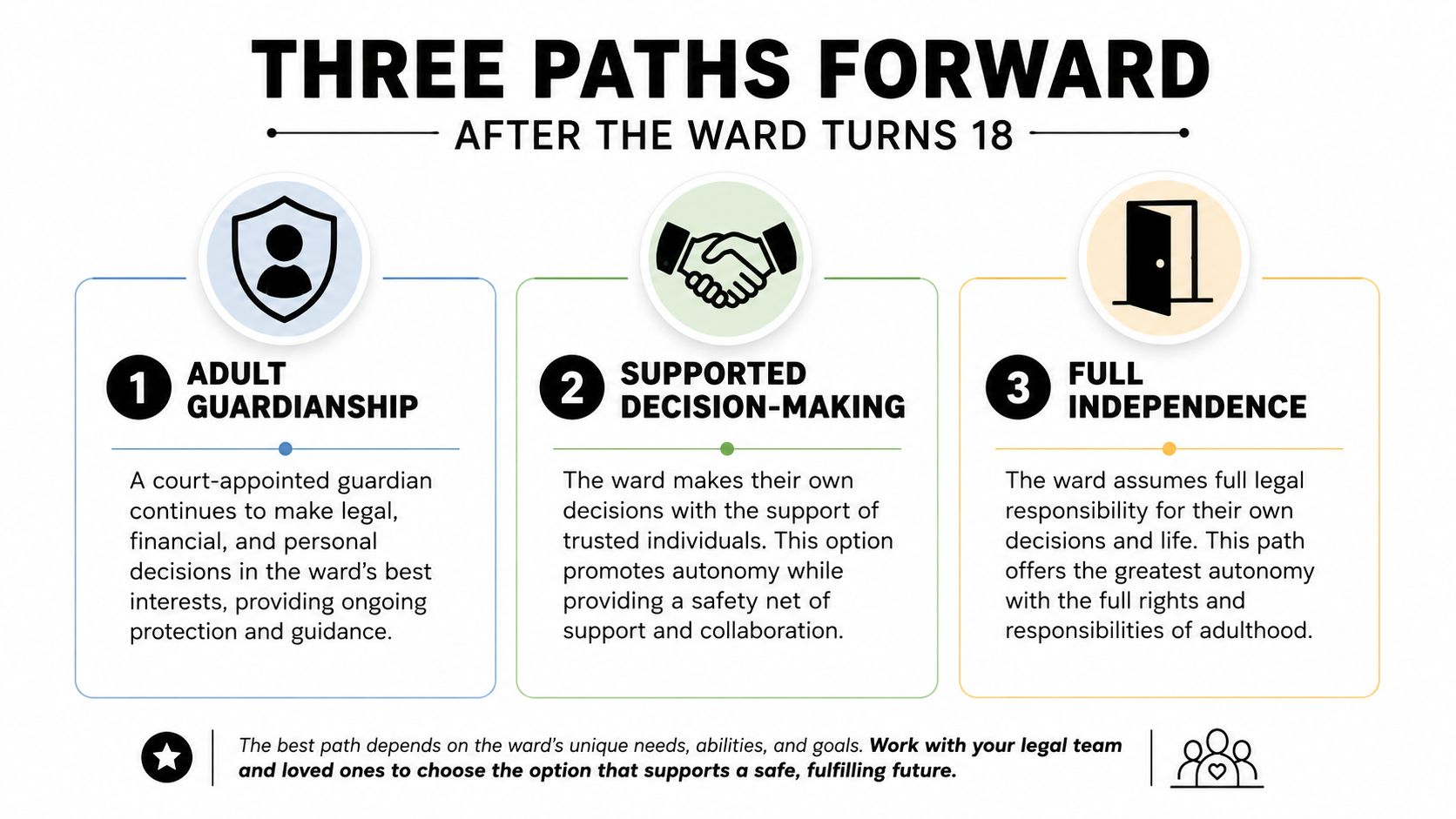
Once the old guardianship ends, families usually face one of three paths. The right choice depends on the young adult's ability to make decisions, their wishes, and whether any money or property still needs management.
Path one, adult guardianship
Adult guardianship fits when the new adult still can't manage personal, medical, or financial decisions safely. Texas families often use this route when a disability or incapacity continues past the 18th birthday and no lighter option will protect the person enough. The adult guardianship case is a new legal matter, not a continuation of the minor one.
The guidance for guardianship of an adult child with disabilities in Texas is especially relevant here because many families are trying to preserve care while respecting adult rights. If the court agrees, the new guardianship can keep decision-making authority in place after the birthday.
Path two, supported alternatives
Some families don't need a full guardianship at all. Instead, they may use supported decision-making, a medical power of attorney, a durable power of attorney, or another legal arrangement that lets the young adult keep control while still getting help. That option can be a good fit when the person can understand choices with support, even if they need guidance.
The question is not, “Does this family love the young adult enough?” The question is, “What legal tool matches the young adult's actual needs?”
Path three, clean termination
The third path is simple. If the young adult can manage life on their own, the old minor guardianship ends and nothing replaces it. That can be the right outcome when the person can handle health care, housing, school, work, and money without a court-appointed decision-maker.
Here's the practical test families can use:
- Adult guardianship: choose this when safety, medical care, or money management requires court authority.
- Supported alternatives: choose this when the young adult can decide with help, but doesn't need someone else to take over.
- Clean termination: choose this when the adult is ready for full independence.
The best answer is often the least restrictive one that still protects the person. That approach respects dignity and avoids adding court oversight where it isn't needed.
Planning Timeline and Steps Before the 18th Birthday
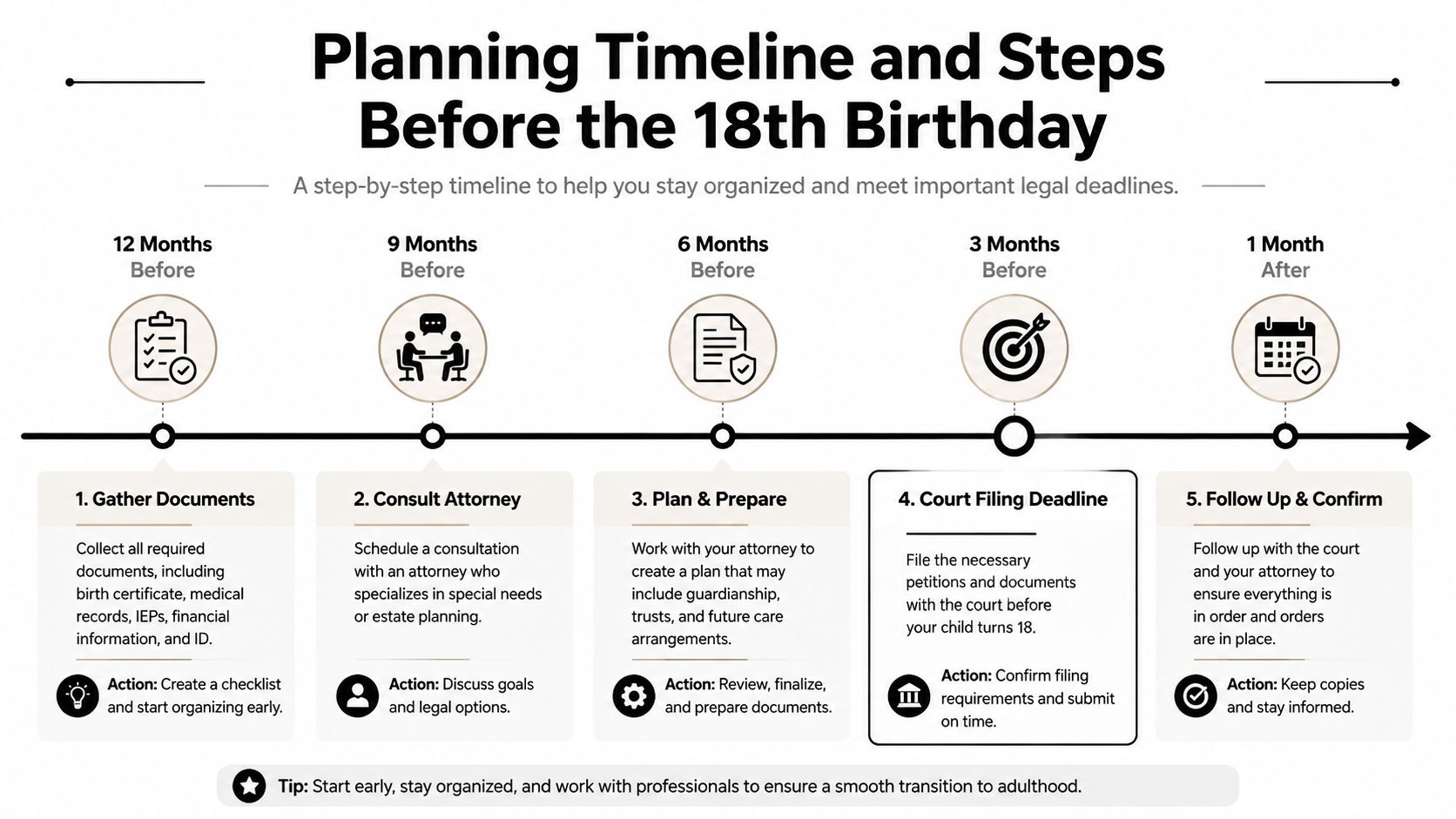
Texas families get the best results when they start early. The law builds in a warning system, especially for students with disabilities. At least one year before age 18, a student's IEP must note that parental rights will transfer to the student upon adulthood unless guardianship has been granted, and the district must notify the student and parent in writing when the student reaches 18.
That timing matters because it gives the family room to act before the legal cliff. It also helps avoid a gap where everyone assumes someone still has authority, but the law has already shifted.
What to do before the birthday
A good planning calendar usually starts with records, not court papers. Families should gather medical notes, school documents, any prior guardianship orders, and information about bank accounts or settlement funds. If adult guardianship may be needed, a physician evaluation or other capacity evidence should be discussed early so the lawyer can prepare the filing correctly.
The probate court filing usually happens in the child's county of residence. In a place like Harris County Probate Court, the process still involves a formal petition, review of evidence, and a hearing. Texas courts don't treat a family agreement as enough by itself.
A simple planning checklist
- Twelve months out: review the IEP, court orders, and medical needs.
- Several months out: talk with counsel about adult guardianship or alternatives.
- Before filing: gather capacity records and asset information.
- Before the birthday: confirm whether written school notices and transfer planning are in place.
- After the birthday: make sure any new order, power of attorney, or support document is signed and usable.
Families who wait until the last minute often create avoidable stress. Families who plan early usually keep the transition calmer and more orderly.
Handling Settlement Funds and Estate Assets at Age 18
Minor guardianship of the estate can be the part families forget until the birthday is already here. That usually happens when a guardian manages injury settlement money, inherited property, or other assets for a child. Texas law requires that kind of estate guardianship to end when the ward reaches majority, and then the guardian must settle the estate and turn everything over.
That is not a casual handoff. The guardian has to account for what came in, what went out, and what remains. Texas practitioner guidance describing the Estates Code explains that the estate guardianship ends at 18, and the guardian must seek discharge rather than keep control after adulthood begins.
What the final accounting really means
The final accounting is the paper trail. It should show assets received, expenses paid, and the current balance or property status before turnover. If funds were mixed with personal money, or receipts are missing, the accounting gets harder and the court may ask for more detail.
Families can get into trouble by being informal. A parent who says, “I was just holding the money for my son,” may still need to prove every transaction to the court. The safer approach is to document everything and turn over the property promptly once the person becomes an adult.
For families comparing trust-based management with estate guardianship, Texas 1301 management trust vs guardianship of the estate is a helpful related topic. Trust planning can sometimes reduce the need for repeated court supervision, but the right structure depends on the facts.
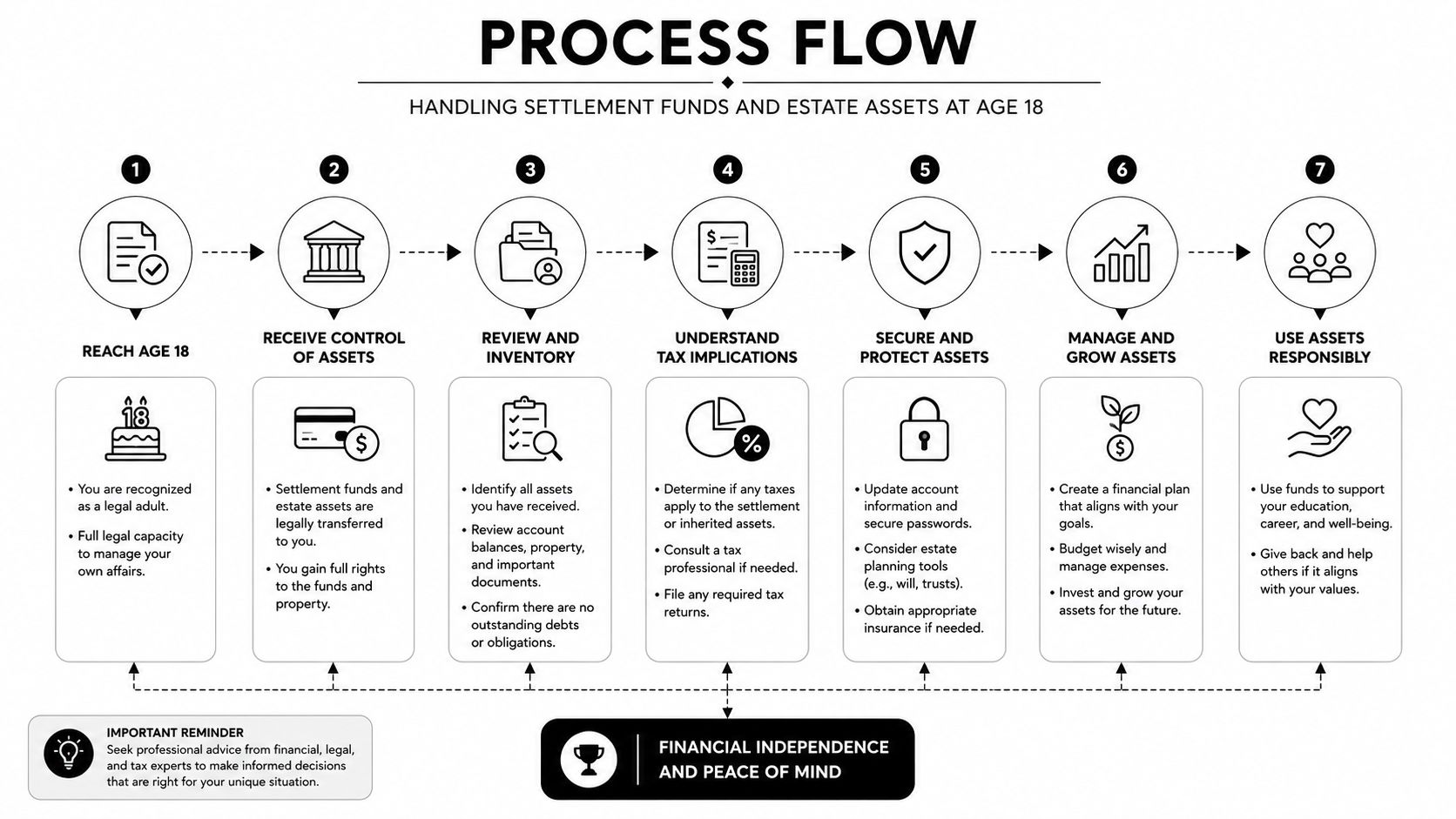
If the estate includes settlement funds, don't wait for a dispute to force the accounting. Turnover and discharge are part of the job, not an optional cleanup step.
Families often do best when they treat the estate handoff as a closing process, not a family favor. That mindset helps protect both the young adult's property and the guardian from later claims.
What Happens When Families Miss the Planning Window
One common mistake is assuming the guardianship just rolls forward after the 18th birthday. A family may get through the celebration, then discover the next morning that they can't consent to treatment, can't access school records the same way, and can't keep managing a bank account that was tied to the minor guardianship.
That's when the scramble begins. If the young adult still needs protection, the family may have to seek emergency or temporary adult guardianship while the full case is prepared. That creates pressure, paperwork, and uncertainty that could have been avoided with earlier planning.
The emotional part is real too. Parents often feel guilty, and the young adult may feel confused or embarrassed about needing court help again. In these situations, a capacity review can be part of the picture, and families sometimes find it useful to understand how assessments are handled in other legal settings, such as the overview at how capacity assessments work.
The better path is usually the quieter one. Start the review early, decide whether the adult needs guardianship or a less restrictive option, and get the paperwork ready before the birthday hits. That keeps the family from learning the rule the hard way.
When to Contact a Texas Guardianship Attorney
If the young adult has a disability, if estate assets are involved, if family members disagree, or if the 18th birthday has already passed, it's time to get legal help. Texas guardianship cases move through probate court, and the filing, evidence, and hearing requirements can be hard to handle alone.
A lawyer can also help families think through related issues, like whether a young person may qualify for benefits connected to special immigrant juvenile status eligibility or whether another planning tool fits better than guardianship. The right answer depends on the person, not just the birthday.
The Law Office of Bryan Fagan, PLLC offers guidance on guardianship, probate, estate planning, and adult-transition planning for Texas families. If you're trying to protect a child who is turning 18, don't wait until the legal cliff has already passed.
The Law Office of Bryan Fagan, PLLC helps Texas families sort out guardianship of a minor, adult guardianship, estate turnover, and other transition issues tied to age 18. If you're facing this decision, visit Law Office of Bryan Fagan, PLLC to schedule a free consultation and get clear guidance on the next step for your family.