Skip to content
Your mother has started wandering at night. Your father's dementia has reached the point where he's unsafe at home, but the family still feels torn because he can have a good conversation one hour and forget where he is the next. If you already have guardianship of the person, the next question often feels urgent and personal. Can you move your loved one into a locked memory care unit in Texas without making a mistake that causes delay, conflict, or a court problem later?
Texas treats that decision as more than a routine care choice. A locked memory care unit is usually a more restrictive placement, so Texas Estates Code Title 3, Subtitle G puts guardrails around the move to protect the ward's liberty and dignity. The law expects families to use the least restrictive environment that still keeps the person safe, which is why the court may want to see proof that home care, assisted living, or other supports won't work. For a plain-English overview of how those care settings fit together, assimilation into a memory care facility can help families understand the adjustment process itself, while the legal question stays focused on who may authorize the move.
If you're also trying to understand how a guardian's authority works more broadly, our page on Can a Guardian Put Someone in a Nursing Home in Texas? is a useful companion. The key point is simple, though the paperwork can feel anything but simple. In Texas, the move may be medically sensible and still require court-supervised steps before it can happen.
Why a Locked Memory Care Move Requires Court Involvement
A daughter in Harris County may already be paying the bills, scheduling doctor visits, and stepping in as guardian for her mother with mid-stage Alzheimer's. Then the mother starts leaving the stove on, opening the front door at 2 a.m., and getting upset when someone tries to redirect her. The family knows home is no longer safe, but the law still asks a harder question, who gets to decide on a locked placement, and what process has to happen first?
The legal reason the move is different
Texas does not treat this like a simple medical transfer. A locked memory care unit usually counts as a more restrictive care facility, so the guardian can't just make the move on personal judgment alone. Texas guardianship practice has moved toward court involvement for major placement changes, especially when the ward is going from a less restrictive setting into assisted living or memory care, as described in a Texas legal publication on guardianship relocation moving your ward.
That shift matters because it reflects the basic structure of Texas guardianship law, the guardian acts for the ward, but the court keeps oversight when liberty is being limited. Families often feel frustrated by that step, especially when the risk seems obvious. Still, the court wants a paper record showing why the locked unit is necessary and why a less restrictive option won't work.
Practical rule: the safer the placement looks to the family, the more important it becomes to document why it is legally “more restrictive.”
The philosophy behind the rule
Texas guardianship law is built around protection, not convenience. That's why the court usually wants a placement that matches the ward's actual needs without taking away more freedom than necessary. A memory care unit may be the right fit when wandering, confusion, or unsafe behaviors make an open setting unrealistic, but the guardian still has to show that the move is tied to the ward's condition.
For families in Dallas County Probate Court or a smaller county court, the concern is the same. The judge is looking for a decision that protects the ward while respecting the ward's rights. That's also why Texas lawyers often frame these cases around capacity, safety, and the least restrictive workable option, not just around family preference or caregiver burnout.
The Notice and Wait Rule Before a Locked Unit Placement
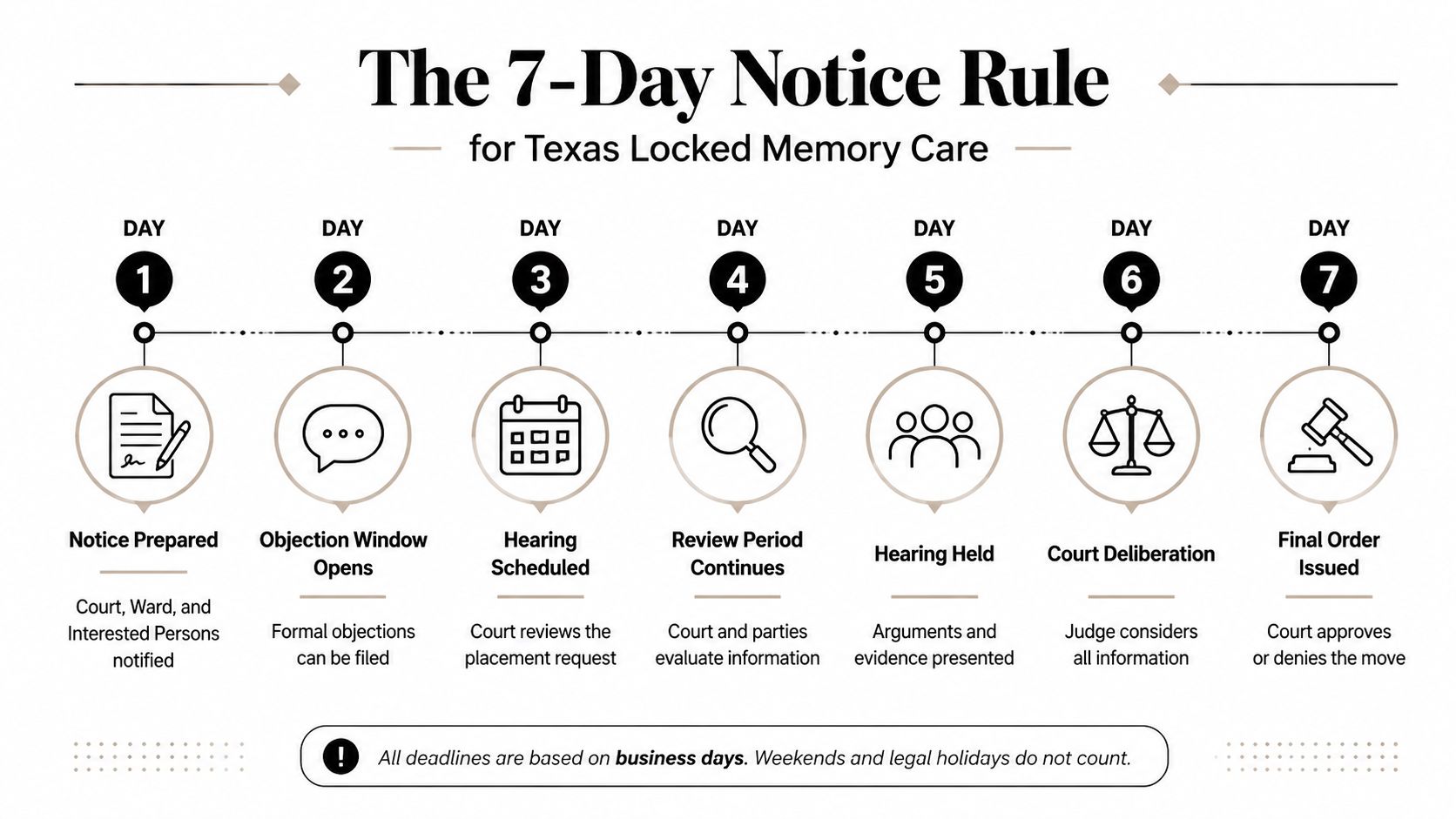
Texas has a specific notice rule that sits at the center of a locked memory care move. The guardian generally must give notice to the court, the ward, and any person who has requested notice, then wait seven business days after the court receives that notice before the placement can go forward if no one objects. That short window is easy to misunderstand, especially when the family is in a rush.
What the guardian must do first
The guardian has to file the notice with the court and serve it on the ward and any person who formally asked to receive notice. An informal text to a sibling or a verbal update at Sunday dinner does not count as statutory notice. The clock starts when the court receives the notice, not when the family thinks the process began.
That detail matters because families often assume the move can happen as soon as everyone “knows what's going on.” Under Texas guidance, that's not enough. The law is asking for a formal checkpoint before a more restrictive placement begins, especially when the ward may be unable to understand or consent to the change.
You can see the notice structure discussed in Texas guardianship materials on notice requirements for guardianship in Texas, and the placement rule itself appears in the Texas Estates Code provision addressing more restrictive care placements Texas Estates Code section 1151.051. For families working through adult incapacity generally, Guardianship of an Incapacitated Adult in Texas explains how the court establishes guardianship in the first place.
Why the waiting period matters
The seven-business-day period gives notice recipients a chance to object before the move becomes final. If no one objects during that time, the placement may proceed without a separate hearing. If someone does object before the eighth business day, the court must address the placement at a hearing.
The wait is short, but it is not optional. Families who move the ward early can create a problem that is harder to fix than the original placement request.
A lot of confusion starts here. A family may think the locked unit is already reserved and the guardian can bring the ward in that afternoon. Texas law makes the timing matter just as much as the destination.
Building the Paper Trail the Court Wants to See
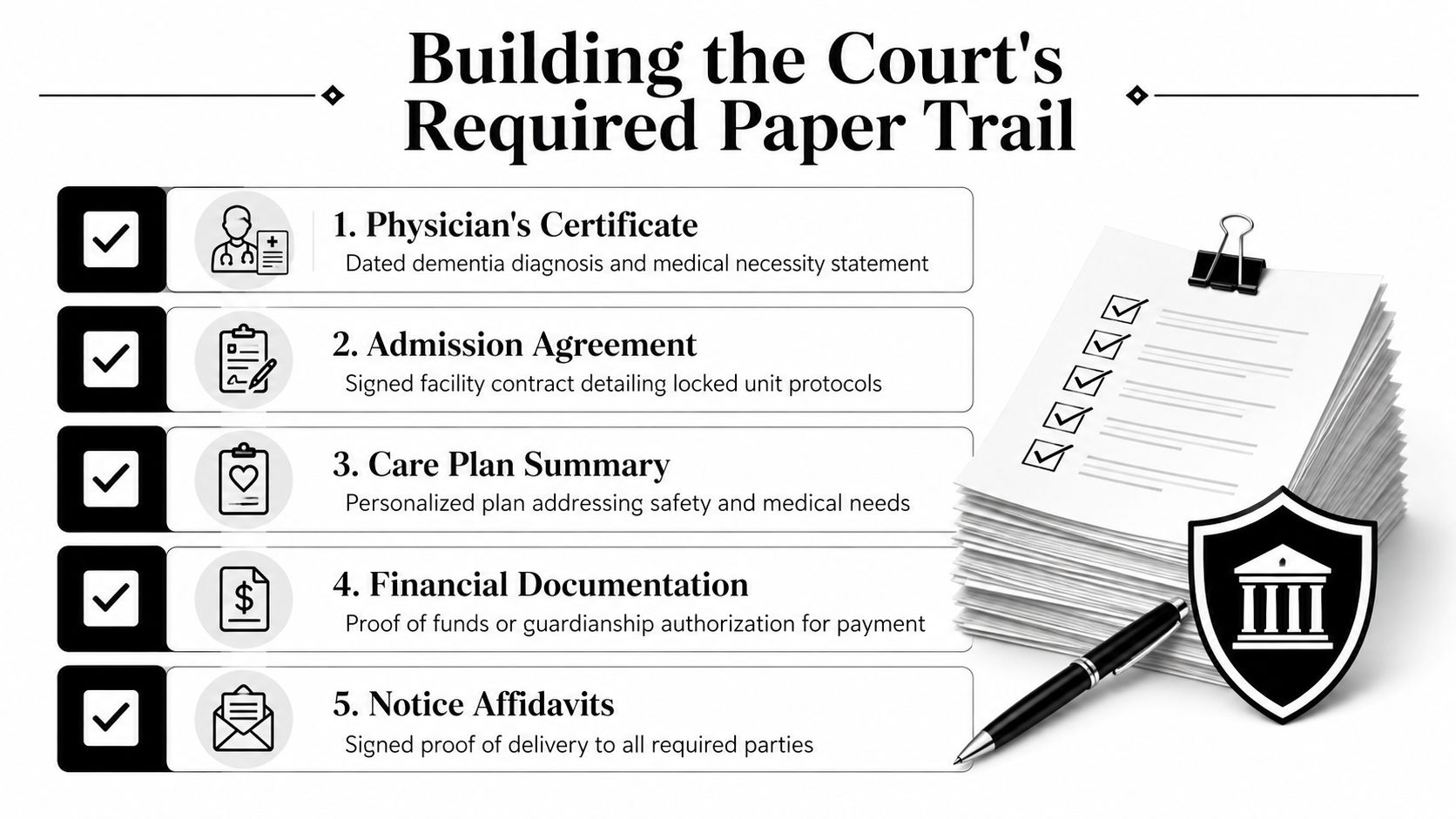
A strong request to move a ward into locked memory care usually rises or falls on the file in front of the judge. Texas probate courts want more than a diagnosis. They want to see a clear link between the ward's condition, the safety risk, and why a locked setting is the least restrictive workable option.
What belongs in the court packet
Texas families often do better when they think in terms of a safety story, not just a medical file. Physician records should describe the dementia or incapacity, but the court also wants the day-to-day facts, wandering episodes, falls, medication confusion, or unsafe behavior that show why home is no longer enough. If the ward has tried in-home care, adult day programs, or assisted living, those efforts matter because they show the family did not jump straight to a locked unit.
A detailed record also helps answer the question judges care about most, why this setting, and why now. Independent Texas commentary on memory-facility placement notes that courts usually look for a detailed incapacity record, proof of risk in the current environment, and evidence that less restrictive options have failed. That same commentary warns that a thin record is often the reason a move stalls, not a lack of family concern.
For one factual snapshot on how Texas courts establish guardianship for adults who cannot manage their affairs, the catalog page How to Get Guardianship in Texas is a useful reference point.
A simple filing checklist for families
Use the court file to answer these questions in plain language:
- What does the doctor say? The physician's records should connect the diagnosis to actual functional limits.
- What unsafe events happened? Wandering, falls, missed medication, and confusion are the facts judges can evaluate.
- What was tried first? Home care, family supervision, and other supports should be documented.
- Why isn't a less restrictive setting enough? The judge needs to see why less restrictive options failed.
- What does the proposed unit solve? The file should show how the locked setting addresses the specific danger.
The best time to gather this material is before the family emotionally commits to a move date. Once everyone has already pictured the transition, evidentiary gaps feel much more painful to fix.
What Happens When the Ward or Family Objects
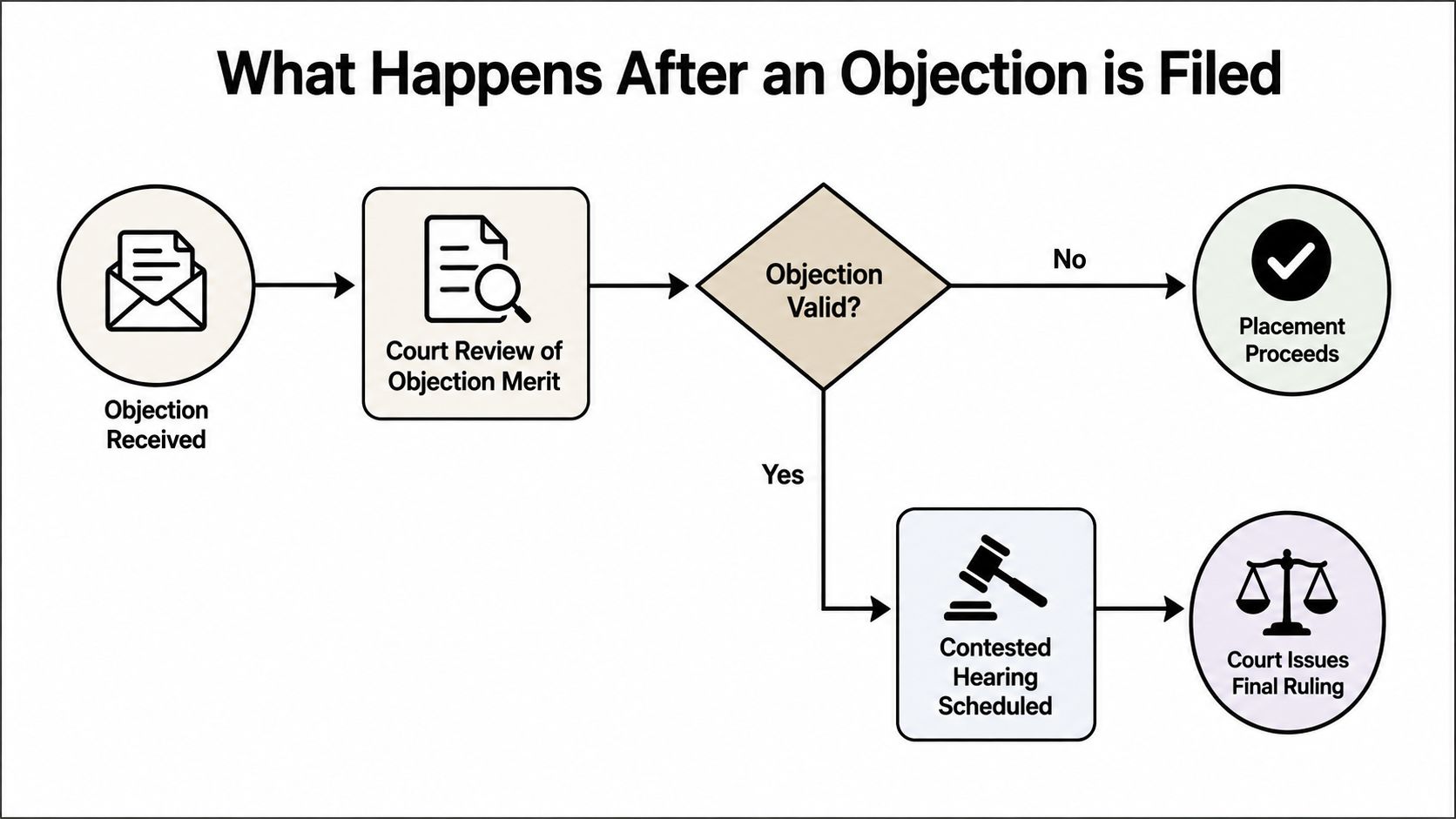
A contested placement changes the whole rhythm of the case. If the ward or a notice recipient objects before the seven-business-day window closes, Texas law pushes the issue into a hearing. In practical terms, that means the judge is no longer deciding based only on the guardian's request and supporting papers, the court has to hear the disagreement.
Who can trigger a hearing
A formal objection can come from the ward, if the ward is able to voice one, or from a person who received the statutory notice. A sibling who asked to be kept informed can matter here, because the law gives notice recipients a real chance to challenge the placement. When dementia affects the ward's ability to understand the situation, resistance can still matter, but the court will look at capacity and medical evidence rather than treating every protest as a full legal veto.
In a Harris County Probate Court hearing, the judge may ask whether the ward understands what the move means, whether the new unit is more restrictive, and whether the guardian has documented the safety risk. That framing is important. The legal issue is often not whether memory care is beneficial in the abstract, but whether the proposed unit triggers the extra safeguards because it is more restrictive.
What the court may do next
If the matter is contested, the court can appoint an attorney ad litem to speak for the ward's interests. The court may also involve a court visitor or order updated medical evidence. Those steps are meant to give the judge a fuller picture before a restrictive placement is approved.
In a contested case, the judge usually wants the least dramatic answer that still keeps the ward safe.
Families sometimes worry that a hearing means the move is doomed. It doesn't. It means the court needs more information because someone raised a legal objection. The strongest cases stay calm, stay factual, and show that the proposed placement matches the ward's real needs rather than the family's convenience.
Emergency and Temporary Placements When Safety Cannot Wait
Not every case fits the planned notice-and-wait path. Sometimes the ward is in immediate danger, or the family is facing behavior that makes waiting unsafe. In those situations, Texas law gives families other tools, but they are different tools with different consequences.
When a guardianship emergency may be the right path
A family may need to look at emergency guardianship in Texas when the ward needs immediate protection and a standard placement request would take too long. That route is about urgent decision-making authority, not a routine move into a facility. It can make sense when the current situation creates a serious safety problem and the court needs to act quickly.
Texas mental-health process materials show how quickly courts can move in true emergencies. After a magistrate finds reasonable cause, a physician's certificate must be provided within 24 hours of admission, a probable-cause hearing must occur within 72 hours, and the full mental-health hearing must happen within two weeks of detention. Those deadlines come from Texas mental-health process materials and show that the system can move fast when immediate protection is needed Texas mental-health deadlines.
Comparing the main pathways
| Pathway | Trigger | Court Deadline | Best Fit Situation |
|---|---|---|---|
| Standard guardianship placement | Need for a more restrictive care setting | Seven business day notice period | Planned move into locked memory care |
| Emergency guardianship | Immediate protection is needed | Fast court review, depending on the case | Sudden crisis where delay creates risk |
| Mental-health detention process | Immediate psychiatric safety concern | 24-hour certificate, 72-hour hearing, full hearing within two weeks | Acute psychiatric emergency, not a routine placement |
The important distinction is this, a mental-health emergency is not the same thing as a long-term memory care placement. Families sometimes try to use the emergency path because they want speed, but if the facts are really about placement planning rather than acute psychiatric detention, the case can become messy later. The safest route is the one that matches the actual problem.
Practical Landmines Families Run Into
Some of the hardest problems in these cases are procedural, not medical. A family may have a strong need for placement and still lose time because the paperwork, the county, or the facility rules don't line up.
Two separate hurdles, court approval and facility acceptance
Court approval is only one step. The receiving facility has its own admission and discharge rules, and Texas nursing-facility regulations generally allow transfer or discharge only when the resident's needs can't be met, the resident's health has improved, or safety or health would otherwise be endangered Texas administrative code on transfer and discharge. That means the facility has to be willing and able to take the person, not just the court.
Jurisdiction matters too. If the locked unit is in another county or another state, the guardianship case may need transfer or additional court attention. Families sometimes discover that the move itself is workable, but the court file needs to follow the person so the new county can supervise the case properly. That mismatch is easy to miss until the family is already packed and ready.
Why timing mistakes hurt good cases
Moving the ward before the notice window closes can create avoidable conflict. So can failing to involve the attorney ad litem or court investigator when the case turns contested. Those professionals are there to protect the ward's interests and help the court understand what's really going on, but they also need time to do their work.
A practical lesson from guardianship practice is that court approval and facility acceptance are separate questions. The guardian can be right on the law and still hit a wall if the unit won't admit the resident, if the transfer crosses county lines, or if the paper trail is incomplete. Families who plan early usually avoid the most painful surprises.
Working With a Texas Guardianship Attorney
Families often wait until the problem becomes urgent, then try to piece everything together in a hurry. That's where counsel helps most, especially when objections are likely, capacity is disputed, the ward may resist the move, or the placement crosses county or state lines. Early legal help also matters when the family needs a clean record for a future hearing or wants to avoid a preventable delay.
Texas guardianship is closely tied to deadlines, and that's true in other legal settings too. If you've ever tried to understand understanding the Texas filing window, you already know how much harm can come from missing a deadline you thought was minor. In guardianship, the same idea applies, the timing of notice, objection, and hearing can decide whether the move goes smoothly or becomes contested.
A Texas guardianship attorney can help gather physician records, prepare the notice, anticipate an objection, and coordinate with the attorney ad litem or court investigator. The Law Office of Bryan Fagan, PLLC handles guardianship, probate, and estate planning matters for Texas families, and our team can help you think through the legal path before emotions and logistics start pulling in different directions. If your family is trying to protect a loved one and choose the safest lawful placement, don't wait until the paperwork gets harder to fix.
If your family is facing a possible move into locked memory care, the Law Office of Bryan Fagan, PLLC can help you understand the guardianship process, the notice rules, and the steps that protect your loved one's rights. Visit Law Office of Bryan Fagan, PLLC to schedule a free consultation and get personalized guidance for your situation in Texas.