Skip to content
When you suspect something is off in a Texas guardianship, the worry usually starts small. A bank balance seems lower than expected. A home that was supposed to be preserved suddenly has a tenant no one in the family knows. A guardian avoids simple questions, or says, “Trust me, I’ve handled it.”
That feeling is hard enough when the guardian is a professional. It’s even harder when the guardian is a sibling, stepparent, or other relative. Many families don't want to accuse someone unfairly. They just want to know whether what they're seeing is normal, or whether their loved one is at risk.
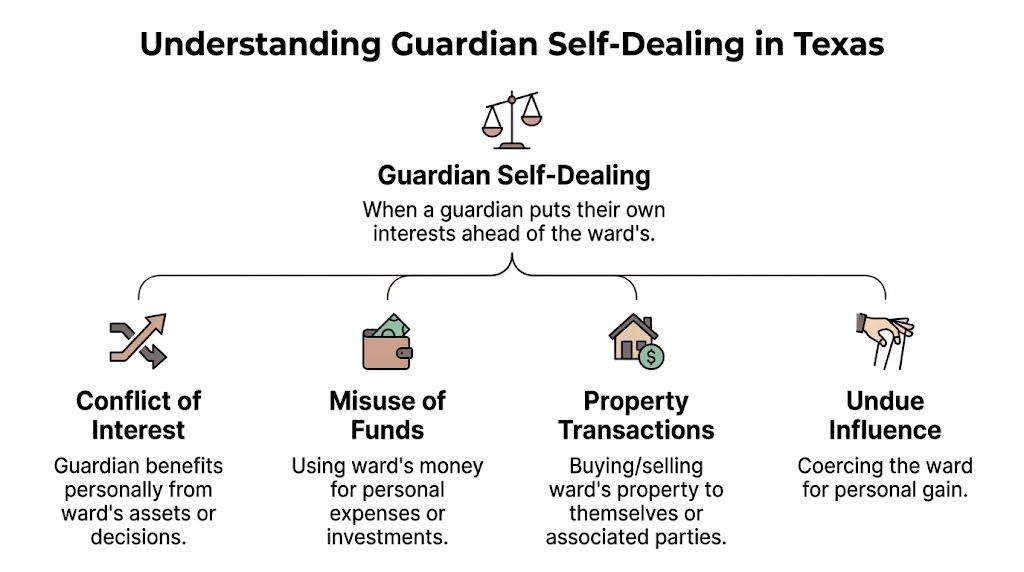
Texas law takes that concern seriously because guardians control intensely personal things. A guardian may manage where a person lives, how care decisions are made, and how money and property are handled. When that power is used for the guardian’s own benefit instead of the ward’s benefit, the issue is called self-dealing.
Protecting Your Loved One from Guardian Misconduct
One reason families feel confused is that guardianship is supposed to be protective. The court appoints a guardian to help a child or an adult who can't fully manage personal or financial affairs. So when the guardian becomes the source of concern, people often doubt themselves first.
That doubt is understandable. It’s also why reporting rules matter so much.
In Fiscal Year 2021, a review of 8,942 active Texas guardianship cases by the Guardianship Abuse, Fraud and Exploitation Deterrence Program found that 39% were out of compliance with statutory reporting requirements, a major warning sign for possible fiduciary problems, according to this Texas guardianship compliance review.
Why that matters to families
A missing report doesn't always prove theft. But it does remove one of the court’s main tools for checking whether the guardian is doing the job properly. If annual accountings and inventories aren't filed, the court has less visibility into withdrawals, property transfers, unpaid bills, and conflicts of interest.
For a concerned daughter in Houston, that may look like this: her mother’s guardian says the condo had to be sold, but no one can explain the sale price or where the proceeds went. For a father managing a minor child’s settlement in Harris County Probate Court, it may look like money moving into investments he doesn't recognize. For a brother living in another state, it may feel like every answer arrives late and none of the paperwork does.
Practical rule: If you feel uneasy because records are missing, changing, or hard to get, pay attention. In guardianship cases, lack of transparency is itself a serious problem.
Families often assume they have to wait for undeniable proof. They usually don't. Texas courts can require accountings, review transactions, remove a guardian, and order repayment when a guardian breaches fiduciary duties.
What to watch for early
Before a crisis grows, look for patterns like these:
- Sudden secrecy: The guardian stops sharing routine updates or refuses to provide copies of court filings.
- Blurred finances: Ward funds, reimbursements, or property expenses don't seem clearly separated.
- Unusual explanations: The guardian says a transfer was “temporary,” “for convenience,” or “what everyone agreed to,” but nothing is documented.
- Changed property use: A house, vehicle, or account appears to benefit the guardian or someone close to the guardian.
Those signs don't answer every question. They do tell you it's time to look closer.
What Guardian Self-Dealing Means in Texas
A guardian is a fiduciary. In plain English, that means the guardian must put the ward’s interests first. Not sometimes. Not when it’s convenient. Always.
The easiest way to think about it is this. If a guardian is holding the ward’s money or property, the guardian is not allowed to treat it like family property, shared property, or “money I can borrow from and fix later.” It belongs to the ward, and the guardian manages it under court supervision.
Texas rules make that duty direct. The Duty of Loyalty forbids guardians from selling, encumbering, or transferring a ward’s property to themselves, a spouse, or other insiders under the Minimum Standards for Guardianship Services, Standard 18, III, as described in this discussion of Texas guardianship legal responsibilities.
Self-dealing is broader than stealing
Families often picture self-dealing as obvious fraud. Sometimes it is. But guardian self dealing texas cases can also involve transactions that look neat on paper while still violating the guardian’s duty.
For example, a guardian may:
- lease the ward’s property to a friend,
- hire the guardian’s own relative for paid “caregiving,”
- use ward funds for mixed personal and ward expenses,
- push a sale that benefits the guardian more than the ward,
- make a transaction without proper court approval.
The problem is not only direct profit. The problem is conflict of interest. If the guardian stands on both sides of the deal, or benefits personally from a decision involving the ward’s estate, the court will look closely.
Where Texas Estates Code fits in
Texas guardianships are governed largely by Title 3, Subtitle G of the Texas Estates Code. Those laws set up the guardianship process, define the guardian’s powers, require court oversight, and provide ways to challenge misconduct. Courts also expect guardians to comply with reporting duties, inventory duties, and restrictions on using estate property.
A guardian of the person and a guardian of the estate don't have identical jobs. But both must avoid using the role for private gain.
Quick guide to common transactions
| Transaction Type | Description | Legal Status under Texas Estates Code |
|---|---|---|
| Sale to the guardian | Guardian buys the ward’s home, vehicle, or personal property directly or indirectly | Prohibited or highly suspect because it creates a direct conflict of interest |
| Transfer to spouse or insider | Property moves to the guardian’s spouse, employee, coworker, or related insider | Prohibited or highly suspect under the duty of loyalty |
| Personal use of ward funds | Guardian pays personal bills or mixes personal spending with ward money | Prohibited |
| Gift from ward estate | Guardian makes a gift that benefits the guardian or close associates | Requires court approval and careful review |
| Routine expense for ward | Guardian pays for housing, care, insurance, or necessary services for the ward | Usually permitted if authorized, documented, and for the ward’s benefit |
| Major estate transaction | Sale of significant assets, large withdrawals, or unusual investments | Often requires court approval and full documentation |
Guardians should ask, “Does this help the ward?” Texas courts often ask a harder question: “Did this also help the guardian?”
What confuses families most
A lot of people ask whether a guardian can ever be paid. Sometimes yes. A guardian may receive compensation or reimbursement if the law and court orders allow it. But proper compensation is different from helping yourself to estate assets, steering business to relatives, or making undocumented withdrawals.
That difference matters. A lawful fee is transparent and approved. Self-dealing is hidden, conflicted, or both.
A Guardian's Fiduciary Duties The Foundation of Trust
The rules against self-dealing aren't technical traps. They're the backbone of guardianship.
A court removes rights from one person and gives decision-making power to another only because the law assumes the guardian will act with loyalty, caution, and honesty. If that trust breaks, the whole guardianship becomes dangerous.
Loyalty comes first
The ward is not supposed to orbit around the guardian’s preferences, convenience, or financial needs. The guardian is supposed to serve the ward. That is why fiduciary duty is more than a paperwork requirement. It is the reason the court allowed the guardianship in the first place.
This matters in everyday decisions. If a ward owns a home in Bexar County, the guardian cannot choose the option solely because it makes life easier for the guardian. The guardian should choose the option that best protects the ward’s health, property, dignity, and long-term interests.
Substituted judgment is about the ward’s voice
Texas also recognizes substituted judgment. That doctrine requires guardians to make decisions based on what the ward likely would have chosen when competent, according to the Minimum Standards for Guardianship Services.
That idea helps families see the difference between care and control. A guardian is not supposed to run the ward’s life based only on the guardian’s own values. The guardian should look at the ward’s prior choices, beliefs, habits, relationships, and expressed wishes whenever possible.
For example, if an adult ward always preferred to keep a modest home and avoid risky investments, a guardian shouldn't move assets into a business opportunity tied to the guardian’s friend. If the ward had long-standing views about charitable giving, family support, or preserving a child’s settlement, those preferences matter.
The best guardians act as careful stand-ins, not owners.
Prudence and recordkeeping matter too
A guardian’s fiduciary duty also includes careful management. Money should be traceable. Property should be protected. Decisions should be documented. Annual filings should be timely and accurate.
Families often discover trouble through poor records before they discover the underlying bad transaction. A missing receipt, unexplained transfer, or vague accounting can point to a deeper problem. That's one reason it helps to understand how Texas guardians manage ward assets.
Guardianship should remain as limited as possible
Texas law also aims for the least restrictive alternative. In practice, that means guardianship should remove only the rights that need protection. When a guardian uses broad control to silence family, block questions, or isolate the ward, families should take notice.
Here are core fiduciary expectations families can use as a practical checklist:
- Act for the ward’s benefit: Decisions should improve or protect the ward’s well-being, not the guardian’s position.
- Keep assets separate: The ward’s bank accounts, income, and property should not be mixed with the guardian’s finances.
- Document major choices: Sales, contracts, and unusual expenses should be traceable and supported.
- Respect the ward’s history: Preferences the ward expressed before incapacity still matter.
- Follow court orders exactly: A guardian’s authority comes from the court, so acting outside that authority is a major risk.
When a guardian ignores those duties, families aren't being difficult by objecting. They're defending the purpose of the guardianship itself.
Common Examples of Guardian Self-Dealing
Self-dealing can look dramatic, but it often starts with ordinary-looking decisions. That’s what makes it hard to spot. A transfer is called a reimbursement. A property deal is described as “keeping it in the family.” A payment to a relative is labeled caregiving support.

The discounted home sale
An elderly ward owns a house in Fort Bend County. The guardian tells the family the house needs to be sold quickly because upkeep is expensive. Later, the family learns the buyer was the guardian’s adult child.
Even if the paperwork looks formal, the court may see a serious conflict. The question is not just whether money changed hands. The question is whether the guardian used control over the ward’s estate to create a personal or family benefit.
The “temporary” credit card use
A guardian has access to the ward’s accounts and uses the ward’s card for groceries, fuel, and online purchases. When asked, the guardian says some charges were for the ward and some were easier to put on one card and sort out later.
That kind of mixing is dangerous. Guardians should keep clear separation and support every estate expense with records. “I meant to repay it” is not a safe answer in probate court.
The relative on payroll
A guardian hires a cousin to provide home care for the ward at a rate the family never discussed. The ward may well need care. But if the guardian set up the arrangement without proper approval, market support, or documentation, the issue isn't just caregiving quality. It’s whether the guardian used the ward’s money to favor someone close to the guardian.
The minor settlement problem
This issue is especially sensitive when a guardianship involves a child’s injury settlement. Recent Texas probate court data shows a 22% increase in minor guardianship disputes from Oct. 2025 through Apr. 2026, often involving guardians profiting from settlement funds, according to the Texas guardianship rights and responsibilities guide.
A common concern looks like this. A parent or other guardian controls funds set aside for a child after a serious injury case. The guardian then moves money into an investment, business arrangement, or asset purchase that also helps the guardian personally. Even if the guardian believes the decision is smart, the conflict can still violate fiduciary duties.
A child’s settlement is not family money. It belongs to the child and must be handled with exceptional care.
The below-market rental
A ward’s rental property is leased to the guardian’s friend or business associate at a favorable rate. The guardian may defend the choice by saying the tenant is reliable or repairs were needed. But when the price is low, terms are loose, or no market check was done, the arrangement may benefit the guardian’s relationships more than the ward’s estate.
A simple red-flag list
If you're trying to separate suspicion from evidence, these patterns deserve attention:
- Unexplained withdrawals: Cash use or transfers that don't match the ward’s care needs.
- Insider transactions: Deals involving the guardian, the guardian’s relatives, or close business contacts.
- Changed titles or ownership: Property records no longer reflect the ward’s prior ownership position.
- Poor supporting records: Missing invoices, missing receipts, or accountings that answer only part of the question.
- Settlement fund drift: Money set aside for a minor starts funding decisions that seem to help adults around the child.
Not every mistake is self-dealing. But when a guardian personally benefits, the court may treat the conduct as far more than a mistake.
Legal Remedies and Penalties for Self-Dealing
When self-dealing is suspected, families often ask the same question first. “What can the court do?” In Texas, the answer is: quite a lot.
The probate court can investigate, demand records, reverse unauthorized conduct in some situations, remove the guardian, and require repayment. In serious cases, related civil claims or criminal investigations may also follow.
Requesting an accounting
One of the most important remedies is a formal accounting. This forces the guardian to show what came into the estate, what went out, and why. If the problem is hidden in vague explanations, an accounting can bring it into the open.
Families often need this step before they can prove the full extent of the misconduct. A bank statement may show one transfer. A court-ordered accounting may reveal a pattern.
Removal of the guardian
If the guardian has breached duties, acted outside authority, or endangered the ward’s property or well-being, the court may remove that guardian and appoint someone else. Repayment alone doesn't always solve the problem; sometimes the ward needs a new decision-maker immediately.
Removal may be especially urgent when:
- Records are missing
- The guardian ignores court orders
- Property is still at risk
- The guardian has become openly hostile to oversight
Surcharge and repayment
Texas courts can require a guardian to restore money or property wrongfully taken or lost through misconduct. Lawyers often refer to this as a surcharge. The goal is accountability. The ward should not bear the financial cost of the guardian’s breach.
That can include repayment of misused funds, restoration of estate value, and related financial consequences depending on the facts and the court’s findings.
Court focus: The question is often simple. What did the ward lose because the guardian put personal interests first?
Additional legal action
Sometimes a probate remedy is only part of the response. Families may also need broader action for breach of fiduciary duty, especially when the misconduct affected major assets or extended over time. This overview of legal action for a guardian’s breach of fiduciary duty in Texas helps explain that path.
The exact remedy depends on the asset, the timing, the court orders already in place, and whether the guardian is a relative, private guardian, or certified guardian.
What to do before a hearing
If you think a court hearing may be needed, gather and preserve:
- Court filings: Letters of guardianship, inventories, annual reports, and prior orders
- Financial records: Bank statements, canceled checks, ledgers, receipts, and tax documents
- Property records: Deeds, appraisals, lease documents, and sale paperwork
- Communications: Emails, texts, and letters where the guardian explains or refuses to explain transactions
- Witness observations: Notes from family, caregivers, neighbors, or professionals who saw changes
Families sometimes fear they're overreacting by going to court. If a guardian has used the role for personal benefit, court intervention is often the safest way to protect the ward and preserve what remains.
How to Challenge and Report Self-Dealing in Texas
If you believe a guardian is using a Texas guardianship for personal gain, don't start with a confrontation that gives the guardian time to clean up records. Start with documentation, court records, and legal strategy.
That is especially important if you live outside Texas. Remote family members often feel powerless, but they usually have more options than they realize.

A 2025 analysis of Texas probate filings found a 15% increase in out-of-state petitions for guardian removal due to suspected financial abuse, highlighting how often remote families need practical oversight tools, according to this discussion of guardian misconduct and remote oversight in Texas.
Start with the probate file
In many cases, the clearest first step is reviewing the court file in the county where the guardianship is pending. That may be a probate court in a large county, such as Harris County Probate Court, or a county court handling guardianship matters in a smaller county.
Look for:
- Letters of guardianship: These define the guardian’s authority.
- Inventory and appraisement filings: These show what the estate included at the beginning.
- Annual accountings or reports: These reveal whether the guardian has been reporting on time and with enough detail.
- Orders approving transactions: If a major sale or withdrawal happened, there may need to be a court order authorizing it.
If you're out of state, ask the clerk what can be accessed electronically and what must be requested formally. A Texas attorney can often obtain and review these records quickly.
Build a timeline before filing anything
Families often jump from suspicion to accusation. A better approach is to build a chronology.
Create a simple timeline with dates for:
- when the guardian was appointed,
- when major financial changes occurred,
- when family access changed,
- when assets were sold, moved, or retitled,
- when reporting deadlines were missed.
That timeline helps the court see pattern, not just conflict.
Remote oversight for out-of-state families
Distance makes self-dealing harder to detect, but not impossible. If you're in another state and your parent, sibling, or child is under a Texas guardianship, focus on records that can be reviewed remotely.
Useful steps include:
- Requesting digital copies: Ask for filed accountings, inventories, and orders.
- Comparing public records: Check deed records or other property filings in the relevant Texas county.
- Using local professionals: A Texas lawyer can request records, appear in court, and coordinate with financial experts.
- Preserving communications: Save every text and email where the guardian discusses money, refuses access, or changes the explanation.
Remote families often see the pattern first because they rely on paperwork instead of informal assurances.
When minor settlement funds are involved
If the ward is a child and the estate was funded by an injury settlement, review every major expenditure with extra care. The questions are narrower and sharper. Did the expense benefit the child? Was it authorized? Was there any side benefit to the guardian?
In these cases, families should look closely at:
- purchases tied to vehicles or homes,
- business investments,
- transfers to relatives,
- “management” fees not clearly approved,
- missing support for large expenses.
A parent serving as guardian may be acting from stress, confusion, or overconfidence. But the court will still expect strict separation between the child’s money and everyone else’s needs.
Reporting and filing in court
Once you have enough information, you may need to report concerns and ask the court for relief. That may include a request for accounting, temporary restrictions, removal, or another protective order. This guide on how to report guardianship abuse in Texas is a helpful starting point for that process.
Some families also need emergency action. If property is actively being sold, funds are disappearing, or the ward is being isolated, your lawyer may ask the court for immediate protective relief.
A short video can help you think through the next move before filing.
What a hearing may look like
At a hearing, the court usually wants specifics. Judges hear a lot of family tension. They respond best to records, dates, and clear examples tied to the guardian’s duties.
Bring the court:
- the transaction,
- the conflict,
- the missing approval or missing explanation,
- the harm to the ward.
That framework works whether you're challenging a suspicious real estate sale in Dallas County, account withdrawals in Travis County, or settlement spending in a child’s estate pending in a Houston-area probate court.
If you only remember one thing, remember this. Courts are much more likely to act when concern is translated into organized proof.
Taking the Next Step to Protect Your Family
If you've read this far, you probably aren't reacting to a vague fear. You’re trying to make sense of conduct that may already be harming someone vulnerable.
Guardian self dealing texas cases are painful because they combine two kinds of loss. First, there may be financial harm. Second, there is the betrayal of a role that was supposed to protect a loved one. Texas law recognizes both.
Families can act at several stages. Before a guardianship, they can explore alternatives such as powers of attorney, supported decision-making, trusts, and other estate planning tools that may reduce the need for court control. During a guardianship case, they can ask careful questions about authority, reporting, and whether a temporary or emergency guardianship is really necessary. After appointment, they can monitor compliance, review annual filings, challenge misconduct, and seek termination or modification when the guardianship is no longer appropriate.
You do not need perfect proof before speaking with counsel. You do need a plan. That plan may involve reviewing the probate file, protecting a minor’s settlement, seeking a formal accounting, contesting a transaction, or asking the court to remove a guardian.
If your family is dealing with concerns in Harris County, Dallas County, Travis County, Bexar County, or anywhere else in Texas, timely legal guidance can make the difference between stopping a problem early and trying to undo serious damage later.
If you're worried about a parent, child, or other loved one in a Texas guardianship, the Law Office of Bryan Fagan, PLLC can help you evaluate the facts, explain your options, and take action to protect the ward’s rights and assets. The firm handles guardianship, probate, and estate planning matters across Texas, including disputes over guardian misconduct, emergency guardianship issues, minor settlement cases, and guardianship compliance. Schedule a free consultation to get clear, personalized guidance for your situation.