Skip to content
When a loved one passes away or becomes unable to make their own decisions, your family’s focus should be on supporting each other, not deciphering a maze of legal rules. This is where the Texas Estates Code comes in. Think of it as the official instruction manual for managing a person's property and affairs in Texas during these difficult times.
This set of laws provides a predictable framework for everything from honoring a will to establishing a guardianship to protect a vulnerable family member. It’s not meant to be a burden; it’s a roadmap designed with compassion to ensure a loved one's wishes are respected and their well-being is prioritized.
Your Guide to the Texas Estates Code
When you're facing the emotional weight of a loved one's passing or declining health, legal chaos is the last thing you need. The Texas Estates Code is the state's way of providing a clear and orderly path forward for families. It’s the rulebook that judges in Texas courts, including the Harris County Probate Court, rely on to oversee these sensitive matters with fairness and predictability.
This code covers the essential processes that most families encounter, such as managing an estate or protecting an incapacitated loved one. It’s a system designed to bring order to what can feel like an overwhelming situation.
The Purpose of the Code
At its heart, the Texas Estates Code is designed to bring clarity to complex family situations. These laws were reorganized and updated to be more accessible for today's families. On January 1, 2014, the state officially adopted the Texas Estates Code, replacing the older Texas Probate Code to create a more modern, consolidated legal framework.
The code is built to answer the critical questions that arise during life’s most challenging moments:
- Who inherits property? It clearly lays out the rules for who receives assets, whether there's a will or not.
- How are debts paid? The code defines the proper procedure for settling a loved one's final bills from their estate.
- Who can make decisions for someone else? It outlines the legal process for appointing a guardian to protect a minor or an incapacitated adult.
- How is a will proven valid? It sets the requirements for a will to be legally recognized by a Texas court.
A System Built for Families
We understand that legal documents can feel intimidating. But the core principles of the Texas Estates Code were created with families in mind. By providing a structured process for handling estates and guardianships, the law helps prevent disputes and ensures decisions are made transparently and fairly.
Whether you're navigating probate, considering guardianship, or planning for the future with estate planning, this code is the foundation for it all. For a deeper dive into specific topics, you can also review our posts covering the Texas Estates Code.
The Four Pillars of the Estates Code
Trying to understand the Texas Estates Code all at once can feel overwhelming. It's not one giant, complicated law but more like a structure built on four essential pillars. Each one is designed to support Texas families during different, often difficult, life events. Knowing which pillar applies to your situation tells you exactly where to turn for guidance.
This infographic breaks down how each part of the code lines up with specific family needs.
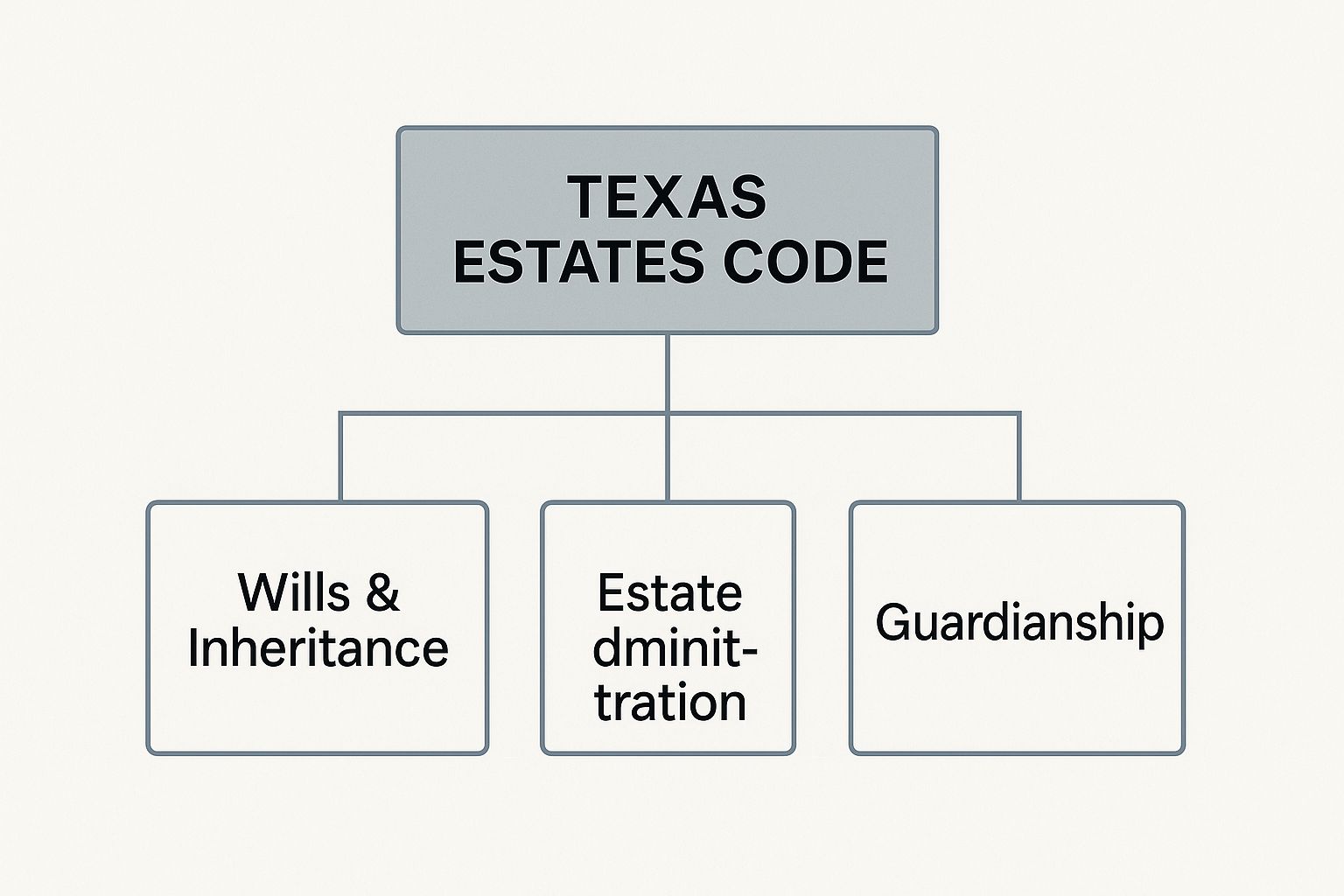
As you can see, major life events—like inheritance, settling a loved one's affairs, or protecting vulnerable family members—are all directly addressed within these core areas of the Texas Estates Code. Let's take a closer look at each one.
Pillar 1: Wills and Inheritance
This first pillar is probably the most familiar. It governs wills and dictates how a person’s property is passed down after they die. Think of a will as your loved one’s final set of instructions; this part of the code ensures those instructions are legally respected. It defines what makes a will valid in Texas, clarifies who has the right to inherit, and lays out the process for what happens if a will is challenged.
This area of the law brings a predictable, clear path forward for families, which can dramatically reduce the potential for disputes during an already emotional time.
Pillar 2: Estate Administration and Probate
When a person passes away, their estate—everything they owned—must be legally settled. This pillar outlines the official process for managing and distributing that estate, a process commonly known as probate. It covers the duties of an executor or administrator, from paying off final debts to transferring assets to the rightful heirs.
Think of estate administration as the formal closing of a person's financial life. The Texas Estates Code provides the step-by-step procedure to ensure this is done correctly and fairly, under the supervision of a court like the Harris County Probate Court.
The whole point of probate is to bring order and legal finality to the process, making sure all responsibilities are met before the family receives their inheritance. Navigating this pillar is a key focus of our probate practice.
Pillar 3: Guardianship
The third pillar is all about protecting those who cannot protect themselves. Guardianship is a legal process established under Title 3 of the Texas Estates Code where a court appoints a responsible person (the guardian) to make decisions for a minor or an incapacitated adult (the ward). We know firsthand how emotionally challenging this process can be for families.
This pillar is built on compassion and is designed for situations like:
- An elderly parent with dementia who can no longer manage their finances or healthcare.
- A minor child who inherits property or receives a settlement from an injury.
- An adult with special needs who requires lifelong support and decision-making assistance.
The code provides a structured, court-supervised system to safeguard a loved one's well-being and assets. If you're considering this path, our team is here to guide you through every step of the guardianship process with empathy and clarity.
Pillar 4: Planning Ahead with Powers of Attorney
The final pillar focuses on being proactive to avoid future legal headaches. It governs powerful tools like Powers of Attorney, which let you designate someone you trust to make financial or medical decisions on your behalf if you become unable to do so yourself. This is a crucial piece of any comprehensive estate planning strategy.
By putting these documents in place now, you can often avoid the need for a court-imposed guardianship later, saving your family a great deal of time, money, and stress. It's about empowering yourself to keep control over your future, even if you can no longer speak for yourself.
To help you see how these pieces fit together, this table breaks down the core components of the code and the real-world situations they address.
Key Functions of the Texas Estates Code
| Key Area | What It Accomplishes | Common Family Situation |
|---|---|---|
| Wills & Inheritance | Ensures a person's final wishes for their property are legally honored. | A parent writes a will to leave their home to their children. |
| Estate Administration | Provides the legal process (probate) for settling debts and distributing assets. | An executor files paperwork with the court to manage a deceased relative's estate. |
| Guardianship | Appoints a responsible person to make decisions for someone who cannot. | An adult child seeks guardianship for a parent with advanced Alzheimer's. |
| Powers of Attorney | Allows you to pre-select someone to act for you if you become incapacitated. | A person signs a medical power of attorney naming their spouse as their agent. |
Together, these four pillars provide a complete framework to support Texas families through some of life's most significant transitions. At The Law Office of Bryan Fagan, we can help you understand which part of the code applies to your unique situation. For personalized guidance, schedule a free consultation with our team today.
A Deep Dive Into Texas Guardianship Law
Watching a loved one lose the ability to make safe decisions for themselves is one of the most heartbreaking situations a family can face. The weight of that responsibility is immense. When this happens, the Texas Estates Code, specifically Title 3, Subtitle G, offers a legal framework called guardianship to protect these vulnerable individuals.

Guardianship isn't a simple legal step; it's a formal, court-supervised process. A judge appoints a qualified person—the guardian—to care for an incapacitated individual, who is then known as the ward. Because this process involves removing some of a person’s most fundamental rights, it’s not something the courts take lightly. The law sets a high standard, demanding that every step is handled with the utmost care and respect for the ward's dignity.
When Is Guardianship Necessary?
The first question every family grapples with is, "Is this truly necessary?" The Texas Estates Code is clear: guardianship should always be the last resort. Before starting this process, you must explore less restrictive alternatives.
For example, if your aging mother in Harris County already has a valid Durable Power of Attorney and a Medical Power of Attorney, those documents might be all you need to manage her affairs. But what if she never signed those documents and now dementia makes it impossible? Or what if a power of attorney is being abused? In those cases, guardianship may be the only way to ensure her safety and protect her assets.
Common situations where guardianship becomes unavoidable include:
- An elderly parent with Alzheimer's who is now susceptible to financial scams and exploitation.
- An adult child with a severe disability who will need lifelong help with medical and personal choices.
- A minor who inherits significant money or property and needs a "guardian of the estate" to manage it properly.
Understanding the Guardianship Process in Texas
Starting a guardianship proceeding can feel overwhelming, but breaking down the process can make it feel more manageable. While no two cases are exactly alike, the journey generally follows a clear path laid out by the Texas Estates Code.
A guardianship is more than just a legal case; it is a profound commitment to protect a loved one. The court's primary goal, as outlined in the law, is always to act in the best interest of the proposed ward.
It all begins with filing an "Application for Appointment of Guardian" with the correct court, such as a Probate Court in the county where the proposed ward lives, whether that's Fort Bend County or Dallas County. This application is a detailed document that provides the court with essential information about the proposed ward, the person applying to be guardian, and a clear explanation of why a guardianship is needed.
Key Steps in a Guardianship Hearing
Once the application is filed, the court initiates several steps to protect the rights of the person at the center of it all. This ensures a fair and thorough review before any decisions are made.
- Physician's Certificate of Medical Examination (CME): The court will require a recent medical evaluation from a doctor, typically completed within 120 days of filing. This report must detail the proposed ward's physical and mental condition and give a professional opinion on whether they are incapacitated and need a guardian.
- Appointment of an Attorney Ad Litem: The judge will appoint an independent attorney, called an "attorney ad litem," whose only job is to represent the proposed ward. This attorney meets with the ward, explains their rights, and acts as their advocate in court.
- Court Investigation: A court investigator is also assigned to the case. Their role is to be a neutral fact-finder, conducting an investigation and providing a report to the judge about the ward's situation and the suitability of the applicant.
- The Court Hearing: Finally, the judge holds a hearing where all parties can present their evidence. You, your attorney, the attorney ad litem, and sometimes the proposed ward will be there. The judge listens to testimony and reviews all the reports before making a final decision about whether a guardianship is necessary and who is the best person to serve as guardian.
Trying to navigate the complexities of the Texas Estates Code and local probate court rules is tough, especially when you're already focused on caring for a loved one. The emotional and financial challenges are very real.
At The Law Office of Bryan Fagan, we're here to guide you through every step with clarity and compassion. If you are considering guardianship to protect a family member, you don’t have to do it alone. Schedule a free consultation with our team today to discuss your family’s needs and receive personalized guidance.
What Happens When There Is No Will in Texas
Losing a loved one is hard enough. Discovering they didn’t leave a will can add a layer of stress and confusion to an already painful time. When someone passes away without a will, the legal term for it is dying "intestate." It’s a situation that leaves many families wondering, "What now?"
Fortunately, Texas doesn't leave things to chance. The state has a clear, default plan to prevent chaos and ensure property is distributed in a predictable way.

This roadmap is laid out in the Texas Estates Code. Think of it not as a penalty, but as the state’s best effort to create a fair outcome based on family relationships. The rules for this process, known as intestate succession, are designed to pass assets to the closest surviving relatives.
The Rules of Intestate Succession
When there's no will, the law steps in to decide who gets what. This follows a strict hierarchy, and the distribution of assets depends entirely on who survives the person who passed away. For instance, what a surviving spouse inherits can change dramatically depending on whether the couple had children together, or if there were children from a previous relationship.
These rules have deep roots in our state's legal history, with the Texas Probate Code of 1955 setting the foundation for a precise order of inheritance that still influences how courts operate today.
It's crucial for families to understand how these scenarios play out in the real world.
The law doesn't try to guess what your loved one might have wanted. Instead, it applies a rigid formula. This is exactly why a will is so powerful—it lets you replace the state’s default plan with your own personal wishes.
Let's break down a few common family situations.
How Property Is Divided in Texas Without a Will
While the rules can seem a bit complicated at first, they follow a logical pattern based on family structure.
- You have a spouse and children together: Your surviving spouse inherits all of the community property, plus one-third of your separate personal property. They also get the right to use one-third of your separate real estate for the rest of their life. Your children inherit everything else.
- You have a spouse and children from a previous relationship: Your surviving spouse keeps their half of the community property. Your children inherit your half of the community property, plus their share of your separate property.
- You have children but no spouse: Your children inherit your entire estate, divided equally among them.
- You have a spouse and living parents, but no children: Your spouse inherits all community property and all of your separate personal property. They also get half of your separate real estate, with the other half going to your parents.
- You have no spouse, children, or parents: In this case, your estate passes to your surviving siblings. If you have no siblings, the law looks to more distant relatives in a state-defined order.
This strict structure really underscores why taking the time to create a will is so important. You can explore different Texas will forms to see how a straightforward document can bring so much clarity and peace of mind to your loved ones.
A Gentler Alternative: The Small Estate Affidavit
For smaller estates, Texas law recognizes that the full probate process can be overkill. The Texas Estates Code provides a simpler, faster, and less expensive option called a Small Estate Affidavit. This tool allows property to be transferred without formal court administration, saving families both time and money.
To qualify, the estate's total value (not counting the homestead and other exempt property) can't be more than $75,000. The person must also have died without a will. If this sounds like your family's situation, a Small Estate Affidavit might be a compassionate way to find closure more quickly.
If you're facing the challenge of settling an estate without a will, please know you don't have to navigate it alone. Our team can help you understand all your options under the Texas Estates Code. Schedule a free consultation today for personalized guidance and support.
Your Responsibilities as an Executor or Guardian
Being named an Executor, Administrator, or Guardian is a profound act of trust. It means someone believed you were the right person to look after their final wishes or care for a loved one who can no longer care for themselves. It's an honor, but it also comes with significant legal duties defined by the Texas Estates Code. We understand that this role carries a heavy emotional weight.
This responsibility demands that you act with complete integrity, diligence, and transparency. In legal terms, this is called a fiduciary duty—the highest standard of care recognized under Texas law. Simply put, you must always put the interests of the estate or the person you're caring for (the "ward") ahead of your own.
Fulfilling these duties isn't just about good intentions; it requires careful attention to detail and a commitment to following the court's rules. Even an honest mistake can lead to personal liability or create painful family disputes.
Key Duties of an Executor or Administrator
If you're the Executor named in a will or a court appoints you as the Administrator, your main job is to settle the deceased person's estate. This whole process is called estate administration, and it involves a series of critical steps that you have to complete under the court's watch. It's also vital to get a handle on what you can and can't do, like understanding the limitations of an executor, such as whether an executor can change a will.
The first few steps you take can set the tone for everything that follows. Think of it as a practical checklist for getting started:
- Locate the Will: Your first task is to find the original will and file it with the correct probate court, like the Harris County Probate Court.
- Notify Beneficiaries: You have a legal duty to formally let all beneficiaries named in the will know that the will has been probated.
- Inventory Assets: You must create a detailed inventory of everything the estate owns. This includes real estate, bank accounts, stocks, and personal belongings, and it has to be filed with the court.
- Pay Debts and Taxes: Before anyone gets their inheritance, you have to pay off the estate's legitimate debts and file any necessary tax returns.
- Distribute Assets: Once all the bills are settled, you'll distribute the remaining property to the heirs exactly as the will instructs.
The Texas Estates Code holds an executor to a specific standard: you must manage the estate with the same care a "prudent person" would use for their own property. This principle should guide every decision you make.
Understanding Your Role as a Guardian
Acting as a Guardian is a deeply personal commitment focused on the well-being of a living person—the ward. The court has placed its trust in you to make critical life decisions for someone who is unable to do so themselves. These aren't one-time tasks; they're ongoing responsibilities that require you to report back to the court regularly to show you're always acting in the ward's best interest.
Your specific duties will depend on whether you are a "Guardian of the Person," a "Guardian of the Estate," or both.
Guardian of the Person:
- You decide where the ward lives and make choices about their day-to-day life.
- You give consent for medical treatments and ensure all their healthcare needs are met.
- You're responsible for providing their food, clothing, and overall personal care.
Guardian of the Estate:
- You are in charge of the ward's finances, property, and any investments.
- You pay their bills and collect any income they might be owed.
- You must file a detailed annual accounting with the court, tracking every single dollar that came in and went out.
Keeping meticulous records isn't just a good idea—it's a legal requirement. It's also wise to keep family members in the loop. Clear communication can prevent a world of misunderstanding and help build trust during what is often a very challenging time for everyone involved.
Navigating the responsibilities of an Executor or Guardian can feel overwhelming, but you don't have to do it alone. The Law Office of Bryan Fagan is here to provide the clear guidance and compassionate support you need to fulfill your role honorably and effectively. For help with Probate or Guardianship duties, schedule a free consultation with our team today.
Using Estate Planning To Protect Your Family
The best way to deal with the Texas Estates Code is to plan so your family never has to rely on its default settings. While the law provides a safety net for unexpected events, taking control of your future with a solid estate plan is one of the most powerful acts of care you can offer your loved ones. It lets you replace the state’s one-size-fits-all rules with your own, personal instructions.
This is where having the right legal tools in place makes all the difference. With forethought, you can help your family sidestep emotional and expensive court proceedings, including both probate and guardianship battles. You get to make the tough decisions now, so they aren't left guessing what you would have wanted later on.

Powerful Tools for Your Family's Protection
A complete estate plan is much more than just a will. Think of it as building a protective shield around your family's future, using the specific legal instruments Texas law provides. These documents all work together, ensuring your financial and healthcare decisions are handled exactly the way you want.
Key estate planning documents include:
- A Legally Sound Will: This is the foundation. Your will is where you name an executor, say who gets your property, and—critically—appoint a guardian for any minor children.
- Trusts: Trusts are incredibly flexible tools. They can be used to protect assets from creditors, provide for a loved one with special needs, and often help your estate avoid the public, lengthy probate process altogether.
- Durable Power of Attorney: This document lets you pick a trusted agent to handle your financial life if you ever become unable to do so yourself. It’s a vital step to avoiding a court-ordered guardianship over your finances.
- Medical Power of Attorney: Similar to the above, this lets you name someone to make healthcare decisions for you if you can't. This ensures your medical care always aligns with your personal values.
Putting these plans in place gives your family a clear roadmap to follow during a difficult time. A key part of that is learning how to avoid probate court, which can save them time, money, and stress. It’s also important to understand how guardianship and estate planning work together to offer complete protection.
The peace of mind that comes from a well-crafted estate plan is immeasurable. The decisions you make today can spare your loved ones from immense stress, expense, and uncertainty tomorrow.
The difference between a family with a plan and one without is stark. One gets a clear, orderly process guided by their loved one's specific instructions. The other faces court hearings, potential family fights, and a legal process that can drag on for months, or even years.
Ultimately, protecting the people you care about most is the goal. The Texas Estates Code provides the rulebook, but it’s your proactive planning that brings that protection to life.
If you’re ready to build a plan that reflects your wishes and safeguards your family’s future, we are here to help. Schedule a free consultation with The Law Office of Bryan Fagan today for personalized guidance.
Common Questions About the Texas Estates Code
When you're dealing with a loss or a sudden health crisis in the family, the legal side of things can feel overwhelming. You have questions, and you need clear, straightforward answers. We've put together some of the most common concerns we hear from Texas families about the Texas Estates Code to help you find your footing.
How Long Does Probate Take in Texas?
This is a common question, and the honest answer is: it depends.
For a straightforward, uncontested estate, the process might take about six to nine months. However, if someone challenges the will, or if the estate has complicated assets and debts to sort through, the process can easily stretch out for more than a year. The Texas Estates Code sets out the roadmap, but having an experienced attorney navigate the courts, like the Harris County Probate Court, is the surest way to keep things moving as smoothly as possible.
What Is the Difference Between an Executor and an Administrator?
It’s easy to get these two mixed up. The simplest way to think about it is that an Executor is chosen by the person who passed away—they are named in the will to carry out its instructions. An Administrator, on the other hand, is appointed by a probate court when someone dies without a will.
While their day-to-day duties are nearly identical under the Texas Estates Code—collecting assets, paying off debts, and distributing what’s left—the key difference is the source of their authority. An Executor gets their power from the will itself, while an Administrator is given their power by the court.
Can Guardianship for a Loved One Be Avoided?
Yes, absolutely. In fact, avoiding a court-ordered guardianship is one of the biggest benefits of good estate planning. The key is to be proactive.
The most powerful tools for steering clear of guardianship are a Durable Power of Attorney for financial matters and a Medical Power of Attorney for healthcare decisions. By putting these documents in place now, you get to choose a trusted person to make decisions for you if you ever become unable to make them for yourself. This simple step keeps the court out of your private life and spares your family the expense, time, and emotional toll of a formal guardianship proceeding.
Getting a handle on how the Texas Estates Code impacts your family is the first step toward real peace of mind. At The Law Office of Bryan Fagan, PLLC, we offer the compassionate, expert guidance you need to protect the people you love most. Schedule a free, no-obligation consultation with us today to talk through your situation.