Skip to content
When a family member can no longer make decisions for themselves, or a child needs temporary care, the right legal documents are essential for providing protection and clarity. In Texas, guardianship letters serve as critical tools for families, providing a framework to grant authority for medical care, education, or financial matters. While some situations require a formal court-ordered guardianship, these letters can often provide a more immediate, non-judicial solution for specific circumstances. However, a poorly drafted letter can create more problems than it solves, leading to confusion, rejection by institutions, and potential legal challenges that leave your loved one vulnerable.
We understand that navigating these issues is often an emotional and stressful experience. This guide is designed to provide clarity and confidence by walking you through several practical examples of guardianship letters, each tailored to a specific situation you might face in Texas. Our goal is to demystify these documents by breaking them down piece by piece. For each example, we will provide a template and a detailed analysis explaining the legal reasoning behind its structure, grounded in Texas law. Above all, clarity is paramount; mastering these essential tips for clear writing will prevent misunderstandings and ensure your intentions are unambiguously stated.
From granting temporary care for a minor child to authorizing medical decisions for an aging parent, you will learn not just what to write, but why it matters. We will explore six common scenarios, including letters for temporary, medical, and educational guardianship. By understanding the components of a strong guardianship letter, you can better protect your family and navigate your responsibilities with greater peace of mind, knowing you have a legally sound plan in place.
1. Temporary Guardianship Letter for Minor Child
A temporary guardianship letter is a crucial, non-judicial document that parents use to grant another trusted adult the authority to care for their minor child for a specific, limited time. This type of letter is essential when parents must be away for reasons such as military deployment, extended work assignments, or medical treatment, ensuring the child’s welfare is maintained without interruption. It empowers the designated temporary guardian to make vital decisions concerning the child's education, daily needs, and routine healthcare.

While this letter is a powerful tool for short-term situations, it's important to understand its legal standing in Texas. This document operates as a form of parental consent rather than a court-ordered guardianship. It provides clear evidence of your wishes but may not be sufficient for all legal or medical emergencies. For more complex situations or longer durations, a court-ordered temporary guardianship, governed by the Texas Estates Code, might be necessary. To understand the full scope of your options, you can learn more about temporary guardianship in Texas.
Strategic Breakdown of a Temporary Guardianship Letter
An effective temporary guardianship letter is built on clarity, specificity, and legal foresight. It must be detailed enough to prevent confusion and strong enough to be accepted by schools, doctors, and other authorities.
- Explicit Naming Convention: Clearly identify all parties involved. This includes the full legal names and addresses of the parents (or current legal guardians), the child, and the appointed temporary guardian. Ambiguity here is the number one reason these letters are rejected.
- Defined Timeframe: State the exact start and end dates of the guardianship period. A vague timeline like "for the summer" is insufficient. Use precise dates, for example, "from June 1, 2024, to August 15, 2024."
- Enumerated Powers: Specifically list the powers you are granting. Do not assume "full authority" is enough. List them out: authority to enroll in school, consent to routine medical care, access school records, and authorize participation in extracurricular activities.
- Notarization: Having the letter notarized adds a significant layer of legal validity. A notary's seal verifies the identity of the signatories, making it much more likely to be accepted by official institutions like a Harris County school district or a medical clinic in Austin.
Actionable Takeaways for Parents
To ensure your temporary guardianship letter is practical and effective, follow these critical steps:
- Attach Supporting Documents: Always include copies of the child's birth certificate, your photo IDs, the child's health insurance card, and any relevant custody orders.
- Provide a Medical Information Sheet: Create a separate, detailed sheet listing the child’s primary physician, dentist, known allergies, current medications and dosages, and emergency contacts. This empowers the temporary guardian to act swiftly and correctly in a medical situation.
- Distribute Copies Widely: Don’t just give one copy to the temporary guardian. Provide notarized copies to the child's school, primary doctor's office, and any daycare or after-school programs. This ensures everyone involved has the necessary authorization on file.
- Review State-Specific Laws: While Texas recognizes such letters, the specific requirements can vary. Always ensure your document aligns with current state guidelines to avoid any legal challenges.
2. Medical Guardianship Authorization Letter
A medical guardianship authorization letter is a focused legal document that specifically grants another individual the authority to make healthcare decisions for a minor child or incapacitated adult. This specialized letter is essential for situations where the legal guardian cannot be physically present during medical emergencies or routine appointments. Unlike a general temporary guardianship letter, this document concentrates solely on medical care, treatment consent, and health-related decisions, making it a critical tool for short-term caregivers like grandparents, coaches, or camp counselors.

This authorization is particularly critical in emergencies where delayed medical treatment could be harmful. Schools, camps, and healthcare facilities across Texas require this documentation before providing non-emergency treatment to minors in the absence of a parent. While this letter provides consent, understanding the full scope of a guardian's role in healthcare is vital. For a deeper understanding of the legal framework, you can explore the authority and limitations of medical decision-making in Texas.
Strategic Breakdown of a Medical Guardianship Authorization
An effective medical authorization letter is precise and comprehensive, leaving no room for misinterpretation by healthcare providers. It must clearly outline the scope of consent to ensure the designated adult can act confidently and appropriately.
- Focused Authority: State explicitly that the authorization is for medical and dental decisions only. This prevents the letter from being misconstrued as granting broader guardianship powers. Specify that this includes the power to consent to examinations, anesthesia, treatment, and hospital care.
- Health Information Access: Include a clause granting the designated adult access to the individual's protected health information (PHI) under HIPAA. This is crucial for doctors to be able to discuss the condition and treatment options openly.
- Specific Limitations and Preferences: Clearly list any treatments that are not authorized. This could include specific procedures based on religious beliefs or personal preferences. For example, you might state, "This authorization does not extend to non-emergency surgical procedures without prior verbal consent from a parent."
- Notarization: As with a temporary guardianship letter, notarization is vital. A notary's verification of your signature provides a strong layer of authenticity, which can be the deciding factor for its acceptance at a busy emergency room in a place like Dallas County.
Actionable Takeaways for Parents
To ensure your medical authorization letter is a truly effective safeguard, implement these practical steps:
- Include a Recent Photograph: Attach a recent, clear color photograph of the child to the letter. This helps medical staff quickly and positively identify the child, especially in chaotic environments like an emergency room.
- Provide Detailed Health Insurance Information: Attach a front-and-back copy of the child’s health insurance card. Also, list the policy number, group number, and the primary policyholder's name and contact information directly in the letter for easy access.
- Specify Contact Protocols: Clearly outline the communication plan. Provide primary and secondary emergency contact numbers and state your preference for being contacted. For instance, "Please attempt to contact [Parent 1] at [phone number] before any non-life-threatening procedure is performed."
- Review and Update Annually: A person's health can change quickly. Make it a habit to review and update the letter annually or whenever there is a significant change in the medical condition, such as a new allergy or medication. An outdated letter can provide incorrect information and cause dangerous delays.
3. Educational Guardianship Letter for School Enrollment
An educational guardianship letter is a focused document that parents use to delegate authority over their child's schooling to another trusted adult. This letter is vital when someone other than a parent, such as a grandparent or other relative, needs to enroll a child in school and manage their academic life. It empowers the designated guardian to handle crucial school-related tasks like attending parent-teacher conferences, accessing records, and consenting to academic programs, ensuring the child's education continues smoothly.
This type of letter is a common requirement in many Texas school districts, from the Houston ISD to smaller districts in Collin County. It serves as formal permission when a child lives with a relative to attend a specific school. For instance, if parents must relocate temporarily and their child stays with grandparents to finish the school year, this letter provides the legal standing the school needs. It’s a practical, non-judicial solution to a common family arrangement, though it does not establish a full legal guardianship through a probate court.
Strategic Breakdown of an Educational Guardianship Letter
A powerful educational guardianship letter must be precise and anticipate the school district's specific requirements. Its effectiveness hinges on providing clear, verifiable information that leaves no room for administrative doubt.
- Statement of Purpose: Begin with a clear statement explaining why the educational guardianship is necessary. For example, "This letter grants educational authority to Jane Doe for my child, John Smith, due to my temporary work assignment out of state." This context helps school administrators understand the situation.
- Specific Authorizations: Do not use vague terms. Explicitly list the powers being granted. This should include the authority to: enroll the child, sign permission slips, access academic and attendance records, consent to educational testing, and make decisions regarding Individualized Education Programs (IEPs).
- Proof of Residency: Since school enrollment is based on residency, the letter must be accompanied by the designated guardian's proof of address. This typically includes recent utility bills or a lease agreement showing they reside within the school district's boundaries.
- Notarization: Most school districts in Texas will not accept this type of letter unless it is notarized. A notary's seal confirms the parents' identities and their voluntary consent, adding a critical layer of authenticity that administrative bodies require.
Actionable Takeaways for Parents
To ensure your educational guardianship letter is accepted without delay, take these proactive steps:
- Contact the School District First: Before drafting the letter, call the specific school district’s administration office. Ask for their exact requirements or if they have a specific form to use. This prevents you from submitting a document that doesn't meet their criteria.
- Compile an Enrollment Packet: The letter is just one piece. Assemble a complete packet including the notarized letter, copies of the parents' and guardian's photo IDs, the child's birth certificate and immunization records, and the guardian's proof of residency.
- Specify Duration Clearly: Define the exact timeframe for the guardianship. State a clear start and end date, such as "for the 2024-2025 academic year, from August 15, 2024, to June 1, 2025." This shows it's a temporary arrangement.
- Update All Parties: Provide copies of the finalized, notarized letter to the temporary guardian and the school. Keep an open line of communication and inform the school immediately if the guardianship situation changes before the specified end date.
4. Travel Consent and Guardianship Letter
A travel consent and guardianship letter is a critical document that authorizes a non-parent adult to travel with a minor child, both domestically and internationally. This letter serves as definitive proof that the child has permission from their parents or legal guardians to travel and that the accompanying adult has the authority to make decisions for the child during the trip. Immigration officials, airlines, and border control agents may require this documentation to prevent child abduction and ensure the child's welfare is secure.

For international travel, this document becomes absolutely essential and often requires notarization. Without it, a child could be denied boarding on a flight from Dallas/Fort Worth International Airport or face significant delays at a border crossing. This letter provides a temporary grant of authority specifically for the duration and purpose of travel, empowering the designated adult to handle everything from flight changes to consenting to medical care in an emergency. It is a vital tool for any minor traveling with grandparents, a coach, a teacher, or even just one parent if custody is shared.
Strategic Breakdown of a Travel Consent Letter
A well-crafted travel consent and guardianship letter leaves no room for doubt. It must be detailed, comprehensive, and tailored to the specific trip to be effective with authorities who prioritize child safety.
- Comprehensive Itinerary Details: Do not just list the destination country. Provide a full travel itinerary, including flight numbers, dates of travel, and addresses of all accommodations. The more detailed the plan, the more credible the authorization.
- Specific Medical Consent: Grant explicit permission for the accompanying adult to consent to all necessary medical and dental treatment. This is crucial as a general travel consent may not be interpreted to cover medical emergencies, potentially causing dangerous delays.
- Parental/Guardian Information: Include full contact information for all parents or legal guardians, even those not present. For divorced parents, the signature of the non-traveling parent is often required to demonstrate unified consent, a common point of scrutiny for border agents.
- Official Authentication: Notarization is the minimum standard for international travel. For countries that are signatories to the Hague Convention, you may need an apostille, a special certification that authenticates the notary's signature, to ensure the document is accepted abroad.
Actionable Takeaways for Traveling Families
To ensure a smooth and safe journey for your child, prepare your travel consent and guardianship letter with these practical steps:
- Attach Key Documentation: Create a travel packet. Include a copy of the notarized letter, photocopies of both parents' passports or driver's licenses, and a copy of the child’s birth certificate or passport.
- Research Destination Requirements: Every country has different entry requirements for minors. Before drafting the letter, check the website of the destination country's embassy or consulate for their specific rules to avoid any issues upon arrival.
- Translate if Necessary: If traveling to a non-English-speaking country, have the letter professionally translated into the local language. Carry both the original English version and the certified translation with you at all times.
- Prepare a Medical and Insurance Summary: Provide the traveling adult with a concise summary of the child's medical history, allergies, medications, and health insurance information, including the policy number and international contact details.
5. Financial Guardianship Authorization Letter
A financial guardianship authorization letter grants a designated individual limited, specific authority to manage financial matters for a minor or an incapacitated adult. This document is a targeted tool, not a full guardianship. It empowers a trusted person to handle necessary transactions, such as accessing a bank account for a child's school fees or managing Social Security benefits. This type of letter is vital when a primary caregiver is unavailable or when a child receives an inheritance or settlement that requires careful oversight.
This letter functions as formal written permission for financial institutions, but it does not replace a court-ordered guardianship of the estate. In Texas, managing significant assets for an incapacitated adult legally requires a court appointment under Title 3 of the Texas Estates Code. This letter is most effective for short-term needs or for managing smaller, designated accounts. Understanding the full scope of a guardian's financial duties is crucial for protecting the ward's assets. You can explore the guardian's roles in managing the ward's finances under Texas law for a deeper understanding of these responsibilities.
Strategic Breakdown of a Financial Guardianship Authorization Letter
An effective financial authorization letter is built on precision, clear limitations, and robust protective measures to prevent mismanagement or fraud.
- Pinpoint Financial Accounts: The letter must explicitly name the financial institutions, account numbers, and types of accounts the agent can access. Vague permissions like "manage my child's finances" are legally insufficient and will be rejected by banks in places like Dallas or Fort Worth.
- Define Transactional Powers: Clearly enumerate the specific actions the agent is permitted to take. Examples include "authority to withdraw up to $500 per month for educational expenses," "authority to deposit child support checks," or "power to pay medical bills from account #12345."
- Set Clear Financial Ceilings: Establish firm spending limits and transaction caps. This protects the assets from being depleted. You can set daily, weekly, or monthly limits or require co-approval for any transaction over a certain amount, for instance, $1,000.
- Fiduciary Duty Clause: Include a statement explicitly declaring that the designated individual is acting in a fiduciary capacity. This legally binds them to act solely in the best interest of the ward and prohibits them from using the funds for their own benefit, a key requirement under the Texas Estates Code.
Actionable Takeaways for Granting Financial Authority
To ensure your financial authorization letter is secure and effective, implement these practical steps:
- Require Detailed Record-Keeping: Mandate that the agent maintains a meticulous ledger of all transactions, including dates, amounts, and purposes, supported by receipts. This creates a clear paper trail for accountability.
- Schedule Periodic Reporting: The letter should require the agent to provide regular financial reports (e.g., monthly or quarterly) to the parents, another designated family member, or a legal representative. This ongoing oversight is a powerful deterrent to misuse.
- Notarize and Distribute Strategically: Have the letter notarized to affirm its authenticity. Provide certified copies directly to the financial institutions involved. This ensures the bank has the official authorization on file and understands its limitations.
- Consult a Legal Professional: Due to the financial risks involved, it is highly advisable to have an attorney draft or review the letter. A lawyer can ensure the document includes necessary protections, complies with Texas law, and accurately reflects your intentions, safeguarding the assets intended for the ward's care.
6. Standby Guardianship Letter
A standby guardianship letter is a proactive legal tool allowing a parent to designate a trusted individual to assume guardianship of their minor child upon a specific, future "triggering event." This document is critical for parents facing predictable incapacitation, such as those with a terminal illness, or those in high-risk professions. Unlike an immediate guardianship, this designation remains dormant, allowing the parent to retain full parental rights until the specified event happens, ensuring a seamless transition of care without a painful legal gap.
This type of letter provides immense peace of mind. For example, a single parent in Houston diagnosed with a progressive illness can designate their sibling as a standby guardian. As authorized by the Texas Estates Code, this designation can become effective upon the parent's incapacitation or death, often with minimal court intervention, ensuring the child's stability during an already traumatic time. It is a compassionate and strategic way to plan for the "what if" scenarios life can present, and serves as an important part of a comprehensive estate plan.
Strategic Breakdown of a Standby Guardianship Letter
An effective standby guardianship letter is built on precision, legal compliance, and clear communication. It must legally stand up in a Texas probate court, like those in Dallas County or Travis County, and provide unambiguous instructions.
- Define the Triggering Event: Be explicit about what activates the guardianship. Vague terms are not enough. Clearly state conditions such as "upon certification by two licensed physicians that I am mentally or physically incapacitated" or "upon my death, as evidenced by a death certificate."
- Formal Designation and Consent: The letter must clearly name the designated standby guardian and any alternates. Critically, it should also include a signed consent from the designated person, acknowledging their willingness to accept the role and its responsibilities.
- Inclusion of Parental Wishes: This is more than a legal appointment; it's a guide for your child's future. Include your specific wishes regarding the child's education, religious upbringing, and healthcare values to guide the standby guardian in raising your child as you would have.
- Compliance with Texas Law: To be legally sound in Texas, the designation should be in writing, signed, and dated by the parent. It is highly recommended to have it notarized and witnessed by two credible adults, mirroring the formalities of a will to strengthen its validity.
The process flow for a standby guardianship designation is designed to be straightforward, ensuring protection is in place before it's needed. This visual breaks down the core sequence from designation to activation.
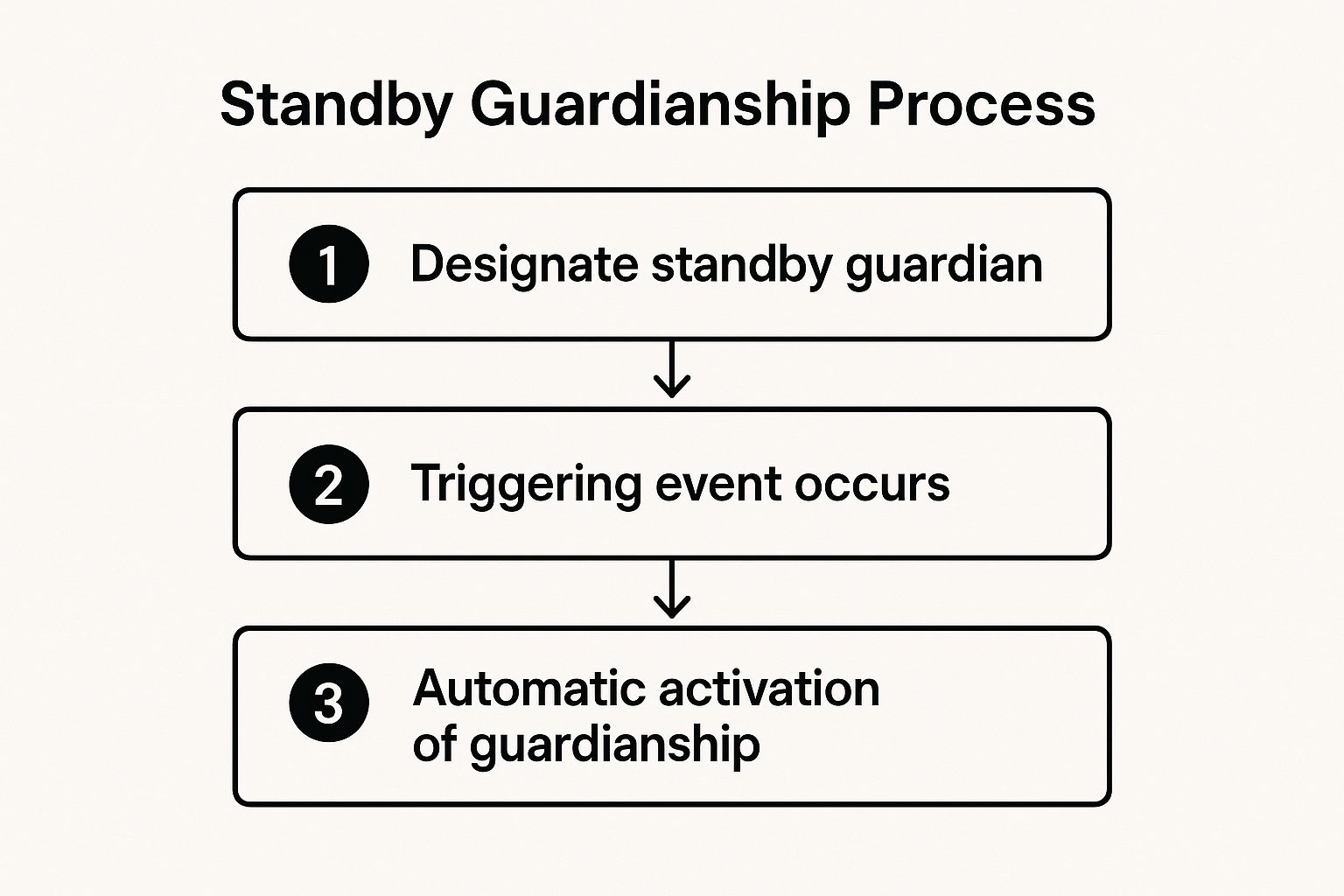
This simple, three-step process highlights the document's power: the parent's proactive planning allows for an automatic and smooth transfer of care precisely when the child needs it most.
Actionable Takeaways for Parents
To ensure your standby guardianship designation is effective and honors your wishes, follow these essential steps:
- Consult with a Guardianship Attorney: Texas laws have specific requirements. An attorney can ensure your document is legally enforceable, properly filed if necessary, and integrated with your overall estate plan.
- Thoroughly Vet Your Designee: Discuss your expectations, parenting philosophy, and financial plans for the child with your chosen standby guardian. Ensure they are fully prepared and willing to take on this profound responsibility.
- Create a Comprehensive Child-Care Packet: Provide the standby guardian with copies of the child's birth certificate, social security card, medical records, school information, and a detailed list of important contacts (doctors, teachers, friends).
- Secure and Distribute Copies: Store the original document in a safe, accessible place. Provide notarized copies to the standby guardian, your attorney, your child's doctor, and school. This ensures all key parties are aware of your plan.
Guardianship Letter Types Comparison
| Type of Letter | Implementation Complexity 🔄 | Resource Requirements ⚡ | Expected Outcomes 📊 | Ideal Use Cases 💡 | Key Advantages ⭐ |
|---|---|---|---|---|---|
| Temporary Guardianship Letter for Minor Child | Moderate – requires notarization, clear scope | Low – accessible legal template, minimal court involvement | Temporary care authority with specific decision rights | Short-term parental absences (travel, work, medical) | Flexible duration; quick setup; parents retain custody |
| Medical Guardianship Authorization Letter | Low to moderate – focused on medical consent, notarization recommended | Low – detailed medical info needed | Legal authority for medical decisions | Medical emergencies, school/camp medical consent | Ensures prompt medical care; accepted by healthcare providers |
| Educational Guardianship Letter for School Enrollment | Moderate – notarization, proof of residency often needed | Low – documentation and school forms | Authority over educational decisions | School enrollment when parents unavailable | Supports educational continuity; legal school access |
| Travel Consent and Guardianship Letter | Moderate to high – notarized, apostille or translation may be needed | Moderate – multiple docs, possible authentication | Child travel authorization and emergency care authority | Domestic/international travel with non-parent adult | Prevents travel delays; legal protection on trips |
| Financial Guardianship Authorization Letter | High – careful drafting, possible attorney involvement | Moderate – banking & legal docs required | Limited financial management authority | Managing child’s finances during parental absence or benefit receipt | Protects assets; legal authority for financial transactions |
| Standby Guardianship Letter | High – legal complexity, possible court filing | Moderate to high – legal counsel advised | Delayed guardianship activation upon trigger | Serious illness, incapacitation, or death planning | Smooth transition; maintains parental rights until needed |
From Examples to Action: Secure Your Family's Future
Navigating the landscape of guardianship can feel overwhelming, but a well-drafted letter is a powerful tool for protecting your loved ones. We have explored several critical scenarios, from authorizing temporary care for a minor to granting specific medical or financial authority. Each example of a guardianship letter serves a unique purpose, acting as a crucial directive when you cannot be there to act yourself.
The key takeaway is that clarity, specificity, and adherence to Texas legal standards are non-negotiable. A vague letter can create more problems than it solves, leading to disputes or legal challenges in a Brazoria County or Fort Bend County courthouse. These documents are more than just paperwork; they are foundational pillars for your family's security during times of transition or crisis.
Key Insights and Actionable Next Steps
Mastering the art of drafting these letters means moving from understanding the templates to applying them strategically to your unique family dynamics. The difference between a helpful letter and an unenforceable one often lies in the details.
Here are the most critical takeaways to transform these examples into effective action:
- Specificity is Your Strongest Ally: As seen in the Medical Guardianship Authorization Letter, ambiguity is the enemy. Vague phrases like "handle medical needs" are insufficient. You must explicitly state the powers being granted, such as the authority to "consent to surgery, access medical records, and communicate with healthcare providers." This level of detail removes any doubt about your intentions.
- Acknowledge Jurisdictional Nuances: While these letters provide a strong framework, Texas law, particularly the Texas Estates Code, governs their ultimate effectiveness. For instance, a temporary guardianship letter may grant authority for a set period, but if a more permanent solution is needed, you will likely need to engage with the formal court process to establish guardianship. These letters are often a first step, not the final one.
- Notarization Provides Crucial Authentication: A recurring theme across all our examples is the need for notarization. A notary’s seal provides a formal layer of verification, confirming the identities of the signatories. This simple step can be the deciding factor for an institution, like a school or hospital, in accepting the letter’s authority.
- Proactive Planning Prevents Reactive Panic: The best time to prepare a Standby Guardianship Letter or a Travel Consent Letter is long before you need it. Waiting for an emergency creates stress and increases the likelihood of errors. Proactive planning provides peace of mind, ensuring a clear plan is in place for a variety of "what-if" scenarios.
Ultimately, these examples of guardianship letters are a starting point. They are meant to educate and empower you. However, every family’s situation carries its own set of complexities, from the specific needs of a child to the intricate financial affairs of an aging parent. Customizing these templates to fit your precise circumstances, while ensuring they are legally sound under Texas law, is the most important step you can take.
This proactive approach not only protects the person in need of care but also provides clear guidance for caregivers, medical professionals, and educators, ensuring that your wishes are honored and your loved ones receive the seamless support they deserve.
Navigating the specifics of Texas guardianship law requires more than just a template; it requires experienced legal guidance. The attorneys at the Law Office of Bryan Fagan, PLLC understand the emotional and legal challenges Texas families face. We specialize in tailoring these documents to your unique needs, ensuring they are robust, enforceable, and provide true peace of mind. Schedule a free consultation with our compassionate team today to create a clear and secure plan for your family's future.