Skip to content
For many Texas families, the short answer is yes—placing your home into a trust is often one of the smartest estate planning decisions you can make. We understand that thinking about the future can feel overwhelming, but taking this step now is a powerful way to protect your loved ones. It helps you bypass the public and often slow probate process, ensures your home passes seamlessly to your family, and safeguards your wishes if you ever become unable to manage things yourself.
The Essential Question for Texas Homeowners
Deciding what will happen to your home is a major part of planning for your family’s future security. When families ask, “should you put your house in a trust?” it comes from a deep desire to protect their most significant asset and the people they care about most. This guide is here to provide clear, straightforward answers to help you navigate this important choice with confidence.
Making this decision involves weighing the significant benefits against the initial time and cost of setting it up. For most families in Texas, a trust offers a level of peace of mind that a simple will just cannot match. It’s about creating a private, efficient, and crystal-clear plan that works for you and your loved ones, both during your lifetime and after you’re gone.
This visual map breaks down the core reasons homeowners start thinking about a trust in the first place.
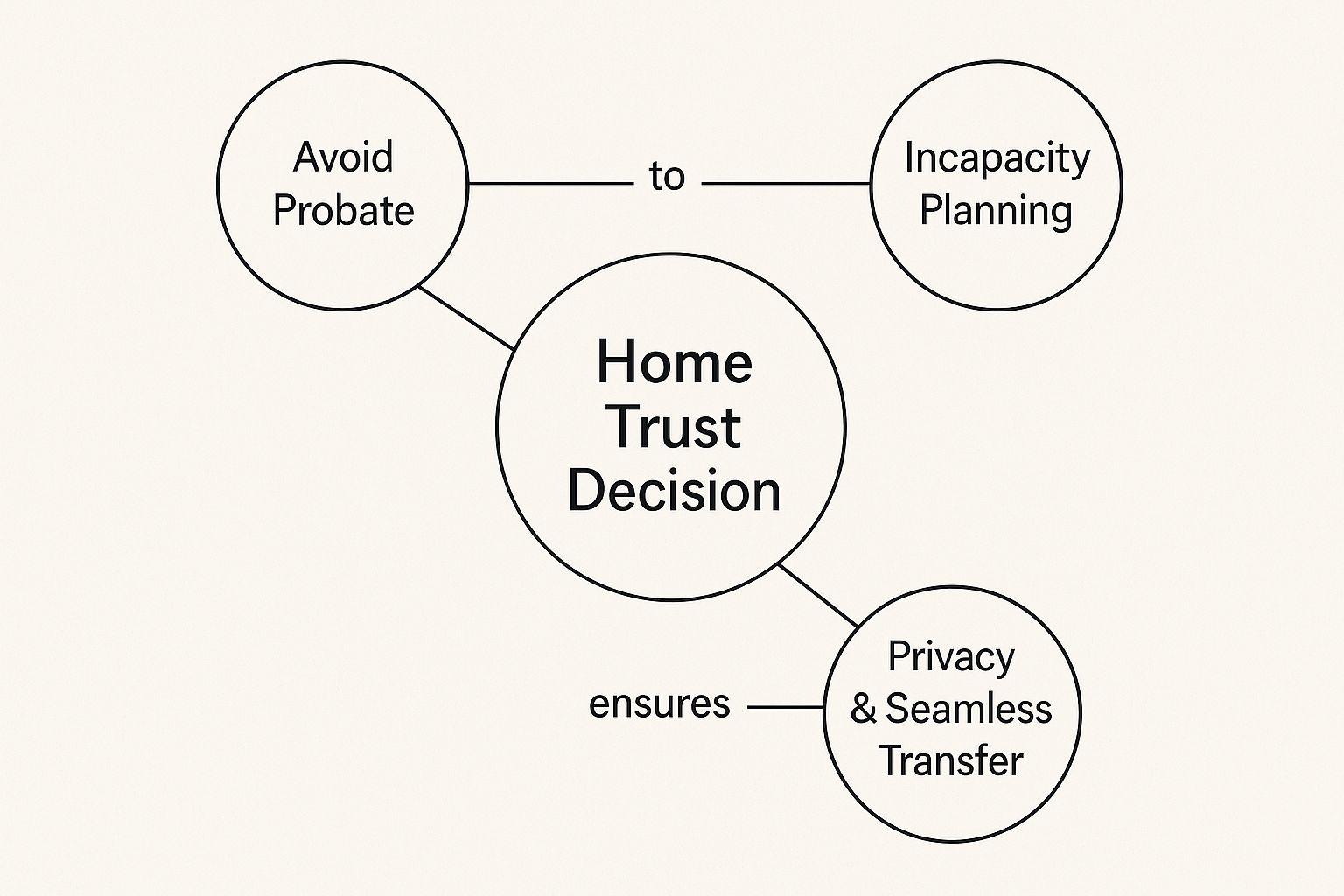
As the infographic shows, it all boils down to three main goals: avoiding probate, planning for potential incapacity, and making sure the transfer of your property is private and smooth.
Key Benefits at a Glance
A trust provides a structured way to manage your property, offering real advantages over other estate planning tools. The main reasons Texas homeowners choose this path include:
- Avoiding Probate: A house held in a trust passes directly to your beneficiaries without needing to go through court. This saves your family significant time, money, and the stress of a public legal process in courts like the Harris County Probate Court.
- Incapacity Planning: If you become unable to manage your own affairs due to illness or injury, the person you chose as your successor trustee can step in immediately to handle the property on your behalf. This avoids the need for a costly and intrusive court-ordered Guardianship, keeping your personal matters private.
- Privacy and Control: Unlike a will, which becomes a public record during the Probate process, a trust is a completely private document. It keeps your family’s affairs out of the public eye and gives you precise control over how and when your home is distributed.
To help you see the big picture, here’s a quick summary of the main factors to consider.
Putting Your House in a Trust at a Glance
| Key Consideration | How a Trust Helps | Potential Drawback or Alternative |
|---|---|---|
| Probate Avoidance | Your house passes directly to heirs, bypassing the court system entirely. | Texas offers simpler probate alternatives, like a Transfer on Death Deed, for less complex situations. |
| Incapacity Planning | A successor trustee can manage the property if you can’t, avoiding a court-appointed guardian. | A Durable Power of Attorney can also grant management authority, but may be less comprehensive. |
| Privacy | The terms of your trust and the transfer of your home remain a private family matter. | A will becomes public record once it enters probate, exposing details to anyone who looks. |
| Control Over Assets | You can set specific conditions for inheritance (e.g., when a child receives the home). | A will offers less granular control; assets are typically distributed outright after probate. |
| Initial Cost & Effort | — | Requires upfront legal fees ($2,000 – $5,000+) and the administrative step of retitling the deed. |
Thinking through these points is the first step in building a solid Estate Planning strategy. The decision isn’t one-size-fits-all, and understanding your options is key to feeling empowered.
At The Law Office of Bryan Fagan, we are here to help you figure out the best path for your family. Schedule a free consultation with us to talk through your specific needs and goals with care and clarity.
How a Trust Works for Your Home

It’s easy to get tangled up in legal jargon, but the concept of a trust is actually quite straightforward. Think of it as creating a special, protective container for your house. You’re not actually giving your home away; you’re just changing the name on the title—moving it from your personal name into the name of the trust.
Once you’ve created this container, you write the rulebook for it. This crucial document, called the trust agreement, is where you spell out exactly how you want your property managed and who will benefit from it, both now and in the future.
The Key Players in Your Trust
To truly understand this process, it helps to know who is involved. Far from taking control away from you, a trust actually solidifies it. In a typical Texas revocable living trust, there are three main roles, and you will likely hold all three to start:
- Grantor: That’s you. You’re the one who creates the trust and puts your home inside it.
- Trustee: Initially, this is also you. The trustee is the manager, the one who follows the rulebook you wrote. You have complete power to manage, sell, or refinance your home, just as you always have.
- Beneficiary: This is also you, for as long as you are living. You are the one who enjoys the home. The people you’ve chosen to inherit the property (like your children) only become the beneficiaries after you pass away.
A common myth is that putting your home in a trust means you’ve lost ownership. With a revocable living trust, that’s completely false. You keep 100% control to live in it, sell it, or change the trust whenever you want.
Making the Transfer Official
So, how do you officially place your home inside this protective container? It’s done with a new deed. This legal document transfers the official title of your property from your individual name, “Jane Smith,” over to your trust’s name, something like “The Jane Smith Family Trust.”
This new deed is then filed with the county clerk right here in Texas—whether you’re in Bexar County, Travis County, or Harris County. That simple action is what allows your home to sidestep the often public and slow Probate process down the road. It keeps your affairs private and guarantees a smooth transition for your family, exactly as you planned it. Taking this step is a fundamental part of thoughtful Estate Planning.
Key Reasons to Place Your Texas Home in a Trust

For most Texas families, the single biggest reason to put a house in a trust boils down to one word: probate. It’s a court-supervised process that can turn a time of grieving into a long period of legal stress and public scrutiny. When your home is in a trust, it’s not part of your probate estate. This means it can pass directly to your loved ones without ever seeing the inside of a courtroom.
This simple step can save your family from months, or even years, of waiting. Probate timelines can be slow, especially in busy jurisdictions like the Harris County or Dallas County probate courts. Bypassing this process entirely ensures a faster, more private, and less expensive transfer of what is likely your family’s most significant asset.
Steer Clear of Public Probate Proceedings
When a will goes through probate, it becomes a public record. Anyone can walk into the courthouse and look up the details of your estate, including the value of your home and who inherited it. A trust, on the other hand, is a completely private document. Your family’s affairs remain confidential, shielding them from nosy neighbors and opportunistic solicitors during an already challenging time.
The financial benefits are just as significant. Probate can be lengthy and expensive, often stretching from six months to over a year. Using a trust allows your heirs to receive the property much faster and with fewer legal fees, preserving more of your legacy for them.
Plan for Incapacity Without Guardianship
A trust isn’t just about what happens after you pass away; it’s a powerful tool for your lifetime. We know it’s difficult to think about, but what if you become ill or injured and can no longer manage your own financial affairs? Without a plan in place, your family might have to go to court to establish a Guardianship, a process that is often expensive, public, and emotionally draining for everyone involved.
A trust offers a seamless and compassionate alternative. In the trust document, you name a successor trustee—someone you personally choose and trust—to step in and manage the property on your behalf if you ever become incapacitated. This ensures your mortgage gets paid, the property is maintained, and your wishes are followed, all without any court involvement.
A trust empowers you to appoint a trusted person to manage your home if you can’t, completely avoiding the public and often contentious guardianship process detailed in the Texas Estates Code, Title 3, Subtitle G.
This proactive approach provides incredible peace of mind. For those looking at more advanced strategies, specialized trusts like Qualified Personal Residence Trusts can offer unique benefits for a Texas home. By making these arrangements now, you protect both your property and your family’s well-being, which is a core component of any thoughtful Estate Planning strategy.
Understanding the Costs and Considerations

While a trust is an incredibly powerful tool, it’s important to understand the commitments involved. The primary factor for most families is the initial cost. Setting up a comprehensive trust with an experienced Texas attorney will cost more upfront than drafting a simple will.
However, viewing this as just an expense is missing the bigger picture. Think of it as an investment in your family’s future peace of mind. That upfront cost is often just a fraction of what your family could end up paying in court fees and legal bills during a lengthy Probate process. In short, you’re paying now to save your loved ones a significant amount of money—and a great deal of stress—down the road.
Managing Your Trust Day-to-Day
Putting your house in a trust isn’t a “set it and forget it” action. It’s an active planning tool, and sometimes that means a few minor administrative steps are needed along the way. These tasks are usually straightforward, but it’s important to be aware of them.
For example, what if you decide to refinance your mortgage? Your lender will have specific rules. Many banks in Texas will require you to temporarily transfer the house out of the trust and back into your personal name while the loan is being processed. Once it’s done, you must formally transfer it back into the trust with a new deed.
It is absolutely critical to ensure the house is retitled back into the trust after a refinance. Forgetting this step can accidentally push the home back into your probate estate, defeating a key purpose of creating the trust in the first place.
Common Misconceptions to Avoid
One of the biggest areas of confusion for Texas families revolves around asset protection. It’s crucial to understand what a standard revocable living trust can—and cannot—do.
- Medicaid Estate Recovery: A revocable trust does not shield your home from Medicaid estate recovery. If you receive long-term care benefits paid for by Medicaid, the state can seek reimbursement from your estate, including your house, after you pass away.
- Creditor Protection: Similarly, this type of trust won’t protect your home from your own creditors or from lawsuits during your lifetime. Since you still have full control over the asset, the law still views it as yours.
There are specialized irrevocable trusts that can offer these kinds of protections, but they come with a major trade-off: you have to give up control. This is why clarifying your goals—is it probate avoidance, or is it asset protection?—is such a vital first step in your Estate Planning.
Navigating these details is exactly where professional guidance becomes so important. To get clear answers that apply directly to your family’s situation, schedule a free consultation with our team.
Navigating Tax Implications for Your Property Trust
Whenever trusts come up, the next question is always about taxes. It’s a major concern for any Texas homeowner, and rightfully so. The good news is that for your lifetime, a revocable living trust is designed to keep things simple.
You can think of it as being “tax neutral.” For all intents and purposes, nothing changes on your tax returns. You’ll continue to file using your own Social Security number, just as you always have, and your property tax situation remains exactly the same.
The real tax benefit often comes into play for your loved ones after you’re gone. This is thanks to a powerful IRS rule known as the step-up in basis. It essentially resets the clock on your home’s taxable value, which can save your beneficiaries a significant amount in capital gains taxes if they decide to sell the property.
How the Step-Up in Basis Works
Let’s walk through a simple scenario to see how this works for a Texas family.
Imagine a couple bought their home in a Houston suburb years ago for $100,000. It was a great investment, and by the time they pass away, its market value has skyrocketed to $500,000.
- With a Trust: The home passes to their children privately, avoiding probate court. Its tax basis is “stepped up” to the current $500,000 market value. If the children turn around and sell it for that price, their taxable capital gain is $0.
- Without a Trust (Using a Will): The tax result is the same, but the process is public and can get stuck in probate. The home’s basis still gets stepped up to $500,000, and a sale at that price would also mean no capital gains tax.
This step-up is a critical benefit of passing property through an estate, whether you use a will or a trust. The trust simply makes the entire transfer faster, easier, and more private for your family.
Estate Taxes and a Look Ahead
For most families in Texas, federal estate taxes are not an immediate concern because the current exemption levels are very high. A primary reason to place your home in a trust is to make transferring wealth simpler while minimizing future tax headaches; Understanding Inheritance Tax is a big piece of that puzzle.
However, tax laws can and do change. The conversation around trusts and taxes is about to become much more important after 2025, when current federal estate and gift tax exemptions are scheduled to be cut roughly in half.
Unless Congress acts, this change could pull many more estates into the taxable range. This makes trusts an even more powerful tool for planning ahead and managing potential liabilities. Our team stays on top of these evolving regulations, including those laid out in the Texas Estates Code, to provide you with the most current guidance possible.
It’s vital to understand how these moving parts fit together. If you’d like to get personalized advice on how a trust could work for your family’s specific financial situation, we’re here to help.
Making the Right Decision for Your Family
Deciding whether to put your house in a trust is a significant step, and there is no single right answer for every Texas family. The best choice depends on your specific situation, your finances, and what you hope to achieve for your loved ones. Our goal is not to push you one way or the other, but to empower you with the clarity you need to protect your family’s legacy.
To get there, it helps to pause and reflect on what truly matters most. Working through a few key questions can help connect these concepts to your own life.
Key Questions to Ask Yourself
- Is avoiding probate a top priority? If your main goal is to shield your family from the public, expensive, and often lengthy probate process—especially in busy courts like Harris County’s—a trust is one of the most effective tools you can use.
- Are you concerned about potential incapacity? Life is unpredictable. A trust allows you to name someone to manage your property if you ever become unable to, sidestepping the need for a stressful and public court-ordered guardianship.
- Is family harmony important? We know that money and property can unfortunately cause friction. By creating a clear, private plan in a trust, you can prevent confusion and potential disagreements among your heirs during an already emotional time.
A living trust gives you control over how your home is managed during incapacity or after death, paving the way for smoother generational wealth transfer with fewer legal hurdles and reduced costs.
For many Texans, the flexibility and control a trust provides is priceless. Revocable living trusts are particularly useful because you can update them as your life evolves, ensuring your plan always reflects your current wishes.
Ultimately, this decision is a crucial piece of your larger estate planning puzzle. Making sure it fits with your overall strategy is key, which is why our guide on the relationship between guardianship and estate planning can help you see the bigger picture for securing both future care and assets.
To get personalized advice on how all this applies to your family, the next step is to talk with an experienced Texas estate planning attorney. We invite you to schedule a free consultation with The Law Office of Bryan Fagan today to discuss your family’s needs.
Common Questions About Texas Home Trusts
The decision to put your house in a trust is a big one, and it’s completely normal to have questions. To help you find some clarity, here are straightforward answers to some of the most common concerns we hear from families just like yours across Texas.
Can I Still Sell or Refinance My House if It Is in a Trust?
Yes, you absolutely can. This is a very common concern, but the reality is simple. When you set up a revocable living trust, you typically name yourself as the trustee. That means you keep 100% control.
If you decide to sell or refinance, the process is almost identical. The only real difference is that when you sign the paperwork, you’ll do so in your official capacity as “trustee” instead of as an individual. An experienced estate planning attorney can walk you through the specifics to make sure everything goes smoothly with your lender, whether they’re in Harris County or anywhere else in Texas.
Does a Trust Protect My Home from Lawsuits or Creditors?
This is a critical point that can be confusing. A standard revocable living trust does not shield your home from your own creditors or from lawsuits. Why? Because you haven’t truly given up control. Since you can dissolve the trust or take the house out at any time, the law still considers that property to be yours.
There are other, more complex tools—like certain irrevocable trusts—that can offer that kind of asset protection. But they come with a major trade-off: you have to give up control and flexibility over the asset. It’s vital to talk with an attorney about what you’re trying to achieve so you can use the right tool for the job.
A trust is a powerful tool for planning for incapacity, which is also a key consideration in guardianship matters. You can learn more by exploring our detailed guide on planning for incapacity with powers of attorney and advanced directives in Texas.
Is a Trust Better Than Adding My Child to the Deed?
For most families, using a trust is a much safer and smarter strategy. It might seem easier to just add your child’s name to the deed as a joint owner, but that one simple act can create a host of problems you never anticipated.
The moment you add them to the deed, your home is suddenly exposed to their financial life. This means your property could be at risk because of your child’s potential lawsuits, creditor claims, or even a divorce settlement. It also makes it harder for you to sell or refinance later and can create unnecessary gift tax issues. A trust allows you to pass your home to your child without these serious risks, all while you stay firmly in control.
We understand that making these kinds of decisions can feel overwhelming, but you don’t have to do it alone. You deserve clear, professional advice built around your family’s unique circumstances. The experienced attorneys at The Law Office of Bryan Fagan, PLLC are here to provide exactly that. Schedule your free, no-obligation consultation today by visiting https://texasguardianshiplawyer.net and take the first step toward securing your family’s future.