Skip to content
A lot of families reach this question later than they expected.
A parent who needed full help after a stroke is now handling daily choices again. An adult child with a disability has grown into skills the court record never fully captured. Or a guardian who once seemed necessary now controls far more than the situation calls for. In Texas, that doesn’t mean you have to accept the current order forever.
Guardianship is supposed to fit the person’s actual needs. If the fit is wrong, the law gives you a path to ask the court to scale it back, reshape it, or end it. That process can feel personal and tense, especially in probate courts in places like Harris County or Dallas County, where families often arrive already carrying stress, guilt, and disagreement. Still, asking to reduce authority is not an attack on the guardian. In many cases, it is the most responsible thing a family can do.
Texas law takes autonomy seriously. Under Texas Estates Code Title 3, Subtitle G, courts must look closely at incapacity, necessity, and less restrictive options before broad authority should continue. That matters whether you’re dealing with a guardianship of the person, a guardianship of the estate, a temporary guardianship, or a long-running case that no longer reflects reality.
Families looking into reducing guardian authority texas usually need two things at once. They need legal clarity, and they need practical steps. Both matter. A strong case is built on evidence, timing, and a clear request the judge can act on.
Understanding Your Right to Reduce a Guardian's Power
If your loved one has regained some ability to make decisions, or if the guardian’s role has become broader than necessary, Texas law allows you to ask for change. In plain English, reducing guardian authority means asking the probate court to narrow the guardian’s powers so the ward keeps more personal rights, financial control, or both.
That can mean different things in real life. A judge may leave a guardian in place for finances but return medical choices to the ward. The court may allow the ward to decide where to live while keeping estate oversight in place. In other cases, the court may terminate the guardianship entirely if it’s no longer needed.
Why this right matters
This issue goes to dignity. A guardianship order can affect where a person lives, how money is handled, who consents to medical care, and whether the person can make basic choices most adults take for granted. When capacity improves, or when support systems improve, the legal order should be reexamined.
Texas families also have more tools than they once did. Supported decision-making can help a person make their own choices with trusted assistance rather than surrendering decision-making power altogether. For families thinking through practical supports outside the courtroom, this guide to disability independence tools gives useful examples of the kinds of resources that can strengthen a less restrictive plan.
The court’s job isn’t to preserve a guardianship at all costs. Its job is to protect the ward with the least loss of rights necessary.
What reducing authority is not
It isn't always a claim that the guardian has done something wrong. Sometimes the guardian has done exactly what the court asked, and the problem is that the original order no longer matches the ward's current abilities.
It also isn’t limited to one kind of family situation. These cases arise in aging-parent matters, adult disability matters, probate disputes, and post-crisis cases where a temporary loss of capacity became the basis for a long-term order. In each setting, the court will focus on the same core question. What level of authority is still necessary now?
When to Consider Limiting a Guardian's Authority
Some families wait because they think a guardianship order is fixed unless something dramatic happens. That’s not how Texas probate courts view these cases. If circumstances have changed in a meaningful way, it may be time to ask whether the current order is still the least restrictive option.

Texas formally shifted in that direction in 2015, requiring courts to explore less restrictive alternatives before imposing full guardian authority. That reform addressed prior over-reliance on guardianships, where over 51,250 active cases controlled $4.9 billion in assets according to the Texas guardianship reform report from the Texas Judicial Branch. The practical takeaway is simple. Guardianship is not supposed to be broader than necessary.
Core principle: If a person can safely make some decisions with support, the court should not strip away all decision-making power.
Capacity has improved
This is the most common reason families start asking hard questions.
A person may recover after a hospitalization, stabilize after a mental health crisis, or learn skills over time that were missing when the original order was signed. Improvement doesn’t have to be perfect. It only has to be meaningful enough that some rights can safely return.
A common example is an older adult who can now understand medical treatment choices and clearly express where they want to live, even if they still need help paying bills. That may support moving from a broader guardianship to a more limited one.
The guardian is overreaching
Sometimes the issue is not the ward’s improvement. It’s the guardian’s conduct.
A guardian may start making decisions the order doesn’t authorize. They may shut family members out, override the ward on routine preferences, or treat convenience as if it were legal authority. In a guardianship of the estate, warning signs can include poor records, unexplained transactions, or delays in required filings.
That doesn’t always mean removal is the right first step. In some cases, narrowing the guardian’s powers gives the court a cleaner, faster remedy than trying to relitigate the whole appointment.
Less restrictive alternatives now exist
Families often seek guardianship in a crisis. Later, the picture looks different. A durable power of attorney may now be possible. A supported decision-making agreement may work. A more organized care team may reduce the need for broad court supervision.
Here are common alternatives that can support a request:
- Supported decision-making helps the person keep authority while receiving help understanding choices.
- Power of attorney documents may cover financial or medical areas if the person has the capacity to sign them.
- Limited guardianship can target one area of need without controlling everything else.
- Informal support systems such as reliable caregivers, treatment providers, and family coordination can help show the court that risk is manageable.
Short examples that often mirror real cases
| Situation | What the family should ask |
|---|---|
| A mother now manages her medications and understands doctor visits | Should medical decision-making be restored to her? |
| An adult son can budget a paycheck but struggles with investments | Should the guardian’s authority be limited to major estate matters only? |
| A guardian controls residence, healthcare, and finances, but the ward consistently demonstrates sound judgment in daily choices | Is the current order broader than necessary? |
In Harris County Probate Court or Dallas County probate court, judges often focus less on family frustration and more on proof of current reality. If you can show that reality has changed, the case for limiting authority gets stronger.
Legal Grounds for Changing a Guardianship in Texas
Texas courts don’t modify guardianships just because family members disagree. They act when the evidence shows that the current order no longer matches the ward’s needs, the guardian is failing in legal duties, or the ward’s rights require a narrower arrangement. The governing framework sits within Texas Estates Code Title 3, Subtitle G, with modifications and restorations addressed through Chapter 1202.
Procedural reforms also matter here. As noted in the summary of Senate Bill 746 and related Texas reforms, court oversight was strengthened and duties were clarified, reinforcing the legal paths to challenge unfit guardians and requiring courts to review incapacity and necessity before authority is maintained or expanded. That fits the larger rule in Texas. Guardianship should be a last resort, not a default setting.
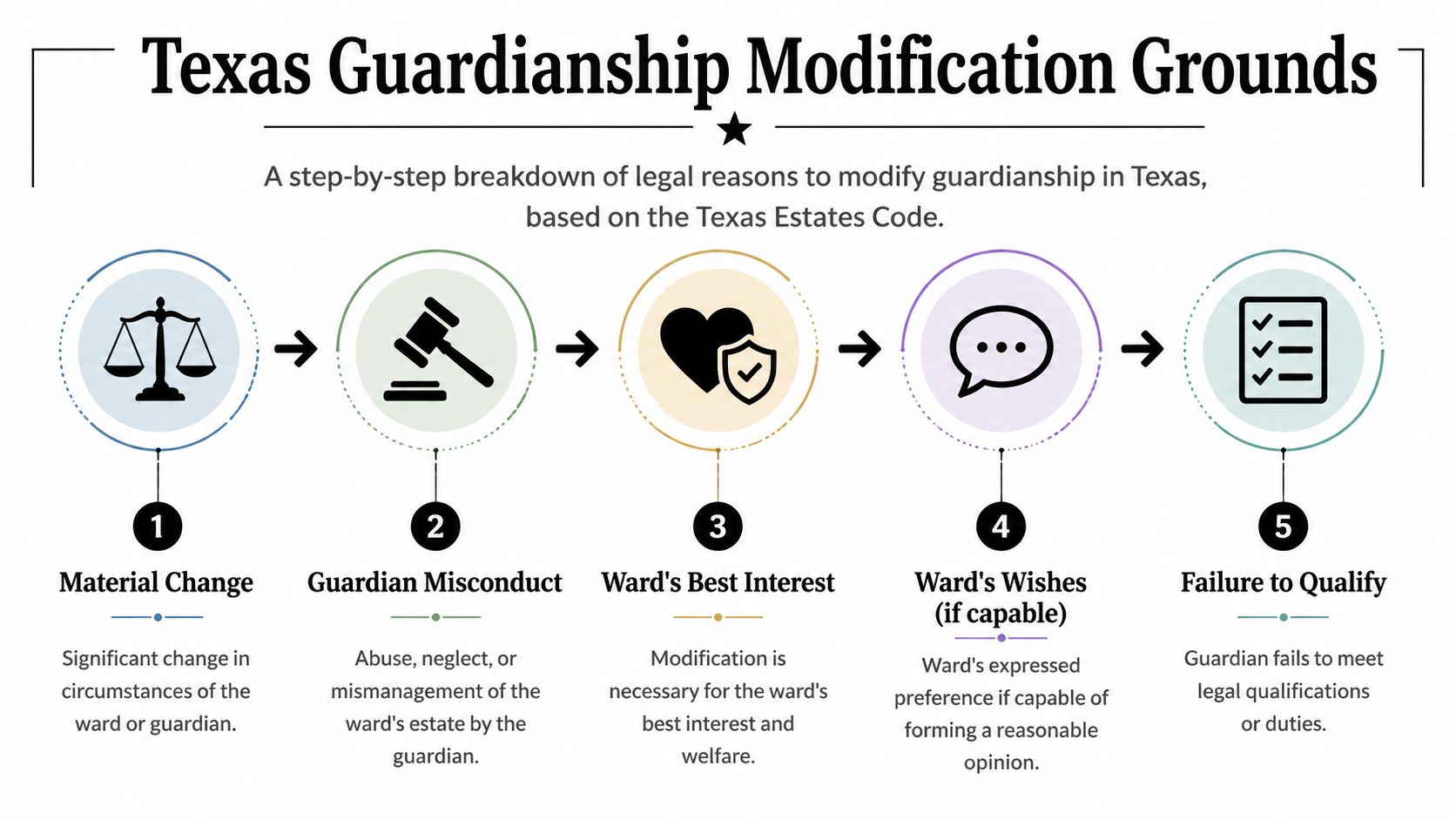
Restored or partial capacity
The strongest modification cases usually start here. If the ward can now understand and make some decisions, the court can restore those rights even if other limitations remain.
For example, an adult under guardianship may now understand housing choices, consent to routine medical care, or manage small personal funds. That does not require an all-or-nothing outcome. A judge can leave some protections in place while returning specific rights.
Guardian misconduct or failure of duty
A guardian is a fiduciary. That means the guardian must act for the ward’s benefit and comply with court orders, reporting duties, and limits on authority.
Misconduct can take many forms:
- Financial mismanagement such as poor accounting, improper use of funds, or missing records
- Neglect of the ward’s needs including care decisions that ignore safety or wellbeing
- Failure to file required reports or accountings with the probate court
- Acting outside the court order by making decisions the guardian was never authorized to make
A simple hypothetical shows how judges often view this. If a guardian of the estate cannot explain where money went and has not kept current accountings, the court may see that as a legal problem, not a family misunderstanding.
Courts pay close attention to specifics. “We don’t trust him” is weak. “He failed to file the required accounting and cannot document estate expenditures” is something a judge can act on.
The current arrangement is no longer the least restrictive means
This ground matters in many disability and elder law cases. A full guardianship may have been appropriate when the case began, but it may now be too broad.
A ward’s bill-paying may still require help, while personal choices do not. A person may need support with contracts but not with choosing services, voting, social relationships, or residence. If less restrictive tools can manage the risk, Texas courts have authority to limit guardianship accordingly.
The ward’s best interest and stated wishes
A court will not merely follow preference alone. But if the ward can form and express a reasonable preference, that matters. Judges and attorney ad litems often want to know what the ward understands, what the ward wants, and whether that request lines up with safety and evidence.
Failure to qualify or remain qualified
Sometimes the issue isn’t abuse. It’s that the guardian no longer meets the practical or legal demands of the role. The guardian may be too ill, too distant, too disorganized, or too conflicted with the ward to continue exercising broad authority.
A practical way to think about the legal grounds
| Ground | Plain-English meaning | Example |
|---|---|---|
| Restored capacity | The ward can now handle more decisions | A parent now understands treatment choices and can express informed consent |
| Misconduct | The guardian is harming the ward or mishandling the role | Estate records are incomplete and money can’t be traced |
| Less restrictive option available | A narrower plan can protect the ward | Supported decision-making now covers personal choices |
| Best interest | The current order no longer fits what protects the ward | Full authority creates unnecessary loss of rights |
| Failure of duty | The guardian isn’t performing required obligations | Required reports remain unfiled |
In courts such as those serving Houston and Dallas families, these cases succeed when the petition ties legal grounds to concrete proof. Chapter 1202 gives the court authority to modify or restore rights, but the judge still needs a disciplined record to justify changing the order.
How to Prepare and File Your Petition to Reduce Authority
The filing stage is where many strong concerns turn into weak cases. Families often know something is wrong, but the petition doesn’t give the judge enough detail to act. Texas probate courts need a clear request, the right supporting documents, and proof that all required parties received notice.
The process usually starts by filing a Motion to Remove Guardian or Petition to Terminate Guardianship. According to the practical guidance in this Texas overview of removing a guardian, uncontested cases can resolve in 2-3 months, while contested matters may take 6-12 months or more. The same source warns that vague disagreements without documented proof can sink a petition early.
Start with the exact relief you want
Don’t file before you know what you’re asking the court to do.
Some families want full termination because the ward has regained capacity. Others want a narrower order, such as removing the guardian’s control over residence, healthcare, or routine spending while keeping estate protections in place. In still other cases, the right remedy is replacing the guardian or reducing only part of the authority.
If the request is fuzzy, the hearing will be fuzzy too.
Build an evidence file before drafting
In many cases, the medical record is the backbone of the petition. If you’re seeking termination based on restored capacity, a Certificate of Medical Examination from a physician is often critical. If you’re asking for a narrower modification, physician evaluations, treatment notes, or other professional assessments can show what the ward can and cannot do.
A useful document checklist often includes:
- Medical support such as a physician’s evaluation, treatment summaries, or a Certificate of Medical Examination if capacity restoration is at issue
- Financial records if you’re alleging estate mismanagement, including bank statements, ledgers, receipts, and missing-account explanations
- Affidavits from caregivers, relatives, social workers, or other people with firsthand knowledge
- Prior court orders so the judge can compare the current request to the original scope of authority
- Alternative-support documents such as a supported decision-making agreement draft, care plan, or relevant power of attorney paperwork if those tools are available
Use facts, not conclusions
A petition should read like a record of events, not a family argument.
Instead of saying the guardian is controlling, state the conduct. For example, identify dates when the guardian blocked medical communication, refused to provide information required by the order, or made residence decisions without consulting the ward where consultation was still appropriate.
Practical rule: If you can attach a document, identify a date, or name a witness, your allegation is stronger.
File in the correct probate court
The petition must be filed in the court that has the guardianship case. In places with dedicated probate courts, such as Harris County Probate Court or Dallas County probate court, local procedures and scheduling practices can shape how quickly the matter moves. In counties without specialized probate courts, the process may feel less predictable, which makes clean paperwork even more important.
Families often benefit from reviewing a detailed discussion of modifying guardianship powers in Texas before filing because the requested relief has to match the evidence and the current order.
Notice matters more than people expect
You must notify the parties the law requires. That typically includes the guardian, the ward, and other interested persons depending on the case posture. If notice is defective, the court may delay the hearing or dismiss the request.
This is one of the most common procedural failures. Families focus on the merits and forget that probate courts cannot skip due process.
A simple filing roadmap
- Identify the legal basis under Chapter 1202 or related guardianship provisions.
- Choose the remedy you are requesting, modification, limitation, replacement, or termination.
- Gather evidence that proves change, misconduct, or the availability of a less restrictive arrangement.
- Draft the petition carefully with specific facts and supporting attachments.
- File in the proper court and obtain a hearing setting if required by local practice.
- Serve notice correctly on all required persons.
- Prepare for ad litem review and possible contested testimony.
What works and what usually doesn’t
| Works | Usually doesn’t |
|---|---|
| Physician support tied to specific decision-making abilities | General claims that the ward is “doing better” |
| Financial exhibits showing missing or misused funds | Suspicion without records |
| A narrow, realistic request | An overbroad demand unsupported by current facts |
| A proposed less restrictive plan | Hoping the judge will design the alternative for you |
Families also ask about emergency situations. If immediate harm is happening, the court may need to address temporary relief or urgent protective issues first. But even in urgent cases, judges still want evidence and a defined request. Speed helps only when the paperwork gives the court something solid to sign.
Navigating the Court Hearing and Potential Outcomes
The hearing is where the paper record turns into a live test of credibility. For many families, this is the hardest part. They worry about saying the wrong thing, upsetting the ward, or facing a guardian who sees the petition as a personal accusation.
That anxiety is normal. It also helps to know that probate judges hear these tensions often. What they usually want is a disciplined explanation of what has changed, what evidence supports the request, and why the new arrangement better protects the ward’s rights and welfare.

Who is usually in the room
In a typical hearing, the key people may include the judge, the ward, the guardian, attorneys for one or more parties, and an attorney ad litem appointed to investigate and represent the ward’s interests. The ad litem’s role often carries real weight because that lawyer gives the court an independent view of the ward’s condition and needs.
In contested cases, you may also see treating physicians, caregivers, financial professionals, or relatives called as witnesses.
What the judge usually wants to hear
The court isn’t looking for a dramatic family narrative. It’s looking for evidence tied to the legal request.
Questions often focus on areas such as:
- Current capacity and what the ward can understand or manage now
- Specific powers at issue such as medical consent, residence decisions, or estate control
- Safety concerns if authority is reduced
- Available alternatives including supported decision-making or limited guardianship
- Guardian conduct if misconduct or failure of duty is part of the motion
A useful hearing mindset is to think in categories, not emotions. Can the ward handle daily spending? Can the ward understand treatment options? Is there a safe support network? Has the guardian complied with reporting and fiduciary duties?
Medical evidence often carries the case
For modification requests, the strongest hearings usually include professional evidence that connects medical findings to real-life decision-making ability. According to this discussion of termination and modification evidence in Texas guardianship matters, physician-backed petitions to modify authority succeed at around 75%, compared with about 35% without strong medical evidence.
That gap explains why unsupported family opinions rarely carry the day on their own.
Bring the court a doctor’s evaluation that answers practical questions, not just a diagnosis. Judges need to know what the ward can do, not only what condition the ward has.
A hearing often unfolds like this
A petitioner presents the request and evidence. The guardian or guardian’s lawyer responds. The attorney ad litem gives findings or recommendations. Witnesses testify, and the judge asks pointed questions where the file is unclear.
If you want a better sense of how judges evaluate proof, this overview of an evidentiary hearing in a Texas guardianship case helps families understand what the court is listening for.
Possible outcomes
| Outcome | What it means |
|---|---|
| Full termination | The guardianship ends because it is no longer necessary |
| Partial modification | Some rights return to the ward, while limited authority remains |
| Guardian replacement or narrowed powers | The court keeps protection in place but changes who acts or what powers exist |
| Denial | The current evidence does not justify a change |
A denial isn’t always the end of the matter. Sometimes it means the evidence was premature, incomplete, or too general. A better medical evaluation, stronger records, or a more focused request may support a later petition. In that sense, the hearing is not only about persuasion. It also shows you exactly where the court believes the case is weak.
Exploring Alternatives to Complete Guardianship Removal
Many families think there are only two options. Keep the guardianship exactly as it is, or end it completely. Texas law gives more room than that.
In a lot of cases, the better solution is a right-sized arrangement. The ward keeps more control, but needed protections remain in place. That often produces a more stable result than pushing for full termination before the evidence is ready.
Limited guardianship
A limited guardianship narrows the guardian’s powers to the areas where help is needed. That may mean authority over estate management only, while the ward keeps personal decision-making rights. Or it may mean control over certain medical decisions while the ward handles daily living choices independently.
This option often works well when capacity is mixed rather than fully restored.
Supported decision-making
Texas was the first state to enact supported decision-making statutes allowing individuals to retain decision-making authority with supporter assistance rather than surrendering rights to a guardian. For some adults with disabilities and some older adults, this can be a strong alternative when the person can decide with guidance but doesn’t need a substitute decision-maker.
A supported decision-making arrangement may help with:
- Medical appointments where the supporter helps gather and understand information
- Housing choices where the person wants advice but keeps the final say
- Financial routines such as reviewing bills or understanding options before acting
Power of attorney
If the person currently has legal capacity to sign documents, a durable power of attorney or medical power of attorney may replace part of what the guardianship was doing. This can be especially useful when the concern is practical access and coordination rather than a continuing inability to decide.
Comparing the main alternatives
- Limited guardianship gives the court continuing oversight, but only in the areas still needing protection.
- Supported decision-making preserves the highest degree of autonomy because the individual keeps decision-making authority.
- Power of attorney works when the person has capacity to appoint a trusted agent voluntarily.
- Removal of the guardian may still be appropriate when the current guardian is the main problem, even if some protective structure remains necessary.
Some of the best outcomes come from asking for less than total victory. A carefully limited order is often easier for a judge to grant and easier for a family to live with.
Families who are weighing whether to seek termination or something more modest often benefit from reviewing a practical guide to removing a guardian in Texas alongside the alternatives. The legal question is not just whether the guardianship can end. It’s whether a safer, narrower structure can meet the ward’s needs with fewer lost rights.
This is also where estate planning and probate planning matter. A thoughtful package of powers of attorney, care directives, financial safeguards, and support agreements can give the court a workable replacement for broad authority. Judges are more comfortable reducing control when they can see what will take its place.
Frequently Asked Questions About Texas Guardianship
Can I ask to reduce authority if I live outside Texas
Yes. Out-of-state family members often play a central role in these cases, especially when a parent relocates to Texas for care. One issue comes up often in practice. After an interstate guardianship transfer, families may want to reduce authority immediately rather than leave a broad order in place by default.
As discussed in this Texas guardianship transfer and authority guide, there is limited guidance on bundling a request to reduce authority with the transfer itself, even though that can be an important strategy for avoiding a needlessly prolonged full guardianship after relocation. If you’re in that position, gather the original orders, updated medical information, and a clear explanation of what has changed since the original case.
What if the ward doesn’t need full removal, only fewer restrictions
That is often the better request. Texas courts can modify powers instead of ending the whole case. If your loved one can handle personal decisions but still needs help with estate issues, or can choose where to live but needs support with complex medical decisions, ask for that specific adjustment.
A targeted request usually works better than asking the court to solve every problem at once.
What if my petition is denied
Read the denial carefully. In many cases, the problem is not that the judge believes no change is ever possible. The problem is that the evidence was too thin, too old, too general, or not tied closely enough to the exact powers you wanted restored.
Common next steps include:
- Update the medical proof with a more detailed physician evaluation
- Tighten the request so it matches the ward’s demonstrated abilities
- Address procedural problems such as notice, missing records, or incomplete attachments
- Consider appeal or refiling after talking with counsel about what the court found lacking
How do I know whether this is a guardianship, probate, or estate planning issue
Sometimes it is all three. A guardianship case may overlap with probate court procedure and with estate planning alternatives like powers of attorney. If your family is trying to preserve autonomy while protecting assets and care decisions, you need a strategy that connects those areas rather than treating them as separate boxes.
If your family is facing questions about reducing or ending a guardianship, specific legal advice matters. The Law Office of Bryan Fagan, PLLC helps Texas families with guardianship, probate, and estate planning matters across Houston, Dallas, Austin, San Antonio, and statewide through virtual consultations. Schedule a free consultation to discuss whether a modification, limited guardianship, supported decision-making plan, or termination petition best protects your loved one’s autonomy and safety.