 Skip to content
A child shows up with a backpack, a few clothes, and no clear plan for Monday morning. That’s how this issue often starts. A grandparent takes in a grandchild after a parent’s medical crisis. An aunt steps in while a parent works out of state. A family friend keeps a child stable while the adults sort out housing, treatment, or deployment.
Then the school office asks a simple question that stops everything. “What legal authority do you have to enroll this child?”
Many caregivers are shocked by that moment. They’re feeding the child, getting them to bed, and trying to keep life normal. But schools have rules, and registrars need paperwork before they can treat a non-parent like the person in charge. Without the right document, a child can end up in limbo when what they need most is routine.
A Grandchild at Your Door and a School Gate That's Closed
A grandmother in Harris County may have the child sleeping in her guest room by Sunday night and sitting in front of a registrar by Monday morning. She has the child’s clothes, maybe a report card, maybe a text message from the parent saying, “Please help until I’m back on my feet.” What she often doesn’t have is the one thing the school wants first. Proof that she has authority to act.
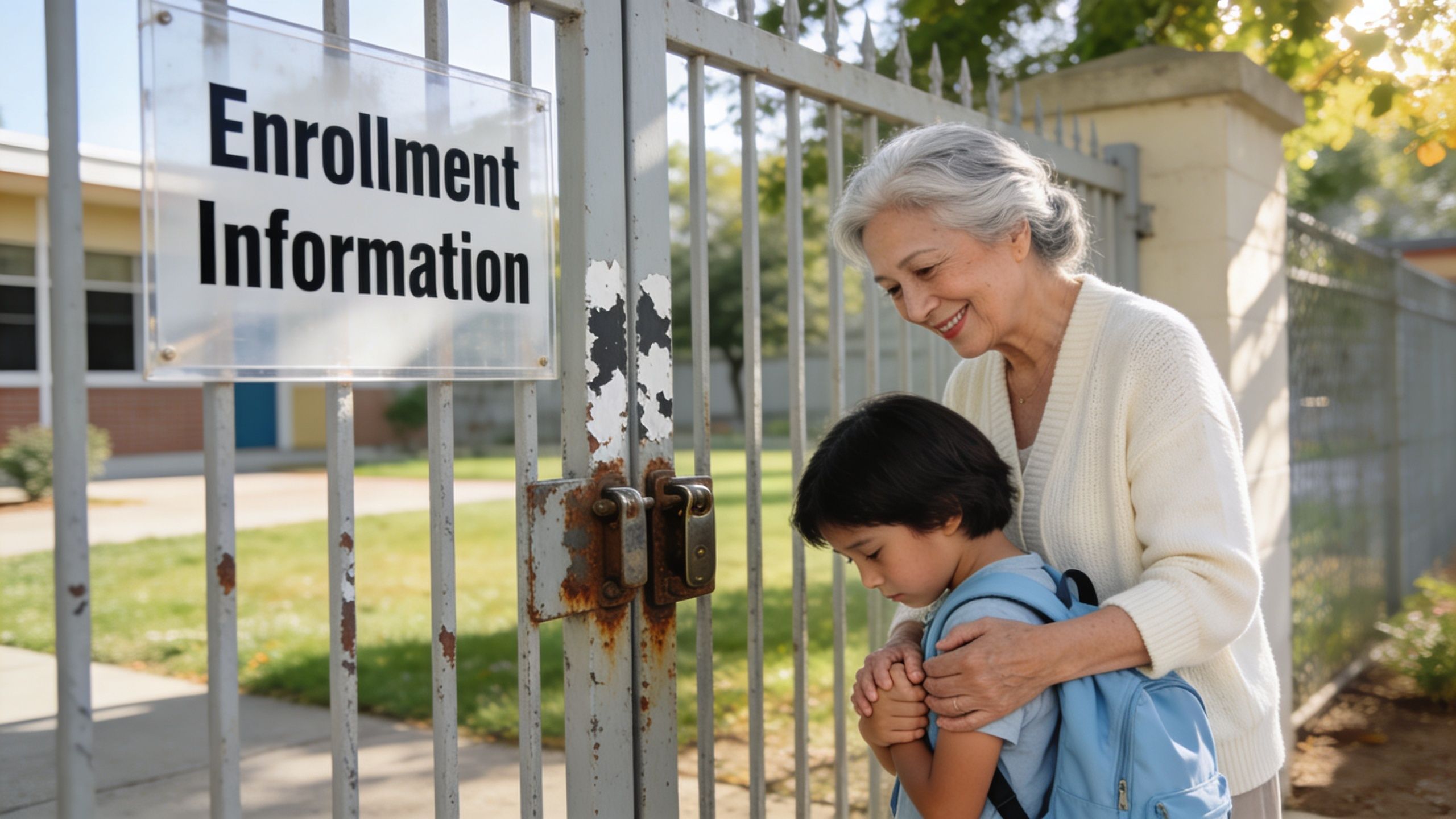
That isn’t a rare problem. Texas public school enrollment has grown over decades and reached over 5.5 million students in the 2024-25 school year, which makes reliable enrollment procedures even more important for children living with non-parents, including grandparents and military families, as discussed in this overview of educational rights and guardianship in Texas.
Why schools stop the process
School staff aren’t trying to be difficult. They need to know who can sign forms, receive records, approve activities, and respond in an emergency. If the child isn’t living with a parent, the district usually wants something formal enough to protect the child and the school.
That’s where families lose time. They may show up with a handwritten note, a text message, or a verbal explanation. Those things may explain the situation, but they usually won’t solve it.
A child’s school placement can stall even when everyone agrees the caregiver is doing the right thing.
The good news
Texas law gives families practical tools for this exact situation. In many cases, you don’t need to rush into a full guardianship case. In other cases, a court order is the only safe and workable path. The key is choosing the right option at the start.
If you’re a grandparent handling day-to-day care, you may also be sorting through money issues, tax questions, and benefits. A helpful companion resource is this essential tax guide for grandparents, especially when a temporary caregiving arrangement starts affecting household finances.
The rest of the decision usually turns on one question. Can the parent still cooperate and sign the right document, or is court intervention now unavoidable?
Two Paths to the Classroom Door Authorization vs Guardianship
Texas families usually have two paths when a non-parent needs authority for school matters. One path stays out of court. The other runs through probate court under the Texas Estates Code.
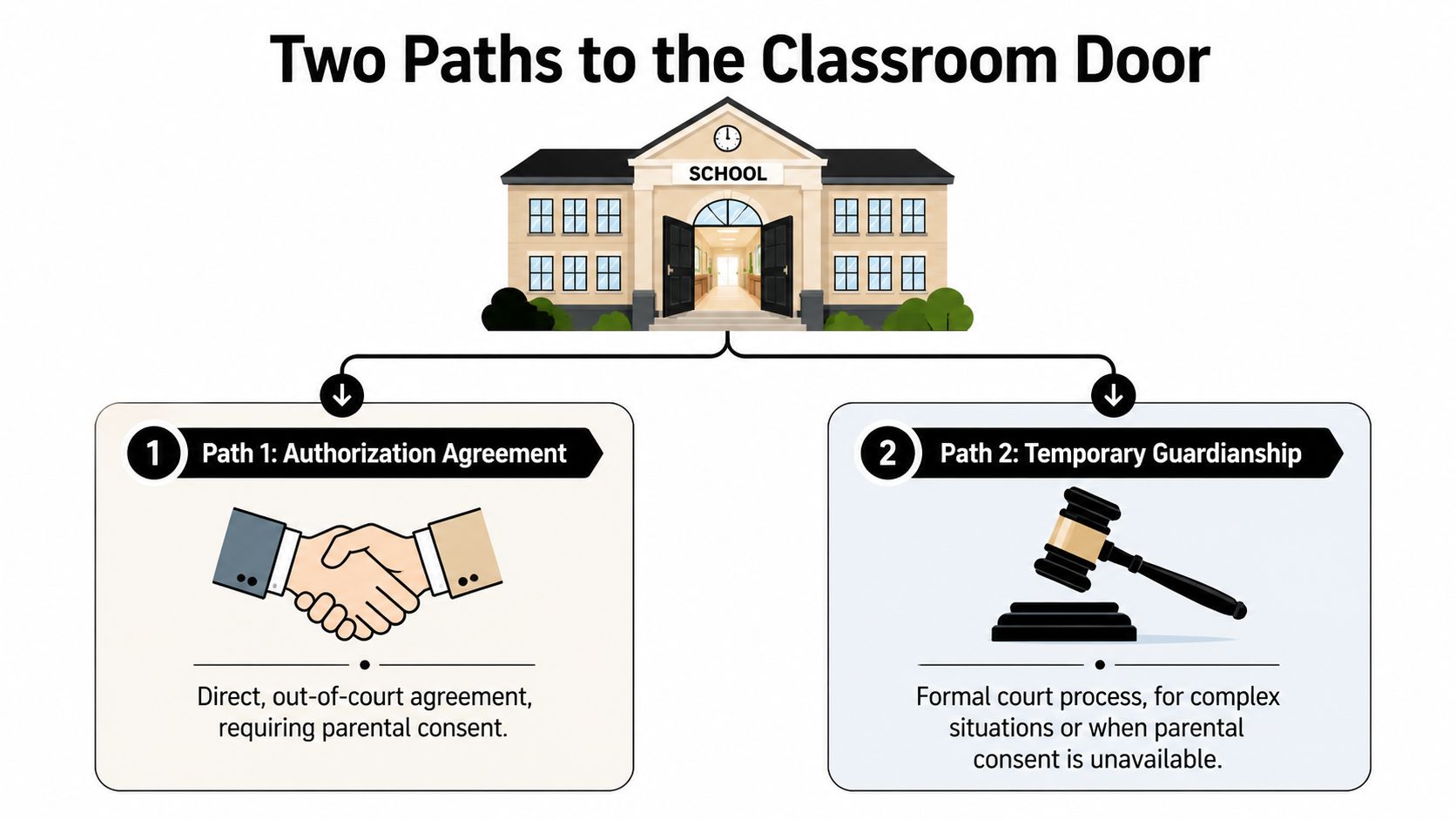
The first path is an Authorization Agreement for Nonparent Relative or Voluntary Caregiver. This is usually the right tool when a parent is still available, still legally capable of consenting, and wants the caregiver to handle school matters without opening a court case.
The second path is temporary guardianship through the probate court. That becomes necessary when the parent won’t cooperate, can’t be located, is incapacitated, or the child’s situation is serious enough that a school-specific document won’t protect the child.
The question that decides the path
Don’t start by asking, “Which form is easiest?” Start by asking, “Do we have valid parental consent?”
If the answer is yes, the non-court route is usually faster, cheaper, and more practical for school enrollment. If the answer is no, or if there’s a real dispute, trying to force an Authorization Agreement often wastes time.
Practical rule: If the parent is fit, reachable, and willing, use the least invasive tool that gets the child enrolled. If the parent is unavailable, unfit, or actively blocking the child’s stability, court involvement usually becomes necessary.
Authorization Agreement vs. Temporary Guardianship for School Enrollment
| Feature | Authorization Agreement (Non-Court) | Temporary Guardianship (Court-Ordered) |
|---|---|---|
| Best use | Cooperative situation with parental consent | Urgent or contested situation |
| Who signs | Parent and caregiver | Judge signs order after hearing |
| Court required | No | Yes |
| Primary purpose | School and related delegated decisions | Broader legal authority where immediate need exists |
| Speed | Often very fast if documents are complete | Slower because filing, notice, and hearing are required |
| Cost | Lower than court action | Filing fees and litigation costs may apply |
| Parent control | Parent keeps rights and can remain involved | Court supervision changes the structure |
| When it fails | Parent won’t sign, form is defective, dispute exists | Evidence is weak, filing is incomplete, urgency isn’t proven |
What each path really does
An Authorization Agreement is not a magic transfer of custody. It is a targeted delegation. It can give a caregiver authority to enroll a child, communicate with the school, access records, and manage day-to-day school issues. It works well when everyone agrees on the child’s placement.
Temporary guardianship is different. It is a court remedy under Texas Estates Code Title 3, Subtitle G. It is designed for immediate need, not convenience. In practice, courts want a clear reason why temporary judicial action is necessary.
Common situations where families choose wrong
Families often pick the wrong route because they focus on emotion instead of legal posture.
A grandparent may think, “I’ve had him for three months, so I need guardianship.” Not always. If the parent is still consenting and school authority is the main issue, a Chapter 34 authorization may be enough.
Another caregiver may think, “I have a notarized note, so court won’t be needed.” That can be wrong too. If one parent objects, if there is abandonment, or if the child’s welfare is in immediate danger, a simple non-court paper may collapse the moment it is challenged.
For a broader discussion of how delegated authority differs from a court-created role, this page on guardianship vs power of attorney is a helpful reference.
What works and what doesn’t
What works:
- Matching the tool to the facts
- Using a complete, notarized document when consent exists
- Going to court quickly when consent does not exist
- Thinking beyond enrollment to school records, discipline, and special education meetings
What doesn’t work:
- Handwritten permission slips
- Assuming every district will accept the same informal paperwork
- Filing for guardianship just because it sounds stronger
- Waiting until school starts to gather records and signatures
If you remember one thing, make it this: temporary guardianship for school enrollment texas is not one process. It is a decision between two very different legal tracks.
The Fastest Route An Authorization Agreement
When a parent is still willing to cooperate, the Authorization Agreement for Nonparent Relative or Voluntary Caregiver is usually the fastest route to the classroom. It comes from Texas Family Code Chapter 34, and when it is properly completed, it can solve the immediate enrollment problem without a court hearing.
According to the Texas Education Agency material on authorization for a nonparent relative, this Chapter 34 tool enables immediate enrollment without judicial intervention. The same source states that acceptance is near 100% when properly executed, and it avoids the 60-90 day delays and $350-500 fees tied to formal court guardianship.
When this is the right choice
Use this option when:
- A parent agrees to let you handle school matters
- The arrangement is temporary or limited
- There is no active dispute that requires a judge
- The school issue is the main legal problem, rather than long-term custody or estate management
This tool is often ideal for grandparents, aunts, uncles, adult siblings, or even a family friend who is serving as the child’s day-to-day caregiver.
What the document should cover
A weak document creates avoidable school-office problems. A strong one is clear and specific.
Include:
- The full legal names and addresses of the parent, caregiver, and child
- The relationship between the caregiver and the child
- The delegated powers, such as school enrollment, record access, conferences, and activity approvals
- The duration
- Required signatures and notarization
Some families also pair this with related paperwork so the caregiver can handle more than school contact. If you want a model for how to organize supporting information, this guardianship sample letter can help you think through structure and clarity.
A practical signing checklist
Before anyone goes to a notary, gather the details the school is most likely to ask about.
Confirm the parent’s legal authority
If there is an existing court order affecting conservatorship or possession, read it first. A parent can’t delegate around a court order that limits their rights.Write the powers plainly
Don’t rely on vague language like “take care of school needs.” Spell out enrollment, attendance matters, school records, parent-teacher meetings, and emergency contact authority.Check names against records
The child’s name on the agreement should match the birth certificate or school record. Small inconsistencies can slow down registration.Notarize correctly
Schools often reject documents that are signed casually and notarized later in a questionable way. Sign in the proper format and keep clear copies.
Bring the original notarized agreement and at least two copies. One often stays with the school, and one should stay in your car or files.
What parents and caregivers misunderstand
The biggest misunderstanding is scope. This agreement is powerful, but it is still limited. It doesn’t automatically resolve every medical, financial, or custody issue. It also doesn’t erase parental rights.
Another misunderstanding is durability. Families sometimes treat a school authorization like a permanent fix. It isn’t. If the child’s placement is becoming long-term, or if conflict with a parent is growing, the legal structure may need to change.
A short hypothetical
A mother in Dallas enters residential treatment and asks the child’s aunt to keep the child through the semester. The mother is reachable, cooperative, and wants the child to stay in the same school. The aunt needs authority to enroll, talk to teachers, and sign routine school papers. This is a strong Authorization Agreement case.
By contrast, if the mother stops communicating, the father objects, and no one can agree where the child should live, the same paper is no longer enough. That family has crossed into court territory.
When You Must Go to Court The Temporary Guardianship Process
Some cases cannot be solved with a notarized agreement. If the parent is incapacitated, unreachable, refusing to cooperate, or the child’s welfare is in immediate danger, a probate court may need to appoint a temporary guardian.

This process is governed by the Texas Estates Code, especially Title 3, Subtitle G, which covers guardianship proceedings. For temporary relief, the court looks for immediate necessity. You are no longer asking a school to honor delegated authority. You are asking a judge to create legal authority.
The court-based process described in this overview of the temporary guardianship process results in a 60-day order after a hearing held within 10 days of filing. That same source states approval rates are 85-90% with sufficient evidence, while 40% of initial filings are rejected for insufficient evidence.
Situations that usually require court action
Temporary guardianship becomes more likely when:
- No parent can or will sign
- A parent is incapacitated
- There is neglect, abandonment, or immediate instability
- The child’s school access is part of a larger emergency
- A dispute makes school-only paperwork unreliable
In counties such as Harris County, the probate court wants more than a hard family story. It wants evidence that legal intervention is necessary now.
What gets filed
The filing is typically an Application for Temporary Guardianship. The pleading must identify the child, explain the emergency, describe the powers requested, and show why the applicant is qualified.
The court may also appoint an attorney ad litem or require notice and supporting proof. Depending on the facts, that proof may include:
- Affidavits from relatives or caregivers
- Medical records showing a parent’s incapacity
- School records showing disruption
- Police or agency records if safety is an issue
- Existing court orders involving the child
What the judge is listening for
Judges hear many family emergencies. What separates a successful application from a weak one is precision.
A vague statement like “the child needs stability” is rarely enough by itself. A stronger presentation sounds more like this: the child is living with the applicant, the parent cannot currently care for the child, the school requires legal authority for enrollment, and immediate educational disruption will continue unless the court acts.
Courts grant temporary guardianship because immediate protection is needed, not because the applicant is the nicest or most involved adult in the room.
Before the hearing
Families should prepare in three lanes.
First, organize documents. Bring copies in a format the court can use. Probate judges and staff do not have time to sort through a stack of unlabeled papers.
Second, prepare testimony. The applicant should be ready to explain living arrangements, why the child is with them, what happened to the parents’ ability to act, and why temporary authority is needed right away.
Third, understand the limits of the order. A temporary guardianship is not the same as a final determination. It is a bridge, not a permanent solution.
For families preparing for filing in a Texas probate court, this step-by-step page on how to file for guardianship in Texas gives a useful procedural overview.
After the hearing
If the court signs the order, get certified copies quickly. Schools usually want the certified order, not just a file-stamped application. Deliver it to the registrar, principal, and any department handling records or special education.
Then calendar the expiration date immediately. Temporary orders expire. If the family needs a longer arrangement, that next legal decision should start before the order runs out.
At The School Office Practical Tips for a Smooth Enrollment
The legal paper is only half the job. The other half is getting the school to process it without delay.
Bring more than the guardianship or authorization document. In real life, registrars often need a packet, not a single page. If you walk in with incomplete records, the child may still leave unenrolled even if your legal authority is solid.
What to bring to registration
A strong enrollment packet usually includes:
- Your photo ID
- The notarized Authorization Agreement or certified court order
- The child’s birth certificate if available
- Immunization records
- Proof of residency
- Any prior report cards, withdrawal paperwork, or school records
- Special education paperwork if the child has an IEP or 504 plan
If you don’t have every item, don’t assume that means you should stay home. Go to the school, explain the gap, and ask what can be submitted that day versus later. Some delays happen because caregivers wait for a “perfect file” instead of starting the process.
How to handle pushback
School staff may hesitate for reasons that have nothing to do with bad intent. They may not see Chapter 34 documents often. They may have district-specific checklists. They may want a supervisor to review anything unusual.
Stay calm and specific.
Try language like:
- “This is the notarized authority the parent signed for school matters.”
- “If your district uses a specific caregiver packet, I’m happy to complete that too.”
- “If you can’t accept this at the counter, please tell me who in student services or legal review can make that decision today.”
That approach keeps the conversation practical and documented.
Ask for the name and title of the person denying or delaying enrollment. Many problems get resolved once the issue is escalated to someone who regularly handles residency and caregiver questions.
Remote notarization and out-of-state signatures
A rising problem involves documents signed remotely or from another state. As noted in this discussion of temporary guardianship without court, Texas expanded remote online notarization rules in 2023, but school districts can still apply inconsistent intake practices and sometimes ask for physical scans instead of purely digital submissions.
That means a document may be legally valid and still create a practical problem at the front desk. The workaround is simple. If the document was notarized remotely, bring:
- A printed copy
- A clear scan saved on your phone
- Any certificate page attached by the notary platform
- A backup contact for the parent if the school wants confirmation
Watch for district-specific forms
Some districts have their own caregiver affidavits or enrollment questionnaires. Those local forms do not necessarily replace your legal document, but they may be part of the intake process.
If you’re dealing with a district such as Alief ISD, Houston ISD, Dallas ISD, or a charter campus with separate procedures, call ahead and ask a focused question: “What does your registrar require when a non-parent is enrolling a child who is living with them?”
That call often saves a wasted trip.
Beyond Enrollment Your Ongoing Responsibilities and Next Steps
Getting the child into school is a major step. It isn’t the last one. Once you become the acting adult for school purposes, the school will look to you for decisions, updates, and follow-through.
That means showing up for conferences, reading discipline notices, signing routine forms, and monitoring grades and attendance. If the child receives special education services, you may also be pulled into ARD or IEP meetings, evaluations, and service planning. School authority creates responsibility, not just access.
The arrangement may be temporary, but the child’s needs are daily
A caregiver who enrolls a child often becomes the person handling:
- Attendance calls and emergency pickups
- Teacher communication
- Counselor meetings
- Testing and academic support
- Behavior plans and extracurricular approvals
Legal paperwork and real parenting work often coincide. If the child has gone through trauma, school success may depend as much on consistency as on legal authority. Families who need support with emotional adjustment may find age-appropriate ideas in this resource on elementary social-emotional learning.
Know when the temporary fix is no longer enough
Texas law separates school-focused temporary solutions from formal guardianship, and non-custodial parents may still retain emergency notification rights under Texas Family Code §153.073 unless a court orders otherwise, as explained in this guide to educational guardianship forms Texas schools accept.
That matters because a family can seem stable on paper while legal conflict is still simmering underneath. A parent may revoke cooperation. Another parent may appear after months of silence. The school may not know who should receive emergency contact or disciplinary notice.
Signs you may need a broader legal plan
Consider a more durable legal strategy when:
- The child has been with you longer than expected
- Parents are not making reliable decisions
- Medical or financial issues go beyond school authority
- Conflict between adults keeps interrupting the child’s stability
- You need authority recognized across multiple settings, not just school
At that stage, families often need to look at full Guardianship planning, related Probate issues, and broader Estate Planning concerns for the adults involved. If a parent’s incapacity, death, or long-term absence is part of the picture, waiting too long can create new emergencies.
Secure Your Family's Future with a Clear Legal Path
Most school enrollment crises in Texas come down to one choice. Use a non-court Authorization Agreement when a parent can still validly consent, or seek temporary guardianship through the probate court when that consent is missing or the child’s situation is too serious for a limited document.
Choosing the wrong path costs time. It can also keep a child out of class when they need stability most.
This area of law is practical, but it’s also emotional. Families are often making decisions while worried about a parent’s health, housing, addiction, military service, or sudden absence. Clear legal advice helps separate what can be handled with a notarized agreement from what must be brought before a judge under the Texas Estates Code.
For families who need help with drafting, filing, hearings, or planning beyond enrollment, Law Office of Bryan Fagan, PLLC works on Texas guardianship, probate, and related family protection issues across the state.
If you're unsure whether your situation calls for an Authorization Agreement or a court-ordered guardianship, Law Office of Bryan Fagan, PLLC can help you choose the clearest legal path. Schedule a free consultation to discuss your facts, your county, and the fastest way to protect the child’s school access and long-term stability.


