Skip to content
A family in Harris County may spend months helping an aging parent through a guardianship case, only to discover that the Social Security deposit still arrives in the parent's name and remains outside the guardian's bank account. That surprise is common because Texas guardianship and Social Security representative payee status are separate legal roles. A court order appointing someone as guardian doesn't, by itself, make that person the individual's representative payee.
The difference matters for families, caregivers, and professionals who must protect a vulnerable adult without creating an accounting problem. Texas courts supervise guardianship under the Texas Estates Code, while the Social Security Administration, or SSA, controls who receives and manages Social Security and SSI benefits. Understanding both systems can help you avoid interrupted benefits, improper spending, and missed reporting duties.
How Guardianship and a Representative Payee Work Together in Texas
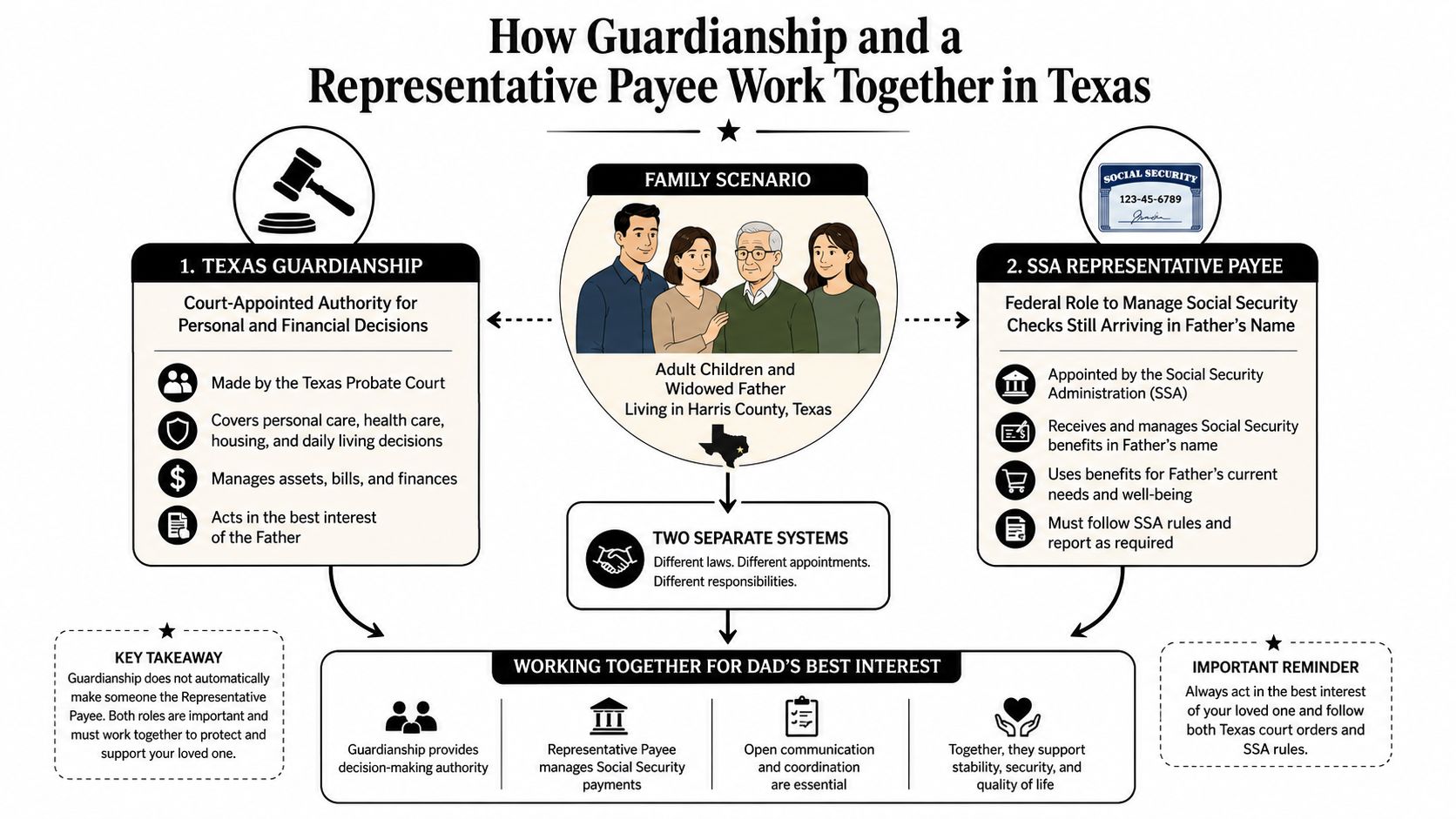
Suppose adult children obtain guardianship of their widowed father in Harris County. The court appoints one child as guardian, but the next Social Security payment still goes into their father's existing account. The family may assume the court appointment gives the guardian immediate control over that money. It doesn't.
A Texas guardian receives authority from a probate or guardianship court. Depending on the order, the guardian may manage personal decisions, financial property, or both. Texas Estates Code Title 3, Subtitle G governs guardianship administration, including the duties of guardians and the court's continuing oversight.
A Social Security representative payee receives authority from SSA. That person manages Social Security or SSI benefits for the beneficiary because SSA determines that direct payment isn't appropriate. The payee's authority is limited to those federal benefits. It doesn't automatically extend to real estate, other bank accounts, contracts, or medical choices.
Why the two appointments can overlap
The same adult child can hold both roles, but each role comes with a different source of authority. The Texas court may appoint the child guardian of the estate, while SSA separately approves that child as representative payee. In another case, SSA may select someone else, even when a Texas guardian already exists.
Families often begin by reviewing the court order, then contacting SSA to ask whether a payee is already appointed and what application materials are required. The federal program is not a formality attached to guardianship. It's a separate appointment based on the beneficiary's needs and the proposed payee's suitability.
For a focused explanation of this overlap, families can review Social Security and Guardianship in Texas while preparing questions for counsel and the local SSA office. The central point is simple: the guardian may have broad Texas authority, but SSA controls the Social Security payment relationship.
Texas Guardianship vs Social Security Representative Payee
Guardianship and representative payee status may serve the same person, but they answer different questions. Guardianship asks what authority a person needs under Texas law. Representative payee status asks who should manage a particular Social Security or SSI benefit.
Texas guardianship proceedings generally arise under Chapter 1101 of the Texas Estates Code. The court evaluates incapacity and the need for protection, and the proceeding may involve medical evidence, an attorney ad litem, a hearing, and a court order. The SSA payee program operates under federal rules, including 20 C.F.R. Part 404, and focuses on benefit management and payee suitability.
| Feature | Texas Guardianship | SSA Representative Payee |
|---|---|---|
| Authority source | Texas probate or guardianship court order | SSA appointment after a federal review |
| Main trigger | Court finding that guardianship is necessary because of incapacity | SSA determination that the beneficiary needs help managing benefits |
| Scope | Guardian of the person may handle personal matters. Guardian of the estate may handle property and finances within the order | Management of Social Security or SSI benefits only |
| Oversight | Texas court filings, annual reports, accountings, and continuing judicial supervision | SSA records, reports, requests for information, and suitability oversight |
| Possible appointee | A qualified person or organization approved by the Texas court | A suitable family member, friend, guardian, or qualified organization |
| Effect on other assets | May include authority over property identified in the guardianship order | Doesn't authorize control of other property or accounts |
One person, two sets of duties
Maria might be guardian of her father's estate in a Dallas County proceeding and later become his representative payee. Her Texas order governs the authority granted by the court. Her SSA appointment governs the monthly federal benefit. She must follow both systems rather than treating one appointment as a substitute for the other.
Families seeking the court process can use How to Get Guardianship in Texas: The Process as a plain-language overview of the step-by-step court process for establishing a guardianship. In Harris County Probate Court, Dallas County probate courts, or another county court with guardianship jurisdiction, the exact filing and hearing instructions still need to be confirmed locally.
The difference also affects disputes. A person may challenge the guardianship in court, ask SSA to change the payee, or raise concerns in both systems. A court appointment doesn't prevent SSA from conducting its own review.
How to Apply to Become a Representative Payee
A Texas family member who needs to manage another person's Social Security or SSI benefits should start with SSA, not assume the guardianship order is enough. Family members, friends, guardians, and qualified organizations may apply. SSA decides whether the applicant is suitable and whether appointment serves the beneficiary.
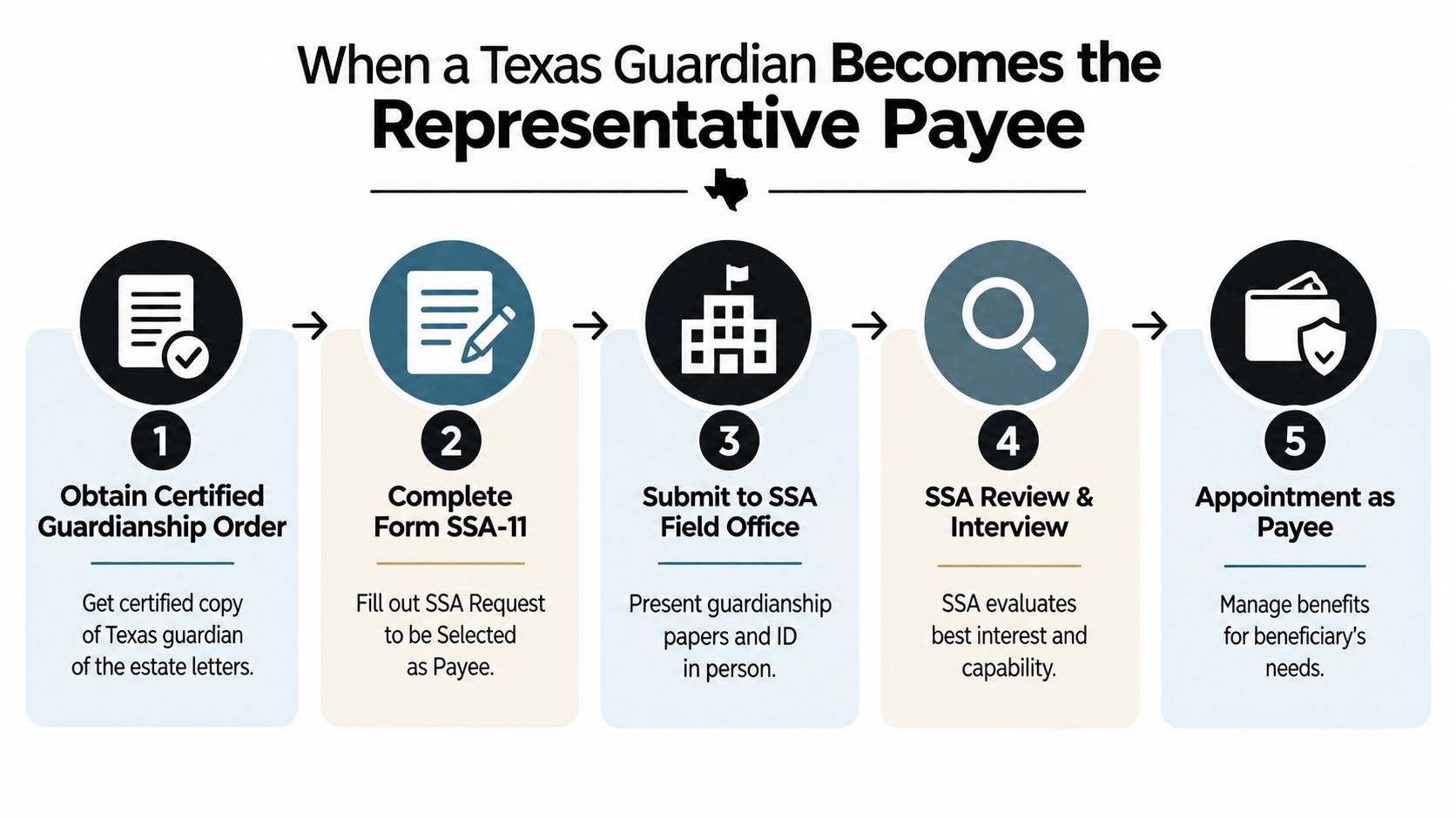
Begin by contacting SSA through its representative payee information and asking how to submit the application for the specific beneficiary. Applicants commonly need Form SSA-11, Request to Be Selected as Payee, and, where applicable, the SSA-623 representation form. The applicant should also gather identification, proof of the relationship, contact information, and documents showing the beneficiary's circumstances.
A practical application sequence
Confirm the benefit information. Gather the beneficiary's Social Security notices, claim details, and current payment information. This helps SSA locate the correct record and identify whether another payee is already appointed.
Prepare the applicant's records. Bring identity documents, relationship evidence, and any guardianship order. If the applicant is a guardian of the estate, the order should clearly show authority over financial matters.
Submit the request. The family may use SSA's available online options or work with a Texas Social Security office serving the beneficiary's area, including communities in Dallas, Travis, or El Paso counties. SSA may require an interview or additional documents.
Answer the suitability questions carefully. SSA reviews whether the proposed payee can manage the funds, act in the beneficiary's interest, and maintain records. Federal priority rules, including 20 C.F.R. § 404.2021, guide the selection process.
Wait for the decision and follow SSA's instructions. The plan notes for this process commonly describe a 6-to-10-week decision window, but applicants should confirm current timing with SSA rather than rely on an estimate. If SSA finds an existing payee unsuitable, the beneficiary keeps direct payment rights unless SSA appoints an appropriate replacement.
Social Security benefits can be especially important for an adult with a disability. Families may also review Social Security benefits for disabled adults while organizing benefit notices and medical records.
When a Texas Guardian Becomes the Representative Payee
A guardian of the estate may apply to SSA, but the application remains federal. The guardian typically starts with Form SSA-11 and provides a certified copy of the Texas guardianship order and current letters showing the appointment. The documents should make clear that the guardian has authority over the beneficiary's financial property.
A guardian of the person alone may not have the financial authority SSA needs. A court order that addresses personal care, residence, or medical decisions doesn't necessarily establish control over Social Security funds. Letters testamentary also aren't a substitute for guardianship papers or an SSA payee appointment. Those letters relate to an estate administration, not automatic authority over a living beneficiary's federal benefits.
Keep the money and records separate
Once appointed, the payee should maintain Social Security funds in a properly designated account and avoid mixing them with personal money. The payee must spend the benefits for the beneficiary and preserve records showing where the funds went.
The 5% rule can create confusion. Texas legal guidance explains that guardianship fees may be paid from a ward's Social Security or SSI funds only when the guardian has court authorization and the payment doesn't deplete funds needed for the beneficiary's current basic needs. SSA's Texas guidance also describes an ordinary Texas cap of 5% for guardianship fees, while allowing a judge to approve a higher amount when the ordinary fee would be unreasonably low for the services provided. Federal beneficiary-needs rules still matter even when a Texas court authorizes compensation.
A guardian of the estate should coordinate SSA records with the Texas annual filing. Texas Estates Code § 1163.101 requires a guardian of the person to file a sworn annual report for the entire guardianship, with a reporting period that cannot exceed 12 months and a filing deadline no later than the 60th day after the reporting period ends. Estate accountings have their own requirements under Texas law, so the guardian should ask counsel how the payee report fits with the annual guardianship accounting in that county.
Fiduciary Duties, Annual Reports, and Misuse Risks
A guardian who also serves as representative payee carries two related but distinct fiduciary responsibilities. SSA's core rule is to use benefits first for the beneficiary's current maintenance needs, then save any remainder for future needs. Current needs can include food, shelter, clothing, medical care, and other expenses that directly support the beneficiary.
The payee must keep detailed records for at least the current year plus the prior two years and provide them to SSA upon request, as explained in SSA's payee guidance. Most payees also face written accounting requirements at least annually, although some household-family payees are exempt from the annual report requirement. A Texas guardian may still have separate state reporting duties even when an SSA exemption applies.
| Duty Area | SSA Representative Payee | Texas Guardian of the Estate |
|---|---|---|
| Use of funds | Apply benefits to the beneficiary's current needs before saving the remainder | Manage estate property under the court order and Texas law |
| Records | Keep benefit receipts, expenditures, and supporting records | Maintain inventories, accountings, receipts, and court-required records |
| Reporting | Provide reports or records to SSA when required | File the annual account and other reports with the county court |
| Account control | Use a beneficiary-focused fiduciary account and avoid commingling | Safeguard estate assets and follow court instructions |
| Compensation | Follow SSA and applicable legal limits | Seek court authorization and comply with Texas fee rules |
| Misuse response | Repayment, removal, benefit changes, and possible criminal consequences | Court sanctions, repayment, removal, or other fiduciary consequences |
What misuse can look like
Misuse isn't limited to stealing cash. It can include paying the guardian's personal bills, converting benefits for another person, commingling funds, or failing to explain a withdrawal. SSA defines misuse as converting benefits to a use other than the beneficiary's use and benefit. When misuse is found, federal law requires SSA to stop paying the misusing payee and appoint an alternate payee or, when appropriate, pay the beneficiary directly. SSA guidance states that the payee must repay the full amount misused, and criminal penalties can reach a $250,000 fine, 10 years in prison, or both under the cited federal rules.
Families who notice unexplained withdrawals or pressure on an older adult may benefit from understanding elder financial abuse before deciding how to respond. Texas-specific concerns about a guardian can also be reviewed through reporting financial abuse by a guardian in Texas.
Practical rule: Keep one ledger that identifies the benefit received, the expense paid, the date, and the receipt or statement supporting it.
A Texas Family's Experience With Both Roles
Maria works in Houston and helps care for her father, Pedro, after a stroke. Pedro can no longer manage bills reliably, and the family asks a Texas court to appoint Maria guardian of his person and estate. The court order gives her authority over his personal needs and financial property, but his Social Security direct deposit continues going into his old account.
Maria learns that her guardianship appointment hasn't automatically changed the federal payment arrangement. She contacts SSA, completes Form SSA-11, and submits the Harris County court order showing her financial authority. SSA conducts its own review rather than accepting the court appointment.
While the application is pending, Maria avoids moving money casually between accounts. After SSA appoints her payee, she opens a separate fiduciary account for Pedro's benefits and uses it for his housing, food, medical needs, and other expenses that benefit him. She keeps bank statements and receipts in a monthly file.
Coordinating the first reporting cycle
When January arrives, Maria reviews the benefit deposits and withdrawals before preparing the representative payee accounting. She also gathers the records needed for Pedro's Texas annual accounting and annual guardianship report. Texas law requires recurring guardianship reporting, so she treats the federal and state deadlines as separate tasks that should be reviewed together.
Maria hires a bookkeeping service to organize receipts and reconcile the account. The service doesn't decide how Pedro's money should be spent, and Maria remains responsible for the fiduciary choices. The arrangement gives her a clearer record when the court or SSA asks how the funds were used.
A relative later asks whether Maria “controls everything.” Maria explains that her Texas order governs the authority granted by the guardianship court, while SSA's appointment makes her responsible for Pedro's Social Security benefits. That distinction helps the family understand why a guardian can have broad duties and still need a separate federal designation.
Alternatives to Guardianship and Payee Arrangements
Guardianship can protect a person who cannot manage essential affairs, but Texas law favors considering less restrictive choices when they can meet the person's needs. A durable power of attorney may help an adult authorize financial action under Texas Estates Code Chapter 751. A medical power of attorney can address health decisions. Neither option, however, automatically gives an agent authority to receive Social Security benefits because SSA controls its representative payee program.
A supported decision-making agreement may let an adult keep more control while receiving help with choices and communication. A limited guardianship may also target a specific area instead of removing authority more broadly. Families should compare the person's actual needs rather than choosing the most powerful legal tool first.
| Option | Court Involvement | Authority Over Social Security Funds | Best For |
|---|---|---|---|
| Durable power of attorney | Usually no guardianship hearing if properly created | Doesn't replace SSA payee appointment | Adults who can choose an agent and need financial assistance |
| Medical power of attorney | Usually no guardianship hearing | No authority over benefit payments | Health decisions |
| Supported decision-making agreement | Generally less court-centered | Doesn't itself appoint a payee | Adults who can make decisions with structured support |
| ABLE account | Account setup rather than guardianship | Doesn't make someone an SSA payee | Eligible individuals who need disability-related spending flexibility |
| Pooled or special needs trust | Trust creation and administration may require legal guidance | Doesn't replace SSA payee status | Protecting benefit eligibility while paying approved expenses |
| Joint account or trusted direct-deposit arrangement | Often no court appointment | Doesn't give SSA payee authority | Limited help when the beneficiary still understands and consents |
| Limited guardianship | Texas court appointment | Separate SSA application remains necessary | Narrow needs that require court protection |
| Full guardianship | Texas court supervision | Separate SSA appointment remains necessary | Broad personal or estate protection when less restrictive options won't work |
ABLE accounts and pooled trusts may help families pay disability-related expenses while preserving access to means-tested benefits, but eligibility and administration require careful review. A joint bank account can also create risk if family members use it as though it were their own money. The right alternative depends on capacity, consent, benefit type, and the level of protection required.
Next Steps for Texas Families and Caregivers
Families can reduce confusion by treating the Texas court process and the SSA process as related workstreams. Start before the hearing if possible, because a guardianship case may take several months and an SSA payee appointment may take 60 to 90 days, depending on the circumstances and agency workload.
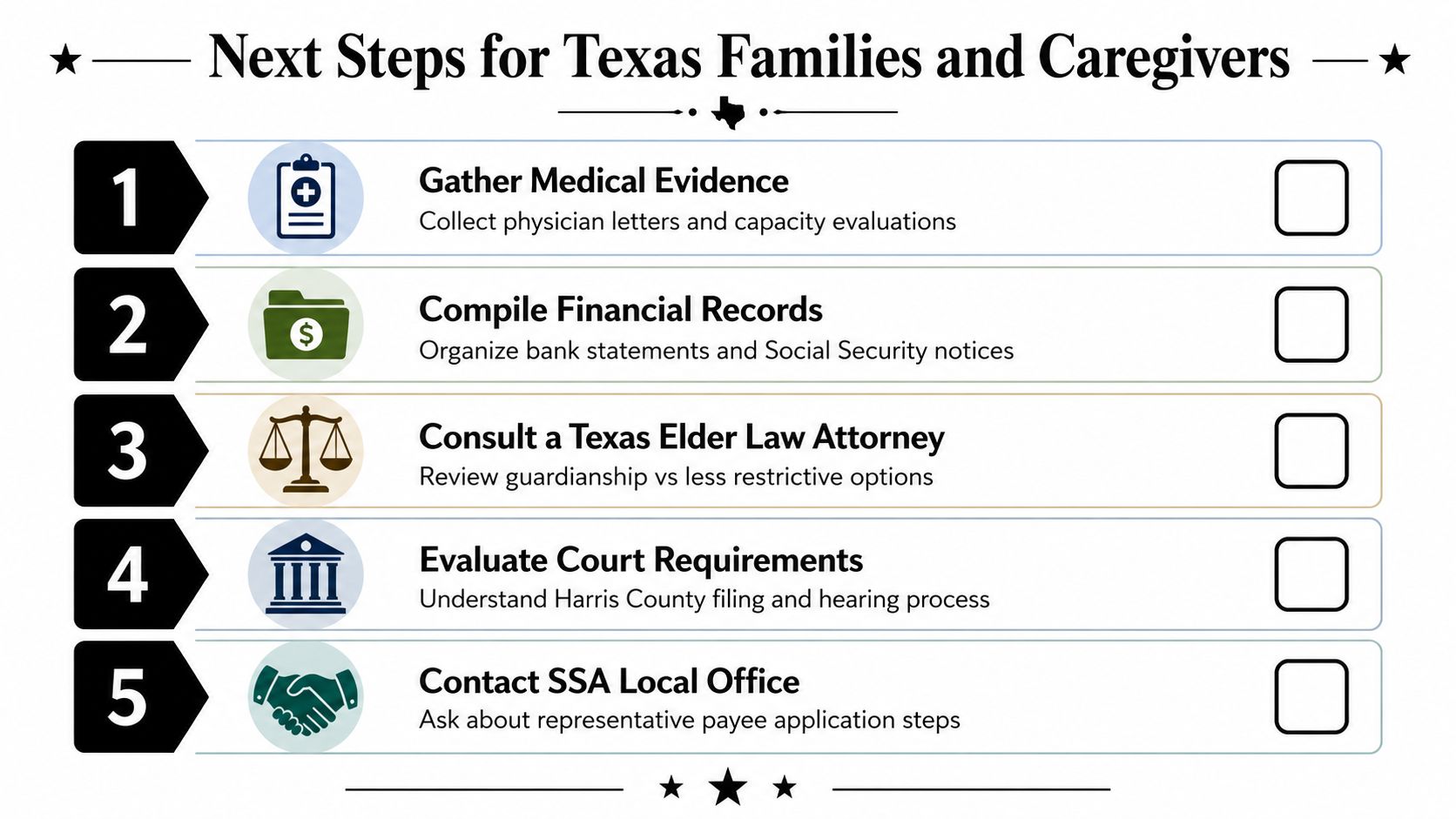
Use this working checklist:
Gather medical evidence. Collect physician letters, capacity evaluations, treatment information, and details about the decisions the person can and can't manage.
Compile financial records. Organize bank statements, Social Security notices, benefit information, recurring bills, property records, and debts.
Review less restrictive options. Ask whether a power of attorney, supported decision-making agreement, ABLE account, trust, or limited guardianship could meet the need.
Confirm the proper Texas court. Learn the filing and hearing requirements for the county involved, such as Harris County Probate Court, and identify whether a temporary guardianship is necessary.
Contact SSA early. Ask the local Social Security office about applying for or changing a representative payee. Keep the guardianship order, identification, and beneficiary information ready.
A temporary guardian must file a sworn property list, a return of sales, and a full account of the temporary guardian's acts when the temporary guardianship ends under Texas law. That short-term arrangement isn't a substitute for planning the long-term guardianship, benefit, and reporting structure.
Caregivers should also review related resources, including information about SSDI caregiver benefits for families, while keeping in mind that benefit rules vary by program and situation. Maintain a dedicated ledger, review SSA records and Texas inventories together, and ask questions before moving or spending protected funds.
The Law Office of Bryan Fagan, PLLC helps Texas families evaluate guardianship, prepare court filings, coordinate medical and financial evidence, and address Social Security representative payee concerns. Visit Law Office of Bryan Fagan, PLLC to schedule a free consultation about your county, your loved one's needs, and the steps required to protect benefits while meeting Texas guardianship duties.