Skip to content
The hearing date is finally on the calendar. Then the county clerk mentions a guardianship background check in Texas, fingerprints, and another record request, and your family realizes that court day isn't the only deadline that matters. A missing or late result can delay an appointment even when everyone is ready to explain why your loved one needs help.
Texas treats the screening as part of the proposed guardian's eligibility process. The clerk generally obtains criminal history information after the application is filed, while the proposed guardian must respond quickly to fingerprint requests and may need to arrange a separate child abuse or neglect history check through the Texas Department of Family and Protective Services, often called DFPS or CPS. The safest approach is to put every task on one calendar, ask the clerk which vendor and payment method the court accepts, and save receipts, confirmation pages, and disposition records.
What This Moment Feels Like for Your Family
Most families reach this point after a difficult change. An aging parent may no longer manage medication or money safely. A child may need a legal representative after a serious injury or the loss of parental care. A daughter living outside Texas may be trying to help while learning that a probate court in Harris County, Dallas County, or another Texas county controls the process.
The background check can feel like an accusation. It isn't. The court is testing whether the person asking for authority can safely handle another person's personal needs or property. The screening applies to most proposed guardians, with important exemptions for Texas attorneys, Texas certified guardians, and corporate fiduciaries. Texas court guidance describes the criminal-history process as a court requirement, not an optional courtesy. Texas court guidance on guardianship criminal history information explains the statewide framework.
Put the deadlines on paper
Start these tasks as soon as the application is filed:
- Ask the clerk for the exact process: Confirm whether the county uses a DPS name-based search, fingerprints, an approved fingerprint vendor, and a separate DFPS or CPS form.
- Schedule fingerprints promptly: If the clerk requests fingerprint information, provide it within the required period. Don't wait for a hearing notice.
- Track the hearing deadline: Criminal-history materials must reach the court at least 10 days before the guardianship hearing, according to Texas court instructions for courts and clerks.
- Save proof: Keep payment receipts, vendor confirmations, fingerprint receipts, and copies of every filing.
An old arrest doesn't automatically answer the fitness question. Don't conceal it or assume the judge won't see it. Obtain the final disposition, write a short factual explanation, and let a guardianship attorney evaluate how the record may affect appointment.
Practical rule: Treat the screening, fingerprints, service of process, social study, medical evidence, and hearing as separate jobs on one family timeline.
The Texas Guardianship Vocabulary You Keep Seeing
Texas guardianship paperwork becomes easier once the people and offices have clear names. Most proceedings are governed by Title 3, Subtitle G of the Texas Estates Code, although different chapters and sections address particular types of guardianship.
The people in the case
- Proposed guardian: The person asking the probate court for legal authority.
- Guardian: The person after the judge signs the appointment order and the required steps are completed.
- Proposed ward: The adult or child whose capacity and need for protection are before the court.
- Ward: The person after the court appoints a guardian.
The word incapacitated doesn't mean that someone has a diagnosis or makes occasional mistakes. In practical terms, the issue is whether the person's ability to receive and evaluate information or communicate informed decisions is impaired enough that the person can't provide food, clothing, or shelter or can't manage financial affairs. The court also considers whether a less restrictive option can protect the person while preserving more rights. A family may need to explore powers of attorney, trusts, supported decision-making, or other planning tools through an alternatives to guardianship resource.
The offices and legal tracks
The county clerk receives filings, collects authorized fees, requests criminal history information, and sends or records notices. The clerk doesn't decide whether guardianship is necessary.
The probate court makes that decision. In a Harris County Probate Court or another county probate court, the judge evaluates the evidence, the proposed ward's needs, the applicant's qualifications, and the authority or limits to include in the order.
A minor guardianship has its own concerns. A parent's rights generally must be suspended or terminated, or another legal basis must apply. An adult case focuses on the adult's functional abilities and the least restrictive protection that will work.
A temporary guardianship is different from an ordinary appointment. Under Texas Estates Code Section 1251.010, the court may appoint a temporary guardian only when substantial evidence suggests incapacity and probable cause shows that immediate appointment is necessary. Emergency timing doesn't turn temporary guardianship into a way around eligibility requirements.
The Three Background Checks That Actually Run
Families often use “background check” as if it describes one search. Texas cases can involve separate screening paths, each answering a different question and each producing different paperwork.
Criminal history record information
For many proposed guardians, the county clerk obtains criminal history record information after the application is filed. Depending on the estate and the applicant's circumstances, the required record may come from the Texas Department of Public Safety, or DPS, through a name-based search or from the FBI through fingerprints.
For an estate with liquid assets of $50,000 or less, Texas court guidance identifies DPS name-based records as the applicable route in the ordinary process. When the proposed guardian is a nonresident or the estate exceeds $50,000, the guidance identifies FBI fingerprint-based records. These are eligibility rules, so the family should confirm the correct path with the clerk rather than choosing a search independently. The clerk may charge a $10 cost-recovery fee for criminal history record information, as described by the Texas Judicial Branch Certification Commission.
DFPS or CPS history
A DFPS central registry check addresses a different concern, child abuse and neglect history. Many proposed guardians must complete the DFPS process and provide the resulting clearance material to the court. A DPS criminal search won't replace a DFPS request, just as a CPS history result won't answer every criminal-history question.
For families comparing screening requirements across caregiving roles, a plain-language overview of a Childcare background check can help explain why criminal records and child-protection records are separate categories. It isn't a substitute for the Texas probate clerk's instructions.
FBI fingerprint screening
An FBI fingerprint-based check can provide nationwide criminal history information when the clerk or court requires it. This matters especially for an out-of-state proposed guardian or a case involving records outside Texas. Fingerprints connect the search to the applicant's identity more directly than a name alone, but the appointment can still stall if prints are rejected, the wrong code is used, or the report arrives after the court deadline.
Where and How the Check Actually Happens
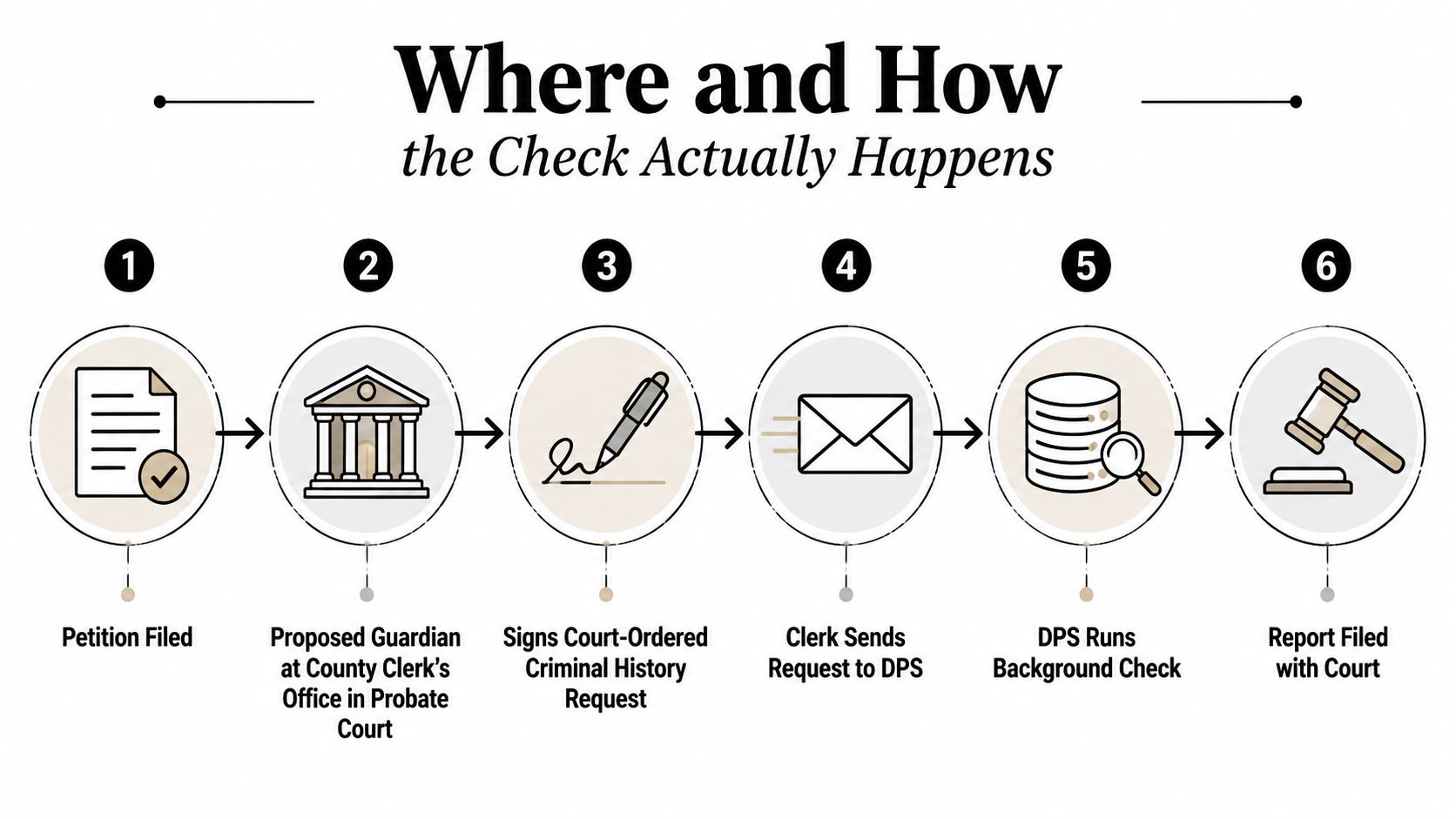
After the guardianship application is filed, the proposed guardian usually begins at the county clerk's office connected with the probate court. The clerk identifies the required criminal-history process, provides or completes the court-approved request, and explains how to pay the authorized cost-recovery charge.
The proposed guardian may sign a court-ordered criminal-history request and provide identifying information. If fingerprints are required, the clerk may provide a code or instructions for an approved vendor. The applicant then schedules digital fingerprinting through a service such as IdentoGO or a local law-enforcement location, depending on the county's directions. The prints may travel through DPS and, when required, the FBI channel.
Read the confirmation page carefully
At the fingerprint appointment, check the spelling of the proposed guardian's name, former names if requested, date of birth, and the transaction or confirmation number. A small data-entry mistake can create a mismatch or force the applicant to repeat the process. Keep the receipt because it helps the clerk locate the submission and lets your attorney show the court that you acted promptly.
The CPS history request runs separately under Texas Human Resources Code Section 48.102. Ask whether the county wants the original clearance letter, a copy, or proof that the request was submitted. Don't assume that one agency automatically sends every result to the court.
The clerk, not the proposed guardian, controls much of the formal court record process. The proposed guardian controls the response time, the accuracy of the information supplied, and the preservation of proof.
For a practical discussion of what probate judges assess beyond a record search, review what judges really look for in a Texas guardianship case. The background check is important, but it sits alongside evidence about need, suitability, and the proposed ward's interests.
Which Type of Guardianship You Are Filing For
The screening path depends on the guardianship track. A family seeking authority for an aging parent shouldn't assume that a minor guardianship or temporary appointment follows the same filing sequence.
| Guardianship Type | Criminal History Check | CPS History Check | Fingerprinting | Extra Forms |
|---|---|---|---|---|
| Adult guardianship under Chapter 1101 | Generally required | Generally required | Used when the clerk or applicable rule requires it, including the FBI path for qualifying cases | Application and supporting capacity and eligibility materials |
| Minor guardianship under Chapter 1102 | Generally required | Generally required | May be required under the court's process | Child-specific findings and supporting papers |
| Temporary guardianship under Section 1101.151 | Required, subject to the emergency process | May be deferred when emergency timing prevents completion | Follow the clerk's urgent-case instructions | Temporary application and proposed order stating powers and duties |
| Professional guardian under Section 1104.053 | Required as part of fitness review | Follow the applicable court and agency process | May be required | Professional guardian information sheet and other professional materials |
Adult and minor appointments
A full adult case usually involves the criminal-history and CPS paths, along with evidence addressing the proposed ward's capacity and the need for protection. In a minor case, the court also examines the child-specific legal basis for appointment and the status of parental rights.
A professional guardian faces a more formal fitness review and must file the required professional guardian information sheet. The proposed guardian's own history can affect how the court evaluates suitability in every category, but the judge still considers the whole record and the ward's needs.
Temporary and urgent appointments
Temporary guardianship is reserved for an urgent situation. Under Texas Estates Code Section 1251.006, the court must set the hearing immediately after filing, and the hearing must occur no later than the 10th day after filing, unless the proposed ward or the ward's attorney agrees to a postponement of up to 30 days. The application receives priority over matters except older matters of the same character.
Families sometimes worry about an old online accusation or inaccurate public information. That concern is different from correcting official court or agency records, but legal counsel can help separate the issues. If an online record creates a separate reputation problem, resources such as urgent reputation cleanup address a different process and shouldn't be confused with Texas criminal-history correction.
Timing and Fees You Can Plan Around
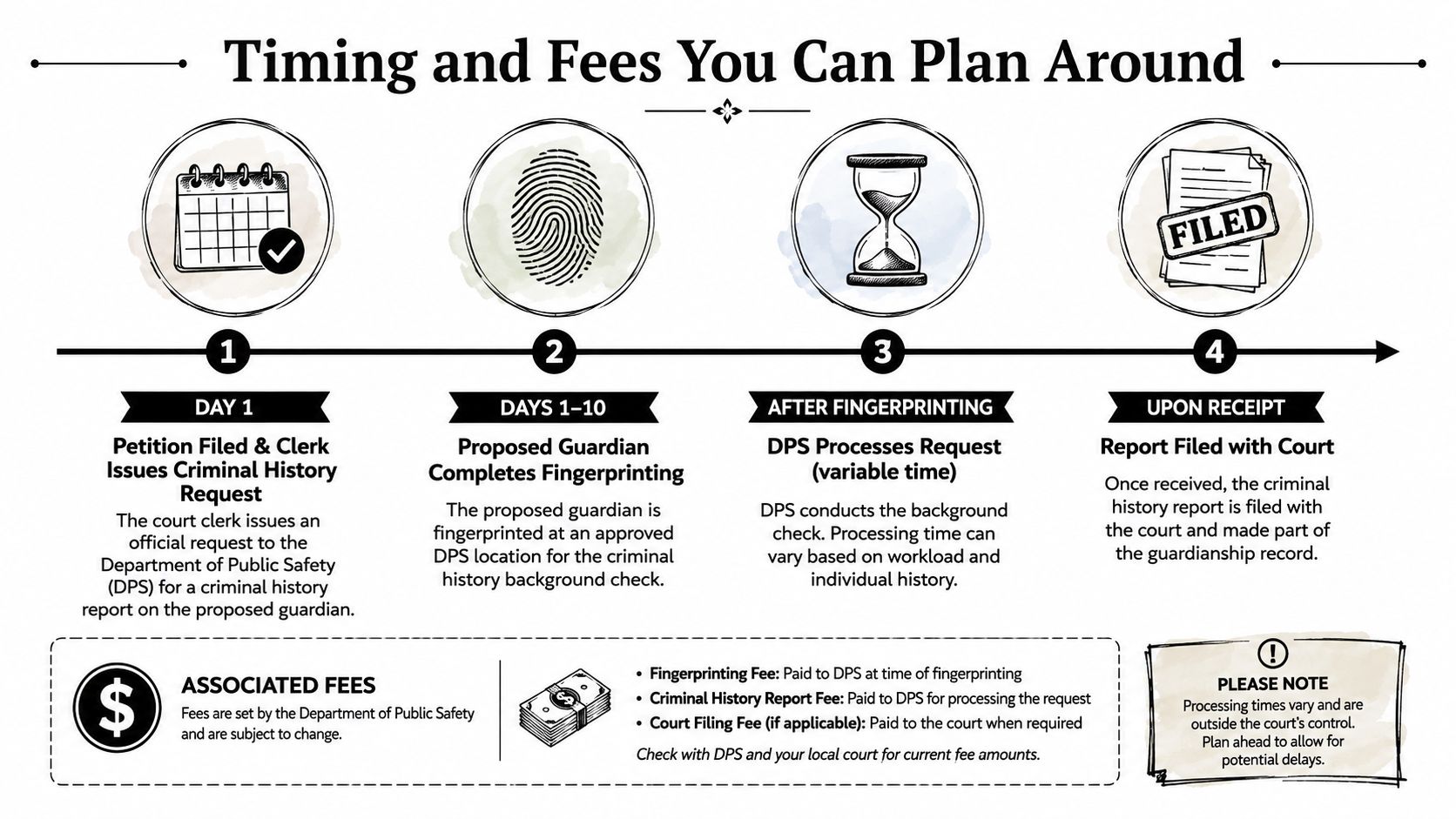
The hard date is the hearing deadline, not the day the family first thinks about guardianship. Texas court guidance requires the criminal-history material to be delivered to the court at least 10 days before the guardianship hearing. That gives the clerk and judge time to verify the required record before appointment.
A workable calendar
At filing, ask the county clerk which check applies and what the applicant must sign. The proposed guardian should arrange fingerprints immediately if the clerk requires them, then complete the DFPS or CPS process separately.
During the next days, monitor the vendor confirmation and contact the clerk if the transaction fails or the identifying information is wrong. Don't rely on a verbal promise that the report is “on the way.” The court needs proof that the correct material reached the right office.
Before the hearing, confirm that the clerk has received the criminal-history result, any required CPS clearance, the proposed guardian's training or registration documents, and the other papers required by the local probate court. A family that waits until the morning of court may discover that the judge can't complete the appointment.
What the fee rule tells you
The verified statewide guidance identifies a $10 clerk fee as a possible cost-recovery charge for obtaining criminal history record information. Other expenses, including fingerprinting, certified copies, filing costs, service, medical evaluations, and attorney fees, can vary by county, vendor, and case. Don't budget from an online fee list without confirming it with the clerk handling your case.
A temporary guardianship changes the pressure, not the importance of preparation. The court must act quickly when the statutory emergency standards are met, but the proposed guardian still needs to respond to the clerk and comply with the order's limits. Texas guardianship filing fees and court costs can help families identify cost questions to raise before filing.
Forms, Filings, and Sample Petition Language
A daughter filing for her father may see a stack of papers that feels larger than the legal issue itself. The usual file can include the guardianship application, medical evidence, the proposed guardian's affidavit or declaration, notices and waivers, the order appointing an attorney ad litem, and the criminal-history materials maintained through the clerk's process.
The proposed guardian may also have a fingerprint receipt or confirmation from IdentoGO or another approved channel. That receipt proves the appointment was initiated, but it isn't necessarily the final criminal-history report. Ask the clerk where each document belongs and whether the court wants an original, a certified copy, or electronic confirmation.
Read the forms as a sequence
The application for guardianship starts the case. It identifies the proposed ward, explains why protection is necessary, names the proposed guardian, and provides information the court needs to evaluate authority and suitability.
The proposed guardian's affidavit supplies sworn information about the applicant. The Order Appointing Attorney Ad Litem identifies the lawyer who represents the proposed ward's legal interests. The criminal-history certificate or report is handled through the clerk and court record system, while fingerprint proof shows how the applicant responded to the request.
Texas probate courts often use Supreme Court of Texas-approved forms, but local rules may add filing instructions or county-specific documents. Before submitting anything, compare the statewide form with the rules for the court where the case is pending. Families can also review Texas guardianship forms with counsel before signing.
A careful example of petition language
A proposed guardian and attorney might adapt language like this to the facts of the case:
“Applicant requests appointment as guardian and agrees to provide the criminal-history information required by the court and county clerk. Applicant has disclosed known criminal dispositions and understands that the court will evaluate suitability under the Texas Estates Code.”
That language isn't a substitute for the court's approved form or legal advice. Don't sign an absolute statement about having no criminal history unless it is accurate and your attorney confirms what the form asks. A prior arrest, charge, or conviction may require context, not concealment.
For the adult-case framework, Guardianship of an Incapacitated Adult in Texas describes how a court establishes guardianship for an adult who cannot manage their affairs.
Delays, Privacy, and What Comes Next
A background check can stall for reasons that have nothing to do with wrongdoing. A proposed guardian may miss the fingerprint appointment, use the wrong transaction code, or submit information that doesn't match the application. A common name, a former name, or out-of-state residency can also require extra review before the clerk is confident that the result belongs to the correct person.
Incomplete CPS information creates a separate problem. The DFPS request and the criminal-history search come from different channels, so one completed result doesn't prove that the other has arrived. Call the clerk early, provide the confirmation number, and ask what remains outstanding.
Who can see the result
Texas court guidance says criminal history record information is confidential and provided only to the clerk and probate court for authorized purposes. The information isn't placed in the guardianship file as an ordinary public document. That protection matters to families who worry that a sensitive record will become broadly available through the case file.
If the report appears incorrect, begin with the agency that produced it. Ask the Texas Department of Public Safety about its error-resolution process, gather certified dispositions or identity documents, and tell the probate clerk and attorney about the dispute. Don't wait until the hearing to mention a common-name match. The court may need a corrected result or additional proof before deciding eligibility.
Life after appointment
The judge's signed order isn't the end of the work. A guardian must follow the powers and limits in the order, complete required oath and security steps, and protect the ward's remaining rights. If the case involves an estate, the guardian must maintain records and file an annual account with the county clerk. Under Texas Estates Code Section 1163.051, the account remains on file for 10 days before judicial review, and the court can't approve it unless required cash, securities, or other safeguarded assets are properly proven.
A guardian of the person may also have annual reporting duties about the ward's well-being. Significant changes, conflicts, or concerns about the guardian's conduct should be addressed through the court process rather than ignored. Families can later seek modification or termination when the legal need changes, and a proposed ward or relative may contest an appointment when the evidence shows that guardianship is unnecessary, too broad, or unsuitable.
The Law Office of Bryan Fagan, PLLC helps Texas families prepare guardianship applications, organize background-check and court paperwork, address temporary or contested guardianships, and plan for ongoing compliance. Visit Law Office of Bryan Fagan, PLLC to schedule a free consultation about your county, your loved one's needs, and the next filing deadline.