Skip to content
Your phone rings after dinner. Your mother left the stove on again, or your brother signed paperwork he could not explain, or the hospital says someone needs legal authority to make decisions now. In that moment, families in San Antonio are not looking for abstract legal terms. They need to know what happens first, what the court will require, and how to protect someone they love without making a hard situation harder.
A guardianship attorney in San Antonio helps turn that first worried call into a step-by-step plan through the Bexar County Probate Court system. The job starts with a simple question: does your loved one need guardianship, or would a less restrictive option work? If guardianship is the right path, the process usually includes gathering medical information, preparing the application, giving formal notice, attending hearings, and following the judge's instructions after an order is signed.
Guardianship works like a safety system with court oversight. It gives a responsible adult legal authority to handle specific decisions for a person who can no longer manage those decisions safely alone. That may involve medical care, finances, or both, depending on what the court finds necessary.
Directories like Avvo list dozens of guardianship attorneys in the San Antonio area, which reflects how often families in Bexar County face these questions. The important point is not how many lawyers appear in a directory. It is finding counsel who can explain each stage clearly and guide your family from the first filing to the ongoing duties that follow.
Many families call after a crisis begins. Clear guidance early often makes the process less confusing, helps avoid preventable delays, and gives everyone a better sense of what to expect in court.
When Your Loved One Needs Help in San Antonio
Many families reach this point slowly. A mother misses doctor visits. A father gives money away to strangers. An adult sibling can no longer understand medical choices after a stroke. What feels confusing at home can become a legal issue very quickly once health, safety, housing, or finances are at risk.
In Texas, guardianship gives one person legal authority to help another person who can't manage key decisions independently because of age, illness, or incapacity. In Bexar County, that usually means going through probate court with medical evidence, formal notice, and court review.
Why families often wait too long
Most relatives don't want to overreact. They hope a rough patch will pass, or they assume being a spouse or adult child automatically gives them authority to act. Often, it doesn't. Hospitals, banks, care facilities, and government agencies may need legal authority before they'll accept instructions from a family member.
That's why legal guidance matters early. A guardianship lawyer helps you determine whether guardianship is necessary, whether a less restrictive option might work, and what documents the court will require if a filing becomes necessary.
Practical rule: If your loved one can no longer understand medical treatment, protect themselves from exploitation, or manage daily safety, it's time to speak with counsel before the problem gets worse.
What this looks like in real life
A common San Antonio situation involves an older parent living alone in Bexar County. The family notices unpaid bills, spoiled food, and repeated falls. The parent refuses help but also can't explain medications or identify trusted contacts. In another case, parents of a young adult with significant disabilities discover that once the child becomes an adult, schools and providers may no longer take direction from them without legal authority.
In both situations, guardianship may be the right path. In others, it may not. The first job is to sort out which legal tool fits the problem.
Understanding the Types of Guardianship in Texas
Texas treats guardianship as a court-supervised legal status that allows a guardian to make personal, medical, or financial decisions for a ward who can't manage those affairs independently. Courts generally recognize two primary categories: Guardian of the Person and Guardian of the Estate. In some cases, one individual may serve in both roles.

The two main roles
Here's the simplest way to think about it. One role handles the person's life and care. The other handles the person's money and property.
| Responsibility Area | Guardian of the Person | Guardian of the Estate |
|---|---|---|
| Medical care | Makes healthcare decisions | No direct healthcare authority unless also appointed over the person |
| Living arrangements | Helps decide where the ward lives | No direct housing authority unless tied to estate issues |
| Daily support | Oversees safety and personal needs | Does not manage day-to-day personal care |
| Bills and income | Usually not the primary financial manager | Manages finances, income, and property |
| Assets and property | No direct authority over assets unless also estate guardian | Controls estate administration subject to court supervision |
A Guardian of the Person usually steps in when the central concern is treatment, supervision, or living arrangements. For example, if your father can't understand discharge instructions after a hospitalization, this role may be what the court needs to consider.
A Guardian of the Estate is different. This role is about property, bills, accounts, and financial decisions. If your aunt owns a home, has income, and can no longer manage her finances safely, the estate side becomes important.
Full and limited authority
Not every case requires the same level of control. Courts can tailor authority based on what the ward can and cannot still do. Some people need broad help. Others need support only in a few areas.
For a more detailed breakdown, this comprehensive guide to different types of guardianship in Texas is helpful background reading. The resource on Guardian of the Person vs. Guardian of the Estate also explains the two distinct types of Texas guardianship and what each controls.
A simple example
Suppose Maria lives in San Antonio and has advancing dementia. She can't remember whether she has eaten, struggles to follow doctor instructions, and leaves the stove on. But her only income is direct-deposited, and her bills are already paid automatically from a small account. Her family may need a guardian of the person, but not necessarily a guardian of the estate.
Now change the facts. Maria also owns rental property, signs confusing contracts, and can't track bank withdrawals. That second set of facts may support a request for authority over both the person and the estate.
Guardianship should fit the person's actual needs, not the family's frustration level.
The Guardianship Process in Bexar County Courts
A family often reaches this stage after weeks or months of trying to hold things together. Bills are going unpaid. Doctors need consent. A bank account does not make sense anymore. In Bexar County, the court process gives the family a formal way to ask for legal authority, and it moves in a set order.
That order matters. A guardianship case is less like a single courtroom showdown and more like a relay race. One required step hands the case to the next until the judge has enough reliable information to decide whether a guardianship is necessary and, if so, how limited or broad it should be.

The case starts with the application and medical proof
The first formal step is filing a sworn application in the Bexar County probate court. Under Texas Estates Code § 1101.001, a guardianship application must identify the proposed ward, explain why a guardian is needed, describe the requested powers, and state whether alternatives and supports were considered, as summarized in Texas Estates Code § 1101.001 on FindLaw.
For families, this is usually the point where the process becomes real. The application is the court's starting map. If the facts are vague, the court has very little to work with. If the facts are clear and specific, the judge can see the person's actual risks, daily limits, and decision-making problems.
Medical evidence is part of that map. In a permanent guardianship case, the court usually expects a current Certificate of Medical Examination from a licensed physician. If the certificate is outdated, incomplete, or does not match the allegations in the application, the case can slow down or require correction. The timing and paperwork rules are discussed by Texas Guardianship Lawyer.
Families who want a practical overview before filing can review this guide on how to file a guardianship petition in Texas.
What happens after the case is filed
Once the application is filed, the court adds protections for the proposed ward. The judge typically appoints an Attorney Ad Litem to represent that person's legal interests. The court may also assign a court investigator or require additional information about the person's condition, living situation, and support system.
This part confuses many families, so it helps to slow down here.
The Attorney Ad Litem is not the family's lawyer. That lawyer speaks for the proposed ward. If your mother says she does not want a guardian, the ad litem must take that position seriously, even if the family disagrees. The court's job is to protect rights first and convenience second.
Notice also has to go out to the people the law requires. Service on the proposed ward is especially important. Guardianship can remove important rights, so the court does not allow the case to move forward without proper oversight.
If your family has already explored understanding POA in Texas, this is often where the court will ask whether that option, or another less restrictive tool, could handle the problem without a guardianship.
The hearing in Bexar County Probate Court
After the filings, medical proof, appointments, and notice requirements are in place, the court sets a hearing. That is the point where the judge decides whether the applicant has met the legal standard.
The burden is high. The applicant must prove incapacity and the need for guardianship by clear and convincing evidence. In plain language, the court wants solid proof, not family frustration, suspicion, or a general sense that someone is struggling.
A well-prepared hearing usually answers four practical questions:
- What decisions can the proposed ward no longer make safely?
- What evidence shows that loss of capacity?
- Why is guardianship necessary instead of a less restrictive option?
- What specific powers should the guardian receive?
That last question matters more than many families expect. Judges in Bexar County do not only ask, “Does this person need help?” They also ask, “How much authority is needed?” A careful order should fit the person's real limitations.
Here is a short video that helps introduce the process:
What the client journey usually looks like
From a family's point of view, the process often feels like this: an initial phone call with counsel, gathering medical records and background facts, preparing the sworn application, filing in the correct Bexar County probate court, waiting for appointments and service, attending the hearing, and then receiving signed letters of guardianship if the court grants the request.
The court order is not the finish line. It is the start of the guardian's legal duties.
After appointment, the guardian may need to qualify, take an oath, post bond if required, and follow reporting rules set by the court. Families are often relieved when the order is signed, but the court continues to supervise the case. That ongoing supervision is one reason it is so important to start with a filing that is accurate, specific, and grounded in the person's actual needs.
Emergency Guardianships and Less Restrictive Options
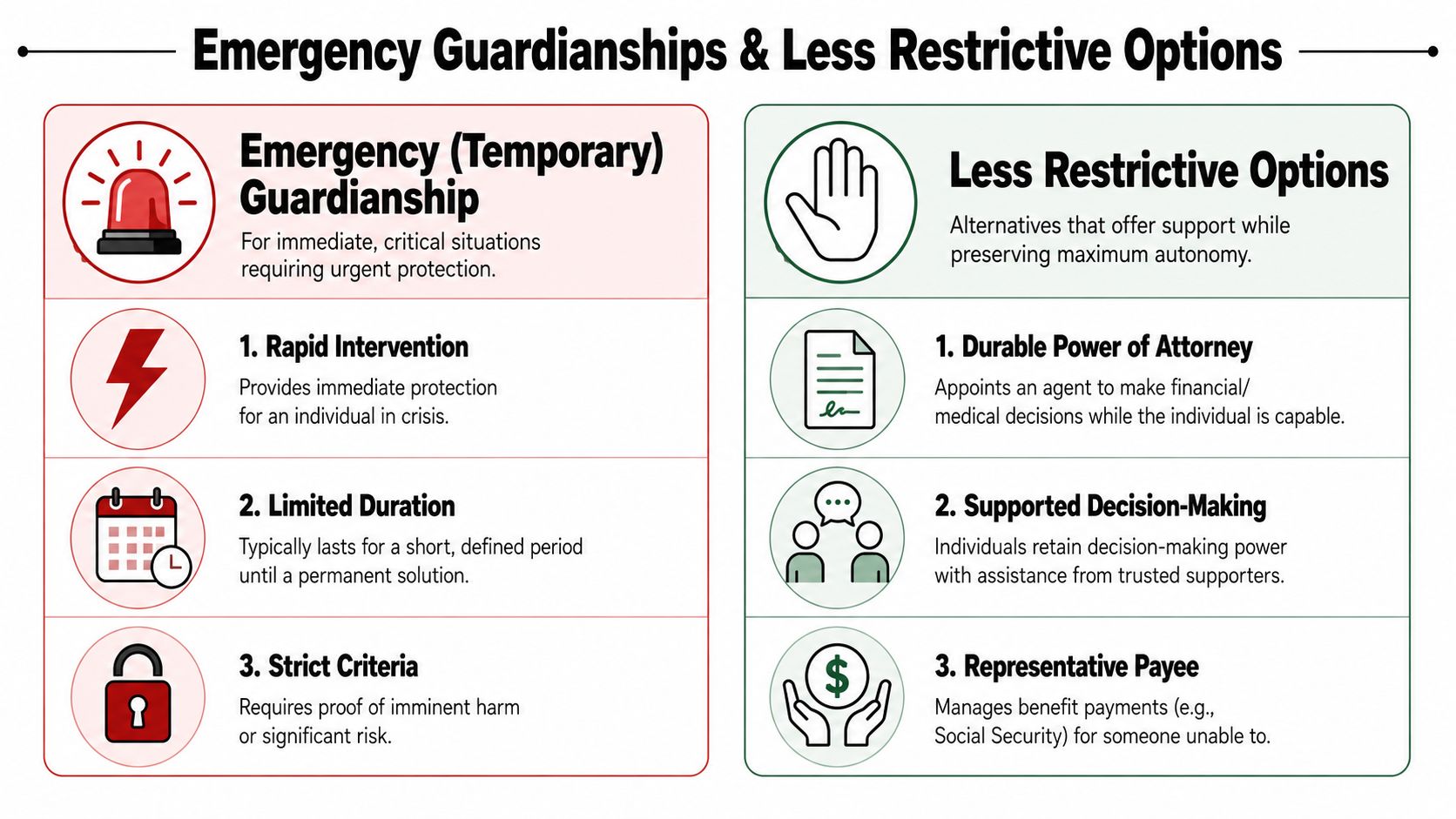
Some families call after a sudden crisis. A vulnerable adult is being financially exploited. A person with severe confusion wanders away from home. Assets are at immediate risk. In those situations, Texas law allows a temporary court response, but only under strict conditions.
When an emergency filing may be appropriate
For temporary or emergency guardianship, Texas Estates Code § 1251.003 requires a sworn application alleging imminent danger to the person or property, identifying the type of appointment requested, and stating the facts supporting the claim, as set out in Texas Estates Code § 1251.003 on Justia.
That legal standard matters. “I'm worried” is not the same as “there is imminent danger.” Courts look for immediate risk and specific facts.
Examples may include:
- Medical danger: A person can't understand life-sustaining care decisions and no authorized decision-maker is available.
- Financial harm: Someone is draining the proposed ward's funds or pressuring them into transfers.
- Unsafe living conditions: The person is exposed to serious danger and can't recognize the risk.
Temporary guardianship is powerful, but it's narrow and short-term. It is not meant to replace the full process unless the facts demand immediate action.
The court must also consider less restrictive options
Texas guardianship law does not start with “file for guardianship.” It starts with a different question. Is there a way to protect this person without removing more rights than necessary?
That's why the sworn application must address whether alternatives and supports were considered. Courts expect families and lawyers to look at options that preserve as much independence as possible.
Sometimes the right legal answer isn't guardianship. It may be a document the person signed earlier, or a support system that solves the problem without full court control.
Possible alternatives can include:
- Durable powers of attorney: These can authorize someone to handle financial matters if properly executed while the person still had capacity.
- Medical decision documents: These may help with treatment choices, depending on the facts.
- Supported decision-making: This can help an adult keep decision-making authority while receiving assistance from a trusted supporter.
- Representative payee arrangements: These may help manage certain benefit payments without broader guardianship.
If your family is comparing these options, this plain-language resource on understanding POA in Texas can help clarify how power of attorney differs from guardianship.
A side-by-side example
Suppose your uncle still understands his choices but has trouble reading forms and organizing paperwork. A supported decision-making arrangement or power of attorney may be enough.
If he no longer understands what money is, can't identify close family, and signs anything placed in front of him, a less restrictive option may no longer protect him adequately. That's when guardianship becomes a more realistic court remedy.
Your Responsibilities as a Guardian and Common Conflicts
Being appointed guardian is not the end of the case. It is the start of a legal duty. Guardianship in Texas stays under court supervision, and the guardian must follow the judge's order carefully.
What happens right after appointment
Once appointed, a guardian must take formal steps to activate authority. Texas law requires the guardian to sign an oath and post a bond within 20 days of appointment. The court then issues Letters of Guardianship, which expire after 16 months and must be renewed annually with a new bond and annual report to maintain legal authority, as explained by Texas Law Help's guardianship overview.
Those Letters matter in daily life. Banks, hospitals, care facilities, and other institutions often want to see current Letters before they will recognize the guardian's authority.
Core duties of a guardian
The court expects a guardian to act as a fiduciary. That means the guardian must act in the ward's best interest, not in the guardian's convenience or personal financial interest.
Common duties include:
- Protect the ward's wellbeing: A guardian of the person must help with care, safety, and appropriate living arrangements.
- Manage money carefully: A guardian of the estate must keep records, separate funds, and follow court rules for financial management.
- Report to the court: Texas guardianship requires ongoing reports and, where applicable, accountings.
- Respect the ward's dignity: Guardians should not treat the ward as voiceless. Even when a person lacks full legal capacity, their preferences still matter.
Important reminder: Guardianship gives authority, but it also creates accountability. If you miss deadlines or misuse funds, the court can intervene.
Where disputes usually begin
Many conflicts are not about the law at all. They start with family history. One sibling thinks another wants control. A second marriage creates tension between a spouse and adult children. A relative living out of state questions what's happening in San Antonio from a distance.
Disputes often involve:
- Who should serve as guardian
- Whether incapacity is being exaggerated
- Whether a current guardian is acting properly
- Whether guardianship should be modified or ended
Texas law sets an order of preference for guardianship appointments that generally prioritizes the person's own written designation first, then spouse, adult children, parents, and nearest kin, according to Amsberry Law's discussion of Texas Estates Code Chapter 1104. That doesn't mean the nearest relative always wins. The court still looks at suitability and the ward's best interest.
When compliance problems become serious
A guardian can face objections if they fail to file reports, ignore court limits, or use the ward's money improperly. On the other side, some guardians face unfair accusations from frustrated relatives.
That's why many families need continuing legal guidance even after appointment. Guardianship cases can involve modifications, removals, contested hearings, and requests to terminate the arrangement when it's no longer needed.
How to Choose the Right Guardianship Attorney in San Antonio
Not every probate lawyer handles guardianship cases the same way. If you're looking for a guardianship attorney in San Antonio, focus on fit, clarity, and local court experience.
What to look for
A useful checklist includes:
- Bexar County probate familiarity: Local process knowledge matters because filing habits, hearing expectations, and court logistics can vary from county to county. What works in Harris County Probate Court may not match how a Bexar County judge prefers to see a case prepared.
- Comfort with medical evidence: Guardianship cases often turn on physician evaluations, incapacity evidence, and careful coordination before filing.
- Plain-language communication: You should be able to ask basic questions and get direct answers without being buried in jargon.
- Experience with disputes: Even if your family starts out united, tension can surface later.
A focused resource on when to hire a Texas guardianship attorney can help you compare your options and decide when legal representation becomes necessary.
Questions worth asking in a consultation
Ask how the lawyer handles emergency filings, contested guardianships, and post-appointment compliance. Ask who will communicate with you. Ask how they approach cases where a less restrictive option may solve the problem without filing for full guardianship.
The right attorney won't just push paperwork. They'll help you understand what the court is likely to require and what your family will need to do next.
How The Law Office of Bryan Fagan Can Guide Your Family
A daughter calls because her father left the stove on again, missed his medications, and now the hospital is asking who can make decisions. She is scared, tired, and unsure whether she needs guardianship, a power of attorney, or something else. That is often how this process begins in San Antonio. With one hard moment and a family trying to find the next clear step.
The Law Office of Bryan Fagan, PLLC helps families work through guardianship cases involving the person, the estate, emergency applications, and disputes about incapacity or fiduciary conduct. The firm also handles related matters like probate and estate planning, which can matter when a case involves a home, bank accounts, end-of-life planning, or conflict between relatives.

Support through the full client journey
Good legal help should feel like having a guide who knows each stop in the Bexar County Probate Court process. It starts with listening. The first call usually focuses on what is happening right now, what decisions need to be made, whether your loved one is in immediate danger, and whether a less restrictive option may solve the problem without asking for full guardianship.
If guardianship appears necessary, the next phase is preparation. That can include gathering medical records, identifying family members who must receive notice, reviewing finances, and making sure the application matches the type of authority the court may be willing to grant. Families are often surprised that the court does not approve guardianship just because everyone agrees it would help. The judge will want evidence, proper filings, and a clear explanation of why this step is needed.
Then comes the court process itself. A lawyer can prepare the application, coordinate with the required physician evaluation, address questions from the court, and appear at hearings in Bexar County Probate Court. That matters because guardianship is not a single form. It works more like a chain, where each link must be in place before the court will issue an order.
The work does not stop when the judge signs.
After appointment, a guardian may need help understanding letters of guardianship, reporting duties, spending limits, inventory requirements, care decisions, and what court approval is needed before taking certain actions. Families often feel relief after the hearing, then realize the ongoing duties are a second phase of the case. Clear guidance at that stage can prevent avoidable mistakes.
A practical next step
If your family is weighing guardianship, considering an emergency filing, or dealing with concerns about a current guardian, a consultation can give you a clear plan based on your facts. You can explain what is happening, learn what Bexar County Probate Court is likely to require, and find out whether the next step is filing a case, gathering more evidence, or choosing a less restrictive option.
For many families, peace of mind starts with understanding the path ahead. A focused conversation with Law Office of Bryan Fagan, PLLC can turn a confusing situation into a step-by-step plan.