Skip to content
When an aging parent starts missing medical appointments, gives money to strangers, or forgets to pay the electric bill, families usually feel two things at once. Fear, and guilt. You want to protect the person you love, but you also know that asking a Texas court to remove an adult's decision-making rights is serious.
That tension is exactly why guardianship law in Texas is detailed and court-supervised. If you're trying to understand how to get guardianship of an adult in Texas, the process isn't just paperwork. You have to prove incapacity, show the court that less restrictive options won't work, follow the rules in Texas Estates Code Title 3, Subtitle G, and be ready for ongoing duties after appointment.
Texas courts, including courts such as Harris County Probate Court, look closely at these cases because guardianship can affect where a person lives, who handles their money, and who makes medical decisions. Families often come in thinking guardianship is automatic for a parent with dementia or an adult child with disabilities. It isn't. The court wants evidence, planning, and a practical reason for every step.
Navigating a Loved One's Need for Guardianship
Maria noticed the first signs with her father's checkbook. Bills sat unopened. His bank balance didn't make sense. Then came the doctor's office call about missed appointments. He insisted he was fine, but he couldn't explain where his money was going or which medications he was taking.
That's a common starting point. A spouse sees confusion getting worse. A sibling realizes an adult brother can't safely manage housing or healthcare. A parent of a young adult with disabilities learns that turning 18 changed the legal reality overnight. Love is still there, but legal authority may not be.

What families are really asking
Many individuals don't begin by asking for guardianship. They ask questions like these:
- Can I help my mom with medical decisions if she can't understand treatment options?
- What happens if my adult son signs contracts he doesn't understand?
- How do I stop financial harm without violating my loved one's dignity?
- What if family members disagree about whether guardianship is needed?
Those are the right questions. Guardianship is one legal response, but it's not the first answer in every case.
Practical rule: Start with the person's actual risks. Courts want to know what decisions the adult can't safely make, not just whether the family is worried.
Why the process feels overwhelming
Texas guardianship cases combine medicine, court procedure, family dynamics, and long-term responsibility. One relative may think intervention is overdue. Another may believe the adult just needs more support. The proposed ward may resist help entirely.
That's why a careful roadmap matters. Families need to know when guardianship fits, how to prepare a strong filing, what happens in probate court, how emergency guardianship works, and what responsibilities continue after the judge signs the order. Guardianship can protect a vulnerable adult, but only if the case is built correctly and handled with care.
Is Guardianship Truly Necessary in Texas
A lot of families reach this point after something concrete happens. A father wires money to a scammer. A sister cannot explain a surgery decision. An adult son keeps signing papers he does not understand. The question is not whether your family is worried. The question the court will ask is narrower and more important: is guardianship the only practical way to protect this adult now?
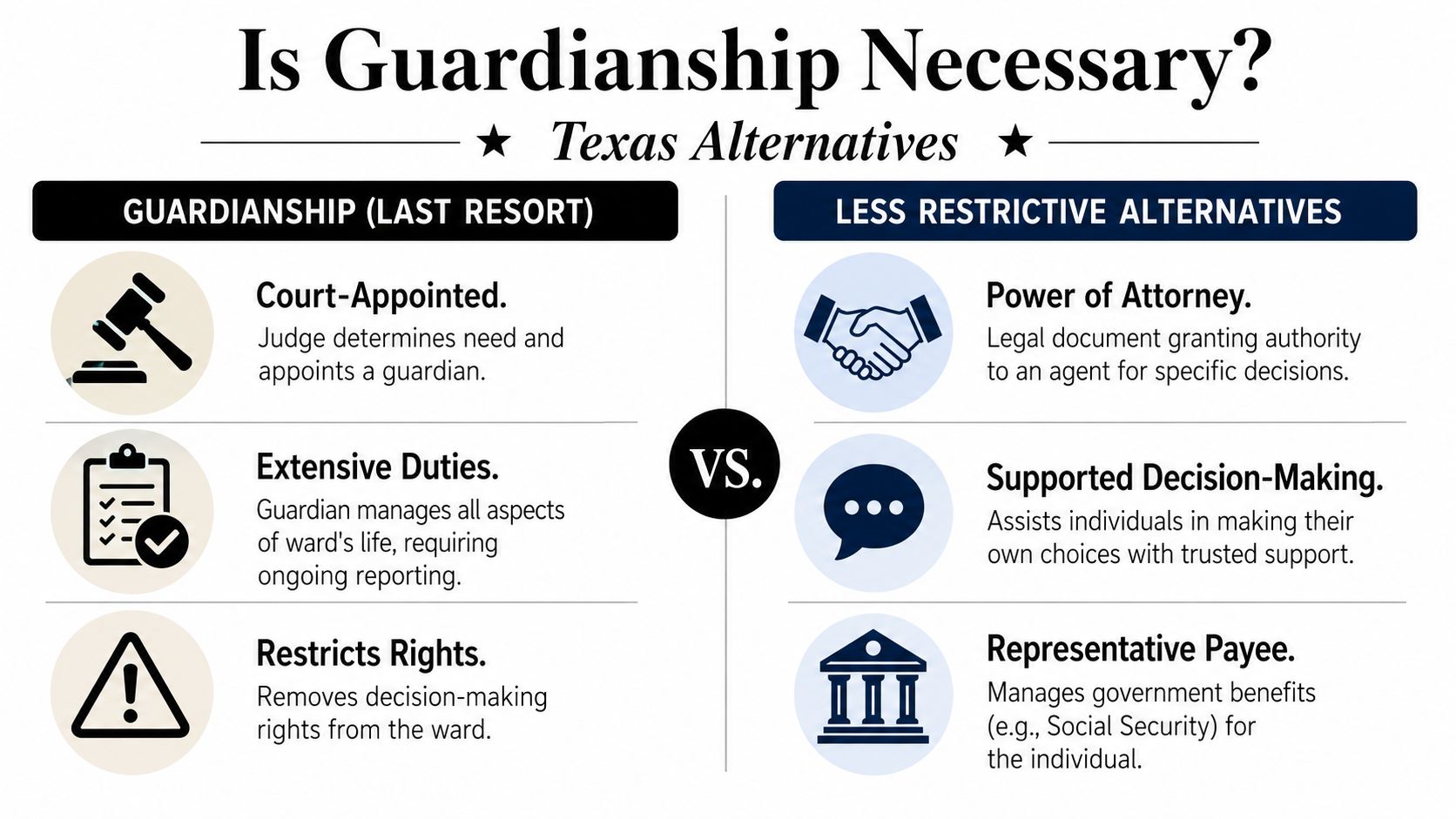
In Texas, guardianship is treated as a last resort because it can transfer major decision-making rights from the adult to someone else. Judges are not looking for a diagnosis alone. They are looking for proof that the person cannot make or communicate responsible decisions in specific areas, and that narrower supports will not solve the problem.
What the least restrictive alternative rule means
This rule shapes the whole case.
Under Texas Estates Code Section 1101.001, the application must tell the court what alternatives to guardianship and what available supports or services were considered, and whether they could remove the need for guardianship. In plain English, the judge wants to see your work. Families have to show what was tried, what could have been tried, and why those options did not protect the person well enough.
That is where many applications lose force. A family may have real concerns, but the filing only says the adult has dementia, mental illness, or an intellectual disability. That is not enough by itself. A diagnosis describes a condition. Guardianship cases are decided on function. Can the person understand medical choices? Pay rent safely? Resist exploitation? Communicate a consistent decision?
A helpful way to view it is this: the court is deciding whether a lock on every door is necessary, or whether a few targeted safety measures would address the risk.
What a stronger showing looks like
A stronger case usually includes specific facts about the less restrictive options the family considered or used before asking for guardianship, such as:
- Money management help: A relative helped with bill pay, set up limited account access, or explored a representative payee arrangement, but the adult still gave away funds, missed basic expenses, or remained open to scams.
- Decision support: The adult used trusted supporters to explain choices, attend appointments, or review paperwork, but still could not understand the consequences well enough to make safe decisions.
- Existing legal documents: The family checked for a valid power of attorney, medical power of attorney, directive, trust, or supported decision-making agreement, and found that no document existed, the adult lacked capacity to sign one now, or the document did not work in practice.
- Available services: Home health, case management, adult protective services involvement, placement support, or community programs were considered, but they did not address the decision-making problem itself.
For a fuller explanation of less restrictive options for decision-making before guardianship, review the alternatives carefully. The same issue is discussed in Less Restrictive Alternatives to Guardianship in Texas, which focuses on why Texas courts must consider alternatives before granting guardianship.
County practice matters more than families expect
The statewide rules come from the Estates Code, but probate courts are not identical from county to county. Harris County, Dallas County, Bexar County, and Travis County courts often expect a well-documented explanation of why a limited guardianship, a temporary arrangement, or another support system will not work. In smaller counties, the process may feel less formal, but the legal standard is the same. The judge still needs evidence, not conclusions.
That county-specific reality matters because a compelling case is not just about being right. It is about presenting the facts in the form the local court expects. Families who understand that early usually prepare better examples, better medical support, and a clearer explanation of why guardianship should be limited to the areas where help is needed.
Guardianship compared with narrower options
| Feature | Guardianship | Power of Attorney (POA) | Supported Decision-Making |
|---|---|---|---|
| Who creates it | Court appoints a guardian | Adult signs the document voluntarily | Adult keeps decision-making authority and uses trusted support |
| Effect on rights | Can remove rights unless the court preserves them | Adult keeps rights and authorizes an agent | Adult keeps rights |
| Best fit | Adult cannot make or communicate responsible decisions, and other options will not protect them | Adult still has enough capacity to choose an agent | Adult benefits from guidance but can still participate in decisions |
| Court supervision | Yes | No ongoing court oversight in the same way | No guardianship court oversight in the same way |
A simple example
Two adults can have the same diagnosis and need very different legal solutions.
One person understands choices if information is explained slowly, can consistently say what he wants, and can still sign a valid power of attorney. Guardianship may be too restrictive for that situation.
Another person cannot understand bank statements, cannot explain medical options, forgets repeated warnings, and continues to be exploited even with family help. That fact pattern is much closer to what courts look for in a guardianship case.
The court focuses on day-to-day decision-making, real-world risk, and whether a narrower option can work. That is the center of the analysis.
The First Steps Preparing Your Guardianship Case
The first strong guardianship cases are built before anyone goes to court. If you skip preparation, the case often stalls.
Start with the medical evidence
The medical proof is not optional. Objective medical proof of incapacity is mandatory and must come from a licensed Texas physician who completes a “Certificate of Medical Examination” after personally evaluating the proposed ward within the last 120 days before the application is filed; without this recent, physician-certified document, the court lacks the medical basis required to appoint a guardian according to Texas guardianship law guidance.
That timing matters. If the exam is too old, you may have to start over on the medical side before the court can act.
If you need a focused explanation of the form and timing, review physician certificate requirements for guardianship in Texas. Families also often find The Certificate of Medical Examination in Texas Guardianship useful because it centers on why a guardianship case starts with documented incapacity.
Build facts, not conclusions
Judges don't just need a statement that someone is “unable to manage.” They need examples that show what is happening in real life.
Useful information often includes:
- Medical concerns: missed appointments, refusal of necessary care, medication confusion
- Financial warning signs: unpaid bills, unusual withdrawals, inability to understand spending
- Personal safety issues: wandering, unsafe living conditions, vulnerability to manipulation
- Functional limits: inability to communicate choices, understand consequences, or manage basic tasks
Keep your notes factual. Write down dates, what happened, who observed it, and what harm resulted or nearly resulted.
Gather the right records early
Families usually move faster when they collect records at the start instead of waiting for the hearing date. That may include:
- Basic identity documents such as addresses, family relationships, and contact details.
- Medical records and provider information that match the physician's evaluation.
- Financial snapshots that show why estate management may be needed.
- Alternative planning documents such as any existing POA or supported decision-making papers.
A parent seeking guardianship of an adult child with disabilities should also think carefully about scope. Does the adult need help with medical decisions, financial decisions, or both? Tailoring the request can make the case more credible.
Filing the Application and Navigating Court Procedures
Once the medical certificate and supporting facts are ready, the case moves into probate court.

Where the case is filed
A guardianship proceeding begins when an application for permanent guardianship is filed in the probate court in the county where the proposed ward lives. That filing location rule appears in the Texas guardianship timeline discussion, which also notes that establishing guardianship for an adult in Texas typically takes between 30 and 90 days, and that after filing, the court must appoint an attorney ad litem to represent the proposed ward's interests and a court investigator to assess the need for guardianship.
In larger counties such as Harris County, court scheduling and investigator availability can affect how the case moves. Other counties may have different local practices even though the core legal rules come from the Estates Code.
What the application needs to say
The application is a sworn written pleading. It doesn't just identify the parties. It needs to explain why guardianship is necessary and why alternatives won't do enough.
Expect the filing to address:
- The proposed ward's condition
- Whether you seek guardianship of the person, the estate, or both
- Relatives and other interested persons who must receive notice
- Why less restrictive options are not feasible or not sufficient
This is one place where families get tripped up. They describe the problem broadly, but they don't connect the facts to the exact legal relief they're requesting.
Notice, service, and the attorney ad litem
The proposed ward and certain family members must receive formal notice. Service rules matter because the court wants everyone with a legal interest to know the case is pending.
If service becomes complicated, especially when relatives are hard to locate or formal delivery is contested, families sometimes consult professionals who handle process serving services so proof of delivery is documented correctly. That doesn't replace legal advice, but it shows how procedural details can affect the timeline.
The court-appointed attorney ad litem has a separate role. This lawyer does not represent the applicant. The ad litem represents the proposed ward's interests, meets with the ward, reviews the circumstances, and gives the court an independent perspective.
Later in the process, a court investigator may also review whether guardianship is necessary. That review can include interviews and a close look at alternatives.
A short overview may help before the hearing:
Preparing for the hearing
At the hearing, the judge wants a clear answer to three practical questions:
- Is the adult legally incapacitated?
- Is guardianship necessary?
- Is this applicant suitable to serve?
Bring examples that show risk and need. “He has dementia” is less useful than “He missed specialist care, stopped taking prescribed medication, and sent money to unknown callers.”
The proposed ward has rights in the process. The ward is entitled to attend the hearing and may contest the case, including asking for a jury trial. If a sibling objects or the ward strongly opposes the petition, the matter can become a guardianship dispute rather than a routine filing. In those cases, the quality of the medical evidence and the least-restrictive-alternative record often makes the difference.
Emergency Guardianship When Immediate Action Is Needed
Your mother is in the hospital, confused, and the discharge planner says someone must approve placement today. Or your brother with a brain injury is being pressured to sign away money, and the losses are happening now, not next month. In that kind of moment, families usually ask the same question. Can the court act fast enough to prevent harm?
Sometimes, yes. Texas courts can appoint a temporary guardian in a true emergency. But judges treat this remedy like a fire extinguisher, not a long-term care plan. You use it for immediate danger, and only to the extent needed to stop that danger.
What the court needs to see
Under Texas Estates Code Section 1251.003, the application must be sworn and must state specific facts showing imminent danger to the person or property of the proposed ward, along with the protection being requested.
Specific facts matter here more than almost anywhere else in the case.
A statement like “we are worried about her” usually will not carry much weight. A statement like “she left the hospital against medical advice twice this week, cannot explain her medications, and no one has legal authority to consent to needed placement” gives the judge something concrete to evaluate. The same is true in financial cases. “He is bad with money” is weak. “A new acquaintance withdrew funds, changed online passwords, and scheduled a deed signing while he could not explain what property he owned” is the kind of detail that shows immediate risk.
The least restrictive alternative still matters, even in an emergency. If an adult signed a valid medical power of attorney, has a working representative payee arrangement, or only needs a narrow court order aimed at one urgent problem, the judge may question why a broader temporary guardianship is necessary. In other words, the emergency filing must prove two things at once. Harm is close at hand, and a smaller intervention will not solve it.
How temporary guardianship is different
Temporary guardianship is limited in both time and scope. The court sets a prompt hearing, and if a temporary guardian is appointed, the order lasts for a short period while the larger guardianship question is sorted out.
That practical reality changes how you should prepare.
You are not only asking, “Is there danger today?” You are also showing the court that your request is specific to today's problem. If the immediate issue is medical consent and safe placement, ask for powers tied to those needs. If the immediate issue is asset protection, focus on freezing the bleeding rather than asking for every possible power. A narrow request often looks more credible because it matches the emergency.
County practice also matters more than families expect. Probate courts in larger counties such as Harris, Dallas, Bexar, and Tarrant often have standing procedures, staff expectations, and scheduling habits that shape how quickly an emergency request gets in front of a judge. In smaller counties, the process may be less formal but more dependent on the local court's availability. The statute is statewide. The pace and mechanics can feel local.
What a strong emergency case looks like
A strong temporary guardianship application usually reads less like a general family history and more like a timeline of danger.
Include:
- recent events, with dates if possible
- names of facilities, banks, or people involved
- what the adult could and could not understand in the moment
- why existing documents or supports are not enough
- the exact authority needed right now
That last point is where many cases get stronger or weaker. Judges are looking for fit. If the problem is a pending unsafe discharge, they want to know why someone needs authority over placement and treatment decisions immediately. If the problem is exploitation, they want to know what property is at risk and what temporary authority would protect it.
For a practical look at urgent filings, see how to get emergency guardianship fast in Texas.
After the Hearing Your Responsibilities as a Guardian
The hearing is over. The judge signed the order. Then a different kind of work begins.
Many families expect the hardest part to be proving incapacity. In practice, one of the hardest parts is serving as guardian in a way the court will continue to trust. Texas guardianship is not a private family arrangement. It is an ongoing court-supervised job, and the same idea that shaped the case in the first place still applies after appointment. Protect the adult, but limit restrictions to what is necessary.
What happens right after appointment
A signed order does not usually give you everything you need to act that same day. After appointment, the guardian must complete post-appointment requirements, including taking the oath and, in many cases, posting bond. The clerk then issues Letters of Guardianship, which are the documents banks, hospitals, and care facilities often ask to see. Texas Law Help explains these post-appointment requirements in its guardianship guidance.

That paperwork matters more than families expect.
You may have authority on paper because the judge signed the order, but third parties usually want current Letters of Guardianship before they will release information, honor instructions, or allow account access. If the letters expire and are not renewed, daily tasks can stall fast.
County practice can affect the timing here too. In larger probate courts such as Harris, Dallas, Bexar, and Tarrant, clerks and court staff often expect very specific post-appointment filings and formatting. In smaller counties, the process may feel less formal, but the same responsibilities still exist. A guardian who asks the clerk early about local procedures often avoids delays later.
Your duty is to the ward, not to family pressure
After appointment, your client is not the sibling who helped file the case or the cousin who agrees with you. Your duty runs to the ward.
That matters in real life. A brother may insist Mom should move in with him. A daughter may want to sell a house quickly. Another relative may object to care costs. The guardian cannot treat the role like a vote among family members. The guardian has to make decisions based on the ward's welfare, the court's order, and any rights the ward still keeps.
A useful way to understand the role is this. Guardianship works like a limited tool kit, not a blank check. If the court gave you authority over medical and placement decisions, that does not automatically mean you can manage every financial issue. If you are guardian of the estate, that does not automatically mean you control personal decisions.
Your responsibilities may include:
- Personal decisions: arranging care, coordinating medical treatment, and choosing an appropriate living setting if you are guardian of the person
- Financial decisions: protecting assets, paying valid expenses, and handling property if you are guardian of the estate
- Court compliance: filing required reports, keeping records, and getting court approval for actions that need permission
The least restrictive alternative test does not disappear after the hearing. It continues to shape good guardianship practice. If the ward can still make some choices, involve them. If a narrower arrangement will work, use it. Judges look more favorably on guardians who protect safety without taking over decisions the ward can still handle.
Ongoing compliance and why courts pay attention to it
Texas courts do not treat guardianship as a one-time event. They review what the guardian is doing, whether deadlines are being met, and whether the ward still needs the same level of restriction.
That is why recordkeeping matters. Keep copies of reports, receipts, account statements, care notes, and major communications. If someone later accuses you of overspending, isolating the ward, or acting outside your authority, clear records often become your best protection.
Pay close attention to:
- Annual reports and accountings
- Bond renewals and current letters
- Limits written into the appointment order
- Changes in the ward's condition that may justify modifying or ending the guardianship
Families are often surprised by that last point. Guardianship is supposed to fit the ward's present condition, not freeze life in place forever. If the adult regains some ability, develops better support, or can use a less restrictive option, the court may need to restore rights or narrow the guardianship.
Disputes, restoration, and related planning
Some of the most difficult problems begin after appointment, not before. A relative may claim the guardian is doing too much. The ward may ask the court to restore rights. A care facility may raise placement concerns. Property issues may overlap with probate or longer-term planning.
Those related issues can require separate legal work. In many families, guardianship intersects with probate matters and estate planning, especially if the ward owns a home, receives income, or needs a long-term care plan. Families still comparing options may also review guardianship services.
Law Office of Bryan Fagan, PLLC handles Texas guardianship, probate, and estate planning matters, including applications, emergency cases, disputes, and post-appointment compliance.
If you are caring for a parent, spouse, or adult child and are unsure what the court now expects from you, legal guidance can help you avoid mistakes that are hard to fix later. The Law Office of Bryan Fagan, PLLC offers a free consultation for Texas families who need help establishing, contesting, modifying, or understanding guardianship. A focused review of your loved one's condition, available alternatives, county court procedures, and next legal steps can help you act with clarity and care.