Skip to content
A daughter notices that her mother has started missing medications, giving money to strangers over the phone, and forgetting which bills were already paid. A parent of a young adult with disabilities realizes that school support is ending, but medical and housing decisions still need a legal plan. In both situations, the family is trying to answer the same hard question. How do we protect someone we love without taking away more independence than necessary?
That's where many people start searching for a Guardianship Attorney Dallas families can trust. They're worried, overwhelmed, and often unsure whether guardianship is even the right first step. Texas law does provide a path, but it also puts safeguards in place because guardianship can limit a person's rights in serious ways.
Families in Dallas, Harris County, and across Texas usually need more than a checklist. They need clear explanations, practical next steps, and a realistic sense of what the court will expect under Texas Estates Code Title 3, Subtitle G. They also need space to consider whether a less restrictive option could solve the problem without a full guardianship case.
When You Need to Protect a Vulnerable Loved One
Maria did not wake up one morning and decide her father needed guardianship. The concern built slowly. First she repeated medication instructions after doctor visits. Then she noticed signed forms he could not explain, unpaid bills stacked by the door, and phone calls from strangers asking for money.
That is the point where many Dallas families feel pulled in two directions at once. One side says, "Step in now before something worse happens." The other says, "Be careful. He still has rights, and this decision could change his life."

The moment concern turns into a legal question
Families arrive here for different reasons. A parent may have dementia and cannot track prescriptions or spot fraud. A young adult with disabilities may be turning eighteen, which means a parent no longer has automatic authority to make medical or financial decisions. A stroke, brain injury, or psychiatric crisis can also force hard decisions quickly.
The legal question is not merely, "Do we need guardianship?" The better first question is, "What problem are we trying to solve, and what level of legal authority is necessary?"
That distinction matters.
Guardianship is one tool in the toolbox. It can protect a vulnerable person, but it can also remove important rights. For that reason, families should treat guardianship like surgery, not a bandage. If a narrower option will solve the problem safely, the court will want to know why that option is not enough.
Signs that informal help may no longer be enough
Many relatives are already helping long before they call a lawyer. They drive to appointments, explain insurance letters, or monitor a bank account. Helpful support becomes a legal issue when the loved one can no longer understand choices, communicate reliable decisions, or protect themselves from harm.
You may be seeing problems such as missed medications, unsafe living conditions, repeated financial exploitation, confusion during medical visits, or signed documents the person did not understand. In other families, the warning sign is conflict. One sibling is helping, another disagrees, and no one has clear legal authority.
At that stage, good intentions alone may not protect the person.
Why families hesitate, and why that hesitation is normal
People often feel guilty even asking about guardianship. They worry it sounds controlling. They worry other relatives will think they are trying to take over. They also worry about cost, delay, and whether a judge will see the situation the same way they do.
Those concerns are reasonable. Texas courts treat guardianship seriously because it affects a person's independence. A careful lawyer should not push every family straight into filing. A careful lawyer should first help the family sort the problem into categories. Is the actual issue medical consent? Money management? Housing safety? Exposure to scams? End-of-school planning for a child with disabilities?
Once the problem is clear, the right legal path becomes easier to see.
Start with the least restrictive path that still keeps your loved one safe
This is often the turning point for a family. If your loved one can still sign a valid power of attorney, supported decision-making may work. If the concern is limited to benefits or a bank account, a more targeted solution may be available. If the person cannot understand those options or is already at serious risk, guardianship may be the right next step.
A Dallas guardianship attorney should help you compare those choices before you spend time and money on a full court case. That early review often saves families from filing for more authority than they need, or waiting too long to get protection that has become necessary.
The goal is not to take over a person's life. The goal is to put the right guardrails in place, with as little loss of independence as the situation allows.
What Guardianship Means Under Texas Law
Under Texas law, guardianship is a court-created relationship in which one person receives legal authority to make certain decisions for another person, called the ward, because the ward can't make or communicate responsible decisions in those areas. The court defines that authority. It doesn't come from family status alone.
Texas law separates guardianship into two legal categories. As stated by Dallas probate guardianship guidance, “Guardianship of the Person” and “Guardianship of the Estate” have distinct responsibilities, and the court must define them in the Letters of Guardianship.
Two roles, not one bundle of power
Many families often get confused. They assume one guardianship order automatically covers everything. It doesn't.
If your mother can't safely choose doctors or housing but has no meaningful assets, the court may focus on a guardian of the person. If your brother can handle daily living but can't manage inherited funds, the court may focus on a guardian of the estate. Some cases require both.
| Responsibility | Guardian of the Person | Guardian of the Estate |
|---|---|---|
| Medical decisions | Yes | No |
| Living arrangements | Yes | No |
| Daily care and personal needs | Yes | No |
| Managing income and assets | No | Yes |
| Paying expenses from estate funds | No | Yes |
| Financial transactions | No | Yes |
A useful concept overview is Guardian of the Person vs. Guardian of the Estate, which describes the two distinct types of Texas guardianship and what each controls.
What the court is really deciding
The court isn't deciding whether your family cares enough. It's deciding which legal rights, if any, should be transferred and to whom. That's a serious decision because guardianship can affect where a person lives, who speaks with doctors, and who handles money.
Texas Estates Code Title 3, Subtitle G also requires more than broad statements like “Dad is getting forgetful.” The application must describe the nature and degree of incapacity with specific facts. Courts are looking for evidence of a significant inability to make or communicate responsible decisions, not just age, diagnosis, or family concern.
Practical rule: If you can explain exactly what your loved one can still do safely, and exactly what they can't, you're already thinking about guardianship the way the court does.
The Texas Guardianship Petition Process Step by Step
Your mother misses insulin doses, gives cash to scam callers, and insists she is fine. The family agrees she needs protection. The hard part is figuring out what the court will require, how long it may take, and whether guardianship is the right tool before you spend months in probate court.
Families usually feel calmer once the process is laid out in order. A guardianship case works a bit like building a file for the judge. Each step answers a specific question: Who needs help, what kind of help is needed, and is a court-ordered transfer of rights really necessary?
Step one through step three
Step 1: File the application in the right probate court.
The case starts with a formal Application for Guardianship filed in the county where the proposed ward lives. The application must do more than say a loved one is struggling. It needs specific facts about the person's condition, daily limitations, the type of guardianship requested, and the people involved. If the proposed ward is a minor who will soon turn 18, Texas timing rules matter as well, as described in this Texas guardianship process overview.
Step 2: Support the case with current medical evidence.
Texas courts usually expect medical proof of incapacity, often through a physician's certificate prepared close enough in time to the filing to reflect the person's current condition. This is one reason families should not treat the petition like a stack of forms. The judge is being asked to remove legal rights, so the evidence must be recent and concrete.
Step 3: The court appoints someone to protect the proposed ward's voice.
In many cases, the court appoints an attorney ad litem to represent the proposed ward. That lawyer does not work for the applicant or for the rest of the family. The ad litem's job is to investigate, meet with the proposed ward, and tell the court what that person wants and what the law supports.
That step surprises many families. They expect the court to merely review paperwork. Instead, the court slows the process down on purpose because guardianship can limit fundamental personal rights.
Here is a short video that helps many families understand the court side of the process.
The hearing and what happens after
The hearing is the decision point. The judge reviews the medical evidence, listens to testimony, considers the attorney ad litem's position, and decides whether guardianship is needed at all. If it is needed, the judge also decides how limited or broad it should be.
Families often get tripped up by focusing on diagnosis instead of function. A diagnosis explains part of the story, but the court usually wants daily-life examples. Trouble taking medication, repeated unsafe financial decisions, wandering, inability to understand medical choices, or inability to communicate a stable decision are the kinds of facts that help a judge evaluate capacity.
The less restrictive alternative question is woven into this process, even before the next section examines it in detail. If you are still unsure whether full guardianship fits your situation, this explanation of less restrictive options instead of guardianship in Texas can help you compare the path you are considering.
If the judge grants the application, the court issues Letters of Guardianship. Those letters are the guardian's proof of authority. Banks, doctors, care facilities, and other institutions often want to see them before they will accept the guardian's decisions or instructions.
Appointment is the start of legal duties, not the end of the case. Guardians must continue reporting to the court about the ward's condition or finances, depending on the type of guardianship ordered. Families who are also coordinating medical devices, remote monitoring, or home-based care sometimes find practical support ideas in Rx360's guide for families.
How long it usually takes
The timeline depends on the court's docket, the quality of the paperwork, the strength of the medical evidence, and whether anyone objects. An uncontested case can move much faster than a family dispute over who should serve or whether guardianship is needed at all.
A useful way to think about timing is this. Delays usually come from unanswered questions. If the application is incomplete, the medical evidence is stale, relatives disagree, or the judge is not convinced that lesser options were considered, the case slows down.
Good preparation saves time and expense. It also helps families make the right decision before they commit to a process that can be demanding, public, and ongoing.
Exploring Less Restrictive Alternatives First
For many Dallas families, this is the most important decision point. They know something is wrong, but they don't yet know whether guardianship is necessary. Texas law treats that question seriously.
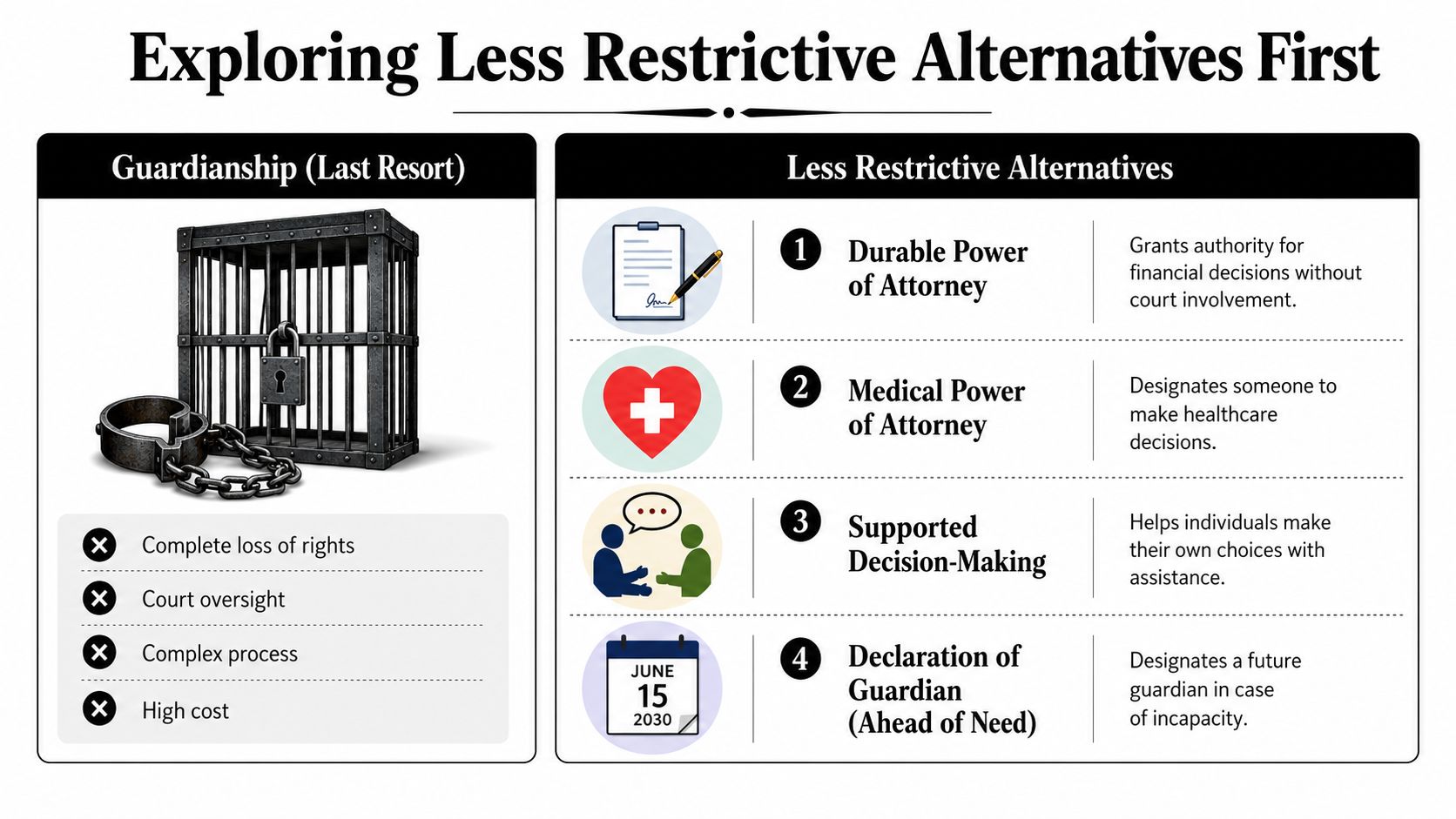
Before filing, the applicant must state in the sworn application whether alternatives to guardianship were considered and whether they're feasible, as required by Texas Estates Code § 1101.001(b)(3-a) and (3-b). That requirement exists for a reason. Guardianship should be a last resort, not the automatic first move.
Options that may preserve independence
A Durable Power of Attorney can authorize someone to handle financial matters without a court guardianship. A Medical Power of Attorney can authorize healthcare decision-making. A Supported Decision-Making Agreement can help a person keep decision-making authority while receiving structured assistance understanding choices.
Some families also use a declaration of guardian in advance planning, especially when they know a future need may develop. That kind of planning can reduce conflict later.
A helpful overview of family-centered support tools outside court is Rx360's guide for families. It can be useful when a household is trying to coordinate care, communication, and decision support before turning to a lawsuit-like court process.
Why this question matters so much
If your loved one can still understand choices with help, sign valid planning documents, or rely on limited assistance from trusted supporters, a full guardianship may be more restrictive than necessary. Texas law also requires a court investigator to examine whether less restrictive alternatives exist. If viable alternatives are available, the court is prohibited from granting guardianship under the legal framework described in the earlier Dallas probate source.
Families often need a plain-English review of that issue. A useful discussion is understanding less restrictive options before guardianship.
The best legal solution isn't always the biggest one. Sometimes the right answer is the least intrusive tool that still keeps your loved one safe.
Handling Urgent Cases with Emergency Guardianship
Your mother is in the hospital after a sudden stroke. The doctors need consent for treatment. A relative is pressuring her to sign checks she no longer understands. There is no valid power of attorney in place, and waiting through the full guardianship process could leave her exposed.
That is the kind of crisis temporary emergency guardianship is designed to address.
Under Texas law, a court can grant short-term authority when someone faces an immediate risk to health, safety, or property. The court is looking for a present danger that needs action now. Concern, family tension, or a long disagreement usually will not be enough. Judges want specific facts. Who is at risk, what is happening, and why a delay could cause harm.
When emergency relief may be appropriate
A few situations come up often. A vulnerable adult may need urgent medical decisions when no directive exists. Someone with serious cognitive impairment may be isolated by a person taking money or controlling access to medication. A facility may refuse placement without legal authority from a decision-maker.
In those moments, families often ask the same question. Should we file for full guardianship right away, or is a temporary order enough to stop the immediate harm?
That decision matters because emergency guardianship is a crisis tool, not a default strategy. It works like a fire extinguisher. You use it to contain immediate danger, then the court decides what longer-term arrangement, if any, is needed.
Temporary authority is usually narrow
Texas courts usually limit emergency orders to the problem in front of them. A judge may allow consent to medical treatment, authorize a safe placement, or freeze access to property at risk of exploitation. The order is not meant to hand one person broad control over every part of another adult's life.
That limited approach fits the larger question Dallas families should ask before spending time and money on a full case. What is the least restrictive legal step that will keep this person safe today?
Sometimes the answer is a temporary guardian followed by a full guardianship case. Sometimes the emergency passes, and the family can return to a narrower option. The court will still expect proof for any broader, longer-lasting arrangement.
If you need a practical overview of timing, filings, and what families should gather first, this guide on how to get emergency guardianship fast in Texas step by step is a useful starting point.
Good preparation also matters in urgent cases. Even under pressure, lawyers and families need organized records, clear timelines, and accurate communication. The Ares guide to legal tech gives a helpful look at how law firms use technology to manage fast-moving matters more efficiently.
How to Choose a Dallas Guardianship Attorney
Choosing a guardianship lawyer is a little like choosing a surgeon for a procedure you hope your family may not need. Skill matters, but judgment matters first. In Dallas guardianship cases, the right attorney does more than file papers. That lawyer should help you decide whether guardianship is the right tool, or whether a narrower option could protect your loved one with less cost, less conflict, and less loss of independence.
That question should come early.
A lawyer who starts with "we can file right away" before asking about powers of attorney, supported decision-making, living arrangements, medical risks, and family dynamics may be moving too fast. Texas courts treat guardianship as a serious restriction on a person's rights. Your attorney should approach it with the same care.
What to ask in the first consultation
Use the meeting to learn how the lawyer thinks, not just what the lawyer charges. A good consultation should leave you with a clearer map of the road ahead.
Which probate courts do you regularly appear in?
Local practice matters. Ask whether the attorney regularly handles cases in Dallas County probate courts and understands how those courts expect evidence, notices, and follow-up filings to be handled.How do you decide whether guardianship should be filed at all?
This may be the most important question. A careful lawyer should walk through less restrictive options before recommending a full case.What facts or records do you want to see before giving advice?
Guardianship cases often turn on medical records, physician evaluations, financial concerns, care history, and family conflict. You want an attorney who asks for specifics, not guesses.Who will prepare the petition and organize the evidence?
Some firms delegate heavily. That is not always a problem, but you should know who is building the case and who will appear with you in court.How will you explain my duties if I am appointed guardian?
Appointment is not the finish line. It is the start of ongoing legal duties. Your lawyer should be ready to explain reporting requirements, court oversight, and practical rules for handling money and care decisions.How do you communicate with families during stressful cases?
Guardianship often involves siblings, hospitals, care facilities, and sudden decisions. Clear updates in plain English matter.
Signs you may have found the right fit
Look for a lawyer who can explain a hard rule without hiding behind legal jargon. If the attorney can describe the difference between guardianship and a less restrictive option in a way that makes immediate sense, that is a strong sign. Good guardianship counsel should sound like a teacher under pressure, not a salesperson.
Organization matters too. These cases involve deadlines, medical evidence, service, hearings, and post-appointment responsibilities. Firms that use secure systems for documents and communication can make the process easier for families spread across Texas or dealing with urgent care decisions. For a broader look at how modern firms handle communication and workflow, see Ares guide to legal tech.
The Law Office of Bryan Fagan, PLLC is one Texas firm that handles guardianship, probate, and related planning matters, including applications, hearings, and Estates Code compliance.
If you want a fuller screening checklist before you hire counsel, review how to choose the right guardianship lawyer in Texas.
One final test helps many families. After the consultation, ask yourself: did this lawyer help me understand whether guardianship is necessary, or only explain how to file it? That answer often tells you more than any brochure or fee sheet.
Common Disputes and Your Duties as a Guardian
Some of the hardest guardianship cases aren't about the paperwork. They're about people. Siblings may disagree about whether guardianship is needed at all. A relative may object to who should serve. The proposed ward may resist the case because the process feels threatening or humiliating.
Those conflicts can intensify after appointment. A guardian who is trying to do the right thing may still face accusations of neglect, overreach, or financial misuse.
When families challenge the case
Disputes often begin with questions like these: Is the person incapacitated? Is a less restrictive option available? Is the proposed guardian acting in the ward's best interest, or in the family's own interest?
If the case becomes contested, the judge may hear competing testimony about caregiving history, finances, medical needs, and credibility. That's one reason records matter so much. Keep notes. Save receipts. Track care decisions. Good documentation can reduce conflict before it grows.
Defending a guardian who acted in good faith
False accusations are more common than many families expect. According to Dallas probate fiduciary defense guidance, over 30% of guardian removal petitions in 2024 were based on unsubstantiated claims rather than actual fiduciary breach. That's a reminder that even responsible guardians may need legal protection.
A guardian should never assume that good intentions alone will end a dispute. Courts want proof of careful conduct and compliance.
Duties that continue after appointment
A guardian's role is supervised. Duties depend on whether the guardian serves over the person, the estate, or both, but common obligations include:
Follow the court order closely
Your power comes from the Letters of Guardianship. Don't act outside them.Make decisions for the ward, not for convenience
Courts expect loyalty to the ward's welfare, dignity, and needs.Meet reporting duties on time
Missing deadlines can create avoidable legal trouble.Keep clear records
Organized records help with annual reporting and protect you if someone challenges your conduct.
A careful guardian reduces the risk of future conflict by treating the role as a fiduciary job, not just a family responsibility.
Frequently Asked Questions About Texas Guardianship
Many families still have a few focused questions after they understand the basics. These are some of the ones that come up most often in Dallas and across Texas.
Can a guardian be paid for serving
Possibly, but the answer depends on the type of guardianship, the court's orders, and the facts of the case. Families shouldn't assume they can reimburse themselves informally. Court oversight matters.
What if the proposed ward objects
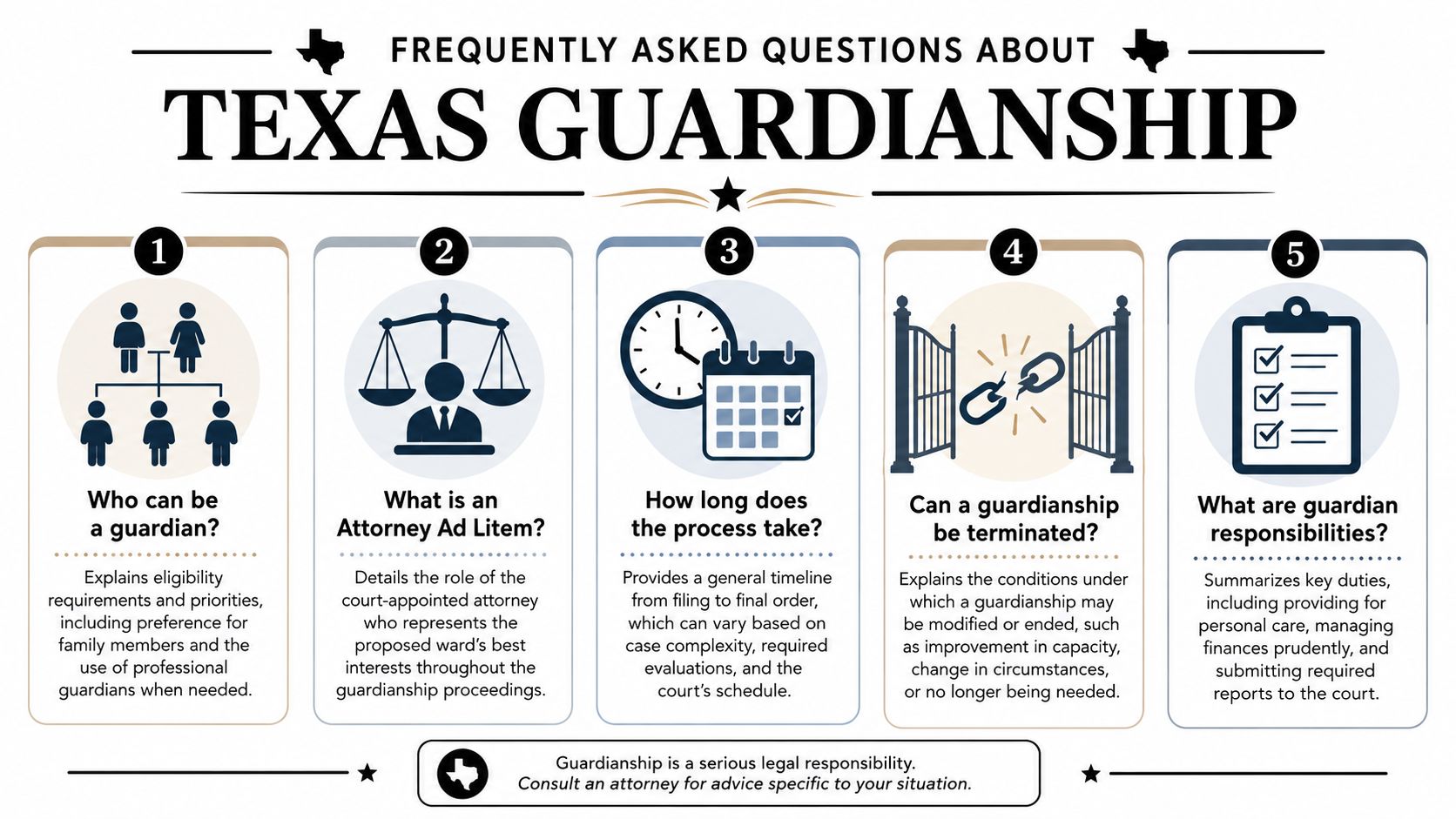
An objection doesn't automatically end the case. It does mean the court will look carefully at the evidence and the ward's rights. The attorney ad litem plays an important role here because that lawyer represents the proposed ward in the case.
Can guardianship be changed or ended
Yes. If circumstances improve, if the guardianship is too broad, or if the current arrangement no longer fits the ward's needs, the court may modify or terminate it. The process still requires formal filings and proof.
What should families do before a hearing
Bring specific facts, recent medical support, and a clear explanation of what decisions the loved one can and cannot make safely. Broad emotional statements rarely help. Concrete examples do.
What should a guardian do after appointment
Read the court's order carefully, calendar every reporting deadline, and keep records from the first day. Most compliance problems start with disorganization, not bad intent.
If your family is weighing guardianship, facing an emergency, or dealing with a dispute in Dallas, Houston, Austin, San Antonio, or anywhere in Texas, legal guidance can make the process much more manageable.
If you need practical guidance specific to your family's situation, schedule a free consultation with Law Office of Bryan Fagan, PLLC. Our team helps Texas families evaluate alternatives, prepare guardianship applications, handle hearings, respond to disputes, and stay in compliance after appointment, with clear advice grounded in Texas Estates Code requirements.