Skip to content
A daughter in West El Paso notices that her father, a retired engineer, has started leaving burners on and missing medications. She lives in Horizon, has a job and children, and is trying to coordinate care from a distance. Her first thought is, “Do I need a guardianship lawyer in El Paso?”
That question deserves a careful answer, not an automatic filing. Texas guardianship can protect a person or property when less restrictive tools aren't enough, but it also affects important rights. The right starting point is to ask what decisions your loved one can still make, what risks exist today, and whether another legal arrangement can provide support without taking broader authority from that person.
When a Family in El Paso First Considers Guardianship
The daughter's father may need help, but a diagnosis or a few frightening incidents doesn't automatically mean full guardianship is necessary. Families should begin with a capacity and safety review. Can he understand bills if someone helps organize them? Can he choose where to live? Can he agree to medication reminders or in-home care? The answers may point toward support rather than court-appointed control.
Texas courts say families should explore less restrictive alternatives before guardianship. Options can include a durable power of attorney for finances, a medical power of attorney, advance directives, a representative payee arrangement for Social Security benefits, a trust, informal family support, and a supported decision-making agreement under Texas Estates Code Chapter 1357. A joint bank account may help with limited household tasks, but families should understand its ownership and misuse risks before adding anyone to an account.

Start with the person, not the paperwork
A useful conversation might sound like this: “Dad, would you be comfortable having me help pay the electric bill?” That approach preserves dignity and may reveal that he can make informed choices with practical assistance. Supported decision-making can allow an adult to choose trusted supporters who help understand information, communicate decisions, or consider options while the adult remains the decision-maker.
A trust may also manage assets without requiring a guardianship of the estate. Estate planning documents, including powers of attorney and healthcare directives, may address future incapacity when they were properly signed while the person had capacity. Families can review these tools with an estate planning attorney and consider how they fit with probate and long-term care planning.
Some families also need immediate caregiving support while legal questions are being resolved. For local information about training and care resources, The CNA Guide Texas listings can help families explore caregiver education options in El Paso.
Practical rule: Guardianship should solve a specific protection problem. It shouldn't become the default response to a difficult family conversation.
If your loved one can't understand essential decisions, faces serious safety risks, or has property vulnerable to loss, a guardianship lawyer in El Paso can help compare alternatives with the facts. The first consultation should focus on remaining abilities, urgent risks, existing documents, and the least restrictive plan that could work.
Understanding Texas Guardianship and the Estates Code
Texas guardianship law is organized primarily through the Texas Estates Code. The modern statewide framework became effective on January 1, 2014, under House Bill 2759, and later amendments in 2015 and 2021 refined the system. Texas Estates Code Chapter 1001 explains that laws and rules governing decedents' estates generally apply to guardianships unless another Estates Code provision is inconsistent. It also anchors filings to the county clerk in the proper county. Texas Estates Code Chapter 1001 provides the statutory foundation for filings, accountings, and court supervision in El Paso and throughout Texas.
Think of guardianship as having two possible keys. Guardianship of the person gives authority over personal decisions, such as living arrangements, medical care, and daily needs. Guardianship of the estate concerns money and property, including accounts, bills, real estate, and other assets. A full guardianship combines both, while a limited guardianship grants only the authority the court identifies as necessary.

What incapacity means in practice
Age alone isn't incapacity. A medical diagnosis alone isn't enough either. The court looks at the person's functional abilities and whether the person can make or communicate responsible decisions about personal care or property. Qualified medical evidence helps the judge evaluate those abilities, but the court must also consider supports and less restrictive choices.
The proposed ward's best interest and the least restrictive intervention guide the court's decision. A spouse, adult child, parent, sibling, or another adult with a legally recognized interest may be able to file, depending on the circumstances and the requested appointment. El Paso County probate courts, like probate courts elsewhere in Texas, must examine the evidence rather than automatically appoint the relative who filed first.
For families seeking representation in guardianship of the person and estate under the Estates Code, Texas Guardianship Lawyer is one legal resource to review. The important question remains the same: what authority is needed, and what authority can safely be left with the proposed ward?
The El Paso Filing and Hearing Process Step by Step
Guardianship begins in the county where the filing belongs. In El Paso, that generally means working through the appropriate El Paso County probate court and county clerk. A careful attorney will first identify the requested type of guardianship, gather medical information, review existing powers of attorney or trusts, and determine whether an urgent application is justified.

The main milestones
Prepare before filing. Gather the proposed ward's identifying information, medical records, financial information, and facts showing why protection is needed. Discuss whether the application seeks guardianship of the person, estate, or both.
File the application. The filing generally includes the guardianship application, a physician's certificate of medical examination when required, and a proposed order. Texas Estates Code Chapter 1051 governs notice and service requirements, so incomplete information can create avoidable delays. Families can review the Texas guardianship application process before meeting counsel.
Court appointments follow. The court may appoint an attorney ad litem to represent the proposed ward's interests. A guardian ad litem may also investigate and report to the judge. These roles aren't a formality. They help the court hear from someone who independently considers the proposed ward's wishes and circumstances.
Service and notice occur. The proposed ward and interested parties must receive legally sufficient notice. The proposed ward has rights in the proceeding and can object to the appointment or proposed powers.
The court holds an evidentiary hearing. The applicant must prove the legal requirements with clear and convincing evidence. Bring organized medical evidence, concrete safety facts, and a focused explanation of why alternatives won't adequately protect the person or estate.
The judge signs an order. If guardianship is granted, letters of guardianship issue after required steps are completed. If an estate is involved, the court addresses fiduciary bond requirements and the guardian's authority.
Families should expect the schedule to depend on service, medical evidence, court availability, objections, and whether the case is contested. Avoiding rushed assumptions and providing complete information at the start often makes the process easier for the court and the family.
A short video can also help families understand the general role of guardianship in Texas:
How Much Guardianship Costs in El Paso
Guardianship costs depend on the work required, the proposed ward's assets, medical circumstances, and whether someone objects. An uncontested matter may involve a defined fee arrangement, while a dispute may require hourly work for discovery, motions, witnesses, and hearings. Families should ask for a written agreement that explains what the fee covers and which services are billed separately.
Some expenses arise outside the lawyer's fee. They may include the county filing fee, medical or psychological evaluation costs, service by a constable or sheriff, attorney ad litem fees, guardian ad litem fees, and a surety bond when the court requires one. The proposed ward's estate may ultimately bear some approved guardianship expenses, but a petitioner shouldn't assume that every initial cost will be paid from estate funds.
| Cost Item | Typical El Paso Range |
|---|---|
| Attorney fee for an uncontested matter | Varies by scope and agreement |
| Attorney fee for a contested matter | Usually based on time and litigation needs |
| Court filing and clerk charges | Set by the applicable court and county schedule |
| Medical or psychological evaluation | Set by the evaluating professional |
| Service of process | Set by the serving authority |
| Attorney ad litem or guardian ad litem | Determined through court procedures |
| Surety bond | Depends on the court's order and the estate |
Budget for the year after appointment
The filing is only one part of the financial picture. Guardians may need accounting assistance, recordkeeping systems, bank coordination, annual reporting preparation, and legal advice when circumstances change. Before signing, ask which post-appointment services are included, which are not, and how the firm handles unexpected disputes.
Families can use this guide to Texas guardianship filing fees and court costs to organize questions. Several firms offer an initial consultation without charging a fee, but families should confirm the terms directly rather than assume that all later work is free.
Uncontested Contested and Emergency Guardianships
The same word, guardianship, can describe very different court experiences. An uncontested case may proceed cooperatively when relatives agree about the need for protection, the proposed guardian, and the scope of authority. A contested case can become a serious dispute about capacity, family motives, property, living arrangements, or who should serve.
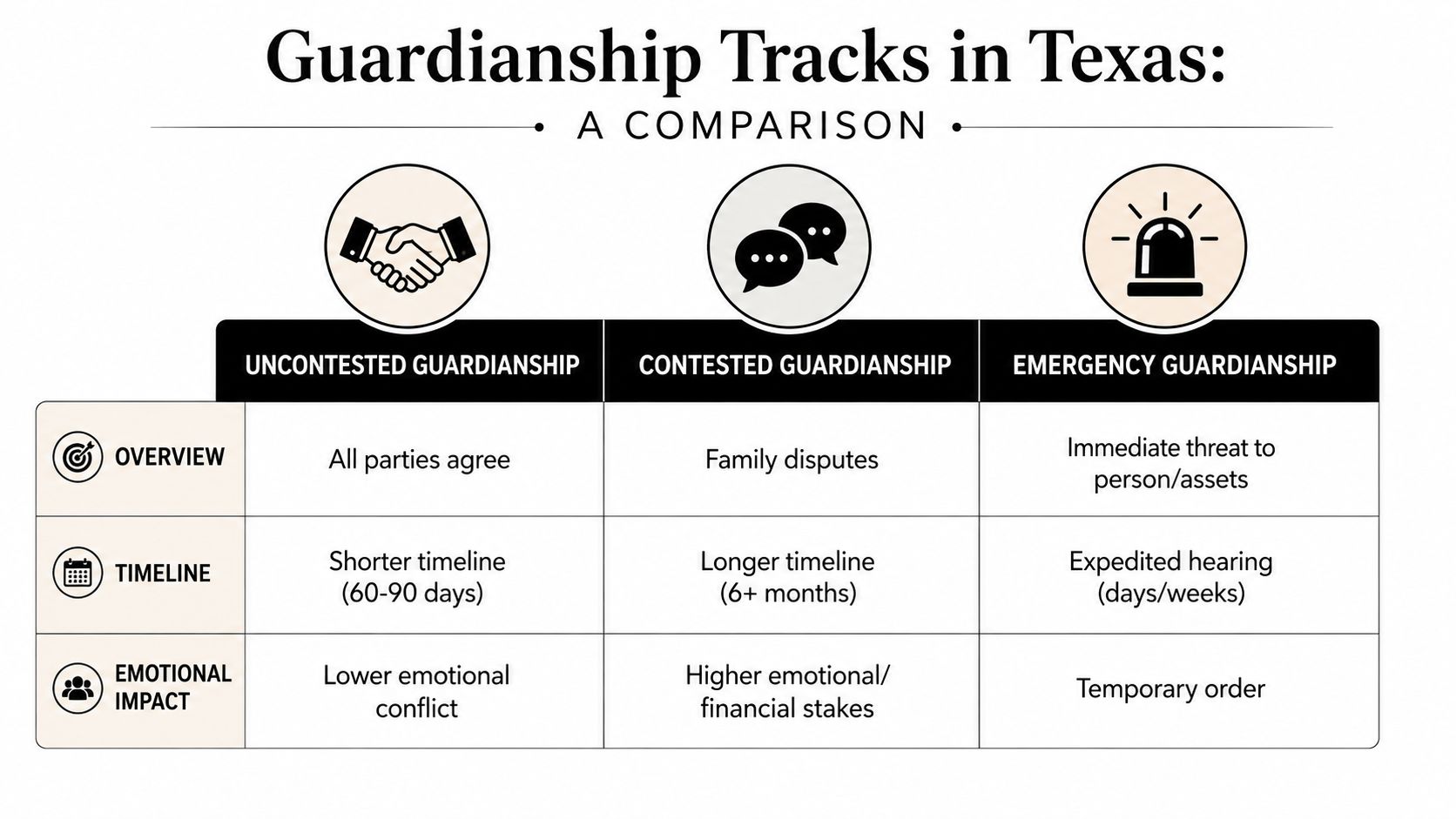
Three different paths
Uncontested guardianship usually involves cooperation and a narrower evidentiary dispute. The court still must protect the proposed ward's rights, review the evidence, and enter an appropriate order. Agreement can reduce conflict, but it doesn't remove the need for proper notice, medical proof, or fiduciary preparation.
Contested guardianship may involve objections from the proposed ward or relatives, competing applications, allegations of financial misconduct, or disagreement about whether alternatives are sufficient. Counsel may need to gather records, question witnesses, respond to motions, and present evidence at more than one hearing. A family should not treat a contested filing as a routine form.
Temporary guardianship is different from a permanent appointment. Under Texas Estates Code Chapter 1251, the court must find substantial evidence that the person may be incapacitated and probable cause that immediate appointment is required to protect the person, estate, or both. The application must be sworn and identify the imminent danger, requested appointment, supporting facts, proposed guardian information, and applicant's interest. The Texas temporary guardianship statute requires a focused showing, not a broad custody-style request.
The temporary guardian receives only the powers necessary to address the immediate risk, and the court's written order must state those powers and duties. The temporary guardianship can expire at the challenge hearing, when a permanent guardian qualifies, or on the nine-month anniversary of qualification unless the court extends it after a motion and hearing. Chapter 1251 also requires a serious imminent threat to health, safety, or the estate before immediate action is justified.
Choosing and Working With a Guardianship Lawyer
The right attorney should make difficult facts easier to organize, not make the family feel pushed into a result. During the first call, ask about experience under Title 3 of the Texas Estates Code, prior appearances in El Paso County probate court, medical evaluation coordination, and whether the attorney can communicate clearly with every family member who needs updates.
A practical first-meeting folder might include:
- Medical information: Bring diagnoses, recent evaluations, medication concerns, and the doctor's contact information.
- Safety facts: Write down dates and descriptions of unsafe incidents, wandering, missed care, exploitation concerns, or inability to manage basic needs.
- Financial records: Collect account information, property details, unpaid bills, benefits information, and existing fiduciary documents.
- Family information: List relatives, caregivers, proposed guardians, known objections, and the proposed ward's preferences.
- Existing planning documents: Include powers of attorney, trusts, advance directives, wills, and prior court orders.
Read the fee agreement slowly. It should explain whether the lawyer charges a flat fee or hourly rate, what happens if the case becomes contested, who pays filing and ad litem expenses, and how post-appointment compliance work is handled. Ask how often the lawyer communicates and who will answer urgent questions.
Virtual consultations may help relatives who live outside El Paso, including family members elsewhere in Texas. Ask the attorney about remote document execution, notarization, and whether the local court permits remote participation in your specific hearing. Don't assume every hearing or signature can be completed online.
Red flags include promises of a guaranteed result, pressure to seek full guardianship without discussing alternatives, unclear billing, and a lawyer who can't explain the proposed ward's rights. You should also ask who will appear in court. Personal attorney attendance can matter when the judge asks detailed questions about capacity, safety, assets, or family disagreement. Guidance on evaluating counsel is available through this resource about choosing a Texas guardianship lawyer.
Annual Reporting Modification and Ending a Guardianship
Appointment isn't the end of a guardianship. It begins a fiduciary relationship with continuing duties. A guardian of the person must file a sworn annual report about the ward's condition and care. Texas requires that report every year within 60 days of the anniversary of qualification, as explained by the Texas courts annual reporting guidance.
A guardian of the estate has separate financial obligations. Texas requires an annual account filed with the county clerk, and the account must remain on file for 10 days before the judge may consider it. A guardian of the person files a yearly report covering the applicable reporting period, with the deadline tied to the end of that period under Texas Estates Code Chapter 1163. The annual account statute provides important detail about these filings.
Treat compliance as part of care
State review data shows why families need a reliable calendar and recordkeeping system. In Fiscal Year 2021, courts reviewed 14,159 guardianship cases, identified 8,942 active cases, and found 39% out of compliance, including 27% missing annual reports, 41% missing annual accounts, and 42% missing inventories. The review classified 2,982 guardianships as out of compliance. These figures appear in the Texas guardianship compliance report.
A later Fiscal Year 2025 report reviewed 7,590 cases and found 1,569 cases, about 34%, out of compliance, including 23% missing annual reports, 40% missing annual accounts, and 41% lacking required inventories. Missed filings can lead to court notices, corrective orders, restrictions, or other consequences. They can also expose a guardian to personal stress and possible financial liability.
Capacity can change. Under Texas Estates Code Section 1202.051, a ward or interested person may seek restoration or modification, including partial restoration with supports and services. Updated medical evidence may support narrower powers, a less restrictive arrangement, or termination of the guardianship.
A guardianship may also end when the ward dies or when the court determines that guardianship is no longer needed. A guardian who wants to resign must follow the court process rather than abruptly stop acting. Keep receipts, account statements, reports, court orders, and communications in an organized file from the first day.
El Paso Guardianship Questions Families Actually Ask
Can a guardianship lawyer handle the case virtually?
Some preparation and meetings may happen remotely, which helps relatives outside El Paso participate. Court rules, notarization requirements, service, and hearing procedures still control. Ask specifically whether the attorney will appear in person when required and how the proposed ward will participate.
How long does an uncontested case take?
There isn't one guaranteed El Paso timeline. The schedule depends on medical documentation, service, court availability, attorney ad litem work, and whether anyone objects. A family should ask for a case-specific estimate after counsel reviews the facts, rather than relying on a general promise.
What if the proposed ward refuses?
The proposed ward has rights and can object. Refusal doesn't automatically decide the case, but it signals that the court must take the person's wishes and evidence seriously. Families should never try to force cooperation, hide the filing, or treat a guardianship hearing like a private family meeting.
Can a relative in Juárez serve as guardian?
A relative living across the border may have a meaningful role, but eligibility, residency, bonding, court approval, and practical administration require careful review. The court must be satisfied that the proposed guardian can perform the duties and protect the ward's interests. A family member in Juárez should obtain advice before being named in an application.
How do Medicaid and VA benefits fit in?
Guardianship doesn't automatically determine eligibility for Medicaid or VA benefits. It may affect who can manage applications, documentation, or funds, but benefit rules are separate and fact-specific. Families should coordinate guardianship counsel with a benefits professional before moving assets or changing account arrangements.
When should we call immediately?
Contact counsel promptly if someone faces immediate danger, suspected exploitation, rapid asset loss, unsafe living conditions, or a pending hearing. Texas temporary guardianship requires substantial evidence and probable cause of an immediate need, so emergency filings need focused facts and supporting records. Texas Estates Code Chapter 1251 explains the narrow protective standard.
The Law Office of Bryan Fagan, PLLC helps Texas families evaluate alternatives, prepare guardianship applications, handle person or estate matters, address temporary appointments, and manage modification or compliance issues. To discuss your El Paso guardianship concerns with counsel, visit Law Office of Bryan Fagan, PLLC and schedule a free consultation focused on your loved one's safety, capacity, and least restrictive options.