Skip to content
Losing someone you love is devastating. The last thing your family should face during that incredibly difficult time is a drawn-out, public, and expensive court battle over your estate. We understand the emotional and financial weight that families carry. Fortunately, with thoughtful planning, you can steer clear of probate in Texas by using the right estate planning tools, like revocable living trusts, beneficiary designations, and joint ownership agreements. These strategies let your assets pass directly to your loved ones, skipping the courthouse altogether.
Why Avoiding Probate in Texas Matters for Your Family

When someone passes away, their estate usually has to go through a court-supervised process called probate. To truly understand why bypassing this is so important for your family, you first need to know what Probate actually is. It’s the formal legal process where a Texas court validates a will, makes sure any debts are paid, and then distributes what’s left to the rightful heirs, as guided by the Texas Estates Code.
While that sounds straightforward, the reality can be an emotional and financial challenge for a grieving family. The probate process is slow, but it's also a public affair. This means your family's private financial details—from the value of your house to every last debt you owed—become public record for anyone to see.
The Financial and Emotional Costs of Texas Probate
Probate in Texas is never free, and it’s certainly not fast. Most cases take 6 to 12 months or even longer to resolve. During that time, the legal fees start piling up, often costing 3% to 5% of the total value of the estate.
Think about it: for a modest $400,000 estate, that's $12,000 to $20,000 gone, just for attorney fees. That doesn't even include court filing fees, property appraisals, or other administrative costs. Imagine a scenario with a retired couple who carefully saved a $425,000 estate. Probate could cost their children around $14,500 and make them wait over six months just to access the funds their parents left for them.
This delay isn't just an inconvenience; it can cause genuine hardship. While the estate is tied up in a court like the Harris County Probate Court, the assets are often frozen. This means your family might be unable to:
- Access cash to pay the mortgage on the family home.
- Cover ongoing bills or pay for final medical expenses.
- Sell property to settle debts or distribute inheritances.
The whole point of planning to avoid probate is to give your family a smoother, more private, and less expensive transition during an awful time. It's a final act of care that protects both your legacy and your loved ones' peace of mind.
To give you a clearer picture, let's break down the key differences between assets that go through probate and those that don't.
Probate vs Non-Probate Asset Transfers at a Glance
This table offers a quick comparison, highlighting why non-probate transfers are so often the preferred route for a smoother transition of your legacy.
| Feature | Probate Process | Non-Probate Transfers |
|---|---|---|
| Court Involvement | Required; supervised by a Texas probate court. | None; assets transfer directly to beneficiaries. |
| Privacy | Public record; anyone can view the estate details. | Private; keeps family financial matters confidential. |
| Timeline | Lengthy; often 6-12 months or more. | Fast; beneficiaries typically receive assets in days. |
| Cost | Expensive; attorney fees, court costs, appraisals. | Minimal; often just requires filing a death certificate. |
| Control | Court oversees asset distribution per the will. | You control who gets what, when, and how. |
| Asset Access | Frozen until probate is complete. | Beneficiaries can access assets almost immediately. |
As you can see, the benefits of setting up non-probate transfers are substantial, saving your family time, money, and unnecessary stress.
A Roadmap to a Simpler Legacy
At the Law Office of Bryan Fagan, we know the emotional weight that comes with these legal hurdles. We believe that a well-thought-out Estate Planning strategy is one of the greatest gifts you can give your family. It replaces uncertainty and legal bills with clarity and security.
This guide is meant to be your roadmap, walking you through the practical steps you can take to bypass the Texas probate system entirely. From simple tools like beneficiary designations to more comprehensive solutions like living trusts, you have the power to create a legacy that is passed on efficiently and privately—exactly how you want it. For personalized guidance on creating a plan that fits your family's unique needs, we encourage you to schedule a free consultation with our experienced team.
Using Beneficiary Designations and Joint Ownership

Some of the most effective ways to keep your estate out of probate court in Texas are also the simplest. By using beneficiary designations and different forms of joint ownership, you can make sure your assets go straight to your loved ones, sidestepping the court system entirely.
These tools are powerful because they create a contractual shortcut for your assets to follow when you pass away. This path is so direct, in fact, that it will override whatever your will says.
For example, let's say you named your oldest child as the beneficiary on your life insurance policy ten years ago. If your will now states that everything should be split equally among all three of your children, it doesn't matter. The insurance company is legally required to pay the full amount only to the child named on the policy. This is why you absolutely must review these designations regularly as part of your estate plan.
Payable-on-Death and Transfer-on-Death Designations
Texas law provides straightforward forms to name beneficiaries for certain assets. People often call them "will substitutes" because they do the same job—transferring property at death—but without any probate court involvement.
- Payable-on-Death (POD) Accounts: You'll use these for financial accounts like checking, savings, and CDs. Simply fill out a form at your bank to name a POD beneficiary. When you pass, your beneficiary just needs to show a death certificate and their ID to claim the money.
- Transfer-on-Death (TOD) Registrations: This works the same way but for securities like stocks, bonds, and brokerage accounts. In Texas, you can also use a TOD designation for your car by filling out a "Beneficiary Designation for a Motor Vehicle" form.
These designations are incredibly efficient. Your family can often get access to these funds or assets in days, not the months it can take for a probate court to act. For a deeper look at what qualifies, you can learn more about how Texas law defines non-probate assets and how they work.
The Power of Joint Ownership with Right of Survivorship
Another popular strategy is owning property jointly with someone else. But here’s the critical part: the type of joint ownership is everything. You must establish a Joint Tenancy with Right of Survivorship (JTWROS).
When you own property this way, it means that when one owner dies, their share automatically and immediately belongs to the surviving owner(s). The asset never becomes part of the deceased owner's probate estate. It’s a common strategy for married couples who jointly own their home or a main bank account.
For a JTWROS agreement to be valid in Texas, the right of survivorship must be explicitly stated in writing. Just having both names on a deed or account isn't enough; the document must contain specific language, such as "joint tenants with right of survivorship."
Special Considerations for Married Couples in Texas
As a community property state, Texas offers a unique and powerful tool for married couples. Under Texas Estates Code § 112.052, spouses can create a written "Community Property Survivorship Agreement."
This simple agreement turns community property into an asset with an automatic right of survivorship. When one spouse dies, the surviving spouse instantly becomes the sole owner of any property covered by the agreement. This is a game-changer for a primary home or other major assets you acquired together.
For instance, a couple in Dallas can sign a survivorship agreement for their home. If one spouse passes away, the other immediately owns the entire property without it ever entering probate. This one document can save the surviving spouse a massive amount of time, stress, and money.
Whether you're in San Antonio or a smaller Texas town, these tools—POD/TOD designations, JTWROS, and survivorship agreements—are the foundation of many solid probate-avoidance plans. They are simple to put in place but demand careful coordination to ensure they match your overall wishes. For help making sure these powerful tools are correctly implemented in your estate plan, schedule a free consultation with the Law Office of Bryan Fagan.
Using a Revocable Living Trust for Maximum Control and Privacy
When families in Texas are looking for the most comprehensive way to sidestep the probate process, the Revocable Living Trust is usually the answer. It’s often considered the gold standard for a reason.
Think of it as creating a private legal entity—a container—to hold your most important assets. While you're alive and well, you act as the trustee. This means you manage and control everything inside that container just as you always have. Nothing really changes in your day-to-day life.
The real power of the trust kicks in after you pass away. Instead of your will being filed with a probate court, a successor trustee you've already hand-picked steps in to manage things. They simply follow the private instructions you left inside the trust document to distribute your assets to your beneficiaries. The entire process happens outside of the courthouse, protecting your family’s privacy and saving them from the notorious delays and costs of probate.
Complete Probate Avoidance and Unmatched Privacy
The number one reason people create a living trust is to completely bypass the probate process. Since the trust—not you personally—legally owns your assets, there's nothing for the probate court to oversee. This simple shift in ownership means your successor trustee can often settle your affairs and get inheritances into the hands of your loved ones in a matter of weeks, not the months or even years probate can take.
This approach also keeps your family's financial life completely private. Once a will is probated, it becomes a public record. Anyone, from a curious neighbor to a predatory salesperson, can walk into a courthouse in a place like Tarrant County and see a full list of your assets and exactly who inherited them. A trust, on the other hand, is a private agreement. No one sees it but the people you want to see it.
Seamless Management if You Become Incapacitated
A living trust also provides a critical layer of protection that a simple will can't: it plans for the possibility of your own incapacity. If an illness or injury ever left you unable to manage your financial affairs, the successor trustee you named can step in immediately. They can pay your bills, manage your investments, and handle your finances without any court intervention.
This feature is a powerful alternative to guardianship, helping you avoid a stressful and expensive court-supervised proceeding where a judge would have to appoint someone to take control of your assets. The peace of mind this provides is immense, knowing your affairs will be managed by someone you trust, exactly as you've instructed. To dive deeper into how this powerful tool works, you can explore the specifics of creating a living trust in Texas.
The Most Important Step: Funding Your Trust
Here’s the catch: simply creating the trust document isn’t enough. For the trust to actually work as intended, you have to "fund" it. This is the process of legally transferring ownership of your assets from your individual name into the name of the trust. Just listing assets on a piece of paper in the trust document does absolutely nothing.
A common and heartbreaking mistake we see is when a family goes through the trouble of creating a trust but never actually funds it. An unfunded trust is just an empty box—it offers zero protection. Those assets will still have to go through probate, defeating the whole purpose of the plan.
Funding your trust is a meticulous process, but it is absolutely essential.
- Real Estate: You’ll need to sign and file a new deed that transfers your property from your name to the trust's name. For example, a home in Travis County would change ownership from "Jane Smith" to "Jane Smith, Trustee of the Jane Smith Revocable Living Trust."
- Bank Accounts: You will need to work directly with your bank to retitle your checking, savings, and CD accounts into the trust's name.
- Investments: Brokerage accounts, individual stocks, and bonds must also be formally transferred over to the trust.
- Business Interests: If you own part or all of a small business, your ownership interests may need to be assigned to the trust as well.
This process requires careful attention to detail to ensure every single asset you want to protect is properly titled. It’s an investment of time upfront that pays off enormously in security and peace of mind for your family down the road. At the Law Office of Bryan Fagan, we guide our clients through every step of creating and properly funding a trust. To get started on a plan that offers you complete control and privacy, schedule a free consultation with our team today.
Exploring Texas-Specific Strategies Like Gifting and Deeds
Beyond the big-ticket items like trusts and beneficiary designations, Texas law offers some unique tools that can make a real difference in keeping your family out of probate court. These are practical strategies focused on moving assets out of your name now or making the process much simpler for smaller estates. It’s all about being proactive to give you—and your family—some peace of mind.
One of the most straightforward methods is simply giving your assets away while you're still here. Strategic lifetime gifting is a direct, tax-savvy way to shrink your estate's size and sidestep Texas probate. Federal law allows you to give a certain amount to any individual each year without gift tax consequences, and since Texas doesn't have its own gift tax, this can be a powerful move.
This isn't just about reducing your estate's value to potentially avoid probate altogether; it's also about helping your loved ones when they might need it most.
The Texas Transfer on Death Deed (TODD)
For most Texas families, their home is the cornerstone of their wealth. A Transfer on Death Deed (TODD) is a simple yet incredibly effective document that lets you name someone to inherit your real estate automatically upon your death, bypassing the probate process entirely.
Think of it like a Payable on Death (POD) designation, but for your house. While you're alive, you keep total control. You can sell the property, take out a mortgage, or rent it out as if the TODD didn't exist. It only kicks in the moment you pass away, transferring ownership directly to your beneficiary without any court intervention.
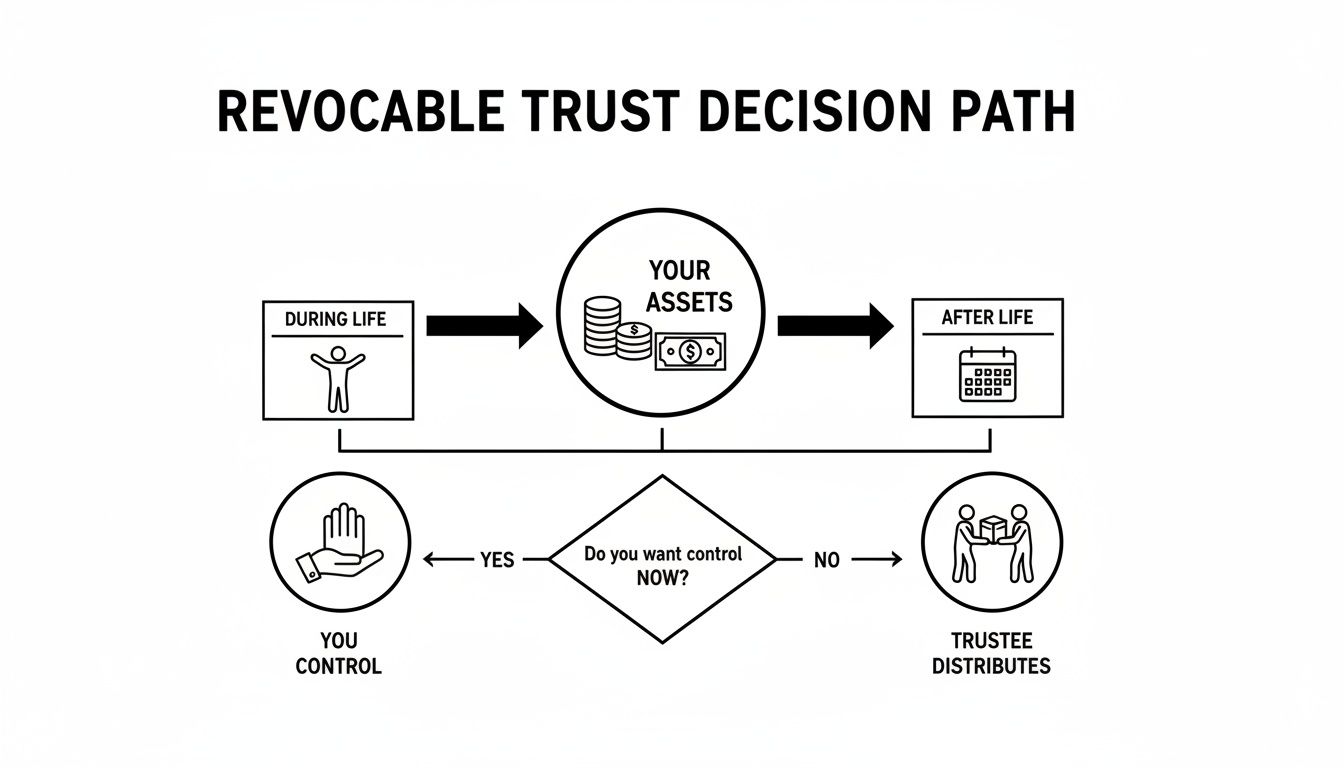
This flowchart illustrates a similar goal achieved with a revocable trust. Whether you use a trust or a specialized deed, the objective is the same: create an automatic, out-of-court transfer of your assets to the people you choose.
For a TODD to be legally binding, it must be signed, notarized, and filed with the county clerk in the county where your property is located before you die. While it's a fantastic tool, it's important to understand where it falls short. Another powerful option for transferring real estate outside of probate is the Lady Bird Deed in Texas, which offers a different set of benefits and flexibility.
Key Takeaway: A TODD is an excellent tool for keeping your home out of probate, but it doesn't shield the property from your creditors. If your estate has significant debts, creditors could still make a claim against the home even after it has passed to your beneficiary.
When a Small Estate Affidavit Is an Option
What happens if a loved one passes away without an extensive estate plan, and their assets are fairly modest? Texas law offers a streamlined alternative to a full, formal probate process: the Small Estate Affidavit (SEA).
This option is available only when the person died without a will and the value of their probate estate (not counting their homestead and other exempt property) is $75,000 or less. The SEA allows the heirs to collect assets from banks or other institutions simply by presenting a court-approved sworn statement, which saves a tremendous amount of time and money compared to a full probate administration.
But there are strict rules. To qualify for a Small Estate Affidavit, you have to check all of these boxes:
- The person must have died without a will (intestate).
- The estate's total assets (excluding the homestead) can't be more than $75,000.
- The value of the assets must be greater than the known debts.
- All heirs must be in agreement and sign the affidavit.
- No one can have already applied to be the personal representative of the estate.
An SEA can be a lifesaver for families with smaller, uncomplicated estates, but it’s definitely not a cure-all. For one thing, it can't be used to transfer title to real estate other than the decedent's homestead. Getting the eligibility and paperwork right is critical—any mistakes can cause the court or a financial institution to reject it.
Which Probate Avoidance Tool is Right for You?
Choosing the right strategy depends entirely on your specific assets, family situation, and overall goals. To help you see how these tools stack up, we've put together a simple comparison.
| Strategy | Best For | Complexity & Cost | Key Benefit |
|---|---|---|---|
| Living Trust | Comprehensive control over multiple assets, privacy, incapacity planning | Higher upfront cost & complexity | Avoids probate entirely, manages assets if disabled |
| Transfer on Death Deed | Passing real estate directly to a beneficiary | Low cost, simple to create | Bypasses probate for your home or other property |
| Lifetime Gifting | Reducing the overall size of your estate now | Simple, but requires awareness of tax rules | Reduces probate assets, helps family immediately |
| Small Estate Affidavit | Settling a modest estate (under $75,000) without a will | Low cost, but requires strict adherence to legal rules | A simplified, faster alternative to full probate |
This table is a great starting point, but it's no substitute for professional advice. Navigating these Texas-specific tools requires careful planning. For personalized guidance on whether gifting, a TODD, or a Small Estate Affidavit is the right choice for your family, schedule a free consultation with the Law Office of Bryan Fagan.
Common Mistakes and How to Prevent Them
Even with the best of intentions, a plan to sidestep probate can fall apart over simple but devastating oversights. At the Law Office of Bryan Fagan, we've walked countless Texas families through these exact issues. We've seen firsthand how tiny mistakes can mushroom into massive problems, and we are committed to helping you avoid them.
Knowing where others have stumbled is the best way to keep your own plan on solid ground.
The Empty Shell: Forgetting to Fund Your Trust
One of the most frequent and genuinely heartbreaking errors we see is the failure to properly fund a living trust. A family will invest the time and money to create a fantastic, comprehensive trust document… but then they fail to complete the final, most crucial step: actually retitling their assets into the trust's name.
An unfunded trust is nothing more than an empty shell. That house in Harris County or the brokerage account you set up the trust for? If they're still in your individual name, they are headed straight for the probate process, completely defeating the entire purpose of your planning.
Outdated Paperwork: A Recipe for Disaster
Life happens. People get divorced, babies are born, and loved ones pass away. Your estate plan has to keep up. A huge mistake is forgetting to update beneficiary designations on your accounts after these major life events.
Those beneficiary forms for your life insurance, retirement accounts, and bank accounts are legally binding contracts. Here's the critical part: they override any instructions in your will.
Imagine this scenario: you divorce and happily remarry, but you never get around to changing the beneficiary on your sizable 401(k) from your ex-spouse to your current one. Under Texas law, your former spouse is very likely getting that money, no matter what your new will says. It’s an outcome no one wanted, but it’s the legal reality.
We tell all our clients that regular reviews of their entire estate plan are not just a good idea—they're essential. You should sit down with an attorney at least every three to five years, or immediately after any major life change, to make sure your plan still does what you want it to do.
This isn't about being paranoid; it's about being proactive. It's how you prevent unintended consequences and protect the people you love.
Creating Family Drama: When Your Documents Don't Agree
A solid estate plan is like a well-oiled machine where every part works together. A major pitfall is creating conflicting instructions between your will and your non-probate tools. This is a surefire way to ignite family feuds and sink your estate into expensive litigation.
We see this play out all the time. A parent sets up a Payable-on-Death (POD) designation on a large savings account, naming only their oldest child. But inside their will, they’ve clearly written that all assets should be divided equally among all three of their children.
So what happens? The bank is legally required to hand over the entire account to the one child named on the POD form. The other two children get nothing from that account. This almost always leads to feelings of betrayal and fractures family relationships—all because of uncoordinated planning.
You have to make sure every piece of your plan is singing from the same song sheet. Here’s a simple checklist to get started:
- Create an Asset Inventory: Make a list of all your major assets. For each one, note exactly how it's titled and who the named beneficiaries are.
- Do a Holistic Review: Lay out your will, trust documents, POD/TOD forms, and retirement account paperwork all at once. Read through them specifically looking for contradictions.
- Get a Professional Second Look: An experienced Estate Planning attorney can audit your entire plan to ensure it’s a cohesive strategy that honors your wishes without creating unintended family strife.
Avoiding probate in Texas is absolutely achievable, but it's not a "set it and forget it" task. It demands careful and ongoing attention to detail. By sidestepping these common mistakes, you can ensure your legacy is passed on smoothly, efficiently, and exactly as you intended.
If you’re worried about your current plan or need to create one from the ground up, our team is here to help. Schedule a free consultation with us for personalized, practical guidance.
It’s Time to Create Your Personalized Estate Plan
Taking action on your estate plan is a genuine act of love for your family. This guide has walked you through the tools available in Texas—trusts, beneficiary designations, and special deeds. Think of them not as legal burdens, but as powerful ways to ensure your legacy is passed on smoothly and privately.
Whether you're a parent in Harris County planning for the future or an adult child in Dallas helping your own parents sort through their options, a clear plan brings profound peace of mind. It replaces the anxiety of the unknown with the confidence that your wishes will be honored, all without unnecessary court intervention.
Turning Knowledge Into Action
The next step is to transform what you've learned into a concrete strategy that fits your unique family and financial picture. A personalized plan isn’t a one-size-fits-all document; it has to account for your specific assets, your family dynamics, and your long-term goals. It's about creating a cohesive roadmap that protects everything you’ve worked so hard to build.
As you put your plan together, it's also smart to consider the tax implications of different strategies. We always recommend you consult a qualified tax accountant to make sure your plan doesn't create unintended financial headaches for your beneficiaries down the road.
Protecting your family from the stress of probate is one of the most meaningful gifts you can give. A well-crafted plan ensures your legacy is one of support and security, not legal complexity and expense.
Get Expert Guidance for Your Family
The most effective estate plans are almost always created with professional legal guidance. An experienced attorney can help you navigate the complexities of Texas law, sidestep common pitfalls, and ensure every detail is handled correctly. Taking this proactive step now prevents costly disputes later and guarantees your plan will work exactly as you intend when your family needs it most.
We invite you to schedule a free, no-obligation consultation with the Law Office of Bryan Fagan to create a plan that safeguards your family's future. With offices across Texas and convenient virtual options available, getting the expert help you need is simple and accessible.
Common Questions We Hear About Texas Probate
When families start thinking about estate planning, a lot of questions come up. It's only natural. To give you some clarity, we've put together straightforward answers to some of the most common concerns we address here at The Law Office of Bryan Fagan.
Does a Will Let Me Avoid Probate in Texas?
This is probably the biggest misconception out there, and the short answer is no. In reality, a will is your set of instructions for the probate court. Think of it as a script for the judge to follow. It's an essential document for things like naming guardians for your kids and spelling out who gets what, but it doesn't skip the court process—it actually triggers it.
If you want to transfer assets without court intervention, you need to use non-probate tools. Things like a living trust, beneficiary designations (often called POD or TOD accounts), or specific types of joint ownership are designed from the ground up to bypass the courthouse completely.
Can I Just Add My Child's Name to My Deed?
You can do this, but it's a move fraught with risk and one we almost always advise against. Adding your child to your deed gives them immediate ownership rights. That means your home could suddenly be at risk if they face a lawsuit, get a divorce, or have creditors come after them. It's no longer just your asset.
On top of that, it can create a messy capital gains tax situation for your child down the road when they decide to sell. For nearly every situation, a Texas Transfer on Death Deed (TODD) or a revocable living trust is a far superior and safer way to pass on real estate, protecting both you and your family.
We've seen firsthand in places like Harris County Probate Court how this "simple" shortcut can unravel, causing immense stress and financial loss for families. The best way to transfer property is rarely the quickest; it's the one that builds a fortress around the asset.
What Does a Living Trust Cost to Set Up?
The cost to create a revocable living trust will depend on how complex your financial and family situations are. But it's crucial to reframe this from an "expense" to an "investment." You're investing in your family's future peace of mind.
Putting it in perspective, you are paying a predictable, one-time fee today to shield your family from the much higher, drawn-out, and unpredictable costs of probate tomorrow. A trust can help them sidestep thousands of dollars in legal fees and months of court-related stress, making it one of the most powerful tools available for protecting what you've built.
Navigating Texas probate and estate planning law requires clear, compassionate guidance. The experienced attorneys at The Law Office of Bryan Fagan, PLLC are here to help you create a personalized plan that protects your family and ensures your wishes are honored. Schedule a free consultation with us today to take the first step toward securing your legacy. https://texasguardianshiplawyer.net