Skip to content
A lot of families start this search on a bad day.
A mother in Houston forgets to pay the same bill for the third month in a row. A father in Dallas signs papers he doesn't understand. An adult child in Harris County realizes the problem is bigger than “just getting older” and starts wondering who can legally help, what guardianship means, and whether waiting will make things worse.
If that's where you are, the pressure is real. You're trying to protect someone you love without taking away more independence than necessary. You may also be dealing with siblings who disagree, doctors who speak in careful terms, and a court process that feels unfamiliar and intimidating.
Finding the right lawyer in that moment isn't just a legal errand. It's often the first concrete step in protecting a vulnerable person, preserving dignity, and bringing order to a situation that feels like it's slipping. In Texas, that matters because guardianship cases are court-supervised, fact-specific, and governed by the Texas Estates Code, especially Title 3, Subtitle G. The lawyer you hire needs more than a pleasant website and a broad “elder law” label. They need the right credentials, courtroom judgment, and the temperament to handle a family in crisis.
The First Step in Protecting Your Loved One
One common Texas scenario looks like this. A daughter in Sugar Land notices her father has started missing medication, giving away money to people who pressure him, and becoming suspicious when the family asks simple questions. He still has good days. He can still carry on a conversation. But he's making decisions that put his safety and finances at risk.
That's when families often feel stuck. They don't know whether they need estate planning, probate help, a guardianship case, or something less restrictive. They worry that calling a lawyer means they are “taking over” too quickly. They also worry that if they don't act, a hospital discharge, financial exploitation, or sudden decline will force a rushed decision.
Practical rule: The search for counsel should start when the pattern becomes clear, not when the crisis becomes unavoidable.
A good elder law attorney helps you sort out that first question. Is guardianship necessary, or is there a workable alternative? Texas law requires that a guardianship application state whether alternatives to guardianship and available supports were considered, and whether those alternatives are feasible, under Texas Estates Code § 1101.001. That requirement matters in real life. Sometimes the answer is a full guardianship. Sometimes it isn't.
Why this search feels so heavy
Families aren't just hiring for legal skill. They're hiring someone to guide medical evidence, court filings, family conflict, and the dignity of a person who may resist help. That's why “how to find a good elder law attorney” is really a question about judgment and trust.
In practice, the strongest attorneys don't push every family toward the same solution. They listen first. They ask what changed, who's involved, whether there are powers of attorney already in place, and whether immediate danger exists.
Some families are also thinking beyond guardianship. They're worried about protecting a home, coordinating long-term care, or managing broader liability concerns around family assets. In that larger planning conversation, some people also explore ways to find personal umbrella policies in NJ when they're comparing asset-protection tools across different parts of a family's financial picture.
What works and what usually doesn't
What works is early, focused legal advice from someone who handles these issues regularly in Texas courts.
What usually doesn't work is waiting until Adult Protective Services, a hospital, or a financial institution forces the issue. By then, the family is often reacting instead of planning. That makes every decision harder.
Where to Begin Your Search for a Texas Attorney
Start local and specific. If your case may end up in a probate court in Harris County, Bexar County, Travis County, or Dallas County, you want a lawyer who understands how Texas guardianship practice unfolds, not just someone who lists elder law among many unrelated services.

Start with referrals, but verify them
Referrals from trusted professionals can be useful. A family attorney, accountant, financial advisor, physician, geriatric care manager, or social worker may know which lawyers handle guardianship matters well.
Still, a referral is only the start. Ask why that person recommends the lawyer. Did the attorney handle a guardianship case well? Do they communicate clearly? Do they know local probate court practice? A name alone isn't enough.
The same is true for online searching. A broad search result may show a lawyer who writes about elder law but rarely appears in contested guardianship hearings. For a starting point focused on location and subject matter, families often use resources such as this page for an elder care attorney near me in Texas.
Use professional directories that matter
The strongest public starting point is often NAELA. To find a qualified elder law attorney, prioritize membership in the National Academy of Elder Law Attorneys, an organization that has supported elder and special needs attorneys for over 35 years, with a searchable directory available at NAELA to locate members in your specific geographic area.
Certification matters too. NELF certification is another strong sign that a lawyer has met rigorous standards recognized by the American Bar Association. If a lawyer claims certification or specialization, verify it.
A polished profile is not the same thing as a focused practice.
Build a shortlist with a simple filter
Use this four-part screen before you call:
- Relevant focus: Does the lawyer's practice center on elder law, guardianship, probate, or estate planning?
- Texas location: Can they appear in or regularly work with the county where the case will be filed?
- Courtroom fit: Do they mention contested matters, temporary guardianships, or incapacity disputes?
- Verifiable credentials: Can you confirm bar standing, malpractice coverage, and any claimed certifications?
If you're trying to understand the legal process while building that shortlist, Guardianship of an Incapacitated Adult in Texas gives a factual overview of how a court establishes guardianship for an adult who cannot manage their affairs.
Don't rely on one source alone
A lawyer who comes highly recommended may still be wrong for your case. A lawyer with strong credentials may still not be the right communicator for your family. Good screening uses more than one input: referral, directory, licensing check, and consultation.
That combination gives you a much better chance of finding someone who fits both the legal problem and the family.
Key Qualifications for a Guardianship Attorney
Not every elder law attorney is the right attorney for a Texas guardianship case. Some focus mostly on wills, trusts, or Medicaid planning. Those are important areas, but a family dealing with incapacity, family conflict, or emergency protection needs guardianship-specific skill.

Look for work that intersects
A strong Texas guardianship lawyer often works at the overlap of several practice areas:
| Need | Why it matters |
|---|---|
| Guardianship establishment | The attorney must know the filing requirements, evidence standards, and hearing procedures under Texas Estates Code Title 3, Subtitle G. |
| Emergency or temporary guardianship | If there is immediate risk, the lawyer must know how to frame urgent facts for court review. |
| Probate and estate administration | Families often face parallel issues involving property, beneficiary confusion, or fiduciary concerns. |
| Estate planning and alternatives | The right lawyer should evaluate whether a less restrictive tool can solve the problem before seeking guardianship. |
| Guardianship disputes | If siblings disagree or someone has mishandled money, courtroom experience becomes central. |
A practical example helps. Suppose a son in Harris County believes his mother can no longer manage finances, but the daughter who has been “helping” with accounts won't provide records. The family may need advice about incapacity evidence, possible guardianship of the estate, possible fiduciary misconduct, and whether temporary relief is necessary. That's not a simple document-prep matter.
Texas procedure knowledge is not optional
Texas guardianship cases have procedural protections that a lawyer must understand and respect. Under Texas law, the proposed ward must be personally served with the guardianship application, and an attorney ad litem must be appointed to represent the ward's interests in the proceeding, with the requirement that the attorney and ward have a true attorney-client relationship where the attorney represents the ward's expressed wishes, as updated by Senate Bill 1093 in 2023, as explained by Disability Rights Texas.
That rule affects case strategy in a real way. It means the proposed ward is not just a passive subject of paperwork. They have rights, representation, and a voice in the process. A lawyer who is casual about those protections is not the right fit.
Ask about the attorney's actual guardianship practice
When families say they want an “elder law” lawyer, they often really need answers to narrower questions:
- Do you handle contested guardianship hearings?
- Have you worked on temporary guardianship requests?
- Do you know the local probate court's filing and hearing practices?
- How do you address alternatives to guardianship before filing?
- How do you deal with allegations of financial misuse by a caregiver or relative?
The title on the website matters less than the work on the calendar.
Don't forget what happens after appointment
The right lawyer should also be able to explain the guardian's ongoing duties. In Texas, once appointed, the guardian must sign a sworn oath and post a bond within 20 days of appointment, and Letters of Guardianship expire after 16 months, requiring annual reporting and a new bond for renewal, according to Texas Law Help's guardianship guide.
That's one reason families should hire for long-term fit, not just filing speed. Guardianship doesn't end at the hearing.
Vetting Your Shortlist Questions to Ask and Red Flags
Credentials get a lawyer onto your shortlist. They don't answer the harder question, which is whether that lawyer can manage your family's case in court, under pressure, with compassion.
In Texas, 68% of elder law consultations involve guardianship or incapacity issues, yet few public resources explain how to verify if an attorney has successfully contested or modified guardianships in court, according to AgingCare. That gap matters because many families assume “elder law” automatically means courtroom guardianship experience. It doesn't.
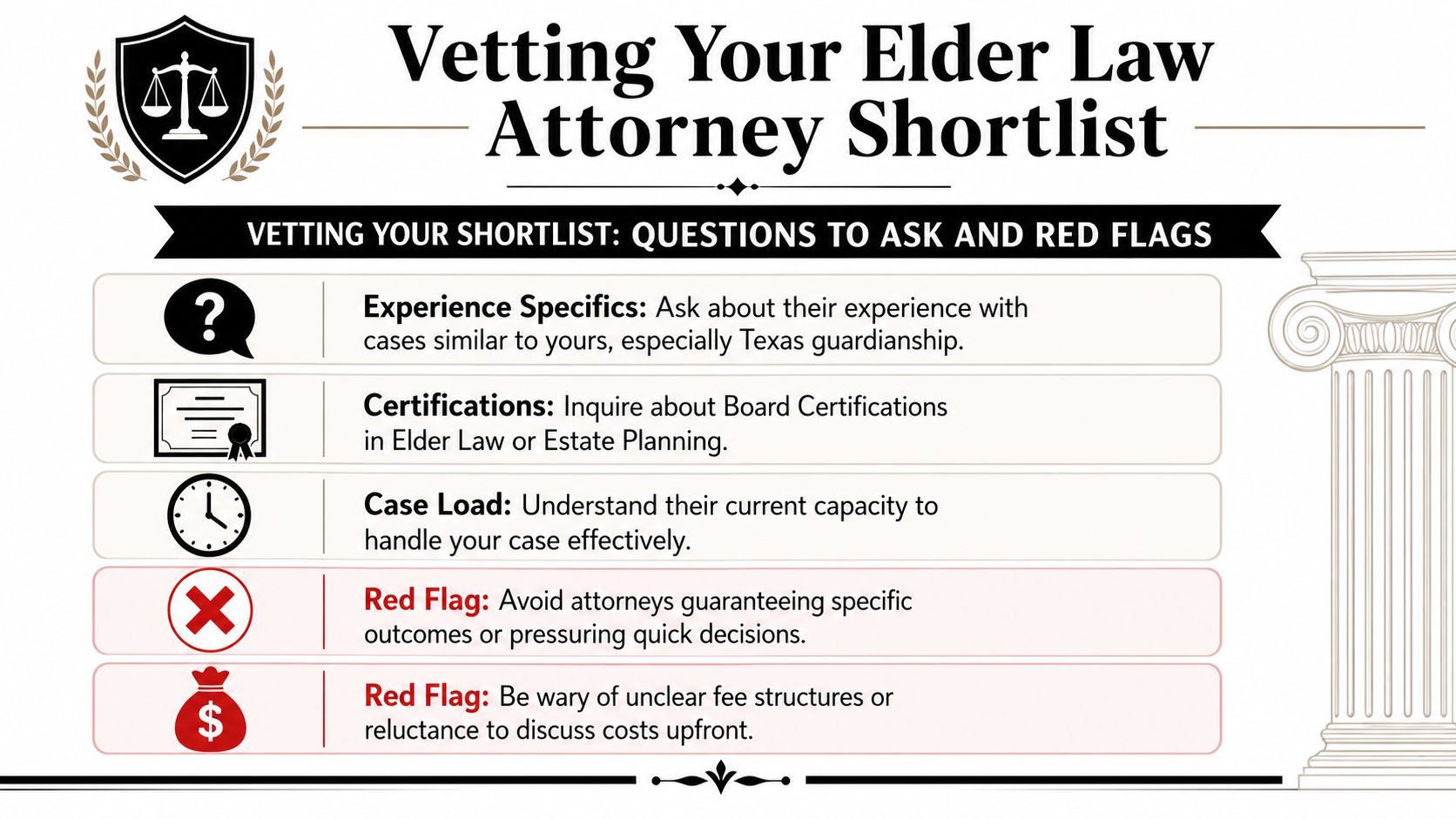
Ask questions that reveal courtroom reality
Don't ask only, “Do you handle guardianship?” Ask questions that force specifics.
- Contested case experience: “Have you handled contested guardianship cases in counties like Harris, Bexar, or Dallas? What kinds of disputes were involved?”
- Emergency practice: “If my loved one is in immediate danger, how would you approach a temporary guardianship filing in Texas?”
- Fiduciary concerns: “How do you investigate a case where a relative may be misusing money or isolating the proposed ward?”
- Alternatives first: “How do you determine whether a less restrictive alternative may work instead of guardianship?”
- Case responsibility: “Who will do the work on my case? You, another attorney, or mostly staff?”
- Communication style: “How will you update me, and how quickly should I expect a response?”
If a family wants an additional framework for comparing lawyers, this guide on how to choose the right guardianship lawyer in Texas can help structure those conversations.
Questions that matter in disputed cases
Guardianship disputes often turn on details. If your case involves sibling conflict, a contested capacity issue, or alleged exploitation, ask sharper questions.
For a possible emergency filing
Texas law requires more than urgency in the abstract. For a temporary or emergency guardianship, the sworn application must allege that danger to the person or property is imminent and provide supporting facts, under Texas Estates Code § 1251.003.
So ask: “What facts would a Texas court need to see to justify emergency relief in my case?”
A lawyer who answers with specifics is usually more useful than one who says only, “We can file something fast.”
For contested family dynamics
Ask how the lawyer handles situations where one child wants guardianship and another resists, or where the proposed ward strongly objects. The answer should include process, evidence, and dignity. It should not sound like a plan to bulldoze everyone involved.
A careful lawyer can explain both your path forward and your weak points. A careless one talks as if every case is easy.
Red flags families should take seriously
Some warning signs appear before the representation even begins.
- Guarantees: Any lawyer who promises a result is telling you something no responsible attorney can know.
- Vague fees: If the office can't explain how billing works, expect trouble later.
- Thin guardianship detail: If answers stay general and never mention procedure, hearings, or evidence, that's a concern.
- Poor responsiveness: Delayed calls and disorganized intake often get worse once the case is opened.
- Dismissive tone: Families need direct advice, not impatience. The proposed ward also deserves respect.
- Rush to file: A lawyer who doesn't ask about alternatives to guardianship may be solving the wrong problem.
Compassion is a qualification
Families often underestimate this point. In a guardianship case, you may be talking about memory loss, mental illness, disability, financial misuse, or long-standing family conflict. A lawyer who can't speak plainly and calmly will make the process harder.
That doesn't mean you need softness instead of skill. You need both. The right attorney can tell you hard truths without making a painful situation worse.
Understanding Fees and Preparing for the First Meeting
A daughter calls after her mother leaves the stove on twice in one week, misses medications, and starts giving money to strangers. Her first question is often not about court. It is, “How much is this going to cost, and what do I need before I come in?”
That question deserves a straight answer. In Texas guardianship matters, fees depend on the facts, the county, and whether anyone objects. A quiet case with strong medical support is very different from a contested case involving family conflict, emergency relief, or disputes about who should serve. Families are better served when the lawyer explains the likely cost drivers early, instead of giving a vague range that falls apart later.

What fees usually involve
Some work is billed hourly. Some planning services are billed at a flat fee. Guardianship cases often involve hourly billing because the amount of work can change fast. A physician's letter may be easy to obtain, or it may take repeated follow-up. A hearing may be routine, or a relative may contest capacity, accuse someone of financial misconduct, or push for a different guardian.
Ask for a clear explanation of the billing method. Ask who in the office does the work, whether paralegal time is billed, how often invoices go out, and whether a retainer is required. In my experience, families do best when they stop looking for the cheapest quote and start looking for the clearest explanation. In guardianship work, low estimates sometimes mean the lawyer has not sized up the procedural demands of the case.
You should also ask what the quoted fee does and does not cover. Many families assume one number includes every expense tied to the case. It usually does not.
Costs outside the lawyer's bill
Several expenses may sit outside the attorney's own fees:
- Court filing fees: These vary by county and by the type of application filed.
- Medical evidence: Capacity proof may require physician records, evaluations, or follow-up documentation.
- Attorney ad litem fees: Texas courts appoint an attorney ad litem to represent the proposed ward's interests.
- Bond premiums: If the court requires a bond, that cost is separate.
- Post-appointment work: Annual reports, accountings, and later court approvals can create additional legal fees.
Families often compare guardianship costs to estate planning costs, but they are not the same kind of work. For a general point of reference, this overview of estate planning attorney cost in Texas can help you ask better billing questions during the consultation.
What to gather before the consultation
A good first meeting depends on the file you bring in. The lawyer does not need perfection. The lawyer needs enough facts to judge urgency, capacity issues, family dynamics, and whether a less restrictive option may still work.
Bring these items if you have them:
- Medical records and provider information: diagnoses, medications, discharge paperwork, and contact information for treating doctors
- Existing legal documents: powers of attorney, directives, wills, trusts, or prior guardianship orders
- Basic financial information: income sources, major accounts, real property, debts, and who currently has access
- Names of close relatives and caregivers: especially anyone likely to agree, object, or ask to be appointed
- A short timeline of recent problems: missed bills, scams, unsafe driving, wandering, falls, self-neglect, or unusual transfers of money
A simple folder with dates and names is often more useful than a long emotional summary.
Bring facts, not polished conclusions. A strong lawyer can work with messy facts. They can't work with missing ones.
After you've gathered records, it can also help to hear a plain-language overview of what families often face in these matters:
How to use the first meeting well
Treat the consultation as a working meeting. A capable Texas guardianship lawyer should be able to tell you what problem the court can solve, what proof is still missing, whether an emergency filing is justified, and whether guardianship is even the right tool. That last point matters. In some families, a valid power of attorney, supported decision-making, trust administration, or another less restrictive option may address the problem without a full guardianship case.
One option families may consider is Law Office of Bryan Fagan, PLLC, a Texas firm that handles guardianship, probate, and estate planning matters, including applications, disputes, and compliance issues. Whether you meet with that firm or another one, leave the meeting with answers to four practical questions: What will the court likely require, what can delay the case, what will this probably cost if the case stays uncontested, and what changes if someone fights it? If the lawyer cannot answer those questions in plain English, keep looking.
Making Your Final Decision and Moving Forward
By the time you choose counsel, the decision usually comes down to three things. Verified qualifications. Real guardianship experience. A manner that builds trust instead of confusion.
The right attorney won't just tell you they handle elder law. They'll show that they understand guardianship establishment, emergency filings, disputes, alternatives, and the ongoing duties that follow appointment. They'll speak in plain English. They'll explain what the court will require. They'll tell you when your case is strong, and when a less restrictive option may make more sense.
A final way to weigh the choice
If you're deciding between two lawyers, ask yourself:
- Who understood the actual problem fastest?
- Who explained Texas procedure clearly without talking down to us?
- Who treated the proposed ward as a person, not a file?
- Who seemed prepared for both the legal issues and the family dynamics?
That last point matters more than people expect. Guardianship cases often involve grief, guilt, old resentments, and fear about money or care decisions. A lawyer who ignores those realities can still create legal problems, even if the filings are technically correct.
What happens after you hire counsel
Once you choose an attorney, move quickly and stay organized. If a guardianship case is needed, the court process will require documents, service, medical support, and careful compliance with the Estates Code. If guardianship is not the best fit, a good attorney should be able to direct you toward alternatives, estate planning, or probate-related solutions.
For families trying to protect a loved one in Texas, this is the true goal. Not just filing something. Making a careful, lawful, compassionate decision that fits the person's actual needs.
If you're ready for that next step, it helps to speak with a lawyer who works in this space every day and understands how Texas probate courts handle these cases.
If your family is facing questions about incapacity, guardianship, probate, or less restrictive alternatives, schedule a free consultation with Law Office of Bryan Fagan, PLLC. We help Texas families in Houston, Dallas, Austin, San Antonio, and statewide virtual consultations understand their options, prepare for hearings, and move forward with clarity and care.