Skip to content
A sudden change in a parent's judgment often starts small. Bills go unpaid. Medications are missed. A neighbor mentions confusion, or a bank calls about unusual withdrawals. In other families, the turning point comes when a child with disabilities turns 18 and school support ends, but legal adulthood begins. You may already be searching for a Guardianship Attorney Near Me Texas because you know something has to change, and you're worried about making the wrong move.
That worry is normal. Texas guardianship law protects vulnerable people, but it also limits rights, so courts expect families to proceed carefully. The process can feel intimidating when you're also dealing with grief, conflict, exhaustion, or the practical demands of caregiving.
This guide is meant to make the path clearer. It explains when guardianship makes sense, what Texas courts require under Texas Estates Code Title 3, Subtitle G, how emergency cases work, what documents to gather, and how to choose legal help in places like Harris County, Bexar County, Dallas County, and Travis County. The goal isn't to push every family into court. The goal is to help you take the right next step for your loved one.
A Compassionate Guide for Texas Families
At 9:30 p.m., a daughter is sorting through a stack of unopened mail at her mother's kitchen table, realizing the problem is no longer occasional forgetfulness. A son is standing in a hospital hallway, hearing doctors ask for consent from a parent who no longer understands the treatment options. A grandparent is trying to keep a child safe while the adults legally responsible for that child are absent, impaired, or unable to act.
Those are the moments that bring families into guardianship law. The legal question matters, but the first problem is usually practical and urgent. Who can speak with doctors? Who can stop financial loss? Who has authority to arrange safe housing, protect benefits, or make sure daily needs are met?
Texas guardianship gives the probate court a way to assign that authority, but only after the court looks closely at what the person can still do for themselves and whether a less restrictive option would work. That balance matters. Guardianship can protect someone from real harm, but it also limits rights, so judges expect families to show a specific need, not just understandable worry.
A point I often have to explain is this: judges do not grant guardianship merely because a family is stressed, frustrated, or convinced they know what is best. The court wants evidence of incapacity, evidence of risk, and a plan suited to the person's actual limitations.
In Texas, that usually means separating two different kinds of responsibility. Guardianship of the person deals with health care, living arrangements, and day-to-day welfare. Guardianship of the estate deals with money, property, debts, and financial decision-making. Some families need both. Others need only one, and asking for more authority than the facts support can slow the case or create objections.
A careful strategy often lowers conflict. It also helps families protect dignity while they protect safety. In practice, the right starting point may be a full guardianship case, a limited guardianship, temporary court action in a crisis, or a less restrictive legal tool if the person can still make some decisions with support.
The goal is not to formalize family concern. The goal is to solve a defined legal problem in the least restrictive way the facts allow.
When to Consider a Guardianship Attorney
Guardianship becomes a serious conversation when concern turns into risk. That risk may involve health, money, housing, or personal safety. The law doesn't expect families to wait until a disaster happens, but it also doesn't treat guardianship as the automatic first answer.

Common situations that call for legal guidance
Some cases are obvious. Others are less clear until a crisis exposes the gap.
- An aging parent with cognitive decline may stop paying bills, forget appointments, or become vulnerable to manipulation.
- An adult child with special needs turning 18 may still need help with medical decisions, housing, benefits, or money management.
- A person injured in an accident or disabled by illness may suddenly lose the ability to understand treatment or protect property.
- A minor without capable parents may need an adult legally appointed to act for them.
- A family facing future incapacity planning may want to evaluate whether proactive legal tools can avoid a later court fight.
Guardianship isn't always the first step
Texas courts must consider less restrictive alternatives before granting guardianship. That matters because some families can protect a loved one without full court supervision. Tools like supported decision-making agreements, medical powers of attorney, and financial powers of attorney may be enough if the person still has the legal capacity to sign them.
A major problem in this area is that many families never get practical guidance on how to use those alternatives. One review found that 78% of local search results omit actionable steps for implementing options like supported decision-making agreements or medical powers of attorney, even though Texas law requires those options to be considered first, according to this discussion of alternatives before guardianship.
That's why it helps to read a focused comparison like Guardianship vs. Power of Attorney in Texas. A power of attorney can prevent the need for guardianship in the right case, but only if it's executed before incapacity blocks valid planning.
Practical rule: If your loved one can still understand what they're signing, explore alternatives now. If they can't, court involvement may be necessary.
What works and what doesn't
What works is early evaluation. Families who act when the warning signs first appear often have more choices. They can gather records calmly, speak with doctors, and decide whether a less restrictive option is realistic.
What doesn't work is relying on informal arrangements. Being “the one who handles everything” doesn't give legal authority to consent to treatment, manage accounts, or deal with institutions that need court papers. In counties such as Harris County Probate Court or Bexar County Probate Court, judges want proof that the requested guardianship is necessary and properly limited.
The Texas Guardianship Roadmap from Start to Finish
At 2 a.m., a daughter is trying to admit her mother to a facility, sign medical papers, and answer a bank's questions about unpaid bills. She has been handling everything for months, but informal help stops working when a hospital, care facility, or financial institution asks for legal authority. Texas guardianship is the court process that turns family concern into enforceable authority, and the process is easier to handle when you know what happens first, what tends to stall a case, and what the court is looking for.
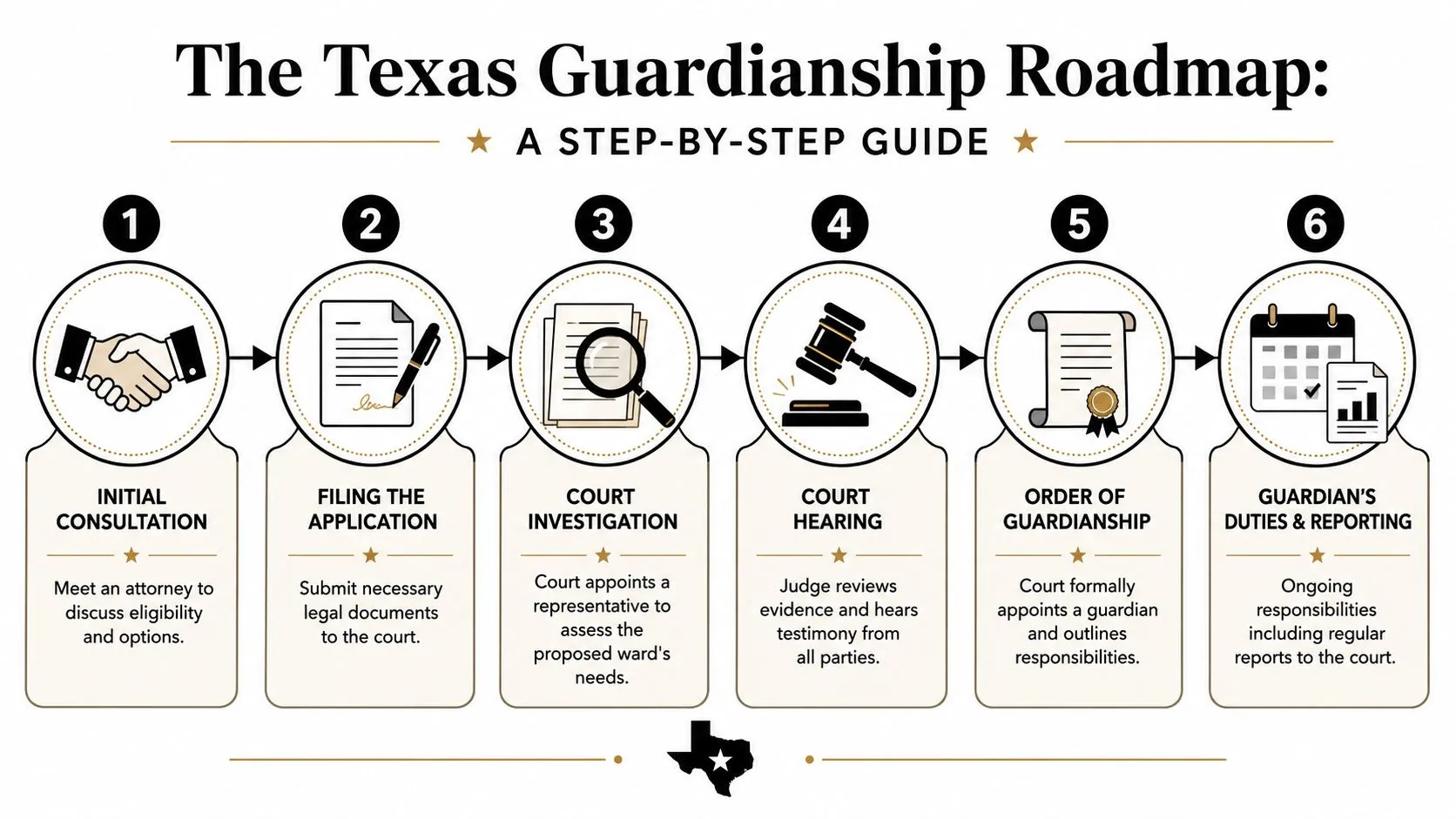
Step one through filing
The first phase is preparation, not courtroom drama. Families usually spend the earliest part of the case collecting the medical evidence, family information, and background details the court will require before a hearing is ever set. The filing and notice stage then follows, including citation to the people Texas law says must be notified under Tex. Est. Code § 1051.103. A practical timeline overview appears in this Texas guardianship timeline overview.
This is often the point where emotions and procedure collide. A son may feel certain his father can no longer manage medications or avoid financial exploitation. The court still needs proof. That usually means current medical support, accurate identifying information for relatives, and a petition that asks for no more authority than the facts justify.
Delays often start with avoidable problems:
- The medical evidence is incomplete or outdated
- The application asks for broad powers without explaining why
- Required relatives are missing from the notice list
- The proposed guardian has not gathered the background information the court expects
A stronger filing answers five practical questions with specifics:
- Who needs protection
- What condition limits that person's decision-making
- Which decisions require a guardian
- Why a less restrictive option is not enough
- Who must receive legal notice
Families also need to prepare for the administrative side of the case. Offices handling intake, scheduling, and document collection can shorten delays in time-sensitive matters. Law firms often use systems that boost client intake for law firms, especially when a family is calling after hours or during a medical crisis.
The attorney ad litem and the court's review
After filing, the court appoints an attorney ad litem for the proposed ward. That lawyer does not represent the applicant. The ad litem represents the proposed ward's interests, meets with them, reviews the medical certificate and pleadings, and reports concerns to the court.
Families are often surprised by that step.
Even in a cooperative family, the judge wants an independent check on whether guardianship is necessary and whether the requested powers are limited to what the person needs. That review protects the proposed ward and often improves the final order because weak assumptions have to be replaced with clear evidence.
For a closer look at the evidence and concerns judges often focus on, see what judges really look for in a Texas guardianship case.
Later in the process, many families benefit from hearing the steps explained visually and verbally:
A complete file does not guarantee a smooth case, but an incomplete file usually leads to delay.
Hearing, appointment, and qualification
If the case stays uncontested and the paperwork is in order, courts often move more quickly. If there are disputes about capacity, family conflict, missing relatives, suspected exploitation, or objections to the proposed guardian, the case can take much longer. The same timeline source cited above notes that straightforward cases may be resolved within a few months, while contested matters can extend well beyond that.
At the hearing, the judge decides three core issues. Is the person incapacitated under Texas law. Is guardianship necessary. If so, what authority should be granted, and how narrowly can it be defined.
Texas courts may appoint a guardian of the person, a guardian of the estate, or both. The first role covers personal decisions such as residence, medical care, and daily support. The second covers property, income, bills, and financial management. Judges usually prefer limited authority tied to proven need rather than a blanket transfer of decision-making.
If the judge signs the order, the case is not finished. The proposed guardian must still qualify before acting. That usually includes taking an oath and, in estate cases or other cases the court requires, posting a bond. The duties that follow are outlined in this Texas guardianship responsibilities guide.
That final step matters more than families expect. Many people feel relieved after the hearing, then learn they still cannot sign papers or move assets until qualification is complete and the clerk issues the documents that show legal authority. Understanding that sequence helps families plan for the gap between court approval and real-world action.
How to Find and Choose Your Guardianship Attorney
A family usually starts this process the same way. Someone has fallen, wandered, missed bills, refused care, or signed papers they did not understand. By that point, the question is rarely just, “Who is nearby?” The core question is who can step in calmly, explain the court process in plain English, and help the family make good decisions under pressure.

Guardianship cases are local in practice, even though Texas law applies statewide. County probate courts have their own expectations about scheduling, notice, medical evidence, and hearing preparation. A lawyer who regularly handles guardianship matters in Harris County, Dallas County, Travis County, or Bexar County will often spot local issues early and keep the case from stalling over avoidable mistakes.
Where to start your search
Texas has hundreds of attorneys who handle guardianship and related probate matters. That gives families options, but it also means the right choice is not always the attorney with the first search result or the closest office.
Start with lawyers whose work regularly overlaps with guardianship. In many families, the legal problem is never just incapacity. It may also involve unpaid bills, a house, Medicaid planning questions, a pending probate matter, or conflict between adult children. A lawyer who understands those connected issues can often save the family time and prevent a second legal crisis a few months later.
Useful places to begin include:
- State Bar and attorney directories that identify Texas lawyers handling guardianship matters.
- County-specific experience so you can find counsel familiar with the probate court where the application will be filed.
- Firm websites that discuss related services such as guardianship, probate, and estate planning, since these matters often overlap in practice.
Families who want a more structured screening process can use this guide on how to choose the right guardianship lawyer in Texas.
Questions worth asking in a consultation
A good consultation should lower confusion, not add to it. Ask direct questions, and listen for direct answers.
- County experience: Have you handled guardianship cases in this court before?
- Less restrictive options: How do you evaluate whether supported decision-making, powers of attorney, or another alternative may work instead?
- Contested cases: What changes if a sibling objects or the attorney ad litem disagrees with the application?
- Communication: Who will call me back, how often will I get updates, and who prepares the filings?
- After appointment: Do you help with qualification, bond questions, annual reporting, and later modifications?
One practical point gets overlooked. Responsiveness matters because families often reach out from hospitals, rehab facilities, or in the middle of a family dispute. Firms that answer calls promptly and collect information in an organized way can start protecting the proposed ward sooner. Some offices use intake systems or outside answering support, and articles on how to boost client intake for law firms help explain why that matters to clients as much as it does to law firms.
Choose a lawyer who can explain hard choices without rushing you. Some families need a limited guardianship. Others need to prepare for a fight over control, money, or care decisions. The right attorney should be able to tell you which kind of case you have.
The Law Office of Bryan Fagan, PLLC handles Texas guardianship, probate, estate planning, and related family matters, including applications, disputes, and ongoing compliance. For some families, that overlap is helpful because the guardianship issue is tied to a larger medical, financial, or probate problem.
Your Guardianship Application Document Checklist
The fastest way to lose momentum in a guardianship case is to file before your documents are ready. Courts want current medical proof, clear information about the proposed guardian, and enough financial and family detail to evaluate the request.
The document families often overlook
The most important document in many adult guardianship cases is the Certificate of Medical Examination. Under Texas Estates Code, Title 3, Subtitle G, the court requires this certificate to be completed by a licensed Texas physician within 120 days before filing the application for permanent guardian. It serves as the objective proof of legal incapacity needed for the court to intervene, as explained in this Texas guardianship law summary.
That timing matters. A family may have old records showing a diagnosis, but if the certificate is outside the required window, the court may not treat it as sufficient. In practice, families should coordinate the medical appointment early so the filing doesn't stall.
Texas guardianship application checklist
| Document | Purpose & Key Details |
|---|---|
| Certificate of Medical Examination | Shows the nature and extent of incapacity. Must be completed by a licensed Texas physician within the required pre-filing window. |
| Guardianship application | Tells the court who the proposed ward is, who the applicant is, what type of guardianship is requested, and why it's necessary. |
| Proposed guardian identification and background information | Helps the court evaluate whether the proposed guardian is suitable to serve. |
| Family contact information | Supports notice to interested parties who must be informed of the case. |
| Financial records | Useful in estate cases to identify income, assets, debts, and urgent financial management issues. |
| Medical records and care summaries | Provide context beyond the formal certificate and help explain day-to-day limitations. |
| Information about alternatives tried or considered | Helps show the court why a less restrictive solution won't adequately protect the person. |
| Proposed order and related court forms | Courts often require county-specific paperwork that should match the relief requested. |
A practical way to prepare
Gather documents in three folders.
- Medical folder: physician certificate, diagnosis notes, medication lists, discharge papers
- Family folder: names, addresses, relationships, any conflict concerns
- Financial folder: bank statements, bills, benefit information, property documents
That simple organization helps families answer questions quickly when the attorney, court staff, or attorney ad litem requests clarification.
Navigating Emergency Guardianships and Legal Disputes
A daughter gets a call from the hospital at 2 a.m. Her father has dementia, cannot understand the treatment decision in front of him, and no valid medical power of attorney is in place. In another family, a son discovers unusual withdrawals from his mother's bank account while a relative is pressuring her to sign documents she does not understand. Those are the moments when families stop asking general questions and need a court order fast.
Texas does allow emergency relief, but judges do not grant temporary guardianships just because a family is scared or arguing. The court looks for immediate, provable risk to the person or the estate.
When an emergency is real under Texas law
Under Texas Estates Code Section 1251.003, a temporary guardianship begins with a sworn written application that states the imminent danger and the specific protection requested, as shown in this Texas temporary guardianship statute. That standard matters. If the filing describes a long-term decline but does not show immediate harm, the court may require the family to proceed through the regular guardianship process instead.
In practice, strong emergency cases usually involve facts the judge can identify quickly: urgent medical consent problems, active financial exploitation, unsafe discharge planning, abandonment, or serious neglect. The narrower the request, the better. Asking for limited authority tied to the immediate threat often gets more traction than asking for full control over every aspect of the person's life on an emergency basis.
If your family is in that position, this step-by-step guide to getting emergency guardianship fast in Texas can help you see what usually has to be gathered on short notice.
A practical question helps families decide whether the situation is urgent: what could happen in the next few days if no court order is entered? If the answer is loss of housing, denial of necessary treatment, disappearance of funds, or immediate physical danger, emergency relief may be appropriate.
When the case turns into a family dispute
Contested guardianship cases are often harder emotionally than emergency cases. The legal issue may be capacity, suitability, or the need for a guardian. The family's real conflict may be grief, mistrust, old caregiving resentments, or fear about money.
Texas Estates Code Section 1055.003 gives an interested person a path to intervene, but it requires a timely motion that states the grounds for intervention and the purpose of the intervention. The probate court can allow or deny that request depending on the circumstances, as described in this Texas intervention rule for guardianship proceedings.
That usually means a sibling cannot appear at a hearing and turn the case into a free-form family debate. The court wants evidence. Medical records. Financial records. Credible testimony. A realistic proposed alternative.
The judge's attention stays on the proposed ward's safety, rights, and actual needs.
What helps in urgent or contested hearings
Families often hurt their own case by bringing the court years of family history when the judge needs focused proof. In emergency and disputed matters, precision matters more than volume.
Useful evidence often includes:
- current medical facts that connect directly to the risk
- bank records or transaction history showing exploitation or misuse
- photographs, discharge paperwork, APS records, or facility reports
- a clear explanation of why a less restrictive option will not solve the immediate problem
- a proposed guardian who is organized, available, and able to follow court rules
I often tell families to separate outrage from proof. Outrage is understandable. Proof is what gets relief.
Costs and real-world trade-offs
Urgent and contested cases usually cost more than an uncontested filing because they require faster document collection, more hearing preparation, and sometimes more than one court appearance. The court may also appoint an attorney ad litem for the proposed ward, and there may be medical evaluation costs, bond costs, and other probate expenses. Whether those expenses are paid personally or from the ward's estate depends on the facts of the case and the court's orders.
There is also a practical trade-off families should understand early. Filing fast can stop immediate harm, but a weak emergency filing can create delay, increase cost, and give objecting relatives more room to argue that the applicant overreached. Filing a targeted request with clean evidence is usually the safer course.
For many families, the hardest part is accepting that a legal dispute can continue even when everyone agrees a loved one needs help. That does not mean the case is off track. It means the court is doing what it is supposed to do: slowing down enough to protect the proposed ward while still addressing immediate risk.
Your Next Steps Toward Peace of Mind
Most families come to guardianship law during a stressful chapter. They don't need more confusion. They need a practical plan. In Texas, that plan starts by deciding whether a less restrictive option can still protect your loved one. If it can't, the next step is preparing a clean filing with current medical proof, proper notice, and a realistic understanding of what the probate court will require.
The process is formal, but it isn't impossible. Families in Houston, Dallas, Austin, San Antonio, and across Texas move through it every day with the right guidance. Whether the issue involves an aging parent, an adult child with disabilities, a temporary emergency, a contested appointment, or ongoing reporting duties after appointment, steady legal advice can reduce risk and bring structure to a difficult moment.
If you're weighing options now, a one-on-one conversation can save time, avoid missteps, and help you protect your loved one with the least disruption possible.
If you need help with a guardianship case anywhere in Texas, schedule a free consultation with Law Office of Bryan Fagan, PLLC. The firm serves families from offices in Houston, Dallas, Austin, and San Antonio, and also offers virtual consultations statewide for those who need guidance on establishing, contesting, modifying, or managing a guardianship.