Skip to content
A child is sleeping in your guest room. Your daughter is in the hospital. Or your father's memory has slipped enough that the pharmacy, the bank, and the doctor all want paperwork before they'll talk to you.
That's usually when families start searching for the difference between a legal custodian vs legal guardian. They're not asking for legal theory. They're asking a practical question: What authority do I need to protect the person I love?
In Texas, that question matters more than many families expect. You might be the person providing the care, driving to appointments, buying groceries, helping with homework, and keeping everything together. But care and legal authority aren't always the same thing. If you don't have the right legal role, a school may refuse enrollment, a doctor may decline your consent, or a bank may block access to funds needed for basic support.
When Your Family Needs More Than Just Your Care
Maria had already moved her mother into her home in Harris County. She handled meals, medications, and doctor visits. She thought that because she was the one doing the work, she could also sign the paperwork. Then the hospital asked who had legal authority to consent to treatment. Maria didn't have a clear answer.
A few weeks later, another family faced a different problem. Grandparents in Fort Bend County took in their grandson after a family crisis. They had his clothes, his school records, and his trust. But the school office asked for legal paperwork before final enrollment could happen.

These are painful moments because families usually step in first and ask legal questions later. That's human. It's also where confusion starts. A person can be the daily caregiver and still lack the power to make binding decisions about school, healthcare, finances, or housing.
Why this confusion happens
Many people use words like custody, custodianship, conservatorship, and guardianship as if they mean the same thing. In Texas, they don't. The court that handles the case matters. The law that applies matters. The scope of authority matters.
One verified warning sign stands out. Emerging data shows that 40% of non-parent caregivers mistakenly assume they can consent to medical treatment or school enrollment without formal guardianship, leading to legal barriers in 12 states that require court orders for such decisions according to Custody X Change's discussion of guardianship vs custody.
When a crisis hits, the biggest problem often isn't a lack of love. It's a lack of legally recognized authority.
What families usually need to know first
Before filing anything, ask three simple questions:
- Who needs protection: Is this a child, or an adult who may be incapacitated?
- What decisions are needed: School and medical care, finances, or both?
- Which court has authority: Family Court or Probate Court?
Those answers usually point you toward the right path.
Defining Legal Roles in the Eyes of Texas Law
A Texas court can give someone day-to-day care responsibilities without giving that person the same legal authority that comes with guardianship. That distinction causes real problems for families, especially when a school, hospital, or bank asks for paperwork.
Texas uses different legal systems for these roles. Family courts deal with parent-child rights under the Family Code. Probate courts handle guardianship cases under the Estates Code. If you mix those systems together, it becomes much harder to choose the right case and ask the court for the right relief.
In Texas, a “custodian” is often what families call a person caring for a child, but the legal term in most family law cases is “conservator.” A guardian, by contrast, is a court-appointed fiduciary under the Texas Estates Code, usually appointed by a probate court to protect a minor or an incapacitated adult. For a fuller Texas-focused explanation of that split, see this guide on guardianship vs conservatorship in Texas.
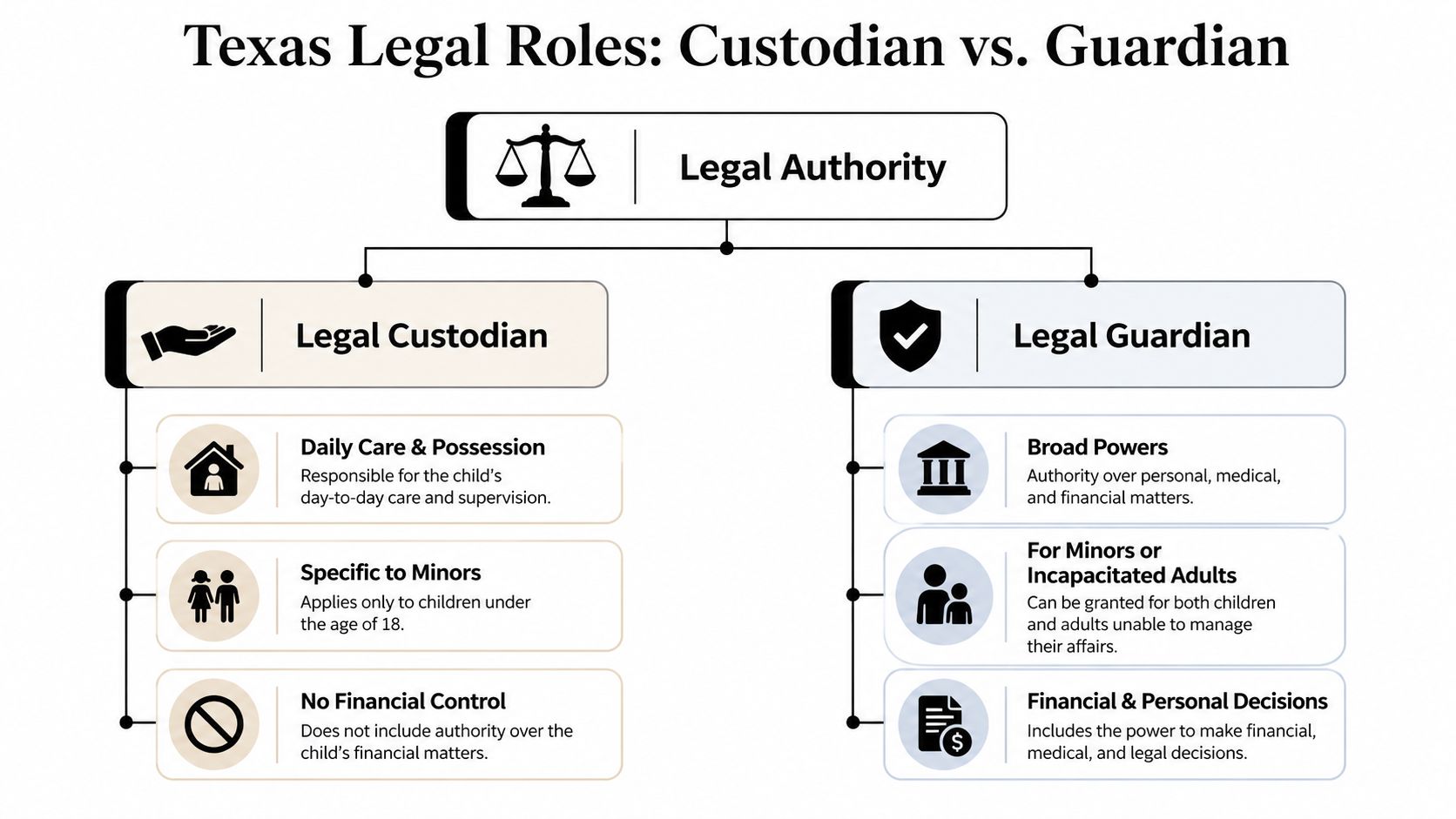
What a conservator means in Texas
In Texas family law, conservatorship works like the rulebook for parental rights and duties. It usually appears in divorce cases, custody disputes, and other suits affecting the parent-child relationship. The court is deciding who has the right to make certain decisions for the child, not appointing a substitute parent through the probate system.
That point matters.
A conservator may have the right to decide where a child lives, consent to medical care, or make educational choices, but those rights come from a Family Court order and the Texas Family Code. The role is tied to the parent-child relationship. Even if a nonparent is involved in a child's care, that does not automatically turn the case into a guardianship matter.
What a guardian means in Texas
Guardianship serves a different purpose. It is a protective court proceeding, usually used when a child does not have a parent able to act, or when an adult cannot manage personal needs or property because of incapacity. These proceedings, which are also addressed by resources such as the Texas Guardianship Lawyer website, fall under the Estates Code.
Probate courts can appoint:
- Guardian of the Person, who makes personal decisions about care, housing, and medical treatment
- Guardian of the Estate, who manages money, property, or other assets
- Both, if the court finds both forms of protection are needed
A simple way to sort this out is to ask what problem the family is trying to solve. If the issue is allocating parental rights after separation or in a child-related Family Court case, conservatorship is usually the right category. If the issue is protecting a minor or an incapacitated adult through a probate appointment, guardianship is usually the right one.
The labels sound similar. In Texas, the legal authority behind them is very different.
Guardian vs Conservator A Side-by-Side Comparison
The easiest way to sort out legal custodian vs legal guardian in Texas is to compare them directly. The chart below uses the Texas terms families are most likely to encounter.
| Attribute | Legal Guardian (Texas Estates Code) | Conservator/Custodian (Texas Family Code) |
|---|---|---|
| Primary legal source | Texas Estates Code, including Title 3, Subtitle G | Texas Family Code |
| Typical court | Probate Court or statutory probate court | Family Court |
| Who usually serves | Non-parent appointed by court | Usually a parent or legal parent |
| Who the role protects | Minor without proper parental care, or incapacitated adult | Child in a parent-child case |
| Purpose | Protective measure when ordinary authority isn't enough | Define and allocate parental rights and duties |
| Scope of authority | Can include broad personal and financial authority, depending on order | Based on parental rights in the Family Code and the specific order |
| Types of authority | Guardian of the Person, Guardian of the Estate, or both | Conservatorship rights are generally unified unless the order limits them |
| Medical and school power | May make major decisions if granted by court | Depends on parental rights assigned in the Family Court order |
| Financial control | Guardian of the Estate may manage assets and funds | Not a probate-style fiduciary estate role |
| Oversight | Ongoing court supervision, reports, bond requirements, renewal duties | Usually less ongoing fiduciary oversight |
The core difference is where authority comes from
A conservator's authority usually grows out of the legal parent-child relationship. A guardian's authority comes from a separate court finding that protection is necessary.
That's why guardianship feels more formal, and often more burdensome. The court isn't just managing parenting time or allocating parental rights. It is creating a protective legal structure for someone who needs another adult to stand in their shoes.
Guardianship has broader fiduciary duties
Texas guardianship also carries stricter accountability. The verified Texas guidance explains that once appointed, a guardian must answer to the court in ways a conservator generally does not.
For many families, that becomes the deciding factor. If you need legal authority over a vulnerable adult's care plan, property, or settlement funds for a child, a Family Court custody-style order usually won't do the job.
A guardian is not just a caregiver. A guardian is a court-supervised fiduciary.
A useful way to think about it
Use this short test:
- Parent versus parent dispute: Usually conservatorship.
- Grandparent, aunt, uncle, or family friend stepping in: Often guardianship.
- Adult with dementia, disability, or serious incapacity: Guardianship.
- Minor receiving funds or property needing court oversight: Often guardianship of the estate.
If you want a closer look at how these labels differ under Texas law, this guide on guardianship vs conservatorship and what Texans need to know adds useful context.
Why families get tripped up
Some confusion comes from ordinary language. “Custody” sounds like daily care. “Guardianship” sounds like just another version of that. In reality, Texas law treats them as different legal systems with different courts, procedures, and consequences.
Another problem is that a family may need immediate action, not a legal seminar. They're trying to pick up prescriptions, enroll a child in school, stop financial exploitation, or pay for care. By the time they realize paperwork is missing, the problem has already become urgent.
The Texas Appointment Process Explained
A lot of families call this stage "getting legal authority." That is true, but it can hide an important point. In Texas, the road to that authority depends on which legal system fits your problem.
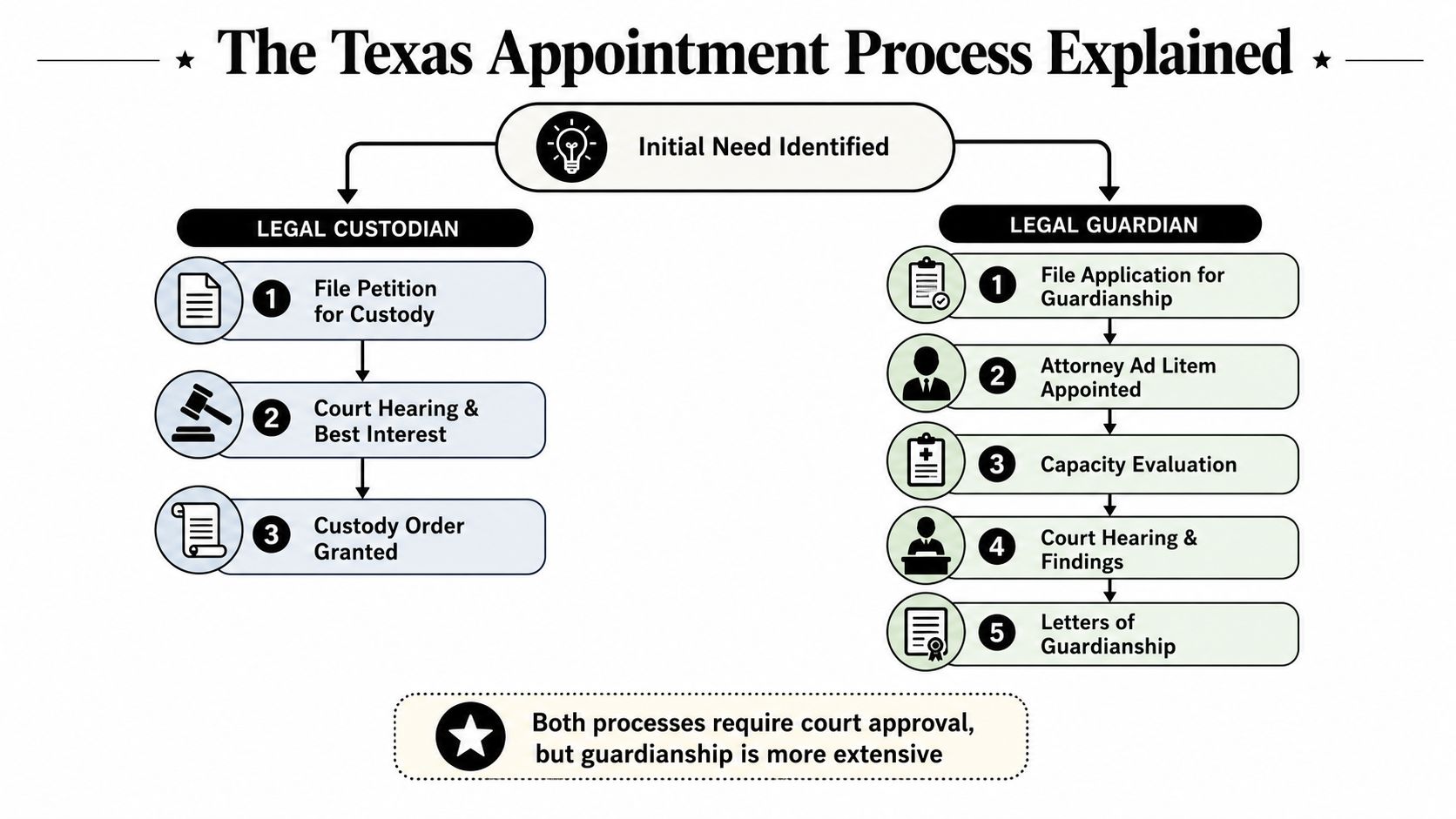
If two parents are asking the court to sort out rights involving their child, that usually starts in Family Court under the Family Code. If a child or adult needs a court-appointed decision-maker because the person cannot safely manage personal care, property, or both, that usually starts in a probate court under the Estates Code. Families often use the words custody, conservatorship, and guardianship interchangeably during a crisis. Texas courts do not.
When the case belongs in Family Court
Family Court cases usually focus on the parent-child relationship. The judge may decide where a child lives, who can consent to medical care, who handles school decisions, and how parents will share rights and duties.
That process can be emotional and urgent. It still asks a different legal question than a guardianship case. The court is usually deciding how parental rights should be allocated, not whether someone is legally incapacitated and needs a substitute decision-maker.
When the case belongs in Probate Court
Probate guardianship is more like asking the court for a carefully limited transfer of authority. A judge has to look closely at what the proposed ward can still do, what help is already available, and whether a less restrictive option would work.
That last point matters. Texas courts do not treat guardianship as the first tool to reach for. In some families, a supported decision-making agreement in Texas may give an adult help with understanding choices and communicating decisions without removing legal rights.
If guardianship is still necessary, the court process is formal because the decision carries significant weight.
What usually happens in a guardianship case
A typical Texas guardianship case often includes these steps:
- An application is filed in the proper court.
- Medical or other required evidence is gathered to show the person's condition and functional limits.
- An attorney ad litem is appointed to represent the proposed ward.
- Notice is given to the people the law requires to be informed.
- A hearing is held so the judge can decide whether guardianship is needed, and if so, how limited or broad it should be.
- The guardian qualifies after appointment by completing the court's required steps before acting.
The proof standard is also demanding. A judge needs more than a family's understandable concern or a pattern of bad decisions. The court needs legally sufficient evidence that a guardianship is necessary and that the powers granted match the person's actual limitations.
Guardianship is a legal remedy for a specific problem. The court is supposed to tailor it to the person, not hand over more control than the situation requires.
Emergency and temporary guardianship
Sometimes waiting for the full process puts a person or that person's property at immediate risk. A relative may be draining an account. An older adult may be leaving the house confused and vulnerable. A child may receive funds that need immediate protection.
In those situations, Texas law allows a request for temporary guardianship. The court still requires a sworn application and specific facts showing imminent danger to the person or property. A temporary order is not automatic, and it is not a shortcut around proof. It is an emergency measure with court supervision from the start.
For families, the practical lesson is simple. Start by identifying the court system that matches the problem. Then gather records, names, dates, and concrete examples of what is happening day to day. That preparation often makes the difference between a filing that answers the judge's questions and one that leaves the family stuck in delay.
Real-World Scenarios Which Path Is Right for You
Legal labels become easier when you match them to real life. These examples show where families in Texas often land.

Grandparents caring for a grandchild
A child's parents die unexpectedly. The grandparents take the child into their home in Montgomery County. They can provide food, clothing, and stability right away. But the school asks who has legal authority to enroll the child and approve educational decisions.
This usually points toward guardianship of the person for a minor, not ordinary custody language. The grandparents aren't just supervising the child. They need legal decision-making authority from the court.
Divorced parents sorting out decision-making
Two parents in a divorce disagree about who decides where the child lives and who can consent to treatment. No third party is stepping in. This is still a parent-child dispute.
That situation usually belongs in Family Court conservatorship, not probate guardianship. The court order will spell out rights and duties between the parents.
Adult daughter helping a father with dementia
A daughter in Bexar County notices her father can't keep track of medication, bills, or basic safety decisions. The bank won't discuss his account. His doctor wants legal authority before accepting treatment decisions from her.
This often calls for guardianship of the person, guardianship of the estate, or both, depending on what the father can still handle. If the family wants to explore something less restrictive first, a useful starting point is supported decision-making agreements in Texas.
Minor receiving settlement funds
A child receives money from a lawsuit or inheritance. The caregiver can meet daily needs, but someone must legally manage the funds for the child's benefit under court supervision.
That usually points to guardianship of the estate. This is one of the clearest examples of why care alone isn't enough. The issue isn't who loves the child. The issue is who has legal authority to manage the child's property.
The right path depends on the decisions that must be made, not just on who is already helping.
Understanding the Responsibilities Risks and Limitations
Guardianship can protect a loved one. It can also remove important rights from that person. That's why Texas courts treat it seriously.
The U.S. Department of Justice explains that when a court appoints a guardian for an adult, the person may lose rights such as voting, consenting to medical treatment, or managing property, and those removals must be proven by clear and convincing evidence at a hearing where the person has the right to legal representation and cross-examination, as outlined in the Department of Justice elder justice guidance on guardianship.
The guardian's ongoing duties
A guardian doesn't finish the job when the hearing ends. Once appointed, a Texas guardian must post a bond with the court within 20 days, submit annual reports regarding the ward's care, and renew their Letters of Guardianship annually, which expire after 16 months; a conservator generally has no such requirements, according to this Texas comparison of guardianship and custody duties.
That means a guardian must stay organized and compliant. Missed deadlines can create serious problems.
- Bond requirement: The court may require financial security before authority is fully active.
- Annual reporting: The guardian must keep the court informed about care and, when relevant, finances.
- Letters renewal: Authority doesn't sit on autopilot. It must be maintained.
Disputes and less restrictive options
Family conflict can surface quickly. One relative may believe guardianship is necessary. Another may believe it goes too far. The court can hear evidence from both sides, and guardianship can be contested, limited, modified, or challenged for misconduct.
Before filing, families should also consider whether a less restrictive tool might work. A good example is comparing power of attorney vs guardianship in Texas and which is better. In some cases, advance planning can avoid the need for a guardianship proceeding. In others, it can't.
A guardianship order solves some problems, but it also creates duties, oversight, and limits that families need to understand before they file.
Your Family's Next Steps on the Guardianship Path
At this stage, many families are not asking a legal question first. They are asking a daily-life question. Who can talk to the doctor? Who can sign school papers? Who can stop the rent from going unpaid? In Texas, those questions often point you toward two very different systems. A Family Code conservatorship for a child, or a Probate Court guardianship for a child or adult who cannot manage personal or financial decisions.
Start with the immediate problem, not the title.
A helpful way to sort this out is to make a simple two-column list. In one column, write the decisions that must be made this week. In the other, write who currently has legal authority to make them, if anyone. That small exercise often brings the answer into focus. If the issue involves parenting rights, possession, or decision-making for a minor after a divorce or custody dispute, you may be dealing with conservatorship language under the Texas Family Code. If the issue involves incapacity, protection from exploitation, or the need for court-supervised authority over a person or estate, guardianship may be the right path.
Once you have identified the problem, gather the records that match it. Medical records can show cognitive decline or inability to consent to treatment. School records may explain who has been acting for a child. Bank statements, unpaid bills, or evidence of suspicious withdrawals can matter if money management is part of the concern. Prior court orders and contact information for close relatives are also important because Texas courts usually want a clear picture of the family before granting authority to anyone.
Texas law also asks whether a less restrictive option could solve the problem. That matters because guardianship is a serious court order, not just a form to sign. Sometimes a supported decision-making arrangement, a valid power of attorney, or another narrower tool will address the need. Sometimes it will not. The right choice depends on the person's actual limits and the risks your family is trying to prevent.
If you are not sure what to do next, focus on these practical steps:
- Write down urgent risks: missed medication, unsafe housing, financial exploitation, school access problems, or refusal of needed care
- Create one document folder: keep medical, financial, school, and court papers in one place
- Identify the court involved: Family Court handles conservatorship issues for children. Probate Court handles guardianship matters
- Ask what authority is really needed: decisions about the person, the money, or both
- Prepare for ongoing duties: if the court appoints a guardian, the work does not end at the hearing
Families often feel guilty for even considering guardianship. That feeling is common. Seeking legal authority is not about taking over a loved one's life for convenience. It is about building a lawful safety rail when informal help is no longer enough.
If your family needs clear guidance on a child, an aging parent, or an adult who may no longer be able to manage personal or financial affairs, consider scheduling a free consultation with Law Office of Bryan Fagan, PLLC. The firm handles guardianship, probate, and estate planning matters for Texas families and can help you understand which legal path fits your situation.