Skip to content
A daughter files for guardianship after realizing her mother can no longer manage medications, bills, or daily decisions safely. She expects the judge to focus on the medical need. Instead, the first question may be whether every required person received the correct legal papers, in the correct way, with enough time to respond.
That's why Texas guardianship notice and citation requirements before hearing matter so much. A guardianship judge in Harris County, Dallas County, or another Texas probate court generally cannot act until the required notice or citation has been completed and the court file contains proof of service. These rules can feel frustrating during a family crisis, but they protect the proposed ward's dignity and right to be heard.
Why Notice Comes First in a Texas Guardianship Case
Consider Maria, whose mother has become increasingly unable to manage her affairs. Maria believes guardianship is necessary, but she also knows her brother lives in another county and her mother's spouse may have legal rights in the proceeding. Before Maria worries about what she'll say at the hearing, she must determine who must receive notice, what document each person receives, and how service must be proven.
Texas Estates Code Title 3 places notice and citation at the front of the process. The 2015 recodification centralized guardianship procedure in Title 3, making compliance with these requirements a threshold issue before a hearing can move forward. Texas law generally requires citation or notice when the Estates Code expressly calls for it, and the document must identify the proceeding, be dated, name the court, describe the matter, and state when and where the recipient must appear or act. A clerk's citation must also be styled “The State of Texas” and signed under the court seal. Texas Estates Code Chapter 1051 provides the statutory framework.
The rule applies whether the case involves an aging adult, a minor, or a contested family dispute. The proposed ward and other interested people need enough information to contest the application, participate in the hearing, or meet a court deadline.
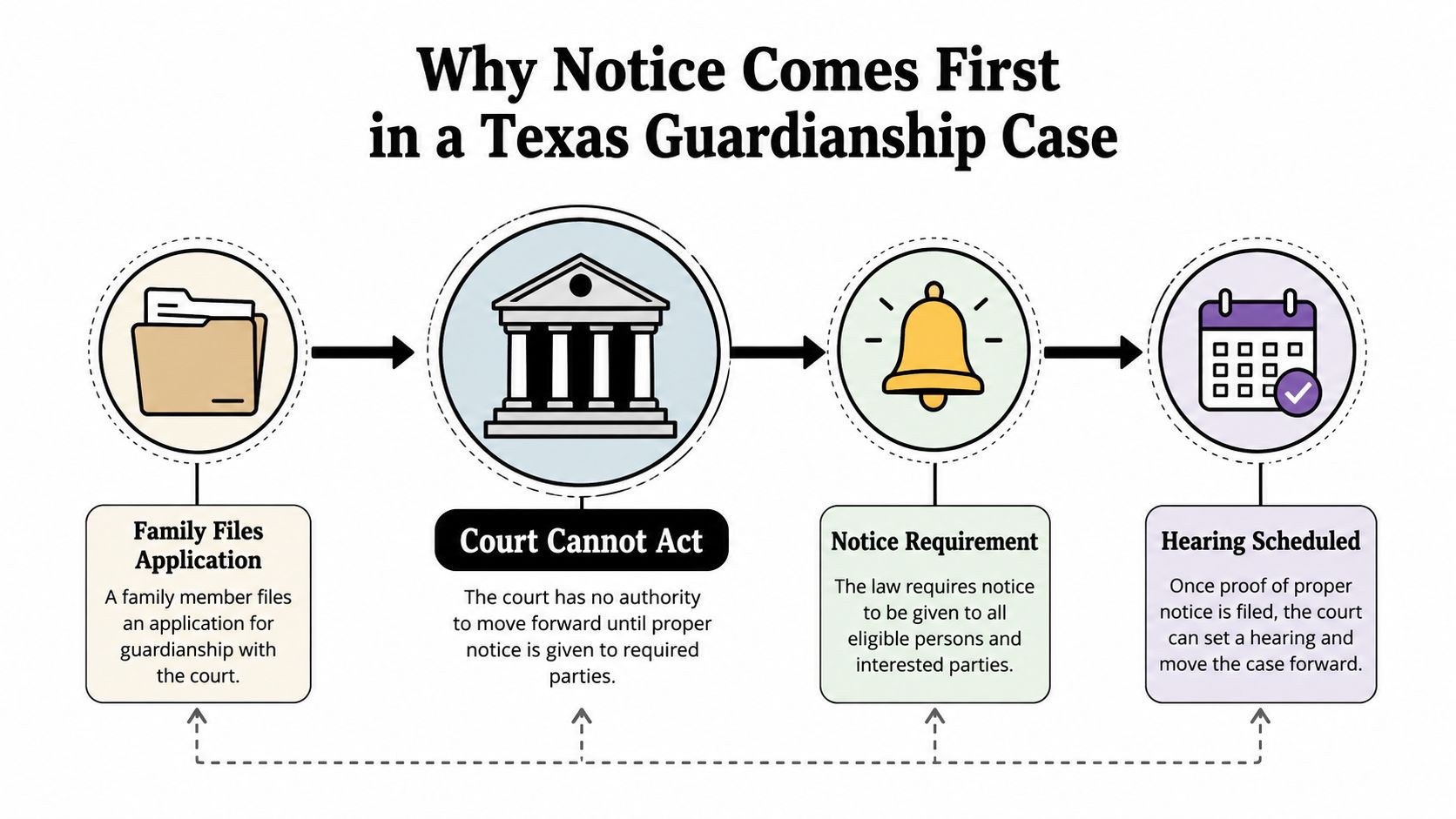
Practical rule: Filing the application starts the case, but proper service and filed proof of service allow the court to lawfully proceed.
A family may feel that urgent medical or financial concerns should let the court skip notice. Texas law treats notice as a safeguard, not a technical obstacle. In a standard guardianship case, the court is barred from acting until the statutory service requirements are satisfied and the required waiting period has passed.
That protection benefits everyone. It gives the proposed ward a meaningful opportunity to understand the case, obtain legal help, express a preference, and challenge the request if appropriate. Careful notice is often the first concrete step toward a lawful and respectful guardianship outcome.
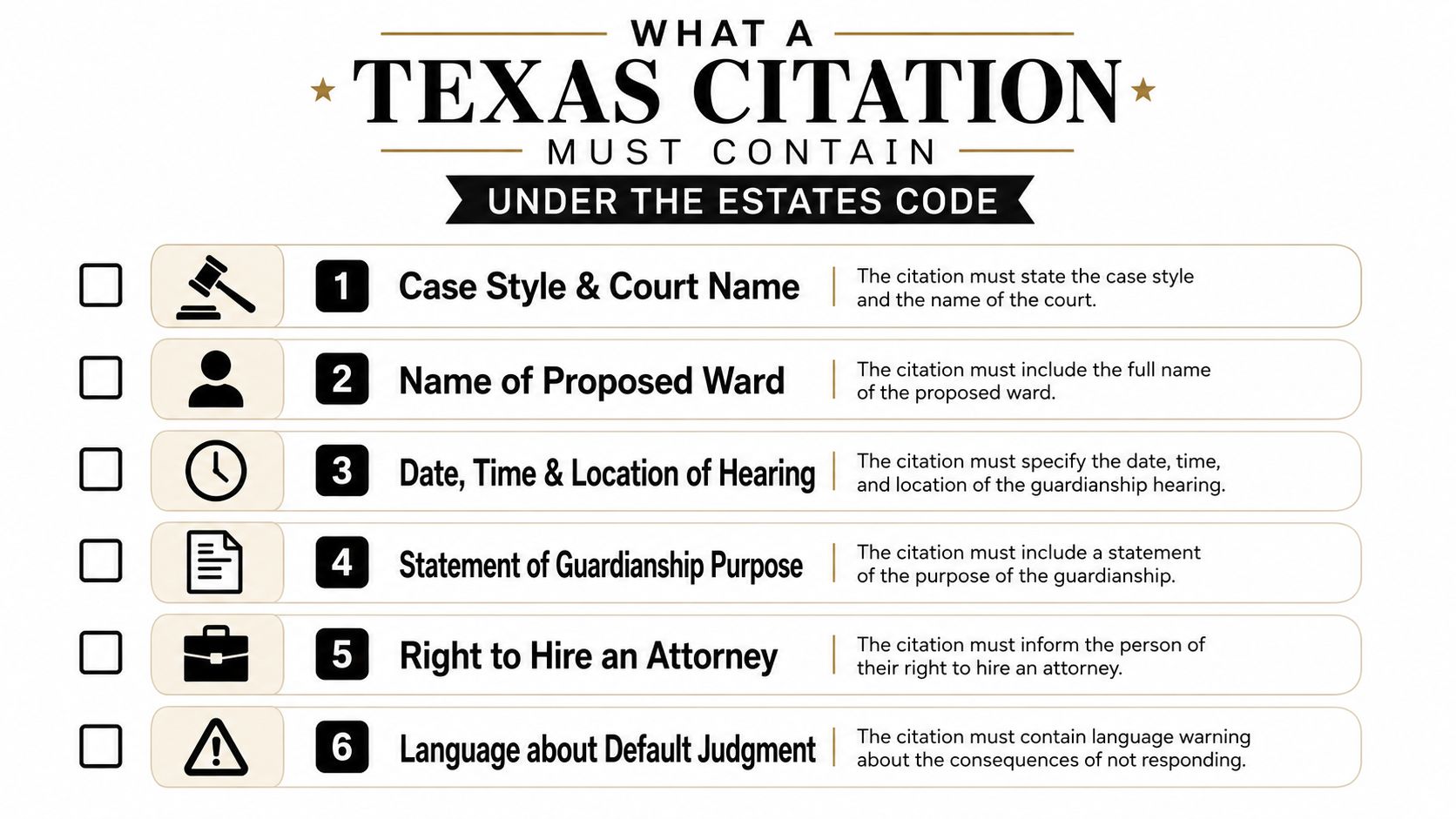
What a Texas Citation Must Contain Under the Estates Code
A citation is the formal court document that tells a person a guardianship proceeding exists and explains what they must do. Families should read it carefully rather than assuming every court form says the same thing.
Under the Texas Estates Code framework, the citation or notice should identify the proceeding and provide enough information for the recipient to respond. The statutory requirements include the following core details:
- Court identity: The document names the court handling the proceeding and uses the required style, “The State of Texas.”
- Case information: It identifies the proceeding and the parties, including the proposed ward.
- Date and authority: It is dated and issued through the clerk under the court's seal.
- Nature of the matter: It describes that the application concerns creation of a guardianship.
- Required action: It tells the recipient when and where to appear or act.
- Future notice rights: The citation must clearly explain that interested people may request notice of later motions, pleadings, and subsequent guardianship proceedings.
The citation's date and hearing information matter because they allow the recipient to calculate the response period and prepare. A relative citation may also include a statement explaining the relative's right to elect in writing to receive future notices if the court creates a guardianship. That election can be important in a family case where relatives want continuing information without appearing at every step.
The Texas Estates Code plain-English guide can help readers place Chapter 1051 within the broader statutory structure. For an adult who cannot manage personal or financial affairs, Guardianship of an Incapacitated Adult in Texas describes how a court establishes that type of guardianship.
A missing case detail, unclear hearing information, or defective signature can create a problem before anyone discusses the underlying medical evidence. If the citation doesn't tell a person what proceeding is pending or when action is required, the document may fail to provide the notice the statute expects.
Before accepting a hearing date, compare the citation with the application and the clerk's file. The names should match, the court should be identified correctly, and the hearing details should be clear enough for a recipient to attend or respond.
Who Must Receive Notice Before the Hearing
The service list is often where families make their first serious mistake. A person may support the proposed guardianship and still have a legal right to receive notice. Personal conflict, distance, or a strained relationship doesn't automatically remove that person from the list.
The proposed ward
The proposed ward is central to the case. If the proposed ward is age 12 or older, Texas guardianship materials require personal service of the citation. Mailing a copy to the home, leaving papers with another relative, or telling the person about the hearing generally isn't the same as personal service.
Personal service gives the court a direct record that the person whose rights are at issue received the legal papers. The proposed ward may participate, object, communicate preferences, or work with appointed counsel.
Family and caregiving participants
The required recipients can include:
- Known parents: Each known parent must be considered for service.
- A court-appointed conservator or caretaker: A person already appointed or serving in that role may have information and legal interests relevant to the application.
- The proposed ward's spouse: Marriage can create a significant connection to the proposed ward's care, property, and daily life.
- The proposed guardian: This person must receive notice if they aren't the applicant.
A simple example shows how an omission happens. Leah applies to become guardian for her father and names her sister as the proposed guardian instead. Because the named guardian isn't the applicant, the sister belongs on the service list even though she supports the application.
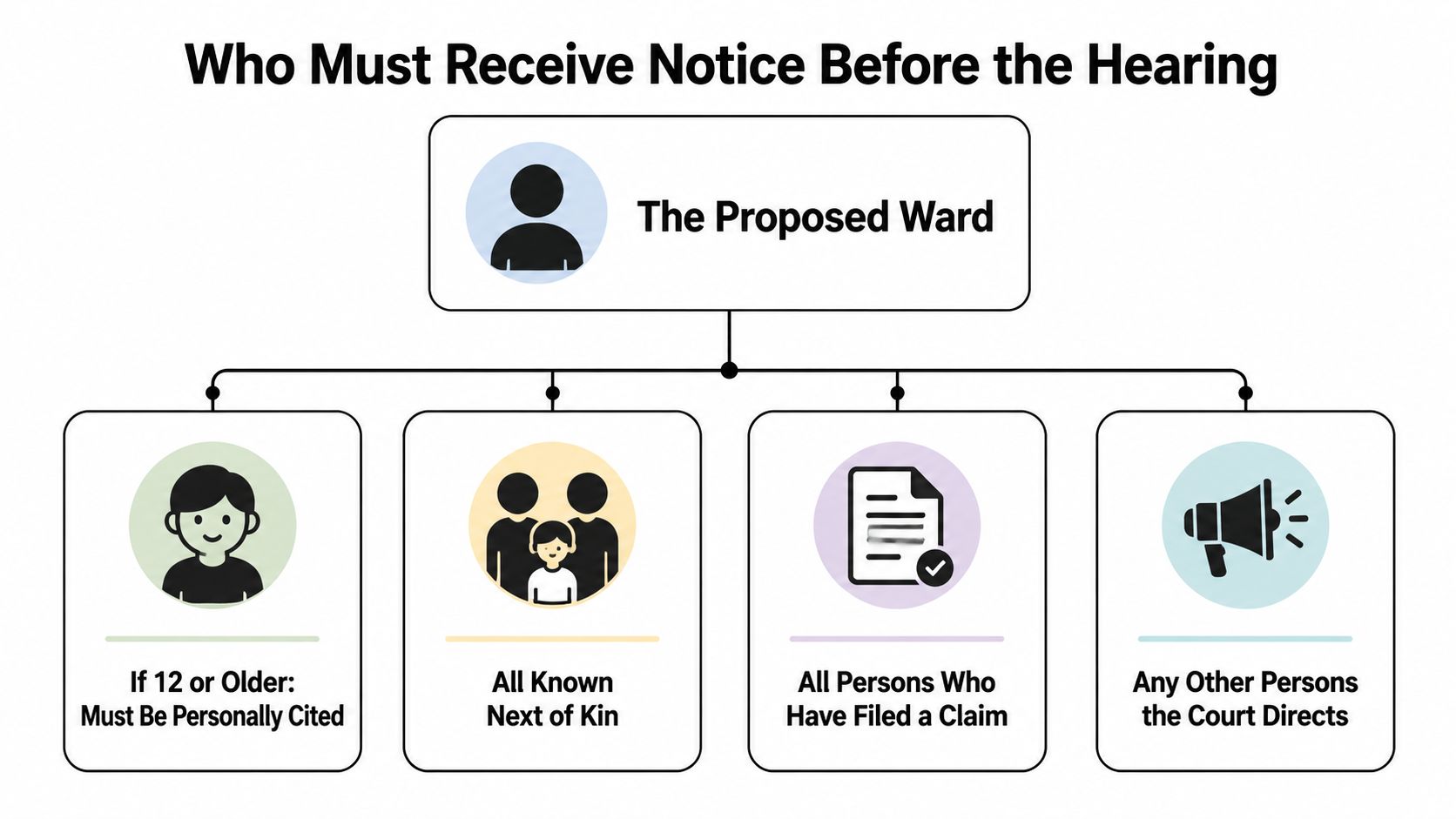
The court may also direct notice to additional people depending on the proceeding. Families shouldn't rely on memory alone, especially when relatives live outside Texas or when a proposed ward has changed residences.
Before filing: Prepare a written service list with counsel, verify addresses, identify each person's relationship to the proposed ward, and compare the list against the applicable Estates Code provisions.
An omitted recipient can lead to a reset, additional service, and more expense. Those consequences are hard on families already balancing caregiving, work, medical decisions, and financial pressure. A careful list protects the proposed ward and reduces avoidable disruption.
Acceptable Methods of Service and Their Timelines
Texas does not use one service method for every recipient. The proposed ward may require personal service, while another person may receive notice by qualified mail. Posting can become necessary when mailed service is returned undelivered.
The distinction matters because each method creates different proof and timing requirements.
| Method | Required Proof | Minimum Lead Time | When It Applies |
|---|---|---|---|
| Personal service | A filed return or other official proof showing delivery | The court cannot act before the Monday after the 10-day period following completed service, under Estates Code Section 1051.106 | Commonly required for the proposed ward when age 12 or older |
| Regular mail or another qualified delivery method | A copy of the citation or notice, plus signed proof of delivery or return receipt filed with the court | At least 20 days before the return day, excluding the service date, under Estates Code Section 1051.052 | Used for recipients who qualify for mailed service |
| Posting | Proof that the new citation or notice was posted after another method failed | Timing depends on the court's issuance and applicable statutory procedure | Used when mailed service is returned undelivered or another authorized method fails |
For mailed service, the clerk or guardian must send the citation or notice with instructions that delivery is limited to the addressee. The delivery must require a signature through a return receipt or another qualified proof of delivery. The filed certificate must include a copy of the citation or notice and proof that delivery occurred.
The 10-day rule and 20-day mail rule are not interchangeable. Under Section 1051.106, the court may not act on an application to create a guardianship until notice and citation requirements have been met and the first Monday after the applicable 10-day period has passed. Section 1051.052 imposes a separate lead-time requirement for mailed service.
A county checklist reinforces the practical requirement that proof of service for each required citation or notice must be filed before the application hearing can proceed. Gonzales County's guardianship hearing checklist also identifies the proposed ward, known parents, a court-appointed conservator or caretaker, the spouse, and a non-applicant proposed guardian as people who may require service.
Temporary and Emergency Guardianship Notice Rules
Temporary guardianship addresses situations where waiting for a standard proceeding could place a person or property at immediate risk. It does not mean the family can ignore citation or notice. The court uses a compressed timetable, but procedural protection remains important.
Under Estates Code Section 1251.006, the court must issue an order setting a temporary guardianship hearing immediately after the application is filed. The hearing must occur no later than the 10th day after filing, unless postponed. The proposed ward or the proposed ward's attorney may consent to postponement, but the postponement may extend only up to 30 days from the filing date.
Suppose Daniel finds his father confused, isolated, and unable to protect his bank account or personal safety. Daniel may need to ask the court for temporary protection while preparing the broader case. The family should gather the facts supporting urgency, identify the proposed ward and other required recipients, and work quickly with the clerk and counsel on the citation process.

The temporary hearing timetable differs from the standard creation hearing. A temporary order is a short-term response to an urgent situation, not a permanent substitute for the regular proceeding. The court still must protect the proposed ward's rights through notice, representation, and an opportunity to be heard as the law requires.
Families considering this route can review temporary guardianship without notice in Texas for related information. Because the facts and requested relief matter, an emergency filing should be prepared with care rather than treated as a shortcut.
Curing Defective Notice and Waiver Options
A defective notice problem doesn't always end a guardianship case, but it can prevent the scheduled hearing from going forward. Common warning signs include an incorrect address, a late mailing, an unsigned return receipt, a missing copy of the citation in the filed certificate, or a hearing date that doesn't respect the applicable waiting period.
Mailed service has a specific fallback. If the citation or notice is returned undelivered, the clerk must issue a new citation or notice and serve it by posting under Section 1051.052. The family should preserve the returned envelope and delivery records, then confirm that the new citation and posting proof appear in the court file.
A competent interested person may waive hearing notice in writing in the limited circumstances recognized by Texas law. Estates Code Section 1051.251 addresses written waiver and shows why families should distinguish between the proposed ward's protections and an interested person's choice to waive.
Waiving notice of one hearing doesn't necessarily mean waiving the right to receive later notices. Texas notice rules recognize that interested people may request notice of later motions, pleadings, and subsequent guardianship proceedings. For example, a competent sister might waive formal notice of the initial hearing because she supports the application, then make a written election to receive future notices.
What to ask counsel to verify
- Service method: Was each person served by a method authorized for that recipient?
- Delivery proof: Is the signed receipt, return, certificate, or posting record filed?
- Timing: Did the required waiting period run before the hearing date?
- Document content: Does the citation identify the court, proceeding, date, and required action?
- Future notices: Did an interested person elect to receive later notices?
The court's ability to cure a problem depends on the defect and the applicable statute. Don't assume that cooperation among relatives fixes missing statutory proof. Ask counsel to review the clerk's file before the hearing date.
A Pre-Hearing Checklist for Texas Families
The week before a hearing, families should focus on the court file rather than relying on verbal assurances. A short written review can reveal a missing return, an incomplete citation, or a timing problem while there's still time to respond.
Confirm with the attorney
- Citation contents: Check the court name, case information, proposed ward, proceeding description, hearing details, required style, and future-notice language.
- Proof of service: Confirm that proof has been filed for every required citation or notice.
- Waiting period: Verify that the applicable 10-day or 20-day timing rule has run under the relevant statute.
- Service list: Compare the people served with the proposed ward's known parents, spouse, caretaker or conservator, and any non-applicant proposed guardian.
Prepare for the courthouse
Bring identification, copies of the application, medical or supporting records provided to counsel, filed returns, and any document your attorney asks you to have available. In a courtroom such as Harris County Probate Court, arrive prepared for security, clerk procedures, and questions about the proposed ward's needs.
The proposed ward's rights remain central even when the family agrees. Preparation is not just administrative work. It helps the judge receive reliable information and helps the family present a respectful plan.
For matters involving evidence and testimony, families can review the Texas guardianship evidentiary hearing guide. If guardianship may be broader than necessary, consider alternatives such as supported decision-making or other less restrictive arrangements, and discuss them with counsel before the hearing.
Common Pitfalls and Next Steps With the Law Office of Bryan Fagan
A family may believe the hearing is ready, then discover that a relative was missed, the waiting period has not run, or the court lacks proof that service occurred. A signed waiver creates another possible misunderstanding. It generally addresses the notice it identifies, not every later motion or proceeding.
Use the pre-hearing timeline as a paper trail. First, compare the service list with the people and procedures required by Chapter 1051. Next, confirm that each return, waiver, or delivery record has been filed. Then check the hearing date against Section 1051.106 or the applicable mailed-service rule in Section 1051.052. These documents function like checkpoints. If one is missing, the court may have to postpone the hearing or correct service before proceeding.
Temporary cases require a separate check. Confirm that the shortened timetable follows Section 1251.006. An emergency may change the schedule, but it does not erase every notice duty.
The Law Office of Bryan Fagan, PLLC handles guardianship, probate, and estate-planning matters for Texas families, including contested proceedings, temporary guardianships, and compliance concerns after appointment. Counsel can also help assess less restrictive alternatives and whether the proposed guardianship, scope, or guardian fits the facts.
Before the hearing, ask counsel to review the citation, service list, proof of delivery, and hearing timeline.