Skip to content
The hearing is over. The judge signed the order. Your family may feel relieved, exhausted, or both.
Then reality sets in. You're now responsible for another person's care, finances, or both, and Texas law doesn't treat that responsibility casually. What happens after guardianship is granted in Texas is just as important as what happened in the courtroom. If you miss the first deadlines, delay a filing, or act before your authority is fully active, you can create serious problems for yourself and for the person you're trying to protect.
I tell new guardians the same thing in probate courts across Texas, including places like Harris County Probate Court and Dallas County probate courts. Slow down. Get organized. Follow the court's timeline exactly. Guardianship under Texas Estates Code Title 3, Subtitle G is a supervised legal role, not informal family permission to help.
A good checklist makes this manageable. That's what follows here.
The First 30 Days Your Immediate Responsibilities
On Tuesday, the judge signs the guardianship order. By Wednesday morning, a hospital, a bank, and two relatives may all expect you to start making decisions. That is usually when new guardians get tripped up. The court appointed you, but Texas still requires a few post-hearing steps before your authority is active in a way third parties will recognize.
Treat the first 30 days like the setup phase after getting the keys to a house. You have the right to step in, but you still need to turn on the utilities, label the rooms, and lock the doors. If you handle this month in order, the rest of the guardianship becomes far easier to manage.
Texas law gives new guardians a short window to qualify after appointment, including taking the oath and, when required, filing the bond before Letters of Guardianship are issued. As noted earlier, those steps matter because banks, doctors, and care facilities usually want proof that your authority is fully in place before they act.
Days 1 to 3: get your paperwork under control
Start with one job. Build a guardianship file.
Use one paper folder and one digital folder. Put in the signed order, hearing notes, the clerk's contact information, your attorney's contact information, and a written deadline list. Add a running log where you record every call, visit, payment, and major decision. That log will help later when the court expects reports and accountings.
Then read the order line by line. Do not rely on memory from the hearing. The order tells you whether you are guardian of the person, guardian of the estate, or both, and whether the court limited any part of your authority.
Days 1 to 20: complete the steps that activate your authority
These are the tasks that new guardians should treat as top priority:
Take the Oath of Guardian
The oath is your formal promise to carry out the role faithfully. It is a legal requirement, not a formality.File the bond if the court requires one
Some guardians must post bond before they can qualify. The amount is set by the court based on the case, especially when property or income must be managed. Do not guess at the amount or the deadline. Confirm both with the clerk and your signed order.Get certified Letters of Guardianship from the clerk
Once you have qualified, the clerk can issue Letters of Guardianship. These letters are what third parties usually ask for. Hospitals want them. Banks want them. Insurance companies and care facilities often want them too. If you need a practical explanation of what institutions usually accept, review this guide on proof of guardianship.Calendar the expiration date on the letters the same day you receive them
In Texas, Letters of Guardianship do not stay current forever. They are generally issued for a limited period and must be kept current through later court compliance. Put the expiration date on your calendar immediately so you are not scrambling months later.

Days 7 to 30: notify the right people and secure the situation
Once your letters are in hand, shift to practical control. The goal is simple. Make sure the people and institutions in the ward's life know who has authority, what needs attention first, and where records will be kept.
Use this checklist:
Notify key institutions
Give copies of your letters, and sometimes the order, to doctors, hospitals, care facilities, banks, schools, benefit offices, or landlords, depending on your role.Meet with the ward promptly
Ask what is urgent right now. Medication problems, missed appointments, unsafe housing, service gaps, and unpaid bills often show up in the first week.Secure records
Gather insurance cards, medication lists, ID documents, bank statements, benefit letters, leases, tax papers, and contact lists for doctors and family members.Start a receipt and decision trail
Keep receipts, invoices, appointment summaries, mileage notes, and written explanations for major choices. Guardianship works best when your file can answer the question, "Why did you do that, and when?"Check before you act
If someone asks you to sign, transfer, consent, move money, change beneficiaries, or admit the ward to a facility, compare that request to your order first. Authority in guardianship is specific. Good intentions do not expand it.
A simple example shows why order matters. If Maria is appointed guardian for her adult son, she may leave the hearing believing she can immediately access his bank account. If she has not completed the oath and bond requirements and obtained her letters, the bank will often refuse to act. The bank is not being difficult. It is asking for the court-recognized proof that your authority is active.
Practical rule: Before you make a medical, housing, or financial decision for the ward, check three things: your signed order, your current Letters of Guardianship, and whether the task fits the authority the court actually gave you.
Establishing Authority Guardian Powers and Initial Filings
Once your authority is active, the next question is simple but important. What are you allowed to do?
In Texas, guardianship is often split into two categories. The court may appoint a guardian of the person, a guardian of the estate, or one person to serve in both roles. The order controls. Not family expectations. Not what “seems necessary.”
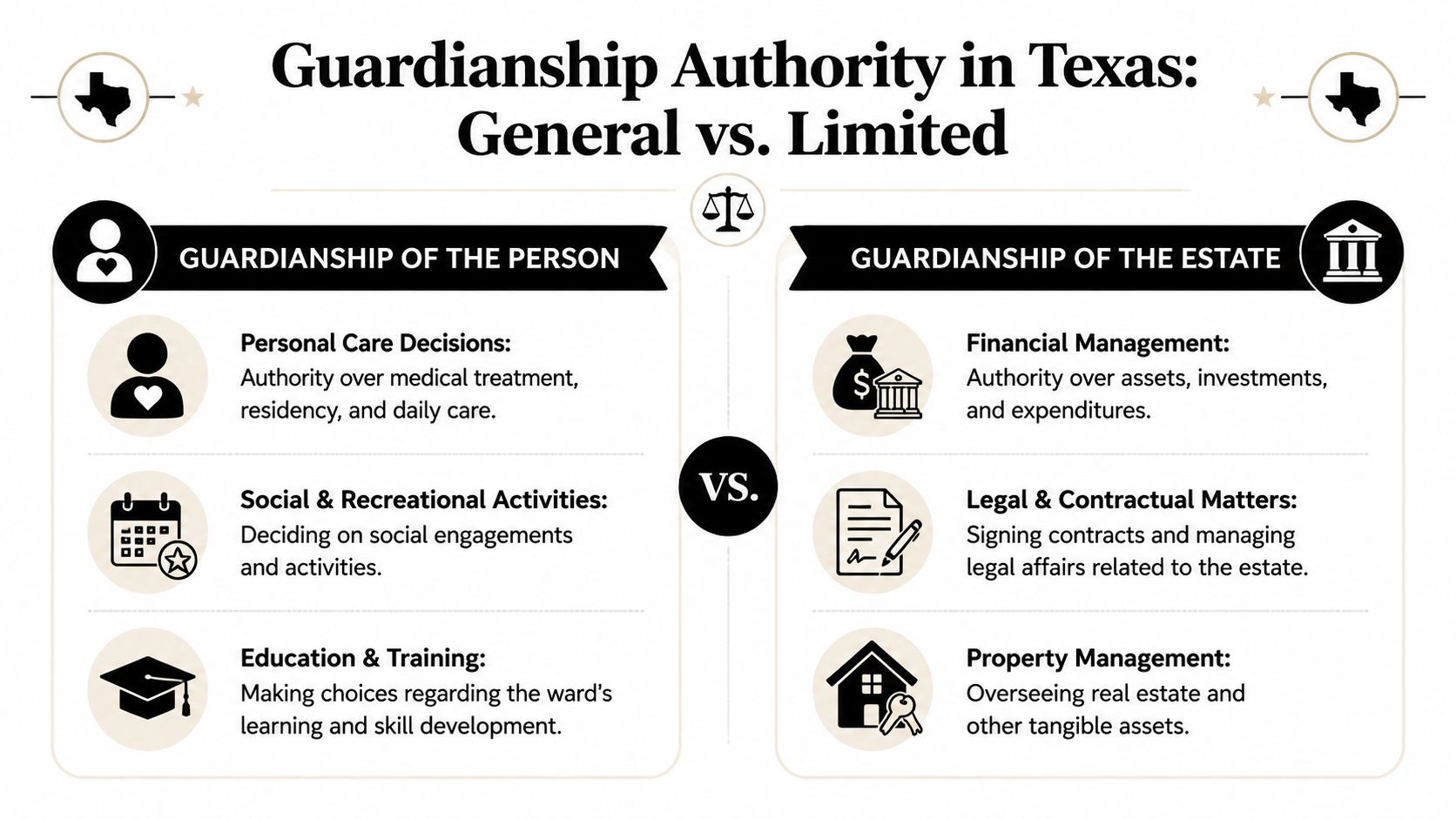
Two types of authority
| Type | What it usually covers |
|---|---|
| Guardianship of the person | Medical care, living arrangements, day-to-day supervision, and decisions about personal well-being |
| Guardianship of the estate | Money, property, accounts, bills, income, legal claims involving assets, and financial management |
A guardian of the person might choose a safer living arrangement, consent to medical treatment, or coordinate services. A guardian of the estate handles the ward's property as a fiduciary. That means the guardian must act for the ward's benefit, keep accurate records, and avoid self-dealing.
That distinction matters in real life. A daughter may have authority to speak with doctors but no authority to move money from an account. A brother may manage the estate but not decide where the ward lives. Many disputes begin because family members assume one appointment covers everything.
Here's a short explainer that many families find helpful:
Your next big filing
For guardians of the estate, one early task is preparing the Inventory, Appraisement, and List of Claims. This filing creates a snapshot of what the ward owns and what the ward may owe. It becomes the foundation for future accounting to the court.
Start by gathering:
- Bank information: Checking, savings, CDs, and online accounts
- Real property records: Homes, land, mineral interests, or timeshares
- Income sources: Benefits, retirement payments, wages, or rental income
- Debts and claims: Credit cards, medical bills, loans, or pending legal claims
- Personal property: Vehicles, jewelry, collectibles, or business interests
A practical way to build the inventory
Don't try to “estimate from memory.” Pull statements and documents.
For example, if James is guardian of his mother's estate in Harris County, he should request current account balances, gather deed records, confirm whether she receives benefit income, and list known debts. If he leaves out a brokerage account because a relative casually says, “I think that was closed years ago,” the court record starts with an inaccurate picture.
Courts use early filings to measure whether a guardian is organized, candid, and capable of following fiduciary rules.
If you're also considering broader planning for the ward and family, it often helps to coordinate guardianship decisions with related legal work such as probate matters and estate planning. Those areas often overlap when property, incapacity, and long-term care are all in play.
Ongoing Compliance Annual Reports and Court Oversight
The hearing is over. You have your letters. A few months pass, daily care settles into a routine, and it is easy to assume the urgent court work is behind you. For a Texas guardian, this is the stage where quiet mistakes happen. The court still expects regular proof that the ward is being protected and that you are following the limits of your authority.
Court oversight works like a scheduled inspection on a house under active management. The court is not waiting for a disaster. It wants regular updates so it can confirm the guardianship still fits the ward's needs and that the guardian is handling the job properly.
Texas guardianship is a timeline, not a one-time appointment.
According to the Lone Star Legal Aid Guardianship 101 guide, annual reporting starts from the date the court approves the guardian's bond, and the first annual report is due one year and 60 days after that date. The same guide also states that guardians should expect an annual check-in visit by a court investigator as part of ongoing court review.
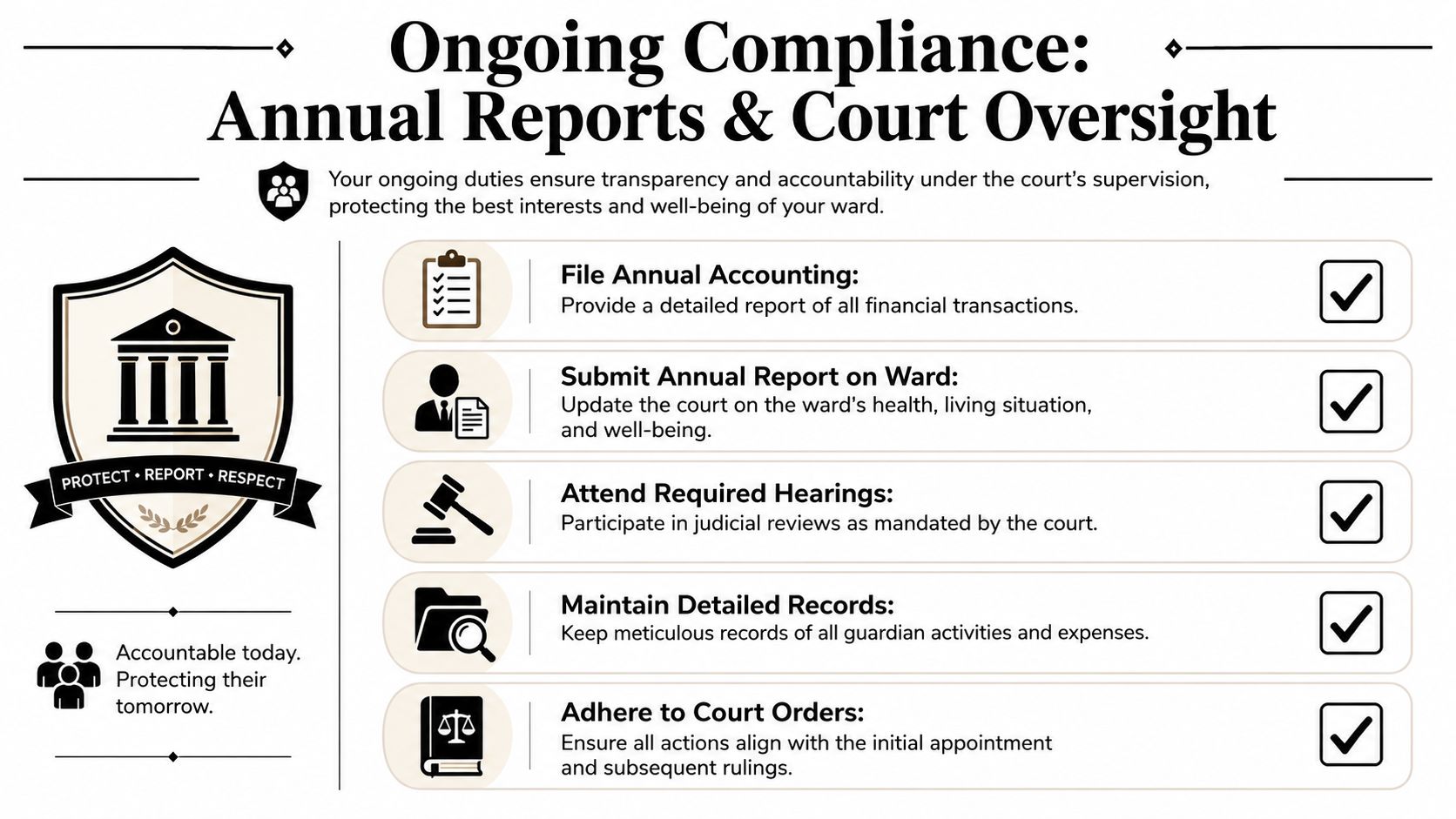
Your yearly compliance checklist
The exact paperwork depends on whether you are guardian of the person, guardian of the estate, or both. Counties may use slightly different forms, but the court usually wants the same core information each year.
- Calendar your due date early. Do not wait for a reminder notice from the clerk or investigator. Put the deadline on your calendar and set a second reminder several weeks ahead.
- Update the ward's current status. The court wants a clear snapshot of where the ward lives, what care the ward receives, and whether the ward's condition has changed.
- Report your actions accurately. If you changed providers, addressed a safety issue, or made decisions within your authority, be ready to explain them plainly.
- File financial information if your role requires it. A guardian of the estate may need to provide an accounting or other financial reporting that shows how the ward's money was handled.
- Confirm your contact information. If you move, change phone numbers, or switch email addresses, update the court promptly so notices reach you.
- Cooperate with court review staff. Investigators, visitors, or other court personnel may ask questions or arrange a visit to check on the ward's circumstances.
What the court is actually checking
New guardians often hear “annual report” and picture a formality. It is more serious than that. The court is checking three things at once.
First, is the ward safe and receiving appropriate care?
Second, is the guardianship still necessary in its current form, or has the ward's condition changed enough that the arrangement should be adjusted?
Third, is the guardian following fiduciary duties, court orders, and reporting rules?
That is why late filings matter. A missed report can signal disorganization, poor recordkeeping, or a larger problem the court needs to examine.
A practical example
Suppose Denise is guardian of the person for her adult brother in Travis County. He still lives in the same group home, but his medications changed twice during the year and he started a new day program. When annual report time arrives, the court does not want vague reassurance that “everything is fine.” It wants current, specific information that shows Denise knows his situation, stays involved, and can explain why the present arrangement still works.
If a court investigator visits, that is not an accusation. It is part of the court's continuing supervision. For a closer explanation of how those reviews work, see this page on court monitoring of a guardian in Texas.
How to stay out of trouble
Use a simple annual file, paper or digital, and add to it throughout the year. Include medical updates, placement changes, service notes, court notices, and copies of anything you file. That way, when the report is due, you are assembling information, not hunting for it.
One missed envelope from the probate court can create weeks of cleanup. Open court mail promptly, respond by the stated deadline, and ask your attorney questions early if a notice is unclear.
Annual oversight protects the ward first, but it also protects careful guardians. Good records and timely filings give the court a clear picture of responsible work.
Managing the Ward's Finances and Medical Care
Daily guardianship work rarely feels dramatic. It's more often a stream of ordinary decisions that need careful handling.
Take Elena, a fictional guardian of both the person and the estate for her uncle. On Monday, she calls his primary care doctor about a medication change. On Tuesday, she pays his assisted living bill from a separate account. On Friday, she saves the invoice, updates her ledger, and writes down why the expense was necessary. That routine is what good guardianship looks like.
Handling money the right way
If you're guardian of the estate, think of yourself as a manager under court supervision. The ward's money is not family money. It is not your reimbursement fund. It is not a convenient account to “borrow from” while waiting on paperwork.
A sound basic routine includes:
- Use a separate account: Keep the ward's funds separate from your own money.
- Track every transaction: Save statements, receipts, invoices, and notes.
- Pay only proper expenses: Housing, medical care, personal needs, and other legitimate ward expenses should be documented.
- Pause on major transactions: Significant actions, especially involving real estate or large assets, may require court approval before you act.
- Review patterns monthly: Don't wait until report time to figure out where money went.
If you need practical guidance focused on asset control and fiduciary handling, this resource on managing ward assets in Texas can help you think through the basics.
Making medical and personal care decisions
A guardian of the person should stay engaged, not passive. That means attending important appointments when possible, asking questions, and making decisions based on the ward's best interests while preserving the ward's dignity and remaining rights.
At a doctor's visit, that can mean asking:
- What treatment options exist?
- What risks and benefits come with each option?
- Can the ward participate in this decision?
- Does the care plan fit the ward's preferences, safety, and daily reality?
It also means documenting what happened. Write down the date, provider, recommendation, and your decision. If another family member later challenges your choice, your notes matter.
Keep two habits at the same time. Be compassionate with the ward, and be businesslike with the records.
A day-to-day example
Suppose Robert is guardian for his adult sister, who has an intellectual disability and lives in a supervised apartment. Her doctor recommends a new therapy program, and her rent increases. Robert should compare the therapy recommendation with her needs, ask whether she can express a preference, confirm the cost, and then pay the rent increase from the ward's account with a clean paper trail.
That may sound basic, but these ordinary decisions are where many guardians either build trust with the court or undermine it. Good care and clean documentation belong together.
If the work starts to spill into related family planning questions, some families consult a guardianship lawyer for specific compliance issues. The Law Office of Bryan Fagan, PLLC guardianship page describes the kinds of guardianship establishment and compliance matters Texas families often need help with.
Modifying Terminating or Contesting a Guardianship
Guardianship is not supposed to run on autopilot forever. A ward's condition can improve. Needs can become more complex. Family conflict can expose a guardian who isn't doing the job properly. Texas law allows the court to adjust, end, or closely examine a guardianship when circumstances change.

When a guardianship may need to change
A modification may make sense when the current order no longer fits the ward's reality.
Examples include:
- Improved capacity: The ward can now handle more personal or financial decisions independently.
- Declining health: The existing authority is too limited to meet current care needs.
- Change in assets: New property, settlement funds, or inheritance creates estate-management issues.
- Practical problems with the guardian: The appointed guardian moves away, becomes ill, or can't continue serving effectively.
The court's job is to ask whether the present arrangement is still the least restrictive appropriate option. Sometimes that means reducing limits on the ward. Sometimes it means increasing oversight.
When guardianship ends
Termination often happens when the legal reason for the guardianship no longer exists. A minor may age into adulthood. An adult ward may regain capacity. A ward may die, which changes the legal process and often shifts matters into probate administration rather than guardianship management.
Even then, the guardian's work usually doesn't end with a phone call to the court. Final reporting, property transfer issues, and discharge procedures may still be required.
When someone contests the guardianship
A contest can happen before appointment or after. Family members may challenge whether guardianship is still necessary, whether the guardian is honoring the order, or whether money is being misused.
Signs of trouble often include secrecy, missing records, unexplained spending, isolation of the ward, or sudden changes around property access. Families worried about exploitation may also find this comprehensive guide on elder financial abuse helpful for understanding warning signs and protective steps.
A guardianship order gives authority, but it doesn't shield a guardian from review. Courts can step in when the facts justify it.
If you believe a guardian should be removed, or you need to modify a current order, act early. Waiting usually makes the paperwork heavier and the family tension worse.
Common Pitfalls and How to Avoid Them
Most guardians don't get into trouble because they're malicious. They get into trouble because they're overwhelmed, informal, or too trusting of family shortcuts.
The probate court won't excuse a violation just because the guardian meant well. That's why I give clients a short list of hard rules.
Mistakes that create the most problems
- Mixing money: Never put the ward's funds into your personal account. Even temporary commingling can look like misuse.
- Acting without checking the order: Some guardians assume they can do anything helpful. They can't. The order defines the authority.
- Poor recordkeeping: If you can't prove what you spent and why, the court may assume the record is incomplete for a reason.
- Ignoring deadlines: Annual filings, renewal issues, and court notices need immediate attention.
- Making major property decisions informally: Selling, gifting, or transferring assets without proper authority can create personal liability.
Better habits that keep you safer
Use routines, not memory.
Try this simple system:
| Task | Good habit |
|---|---|
| Bills | Pay from one guardianship account and save proof |
| Medical decisions | Keep a notebook with dates, providers, and recommendations |
| Court mail | Open the same day and calendar every due date |
| Receipts | Store paper copies and scan digital backups |
| Family communication | Confirm important decisions in writing when appropriate |
A common example is the adult child who buys groceries for the ward, pays with a personal card, then reimburses themselves casually from the ward's money weeks later with no receipt. That may have been a proper expense, but the sloppy process invites questions. A cleaner approach is to keep receipts, note the purpose, and handle reimbursement in a documented way that fits the court's expectations.
The best mindset
Treat guardianship like a job you may have to explain to a judge at any time.
That doesn't mean living in fear. It means staying organized enough that if someone in a Tarrant County probate court asks, “Why did you do this?” you can answer calmly and with documents.
When to Call Your Guardianship Attorney
Some guardianship tasks are routine. Some are not. The hard part is knowing the difference before a manageable issue turns into a court problem.
Call your attorney promptly if any of these happen:
- You need to sell or transfer real property
- A bank, hospital, or care facility refuses to honor your authority
- The ward's condition changes sharply
- A family member starts accusing you of misuse or overreach
- You receive a court notice, citation, or compliance warning
- You're unsure whether a planned action needs court approval
- You think the guardianship should be modified or ended
- You suspect neglect, exploitation, or fiduciary misconduct by someone involved
A lawyer's role after appointment is practical. Review the order. Explain what authority you have. Help prepare filings. Respond to court concerns. Address disputes before they become removal proceedings.
If you're caring for a loved one in Houston, Austin, San Antonio, Dallas, or anywhere else in Texas, getting advice early is usually cheaper and less stressful than fixing a preventable mistake later. Guardianship is about protection, but it also comes with legal exposure for the person serving.
The better question usually isn't, “Can I handle this alone?” It's, “Would ten minutes of legal advice keep me from making a costly error?”
If you need guidance on what happens after guardianship is granted in Texas, the attorneys at Law Office of Bryan Fagan, PLLC can help you understand your duties, respond to court requirements, and address issues involving guardianship, probate, and estate planning. Schedule a free consultation to get advice specific to your family's situation.