Skip to content
Filling out a will in Texas form is a crucial step you can take to protect your family’s future. It is your voice after you are gone—a clear set of instructions that can prevent family arguments and make a difficult time a little easier for your loved ones. We understand that thinking about these matters can be emotional, but creating a will is a fundamental act of care, and our goal is to guide you through the process with clarity and compassion.
Why a Will Is Your Family’s First Line of Defense
It can be tough to face the future, but putting a will in place is one of the kindest things you can do for your family. This is more than just a legal document; it’s a roadmap you leave behind to provide them with security and peace of mind. Without a will, Texas law decides who gets your property through a rigid, impersonal process. That outcome might not match your wishes and can add significant stress and expense for the people you leave behind.

The Core Purpose of a Will in Texas
At its most basic, a will gives you control over three critical things:
- Distributing Your Assets: You decide who receives your property, whether it's your home in Harris County or treasured family heirlooms.
- Naming an Executor: You choose a person you trust to manage your estate, handle debts, and ensure your instructions are followed.
- Choosing a Guardian for Minor Children: For parents, this is often the most important part. You can name a guardian to care for your children, ensuring they're raised by someone you know and trust, which is a key part of our Guardianship practice.
When these decisions are left to a court, the outcome might be something you never would have wanted. Taking the time now to complete a Texas will form ensures your legacy is handled your way and your family is cared for according to your wishes. You can learn more about the consequences of not having one by reading our article on whether you have to have a will.
Meeting the Basic Legal Requirements
The Texas Estates Code outlines clear requirements for a valid will. You don't need a law degree to get started, but understanding these rules is essential.
According to the Texas Estates Code, Title 3, Subtitle C, the person making the will (the "testator") must be of sound mind and either at least 18 years old, married, or a member of the armed forces.
"Sound mind" simply means you understand you are creating a will, have a general idea of your property, and know who your immediate family members are. These standards are in place to protect you and ensure the will truly reflects your wishes. We believe in empowering families with this knowledge so that estate planning feels less like a burden and more like the act of love it truly is.
Essential Clauses for Your Texas Will
A solid will is built with specific, clear clauses that spell out your wishes. Think of these as the foundation of your plan. Each clause has a critical job, ensuring your final instructions are legally sound and easy for your family to understand. Without them, even a simple will in Texas form can become a source of confusion and family disputes.
The first thing your will needs is a declaration. It’s a straightforward statement, such as, "I, [Your Name], a resident of Harris County, Texas, declare this to be my Last Will and Testament." This sentence does two crucial things: it formally cancels any previous wills and establishes this document as the one that counts.
Appointing Your Executor and Naming Guardians
After declaring the document as your will, you must name an executor. This is the person or institution you trust to carry out your will’s instructions. Their duties include gathering your assets, paying debts, and distributing what's left to your beneficiaries. It's wise to name a primary executor and at least one alternate, just in case your first choice cannot serve.
For anyone with minor children, the next clause is arguably the most important one you will ever write.
In your will, you must name a guardian to care for your children if both parents pass away. This decision ensures your children are raised by someone you trust, avoiding a situation where a court has to make that choice for you.
For example, a couple in Houston with two young children can name the wife’s sister as the guardian and her husband as the alternate in their wills. By doing so, they've created a stable, loving plan for their children’s future, no matter what happens. That single clause provides incredible peace of mind.
Detailing Your Bequests and the Residuary Estate
Next are the specific bequests—gifts of particular items or money to people or charities. For instance, you might leave a classic car to a nephew or a cash gift to a favorite nonprofit. The key here is to be as clear and descriptive as possible to prevent any mix-ups.
Finally, every well-written will must have a residuary clause. This clause is your safety net, dictating who gets the "residue" or remainder of your estate—all property not specifically gifted. If you skip this, any leftover assets are distributed according to state intestacy laws, which may not align with your wishes at all. This is a critical part of a complete estate plan. For a closer look, you can learn more about how per stirpes vs per capita distribution could impact your beneficiaries. A simple residuary clause can be as straightforward as, "I give the rest, residue, and remainder of my estate to my spouse."
The Proper Way to Sign and Witness Your Will
After drafting the clauses that protect your family, you’ve reached the final, crucial step: signing the will. It might seem like a simple formality, but getting this part wrong can unravel everything. An improperly signed will in Texas form can be invalidated by a court, undoing all your careful planning.
This moment is governed by strict legal rules designed to make your will legally binding.
The process is straightforward but demands precision. As laid out in the Texas Estates Code, you must sign your will in the presence of two credible witnesses. These aren't just any two people; they must be at least 14 years old and, critically, cannot be beneficiaries in your will. Having an heir witness your will creates a conflict of interest and could void any gift you intended to leave them.
The Signing Ceremony Step-by-Step
Imagine you and your two chosen witnesses gathered in a quiet room. The law requires a specific sequence for the signing to be valid.
- First, you must sign the will while both witnesses are physically in the room and watching you.
- Then, each witness must sign the will while you are still present and watching them.
Everyone must be in the same room, observing each signature. This "in the presence of" requirement is fundamental. A common mistake is having one witness sign, leave the room, and then having the second witness come in to sign later. That simple error could invalidate the entire will.
The whole point is to declare your intentions, appoint the right people to carry them out, and designate guardians if needed.
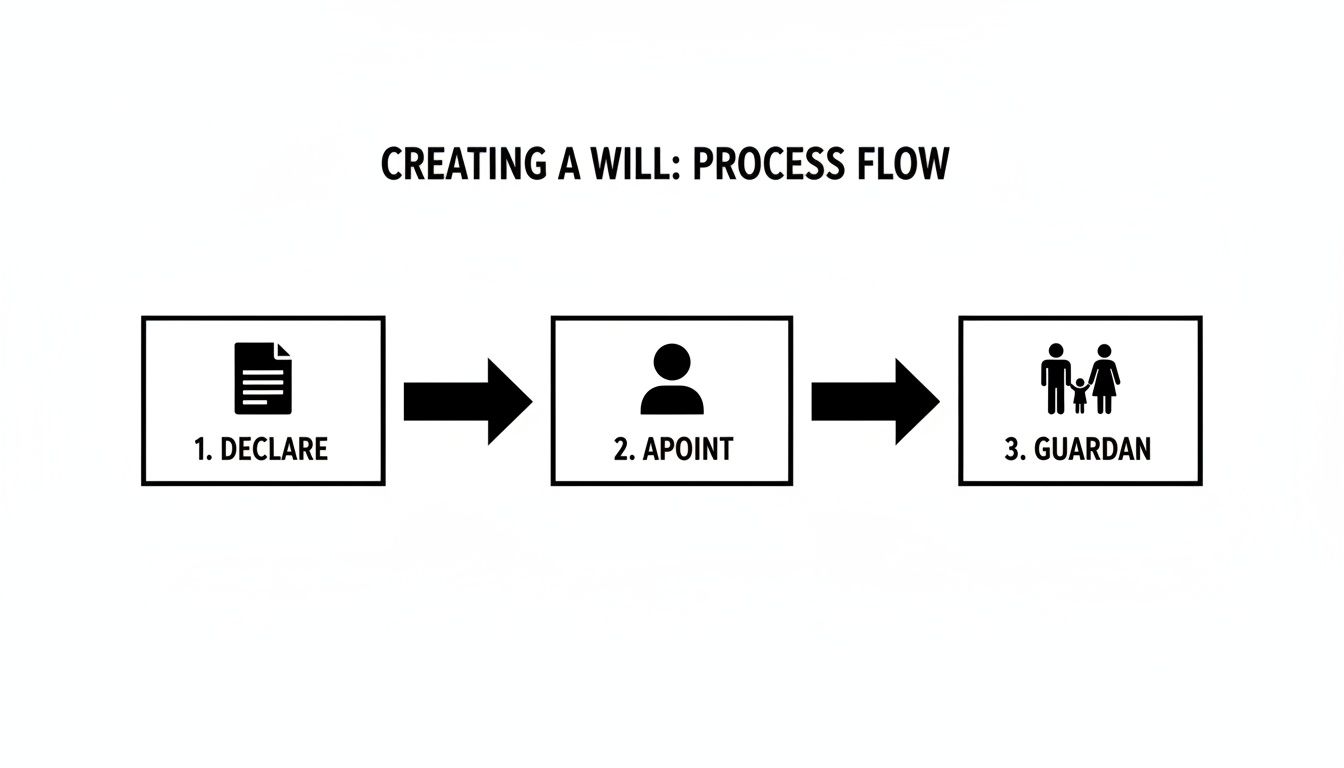
This visual breaks down how each piece—declaring the document is your will, appointing an executor, and naming a guardian—connects to form a solid plan for your family's future.
Simplify Probate with a Self-Proving Affidavit
While not strictly required, adding a self-proving affidavit is one of the smartest things you can do for your family. This is a separate statement attached to the will, which you and your witnesses sign in front of a notary public.
This simple, notarized document pre-validates the signatures on your will. When it's time for probate, a court in a place like the Harris County Probate Court can accept the will without requiring your witnesses to testify. This can save your loved ones a tremendous amount of time, money, and stress during an already difficult period.
Think about the alternative. Without this affidavit, your executor would have the frustrating task of tracking down your original witnesses—who may have moved or even passed away—just to prove the will's validity in court. Protecting your family means getting these final details exactly right.
Costly Mistakes to Avoid with Will Forms
Using a generic will in texas form online might seem like a smart, budget-friendly move. But in our experience, this is one area where cutting corners can cost your family dearly. These one-size-fits-all documents often create more problems than they solve.
A single vague phrase or a missed detail can create enough ambiguity to spark a painful and expensive legal battle among your loved ones. What was meant to bring peace of mind can become the very source of conflict.

Time and again, we see families grappling with the fallout from a will that wasn't drafted with their specific situation in mind. During an already emotional time, the last thing they need is a confusing or outdated document causing more grief.
Forgetting to Update Your Will After Life Changes
One of the most common—and damaging—mistakes is treating a will as a "set it and forget it" document. Your will is a living document that needs to evolve with your life.
Certain life events should be immediate triggers to review your will. These include:
- Marriage or Divorce: A divorce may invalidate gifts to an ex-spouse under Texas law, but it's not a guarantee. A new marriage requires you to proactively update your will to include your new partner.
- Birth or Adoption of a Child: This is a big one. You need to officially include new children as beneficiaries and, just as importantly, name a guardian to care for them.
- Significant Financial Changes: Did you inherit property or sell a business mentioned in your will? Those provisions might now be confusing or void, potentially causing major headaches for your executor.
Relying on an outdated will is like giving your family an old, incorrect map. It can lead to results you never would have wanted.
Using Vague Language or Improper Storage
In a will, clarity is king. Using fuzzy language like, "I leave my personal belongings to my children," is an invitation for an argument. Be specific: Who gets the wedding ring? The classic car? The more detail, the better.
Proper storage is another simple step people often overlook. Your original, signed will is the only one that matters to the law. If your executor can't find it, the court may presume you destroyed it on purpose, meaning your estate would be handled as if you died without a will.
A flawed will doesn't just create family drama; it can have severe legal consequences. Texas courts are very strict when it comes to will contests, which can dramatically impact families trying to navigate the probate process.
Here's a real-world example: Texas law prevents a beneficiary from challenging a will after they've accepted any benefit from it. In one case, a son accepted a life estate valued at $158,000. He later tried to contest that will, hoping for a bigger inheritance. The court ruled that his acceptance of the benefit locked him in.
At The Law Office of Bryan Fagan, we help our clients avoid these kinds of pitfalls every day. Schedule a free consultation with us to make sure your will is clear, current, and legally solid.
When You Need More Than a Simple Will
A basic **will in Texas form** is a fantastic starting point. It’s a powerful tool that lays the foundation for your estate plan, making sure your property goes where you want.
But life isn’t always simple. Some family situations have layers of complexity that a straightforward will can't handle alone. Recognizing when your needs go beyond a standard will is key to truly protecting the people you love.
Situations involving blended families, significant assets, a family business, or a relative with special needs often demand more specialized legal tools to work alongside your will.
Planning for Blended Families
Blended families are common, but they bring unique challenges to estate planning. A simple will could accidentally disinherit children from a previous marriage, especially if you leave everything directly to your new spouse.
To make sure everyone is treated fairly, you'll need a more structured approach, which could involve:
- Trusts: A trust can hold assets for your current spouse to use during their lifetime. After they pass away, the remaining assets go to your children. This is a common and effective strategy.
- Specific Bequests: You can earmark certain assets—like real estate or an investment account—to go directly to your children, keeping them separate from what your spouse inherits.
These tools help prevent misunderstandings and family disputes by making your intentions legally airtight. Without this careful planning, the legacy you leave could become a source of conflict instead of comfort.
Protecting Beneficiaries and Assets
Sometimes, the question isn't just who gets your assets, but how they get them. A simple will transfers property directly, which isn't always the best move.
For example, leaving a direct inheritance to a loved one with a disability could disqualify them from critical government benefits like Medicaid or SSI. A Special Needs Trust is designed to hold assets for their benefit without disrupting their eligibility for assistance.
Similarly, if you own a business, a simple will does nothing to create a succession plan. You'll need other legal structures, like a trust or a buy-sell agreement, to ensure the business can continue running smoothly. These scenarios demand a comprehensive Estate Planning strategy that a basic form can’t deliver.
If your family's situation touches on any of these complexities, a standard will is just the first step. To truly safeguard your family's future, it’s vital to explore trusts and other tools that give you greater protection. We know these decisions are personal and can feel overwhelming. Schedule a free consultation with The Law Office of Bryan Fagan today, and let us help you build a plan that brings you complete peace of mind.
Common Questions About Texas Wills Answered
When you start digging into the details of creating a will, many questions tend to pop up. Let's tackle some of the most common ones we hear from families, giving you clear answers to help you move forward with confidence.
Does a Will in Texas Need to Be Notarized to Be Valid?
This is a big one, and the short answer is no. A standard Texas will does not need a notary's stamp to be legally valid. The absolute requirement is your signature in front of two credible witnesses, who then also sign it in your presence.
That said, we highly recommend including a "self-proving affidavit." This is a separate, notarized statement that you and your witnesses sign. It essentially pre-validates the will for the court. Taking this simple extra step can make the Probate process much faster and smoother for your family in courts like the Tarrant County Probate Court.
What Happens If I Die Without a Will in Texas?
If you pass away without a will in Texas, you are considered to have died "intestate." The state then uses a rigid, one-size-fits-all formula to divide your assets among your closest relatives—spouse, children, parents—in predetermined shares.
This process rarely matches what people actually want. It can be more expensive and time-consuming for your family, and you lose all say in who manages your estate or, crucially, who becomes the guardian for your minor children.
Can I Write My Own Will By Hand in Texas?
Yes, you can. Texas law recognizes a holographic will, which is a will written entirely in your own handwriting. To be valid, every single word must be in your handwriting, and it does not require witnesses.
While this sounds easy, holographic wills are notorious for causing problems. The language is often unclear, leading to confusion and expensive disputes during probate that can tear families apart. To avoid ambiguity, a formal, typed will that is properly witnessed is almost always the safer choice for your loved ones.
How Often Should I Update My Will?
Think of your will as a living document. It's a good rule of thumb to review it every 3-5 years. More importantly, you should revisit it any time you have a major life change.
Key events that should trigger a will review include:
- Getting married or divorced
- The birth or adoption of a new child
- A beneficiary or executor passing away
- A significant change in your finances (like selling a business or inheriting property)
An outdated will can create unintended and sometimes painful consequences, like an ex-spouse inheriting your assets or a new child being accidentally left out. Keeping it current ensures it always reflects your life and your wishes.
Crafting a will is a fundamental act of care for your family, but you don't have to figure it all out on your own. If you have questions about your unique situation or just want the peace of mind that comes with knowing your wishes are legally protected, the team at The Law Office of Bryan Fagan, PLLC is here to help. Schedule a free, no-obligation consultation with us today to discuss your Estate Planning and family law needs.