Skip to content
In Texas, the ward's estate usually pays approved guardianship costs, but families often have to advance filing, evaluation, and attorney fees first and seek reimbursement after the court appoints a guardian. That cash-flow gap is where many worried spouses, children, and caregivers get stuck, especially when a Houston, Dallas, or Harris County family is trying to make fast decisions while also tracking every dollar.
A daughter in Houston may be asking a very practical question after her father's stroke. She needs help, the court needs paperwork, the doctor needs to evaluate capacity, and the bills start showing up before anyone has legal authority to act.
Texas guardianship law answers the “who pays” question in two different ways. Legally, the estate is usually the source of payment. Practically, the family often fronts the money first. That difference matters, and it's why the process can feel far more expensive up front than it looks on paper. For a broader look at the budgeting side of family care, budgeting for therapy without insurance is a useful comparison point because it shows the same reimbursement-versus-out-of-pocket tension families feel in other care settings.
If you want a deeper breakdown of the numbers families usually miss, the true cost of guardianship in Texas is tied to the same core issue, who pays first, who pays later, and whether reimbursement is realistic at all.
What Families Actually Pay in a Texas Guardianship
A family in Houston usually doesn't start with a clean legal question. They start with a stack of bills. A filing fee needs to be paid, an attorney needs to prepare the petition, and a doctor or evaluator has to confirm whether the proposed ward can still make informed decisions.
The headline rule is simple. Once the judge creates the guardianship, the ward's estate usually pays approved costs. Texas Guardianship Association guidance says those expenses may come from the ward's estate if the judge grants the guardianship, while TexasLawHelp explains that the guardian also has to post a bond after appointment and receive Letters of Guardianship before the authority is recognized. That means the money may eventually come from the estate, but the family usually has to get the case filed and supported before the court can approve anything.
Who is really involved in the payment cycle
The ward's estate, the petitioner, the guardian, the court, and sometimes the county all play a role. The petitioner often advances the money, the court decides what can be reimbursed, and the estate, if there is one, becomes the long-term source of payment. If there are no assets, the family may end up carrying a much bigger share of the burden.
That's why guardianship is not just a legal process. It's a budgeting problem.
A lot of families compare it to other care costs, but guardianship is more layered because one payment may happen before appointment and another after approval. The financial plan has to cover both phases. If you're trying to decide whether a guardianship is worth pursuing at all, start by asking what the ward owns, what the case will cost to open, and whether reimbursement is realistic.
Practical rule: if the proposed ward has assets, the court may treat those assets as the eventual source of payment, but the family still has to survive the upfront cash squeeze.
That's why Texas families should talk through the fee structure early, before emotions, deadlines, and hospital discharge pressure make the decision harder. A clear budget helps prevent surprises later.
Types of Guardianship and How Each One Changes the Bill
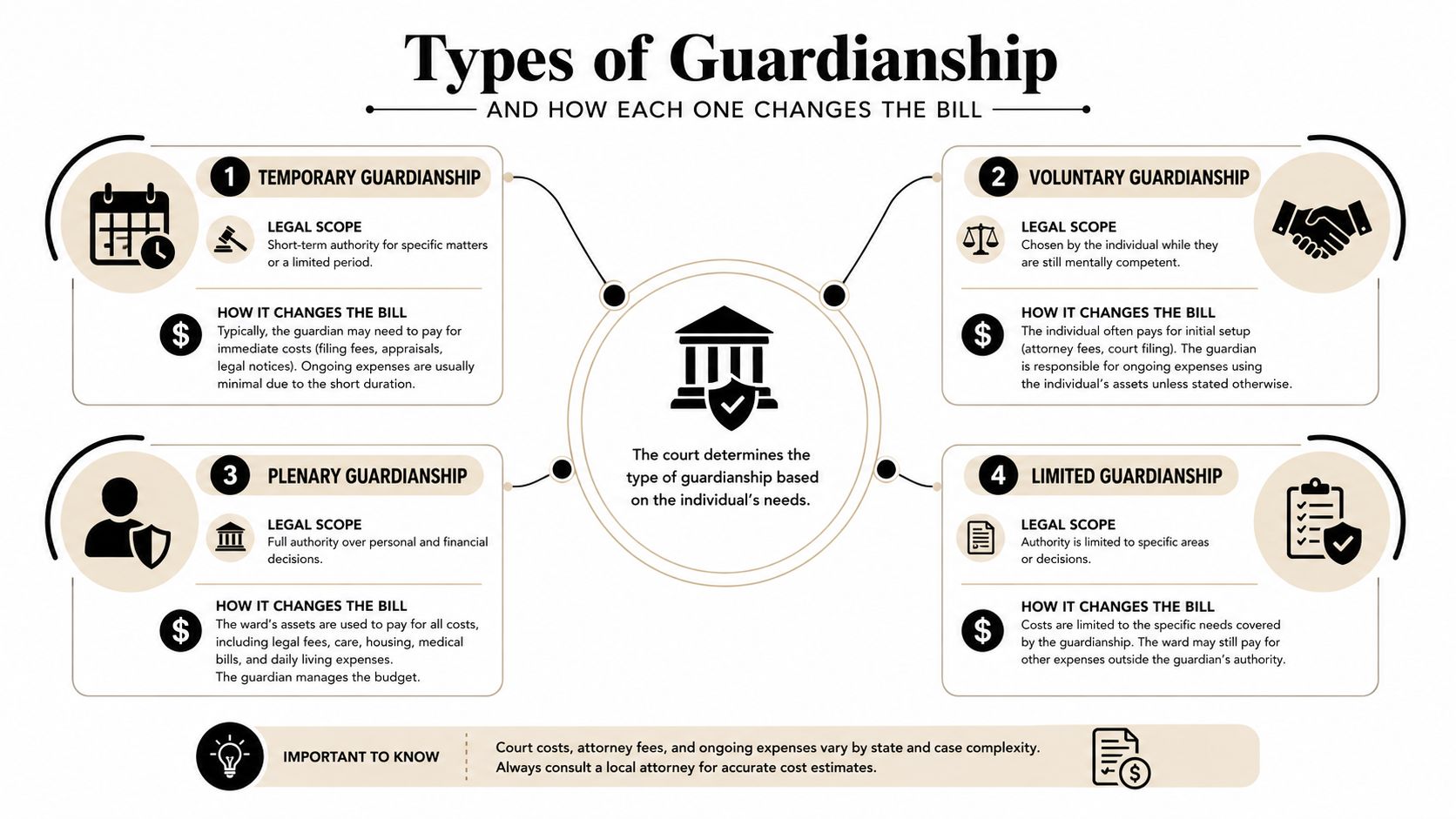
The type of guardianship changes the bill as much as the facts of the case do. A temporary order, a limited appointment, a full adult guardianship, or a minor-related case can all carry different costs and different payment sources. Families often hear the word “guardianship” and assume one price fits all, but that's not how Texas practice works.
Four common paths families see
Guardianship of the person usually focuses on medical, housing, and daily care decisions. The guardian may not be managing money, but the case still involves court filings, evaluations, and compliance.
Guardianship of the estate is the money side. Once assets are involved, the case usually becomes more document-heavy because the guardian may need to protect accounts, report to the court, and handle court-approved spending.
Combined guardianship does both jobs, so the legal work can expand quickly. More authority means more oversight, and more oversight means more tasks that have to be documented.
Minor guardianship often shows up in injury settlements or parental incapacity. In those cases, the settlement proceeds or child-related funds may be part of the payment structure, which can change who advances the money and who ultimately gets reimbursed.
Texas law also moves fast after appointment. Under TexasLawHelp, a newly appointed guardian must, within 20 days of appointment, sign the oath and post bond before Letters of Guardianship are issued. That deadline matters because the appointment isn't fully usable until those steps are done. A bank, doctor, or other third party usually needs the letters, not just the court's oral ruling.
If you're comparing options, the Texas Guardianship Lawyer page describes representation in guardianship of the person and estate under the Estates Code, which is the kind of issue families often need help sorting out before they file.
For a plain-English comparison of role boundaries, the types of guardianship in Texas page can also help families understand why the bill changes depending on what the guardian is allowed to do.
Breaking Down the Real Costs of a Texas Guardianship
The cost range can surprise families because guardianship has both visible and hidden expenses. In an uncontested case, Texas practitioner sources place total costs at roughly $3,000 to $10,000, with court filing fees of about $250 to $400, attorney fees around $2,000 to $5,000, and medical evaluations from about $500 to $2,000. If the case turns contested, total legal fees can rise to $20,000 to $50,000. Bryan Fagan's fee guide gives families a practical starting point for those ranges.
Texas families also need to budget for items that don't always show up in the headline estimate. Bond premiums, ad litem fees, service of process, certified copies, and ongoing court compliance can all add pressure. The bond issue is especially important because the guardian cannot just skip it and move on. Texas law requires the bond before the letters are issued, which means the case may be paused until that step is complete. If you want a separate look at that topic, the guardianship bond requirement in Texas page is a good companion read.
| Typical Texas Guardianship Cost Ranges | Typical Range | Who Usually Pays |
|---|---|---|
| Court filing fees | $250 to $400 | Petitioner upfront, then possibly reimbursed from estate |
| Attorney fees | $2,000 to $5,000 in uncontested cases | Petitioner upfront, then possibly estate-paid if approved |
| Medical evaluations | $500 to $2,000 | Petitioner upfront, then possibly estate-paid if approved |
| Total uncontested case | $3,000 to $10,000 | Often split between upfront family payment and later estate reimbursement |
| Total contested legal fees | $20,000 to $50,000 | Usually much harder to predict and may involve disputed payment issues |
Harris County Probate Court, Dallas County, and other local courts can handle these pieces a little differently in practice, especially on timing and paperwork. The numbers above are estimates, not guarantees, and a local filing strategy matters. That's why families should budget with room to spare, not just for the hearing, but for the full compliance path after appointment.
Who Pays Each Cost and When the Money Actually Moves
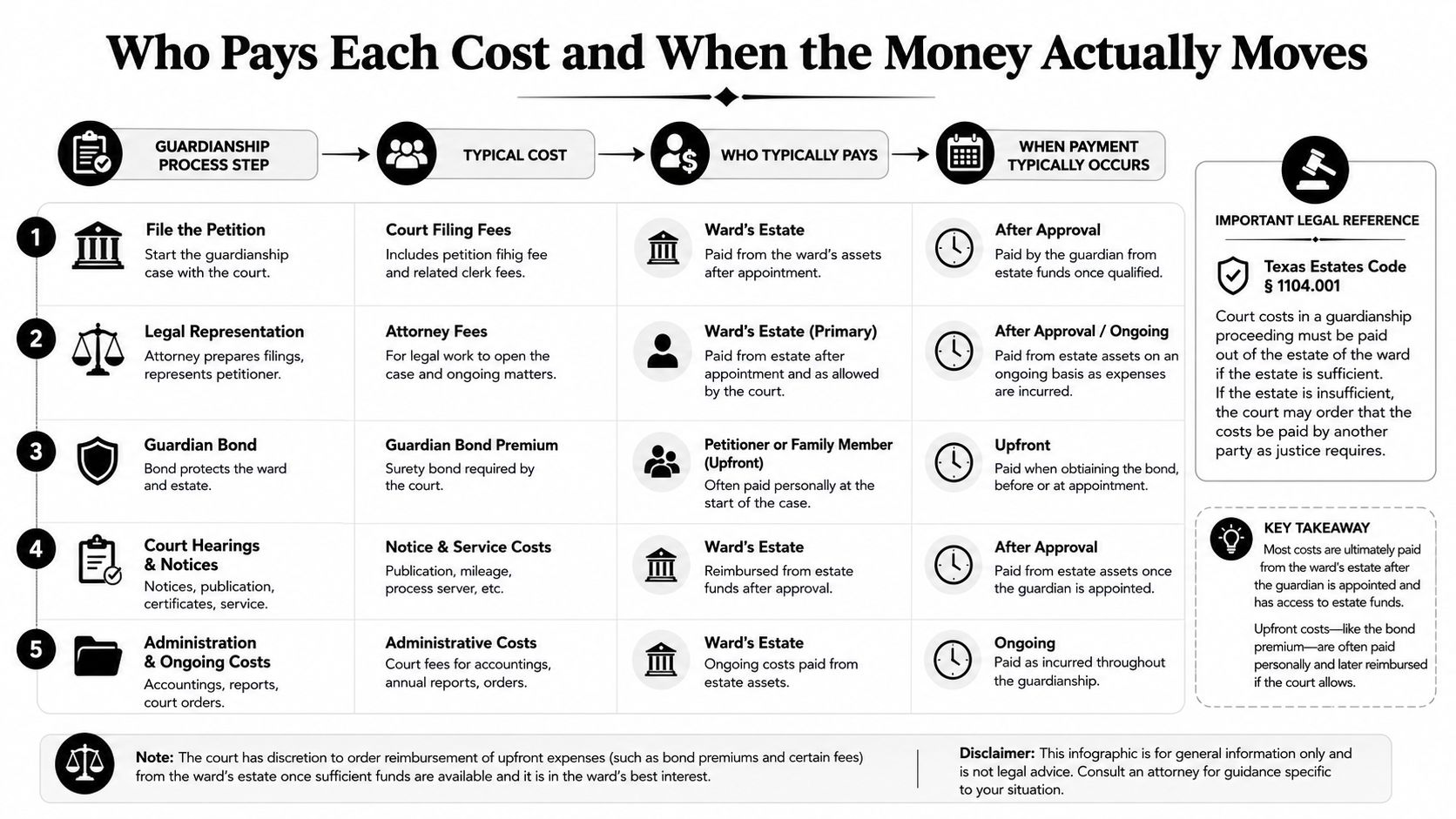
Texas Estates Code § 1155.151 says the proceeding's costs are paid from the guardianship estate, except for a limited exception in subsection (c), and the court must enter judgment accordingly. That is the legal answer to who pays. The practical answer is more complicated, because the petitioner still usually has to fund the case before the judge can say the estate should reimburse it. The statute itself makes that estate-based rule clear.
The payment sequence families usually experience
First comes the petition, which is where the filing fee gets paid. Then come the attorney fee and the evaluation costs, because the court needs enough evidence to decide incapacity and need. If the case is moving forward, the guardian may also need to arrange bond and other appointment-related documents before the clerk issues the letters.
Only after appointment does the reimbursement question become practical. That's why families often feel like they are paying for someone else's estate before they can even reach the point where the estate can legally cover the bill. It's a common source of frustration, especially when the ward's money is in a bank account that can't be touched yet.
Texas law also controls guardian compensation. For a guardian of the person, the estate or other available funds may pay compensation up to the greater of $3,000 per year or 5% of the ward's gross income, according to Texas Estates Code guidance. If the guardian is handling the estate, Texas practice summaries often describe compensation as 5% of gross income and 5% of disbursements, but the court still controls what gets approved. That means the family should not assume the guardian can be paid for every hour spent caring for a loved one.
Court approval drives the money, not the family's good intentions.
That's the key point many people miss. The guardian's authority starts with the oath and bond, but payment still depends on what the estate holds and what the court allows. In a low-asset case, the cash-flow problem can be severe even when everyone agrees guardianship is necessary.
Two Texas Families and How Their Bills Were Paid
A San Antonio family may start with a simple, uncontested adult guardianship for a mother with dementia. The daughter pays the filing and evaluation costs first, the lawyer prepares the application, and the court later approves reimbursement from her mother's modest estate. The case still costs real money, but the estate becomes the source of payment once the judge acts.
That's the clean version. The harder version is a Dallas family in a contested fight over an aging father's care and money.
In a disputed case, attorney fees can climb quickly, and ad litem work can expand too. Texas probate guidance says that when the proposed ward has assets, court-approved guardianship costs are commonly charged to the ward's estate, but if the estate is insufficient, the county may bear certain costs such as ad litem fees. Even then, families often still have to advance filing, medical, and attorney costs before the court rules. That practical split is why two families can have the same legal issue and very different financial pain.
A contested matter also changes settlement pressure. If siblings are fighting, the family has to weigh whether a compromise now is cheaper than a full hearing later. The bill isn't just about the filing fee anymore. It's about the cost of conflict.
Minor guardianship works differently in many cases. When a child has a settlement or a court-controlled recovery, the money source can shift away from the parent or relative who filed the case. That doesn't erase legal costs, but it can change who advances them and where reimbursement comes from. The important part is to identify the fund source early, before someone assumes personal payment is the only option.
When the Ward Has No Assets Options for Indigent Families
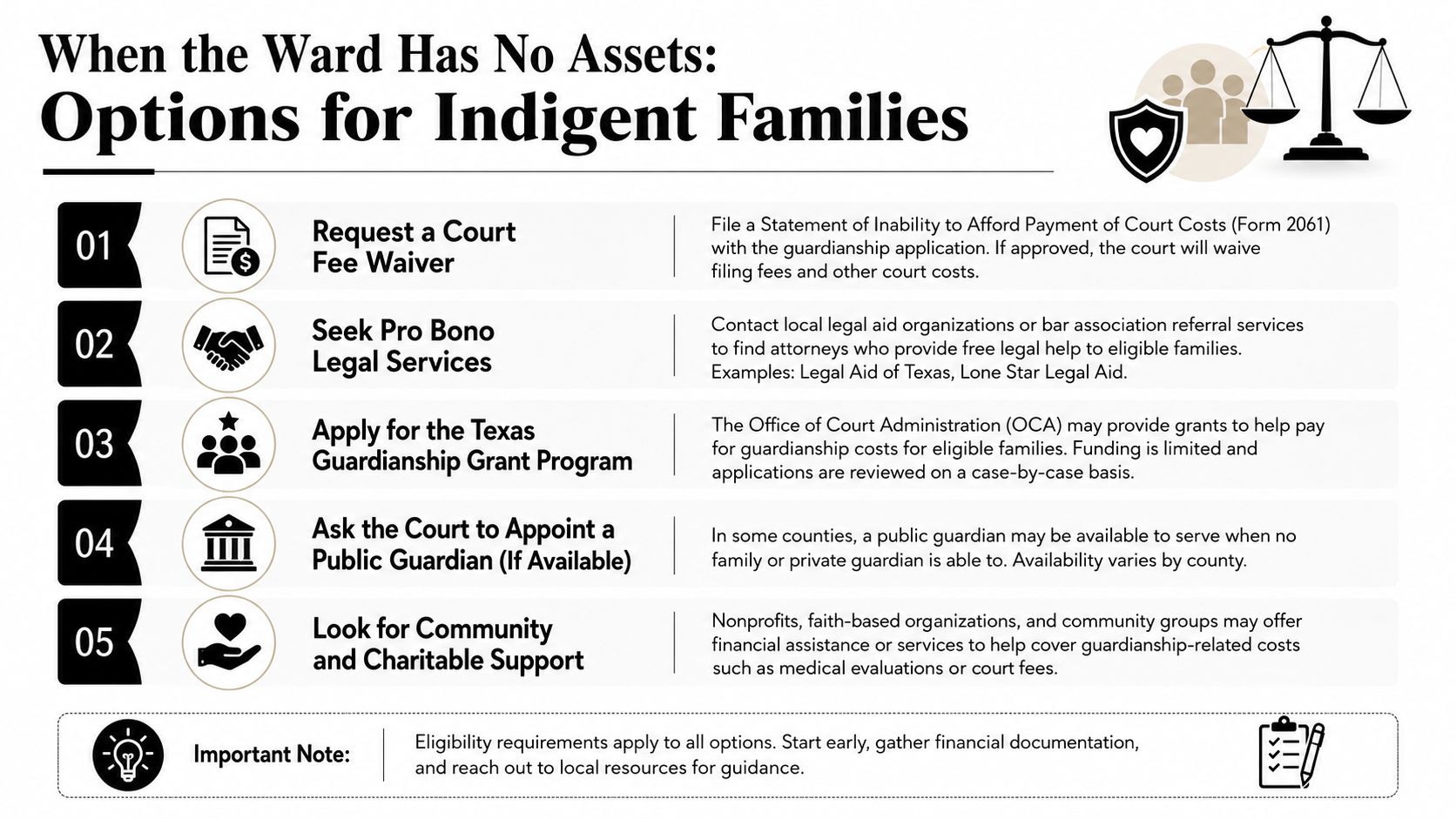
A no-asset case is different from a routine guardianship. The family may still need help protecting a loved one, but there may be no estate to reimburse the filing fee, the evaluator, the bond, or the ongoing reporting costs. Texas guidance for young adults with disabilities points families toward alternatives like supported decision-making and representative payees, because full guardianship is not always the cheapest or least disruptive answer. Navigate Life Texas emphasizes those alternatives for families navigating disability-related decisions.
What low-asset families should look at first
Fee waivers may help if the family cannot afford to start the case.
County-paid ad litem costs may apply in some situations when the estate cannot cover them.
Public benefits can help cover the ward's ongoing care needs even if they do not pay for the lawsuit itself.
Special-needs trusts, pooled trusts, and ABLE accounts can sometimes support long-term planning without derailing benefits.
Representative payees and supported decision-making agreements may avoid the need for full guardianship altogether.
Texas compensation rules also matter here. A guardian of the person is tied to the ward's estate or other available funds, and the compensation cap is limited by statute. That makes a low-asset guardianship a very different financial problem from an estate-heavy one. The issue is not just whether guardianship is possible, but whether it is sustainable over time.
Families in this position should slow down and compare the options before filing. A court fee waiver can help, but it doesn't solve every expense. If there is no money in the estate, the family needs a realistic plan for the first month, the first year, and the reporting obligations that follow.
Common Pitfalls and Misconceptions About Paying for Guardianship
One of the biggest mistakes Texas families make is assuming the applicant personally pays forever. That's not the legal rule. The ward's estate usually pays approved costs, but only after the court creates the guardianship and only if the estate can support payment.
Another common misunderstanding is thinking the case ends at the hearing. It doesn't. Letters of Guardianship expire after 16 months and have to be renewed through continued compliance, so guardianship is an ongoing financial commitment, not a one-time filing. Hailey Petty Law's Texas guardianship guide is one of the clearer public explanations of that renewal burden.
Renewals, reporting, and court oversight can cost more than families expect, especially in a long guardianship.
Families also sometimes assume compensation is automatic. It isn't. The court controls what gets paid, and the guardian's compensation is tied to the ward's funds and statutory limits. If the guardian mixes personal and ward money, skips bond, or fails to document expenses, the financial problem can turn into a fiduciary problem fast.
There's also a quieter misconception. Some families think guardianship is the only answer once a parent or adult child struggles with decisions. That's not always true. For mild impairment, supported decision-making or a power of attorney may be cheaper and less intrusive. For young adults with disabilities, the alternatives can matter even more because they can avoid the low-asset guardianship trap altogether.
The key lesson is straightforward. Don't focus only on the filing fee. Focus on the full life of the case, including renewal, reporting, and how the bills will be paid if the ward has no money.
Practical Steps for Texas Families and When to Call an Attorney
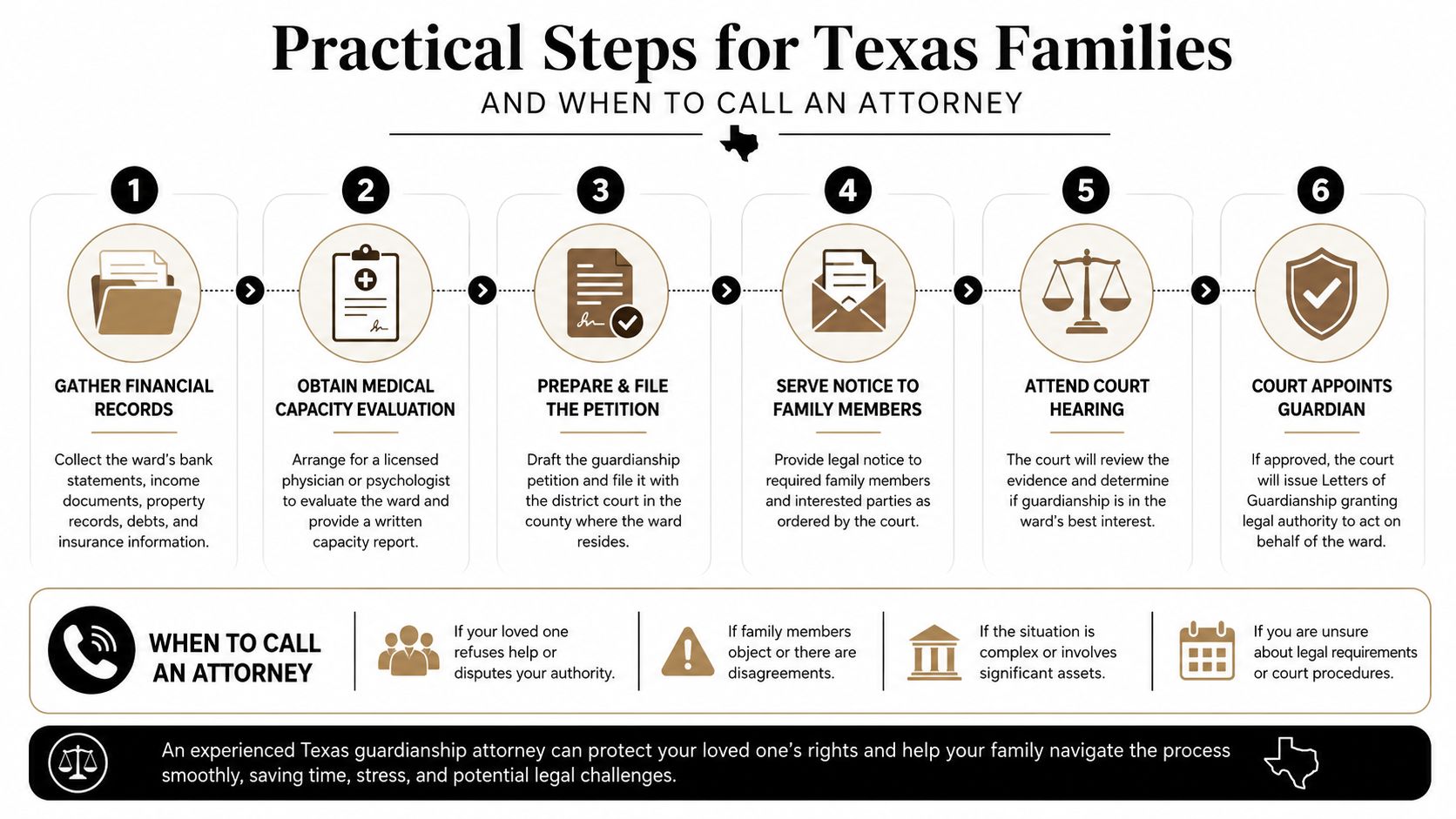
Start with the money trail. Gather bank statements, benefit letters, income records, and anything that shows what the proposed ward owns. Then ask whether the ward has enough assets to cover the case or whether the family will need to front the costs and wait for reimbursement.
Next, get a capacity evaluation and decide whether the matter belongs in a county probate court like Harris County Probate Court or another local Texas court. Filing in the correct county matters because local procedure can affect timing, paperwork, and how quickly a hearing gets set.
After that, choose the right path. Some families hire counsel, and some try to file on their own, but the wrong choice can make a low-asset case harder than it needs to be. The goal is not just to get to a hearing. It's to get to a legally usable result without creating avoidable expense.
Families should call an attorney right away if any of these are true:
- There's a family dispute. Contested cases get expensive fast.
- You suspect financial exploitation. Court intervention may need to happen quickly.
- The ward has no assets. Funding has to be planned before the case starts.
- Emergency help may be needed. Temporary or emergency guardianship may be the right tool.
- You're unsure whether guardianship is even necessary. Alternatives may fit better.
If you're also thinking about probate or long-term planning, it helps to look at related resources like Guardianship, Probate, and Estate Planning pages on the same site so the family's legal and financial plan stays connected.
Law Office of Bryan Fagan, PLLC helps Texas families with guardianship of the person and estate, minor guardianships, temporary appointments, and compliance planning after appointment. If you're trying to figure out who pays for guardianship in Texas in your specific situation, schedule a free consultation and get clear guidance before the bills, deadlines, and court steps get any harder to manage.
Law Office of Bryan Fagan, PLLC helps Texas families with guardianship filings, disputes, and post-appointment compliance in cases involving the person, the estate, and minors. If you need help figuring out who should pay, what can be reimbursed, and whether guardianship is the right option, visit Law Office of Bryan Fagan, PLLC to schedule a free consultation and get guidance for your family's situation.