Skip to content
A standard Texas guardianship has no fixed end date. For minors, it usually ends at age 18, and for adults, it can continue until the court no longer finds incapacity or the ward dies, while a temporary guardianship is capped at 60 days.
When a parent suddenly can't pay bills, a spouse can't get into a hospital conversation, or a teenager is hurt and needs someone to speak for them, families often ask the same thing over coffee, how long does guardianship last in Texas? The honest answer is that Texas does not use one simple timeline for every case. Under Texas Estates Code Title 3, Subtitle G, the length depends on the type of guardianship, the ward's condition, and whether the court still sees a need for protection, which is why the first step is figuring out whether you're dealing with a short emergency or a long-term court arrangement.
Understanding Texas Guardianship Timelines
A family usually feels the timeline before they understand it. One day, everything is handled by the person who's always managed the bills or made the medical calls. The next day, a doctor says capacity is fading, or a child's injury has created a legal gap that no one in the family can fill without court involvement.
Texas law treats guardianship as a status-based legal arrangement, not a simple term-limited order. A standard guardianship does not have a fixed end date under Texas Estates Code § 1202.001. It stays in place until the estate is closed and the guardianship is settled and closed when the ward dies, regains full or sufficient capacity, is no longer a minor, or no longer needs a guardian to receive certain government benefits.
A real-world way to think about it
If a son in Harris County Probate Court seeks guardianship for his mother with dementia, he's not asking for a short assignment date. He's asking the court for ongoing authority that can last as long as the legal need exists. That can feel heavy, because it is.
Practical rule: if the person's need is temporary, the law usually gives you a temporary tool. If the need is ongoing, the court may create an ongoing guardianship.
That difference matters because a family can plan differently once they know what kind of case they're in. A minor who needs help after an injury settlement is on a very different path from an older adult whose memory loss affects everyday decisions. Texas law in Title 3, Subtitle G gives courts the framework to match the remedy to the problem, not force every family into the same box.
For families just starting out, the emotional strain is real. The legal timeline also affects school forms, bank access, medical consent, and court reporting, so knowing the category early can prevent a lot of confusion later.
How Duration Varies by Guardianship Type
Texas uses different timelines depending on why the guardianship exists. That's where many families get tripped up, because they hear “guardianship” and assume one rule applies everywhere. It doesn't.
Temporary guardianship is the shortest path
Temporary guardianship in Texas is designed for urgent situations. Under Texas Estates Code § 1251.151, it may not remain in effect for more than 60 days unless a statutory exception applies. State guidance also says a temporary guardianship expires after 60 calendar days unless the court extends it.
That makes it the tool families use when someone faces immediate harm, such as an emergency medical decision or a short-term need to protect money or property. Temporary and Emergency Guardianship in Texas addresses how a court can act quickly when a person faces immediate harm.
Permanent adult guardianship can continue indefinitely
When the ward is an adult and the court keeps finding incapacity, the guardianship can continue without a preset end date. That's why a dementia case can stay open for years, with the guardian carrying long-term duties, reporting obligations, and court oversight. The court is not counting down to a deadline, it's watching whether the need still exists.
Minor guardianship usually ends at adulthood
For minors, the usual endpoint is age 18. The guardianship is tied to minority, so when the child becomes an adult, the court relationship changes. In some cases, the court may also close a prior guardianship when a new adult guardianship application is filed and the court determines a guardian is not necessary or the newly appointed guardian qualifies, as reflected in Texas closing rules for prior guardianships.
Person versus estate can move on different tracks
A guardian of the person may handle medical and living decisions, while a guardian of the estate manages money and property. Those roles can overlap, but they do not always end for the same practical reason. A family may need one type longer than the other if the ward's needs are uneven.
If you want a deeper dive into the role of authority documents, the What Are Letters of Guardianship? page helps explain why the paperwork matters so much in real life.
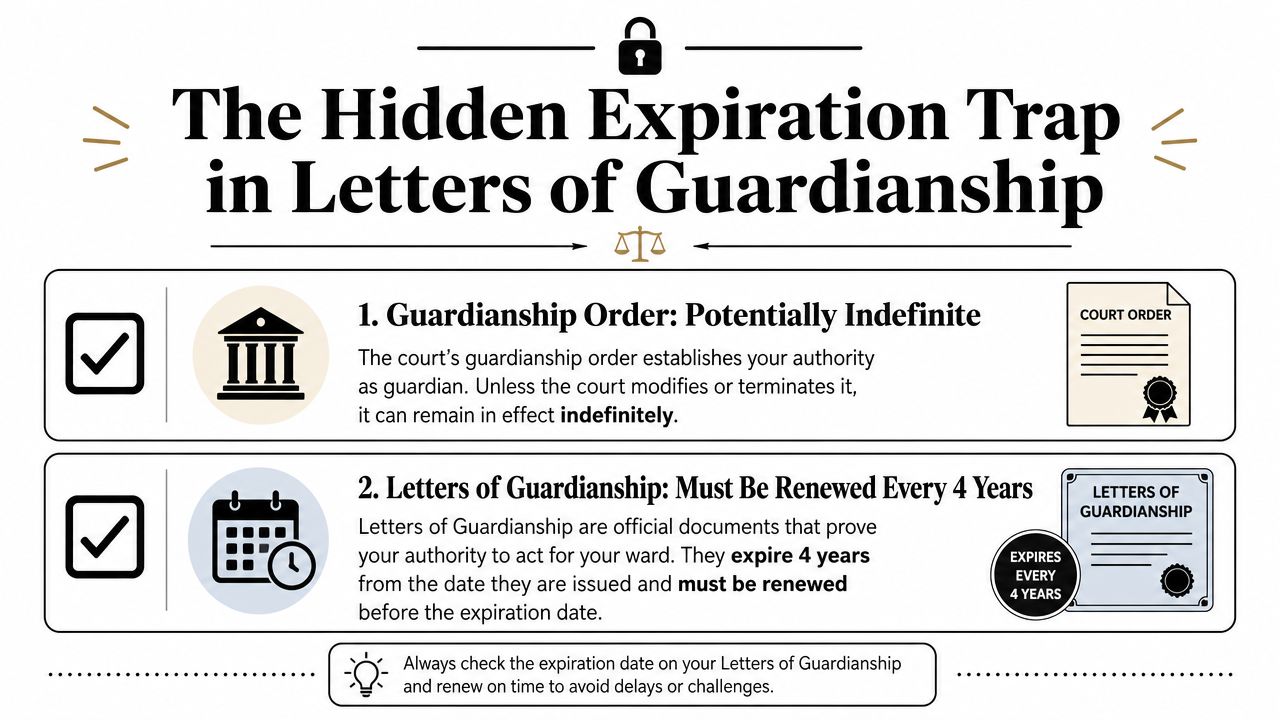
The Hidden Expiration Trap in Letters of Guardianship
A lot of families assume the court order and the proof of authority are the same thing. They're not. The guardianship may still be active, but the document you use to show that authority can expire, and that's where problems start.
Texas' Adult Guardianship Guide says letters of guardianship expire one year and four months after issuance if they are not renewed annually. That detail matters because a bank, hospital, or school usually wants to see current letters before it accepts the guardian's authority. If the letters lapse, the guardian may be shut out even though the case itself is still open.
A common mistake
A daughter in Dallas has been paying her father's bills for months. She goes to the bank with old letters, expecting routine access. The bank refuses because the letters are no longer current, and suddenly a simple trip turns into an emergency. Nothing about the court case has changed, but her ability to act has.
That's why annual reporting and renewal deadlines are critical. Families should mark the calendar, gather the paperwork early, and confirm the court has issued updated letters before trying to sign, withdraw, or authorize anything. Missing that step can create a gap at exactly the wrong time.
A guardian who keeps the court case active but ignores the renewal cycle can lose practical authority fast.
The emotional part is just as hard as the legal part. People often feel embarrassed when an institution rejects them, but this is a paperwork problem, not a personal failure. It's a reminder that guardianship lives in two places at once: the court file and the actual-world documents institutions inspect.
For a broader discussion of when authority changes or ends, the How to Terminate Guardianship page is a useful companion resource.
When and How a Texas Guardianship Ends
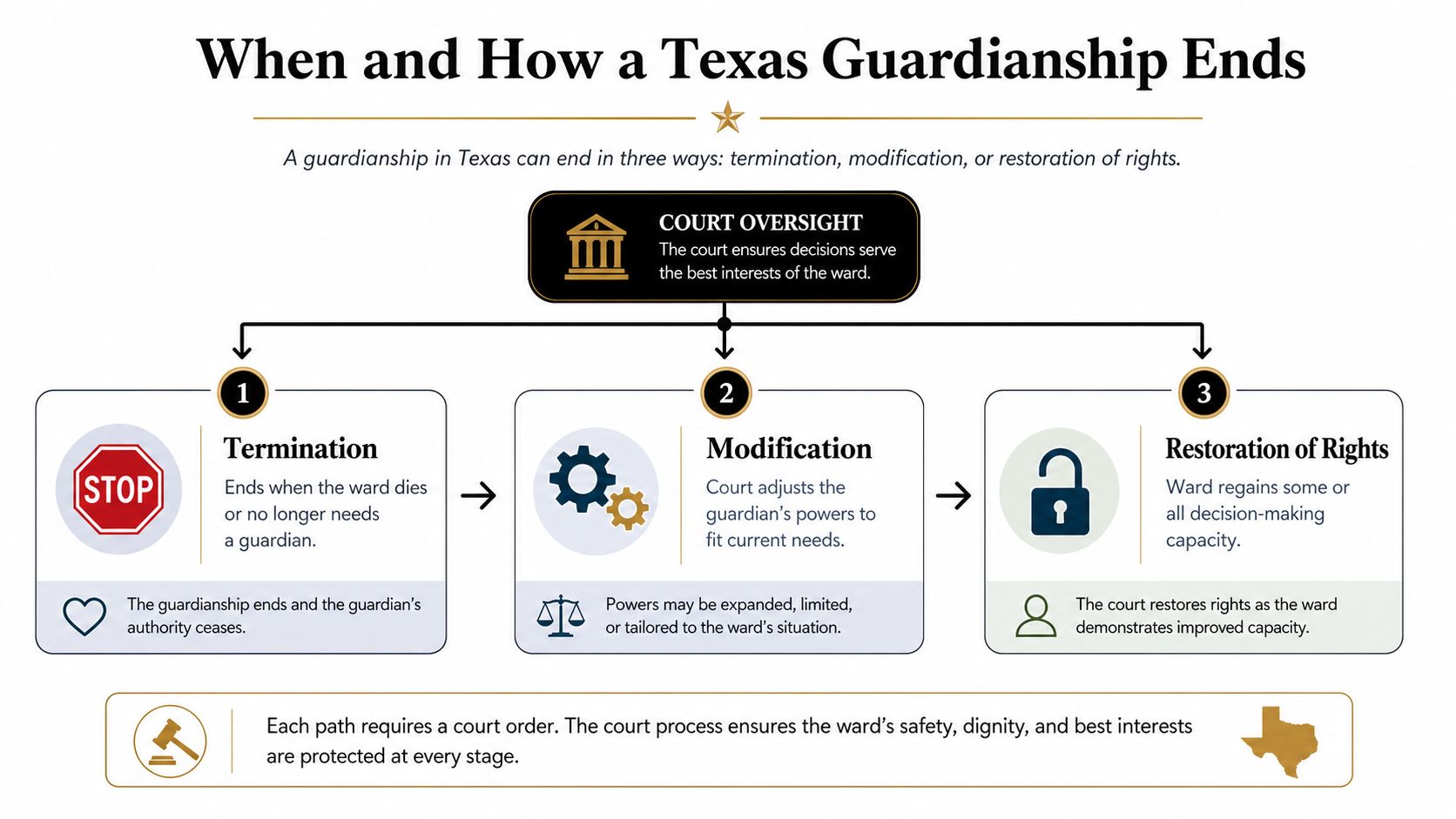
Texas guardianship can end in more than one way, and families should not assume the only path is a full court battle. The court can terminate the arrangement, modify it, or restore rights if the person's condition changes. Each path has its own purpose, and the right one depends on what has changed in the ward's life.
Termination, modification, and restoration are different
Termination is the cleanest ending. It usually happens when the ward dies, no longer needs a guardian, or the person is no longer subject to the legal reason for the case.
Modification is narrower. The court can adjust the guardian's powers if the original order is too broad or no longer fits the person's needs.
Restoration of rights focuses on the ward's capacity. If the person regains enough ability to make decisions, the court can decide that guardianship is no longer needed.
A family seeking change usually needs updated medical evidence and a hearing. The court wants proof, not guesses, and it will look closely at whether the person can manage some or all decisions with support. That's one reason Texas law also recognizes that guardianship may end if the person regains capacity or if other appropriate decision-making options become available.
The court can slow repeated challenges
Texas law also allows the court to restrict repeated petitions claiming the ward no longer needs guardianship for up to one year without special leave. That gives the judge some control over repeated filings while still keeping a route open for legitimate change. Families sometimes miss this and think they can refile over and over until the court gives in, but that's not how the process works.
What families can do
If the person's condition has improved, start with records, doctor input, and a careful review of the original order. If the need is only partly reduced, a limited modification may fit better than trying to end the case entirely.
The right approach depends on the facts, the medical proof, and the court's view of risk. That's why contested situations in probate court can become emotionally draining, especially when siblings disagree or one relative believes the guardian has too much power.
For families thinking about ending or narrowing an existing case, a Texas lawyer can help frame the request clearly and avoid filing the wrong petition at the wrong time.
Less Restrictive Alternatives That Can Shorten or Replace Guardianship
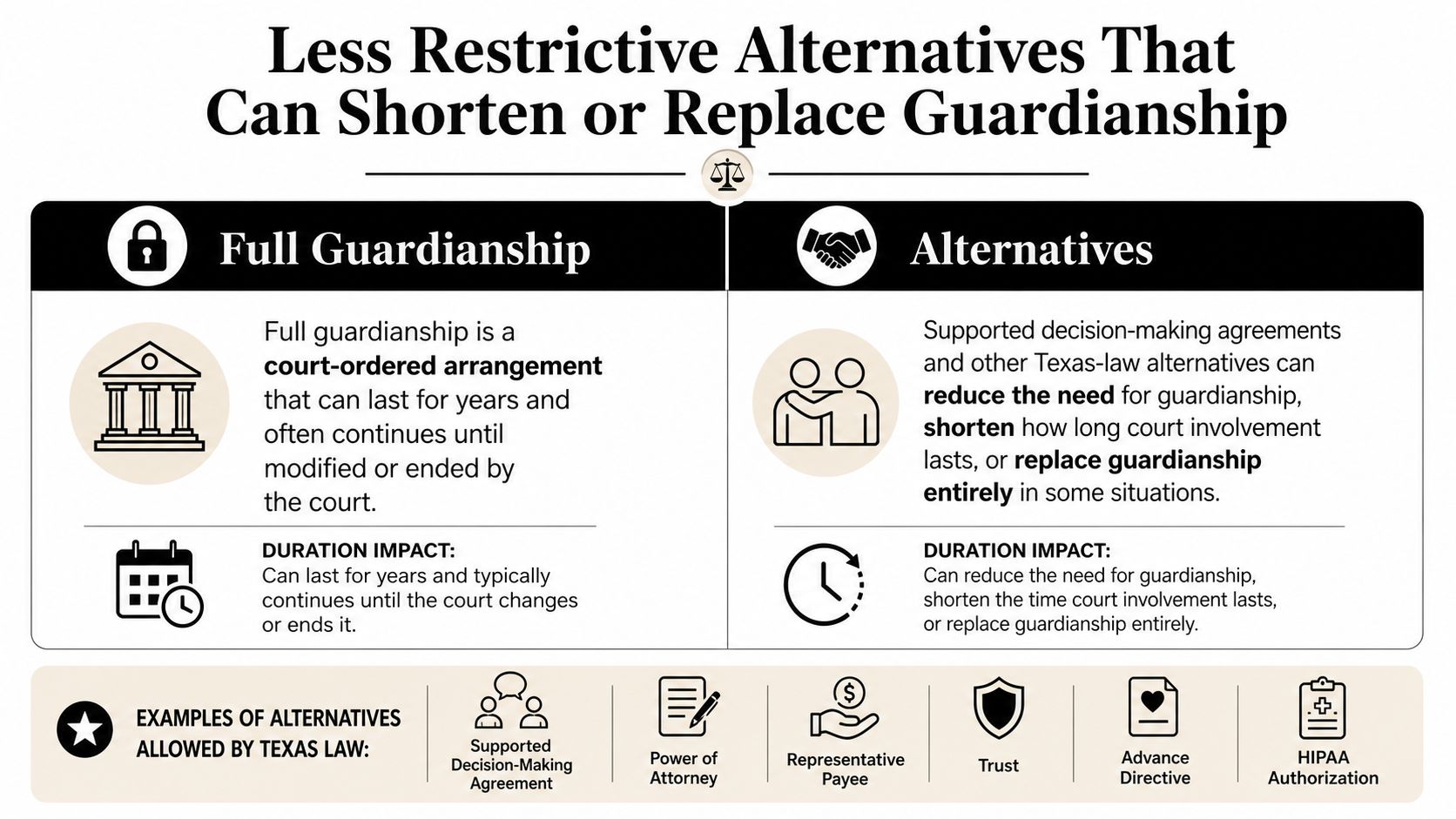
Texas law expects courts to look for less restrictive choices before using full guardianship. That matters because not every person needs a court to control every decision. Some people need help in one area, but still make many of their own choices.
A young adult may need support, not full control
Consider a young adult with a disability who can handle medical choices with help from family, but struggles with complex finances. In that case, the family may not need a broad guardianship order at all. They may be able to use targeted tools that preserve more autonomy while still adding protection.
Support can come from a supported decision-making agreement, a power of attorney, a representative payee arrangement, or other services that address a specific need. Those options can reduce how much court involvement is necessary, and they can keep the arrangement from becoming more restrictive than it has to be.
A broader planning lens helps
Families also think about long-term control in other settings, like property and inheritance planning. For example, the guide to buying with trusts is useful for understanding how a trust can change who controls property decisions outside a guardianship setup. That's not the same as guardianship law, but it shows how legal planning can reduce the need for court supervision later.
You can also compare options in the Do You Really Need Guardianship in Texas, 5 Alternatives to Consider resource if you're unsure whether a full case is the right fit.
Good planning rule: if the person can decide with help, start there before asking for full guardianship.
A limited tool won't fit every situation. But when it does fit, it can preserve dignity, reduce court burden, and avoid creating a lifelong file when a narrower solution would have worked.
Practical Steps for Families Navigating Guardianship Duration
Guardianship works better when someone treats it like a calendar job, not a one-time court win. Families in Houston, Travis County, Bexar County, or elsewhere in Texas should keep a running list of filing dates, review dates, and renewal deadlines so the case doesn't fall out of compliance.
Keep a simple compliance rhythm
- Mark renewal timing early: Track the date the letters were issued so you're not surprised when a bank or hospital asks for current proof.
- File annual reports on time: The court expects updated information, and missed reports can create trouble fast.
- Save updated letters immediately: Don't wait until the next emergency to check whether the court issued fresh documents.
- Document changed circumstances: If the ward's condition improves or worsens, keep medical records organized for a possible court filing.
Prepare before any hearing or review
Bring recent medical records, a clear description of what the ward can still do, and names of anyone who may be affected by the order. If family members disagree, write down the exact issue before the hearing so the judge hears a focused request instead of a family argument.
If the case is contested, the best preparation is a clean file and a clear plan.
Families often hire an attorney when they need to establish guardianship, contest a petition, modify powers, or ask about termination. That becomes especially important when the case involves out-of-state relatives, complex finances, or a judge who wants detailed proof before changing the order.
If you're filing in Harris County Probate Court or another Texas court, a lawyer can help you avoid the common mistakes that delay authority, especially when current letters, annual reports, or capacity evidence are part of the problem. Virtual consultations also make it easier for relatives who live outside Texas to get organized before a filing or hearing.
Moving Forward with Confidence and Support
A guardianship in Texas can be short, long, or open-ended, but the answer depends on the type of case and the ward's condition. Temporary guardianship ends quickly, a minor's guardianship usually ends at adulthood, and an adult guardianship can continue until the court no longer sees a legal need. The hidden trap is often the paperwork, because expired letters can block action even when the case is still active.
Families don't have to sort out every deadline alone. If you're wondering whether a guardianship should start, continue, or end, getting clear legal guidance early can save stress, time, and avoidable court problems.
The Law Office of Bryan Fagan, PLLC helps Texas families with guardianship, estate planning, probate, and related court issues, including temporary authority, renewal compliance, and termination questions. If you need help understanding how long guardianship lasts in Texas or what your current letters allow you to do, visit Law Office of Bryan Fagan, PLLC to schedule a free consultation and get guidance specific to your family's situation.