Skip to content
The first notice usually arrives when life already feels full. A daughter in Houston opens the mailbox, sees a probate court letter about an annual accounting, and realizes she now has to prove where every guardianship dollar went while also keeping up with work, family, and her loved one's care. That fear is normal, but the process is more understandable than it first appears, especially when you treat it as a court check-in on the ward's finances instead of a mystery form.
Texas uses annual accounting as a recurring accountability step under Texas Estates Code Title 3, Subtitle G. For a guardian of the estate, the court requires an annual accounting, and the first one is due within 60 days after the one-year anniversary of appointment, with each later report following the same yearly schedule. Texas also uses a separate annual report for a guardian of the person, so families often need to sort out more than one duty at once. If you're trying to keep the rest of life steady while dealing with guardianship paperwork, sometimes even planning a short reset helps, and a practical resource like find cheap two-day Texas escapes can be useful when you need a brief, realistic break without losing sight of court deadlines.
What the Annual Accounting Actually Is
An annual accounting in Texas is the court's financial snapshot of the guardianship estate. It shows what money and property came in, what went out, what debts exist, and what remains at the end of the reporting period. Under Texas guardianship law, it isn't optional bookkeeping, it's a required compliance duty that helps the court monitor whether the guardian is handling the ward's finances properly. The accounting duty applies even when the estate is small or has no assets, because there's no financial threshold that excuses the filing.
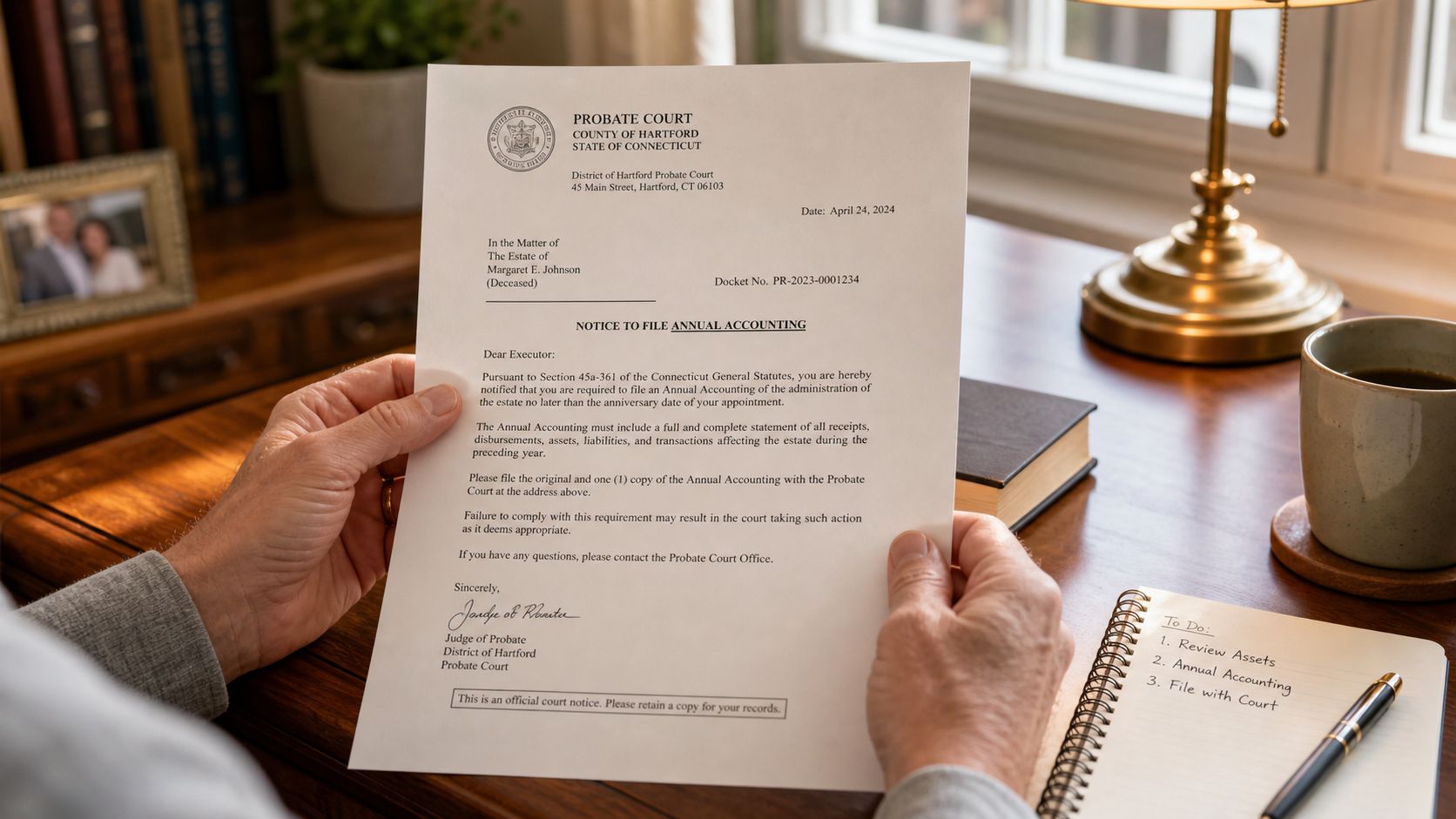
A good way to think about it is this, the court is asking, “Did the guardian protect the ward's money, and can we see the trail?” Texas guidance treats annual accounting as a foundational compliance obligation for guardianships, not a side task. That's why families should read every notice carefully, especially if they're also handling a guardianship hearing, a temporary guardianship request, or a dispute about whether guardianship is still needed.
A Houston example that feels familiar
A woman in Harris County becomes guardian of her father's estate after he can no longer manage bills and benefits on his own. Months later, she gets the annual accounting reminder and worries because she's kept receipts in a drawer, not in a tidy spreadsheet. The court isn't looking for perfection, but it does expect a record that explains where funds came from, where they went, and why those expenses benefited her father. If you want a broader overview of the process, the firm's types of guardianship in Texas page is a useful companion read, and Guardian of the Person vs. Guardian of the Estate is the clearest way to see how the two roles divide responsibility.
Who Must File and What Type of Guardian You Are
Texas separates guardianship duties by role, and that matters because the wrong filing can create avoidable confusion. A guardian of the estate handles money, property, and financial records, so that guardian files the Annual Account. A guardian of the person handles care, residence, and personal decisions, so that guardian files a separate annual report about the ward's well-being under Section 1163.101. If one person serves in both roles, both reporting tracks may apply.
Start with the role, not the form
That distinction is easier to remember if you begin with the question, “What do I control?” If you control income, assets, debts, or spending, you're on the estate track. If you control where the ward lives, medical coordination, or day-to-day care decisions, you're on the person track. Families often assume there's one guardianship form for everything, but Texas splits the duties so the court can review both finances and care separately.
The older adult safety at home guide can help families think through the care side of the equation, especially when a guardian of the person is making choices about housing or daily support. That kind of planning often goes hand in hand with court reporting, because the ward's living situation and financial support usually move together.
Practical rule: if you touch the ward's money, expect a financial accounting. If you direct the ward's personal care, expect a separate personal report.
In real life, counties may label the paperwork differently, but the duty stays the same. A guardian appointed by a probate court in Harris County, Dallas County, or another Texas county still needs to know whether the court expects financial reporting, personal reporting, or both. If a parent, successor guardian, or corporate fiduciary steps in later, the reporting duty follows the court's appointment order, not the family's informal understanding.
Deadlines That Run on the Anniversary of Qualification
Texas does not tie the annual accounting deadline to January 1. It runs on the anniversary of qualification, which is the date the guardian was legally appointed and qualified to act. The first annual account is due within 60 days after that anniversary, and the same yearly cycle repeats after that. That schedule matters because a guardian who was appointed in March follows a different filing rhythm than one appointed in October.
A March appointment means the first deadline arrives in late spring or early summer, depending on the exact qualification date. An October appointment means the first deadline comes in the next winter or early spring. The point is simple, the court tracks the guardian's appointment date, not the calendar year, so the filing window moves with the guardianship itself.
How families usually count the time
A successor guardian often inherits a partial year, which can be stressful when records come in late. In that situation, the best move is to identify the predecessor's final ending balance, then treat it as the new beginning balance for the next accounting period if the court's paperwork supports that transition. If the deadline lands on a weekend or court holiday, families should check the local court's filing rules and confirm the next business day. When records are incomplete, it's better to ask the court or counsel about the best filing path than to ignore the date and hope for the best.
Keep the anniversary date on a wall calendar, phone calendar, and paper file. One missed reminder is how good intentions turn into a late filing.
The deadline is predictable once you anchor it to the qualification date. That predictability is useful in Texas counties with busy probate dockets, because it lets families prepare before the court sends a notice. If the record trail is messy, the answer usually isn't to rush a half-finished accounting, it's to organize the documents first and file a report that can withstand review.
Documents, Schedules, and Forms You Will Need
The paperwork list feels long until you break it into parts. The court wants an Annual Account supported by schedules that show receipts, disbursements, assets, liabilities, and ending balances, all tied back to source documents. Texas court guidance also expects the guardian's attorney to review and sign the accounting, and the filing does not move forward until the court approves the annual report process for both the person and the estate where both apply.
| Document or schedule | What it shows | Who prepares it |
|---|---|---|
| Annual Account form | The full financial report for the estate | Guardian, usually with attorney review |
| Receipts schedule | Income and money received during the year | Guardian |
| Disbursements schedule | Bills, expenses, and payments made | Guardian |
| Asset schedule | Property, bank balances, and other assets at year-end | Guardian |
| Liability schedule | Debts and obligations still owed | Guardian |
| Supporting records | Statements, invoices, receipts, and benefit letters | Guardian gathers, attorney may review |
| Attorney signature and review | Confirmation that the accounting meets court format | Guardian's attorney |
The records behind those schedules matter just as much as the form itself. Bank statements, award letters, invoices, receipts, trust distribution statements, and sales records help show the chain from source document to reported figure. If the paper trail breaks, the accounting becomes vulnerable even when the numbers look right on a spreadsheet.
Local court instructions still matter
Different counties may ask for different formatting details, so families should request the local instruction sheet for the court that appointed the guardian. Harris County Probate Court, for example, may have its own filing preferences, and other counties often do too. For a practical checklist of forms and format issues, the firm's guardianship forms Texas page can help you compare what the court expects with what you already have in hand.
Building the Accounting Step by Step
A clean annual accounting starts long before the due date. The work is basically a financial story, beginning with last year's ending balance and ending with this year's closing balance, with every receipt and expense accounted for in between. A daughter in Dallas who keeps all of her father's receipts in a shoebox can still build a court-ready report, but she has to sort the records into a system the court can follow.
From opening balance to final balance
First, reconcile the prior year's ending balance to the current beginning balance. That means checking the approved prior account, the bank statements, and any changes that carried over from the last reporting cycle. If the beginning numbers don't match the prior ending numbers, the guardian has to explain why.
Next, classify every inflow. That can include benefits, pensions, rent, trust distributions, or proceeds from a sale of property. Then itemize each outflow and connect it to the ward's benefit, such as housing, medical care, personal needs, or approved guardian costs. The court wants to see that spending served the ward, not the guardian.
A receipt without a reason is weak. A receipt with a purpose tied to the ward's care is much stronger.
Finally, build the ending asset schedule so it matches the bank and asset records. If the report says an account has a certain balance, the statement should show the same number. If the ward's funds moved from one place to another, the trail should show the transfer clearly. When cash activity can't be tied to statements, checks, invoices, or receipts, the chain of custody gets shaky fast.
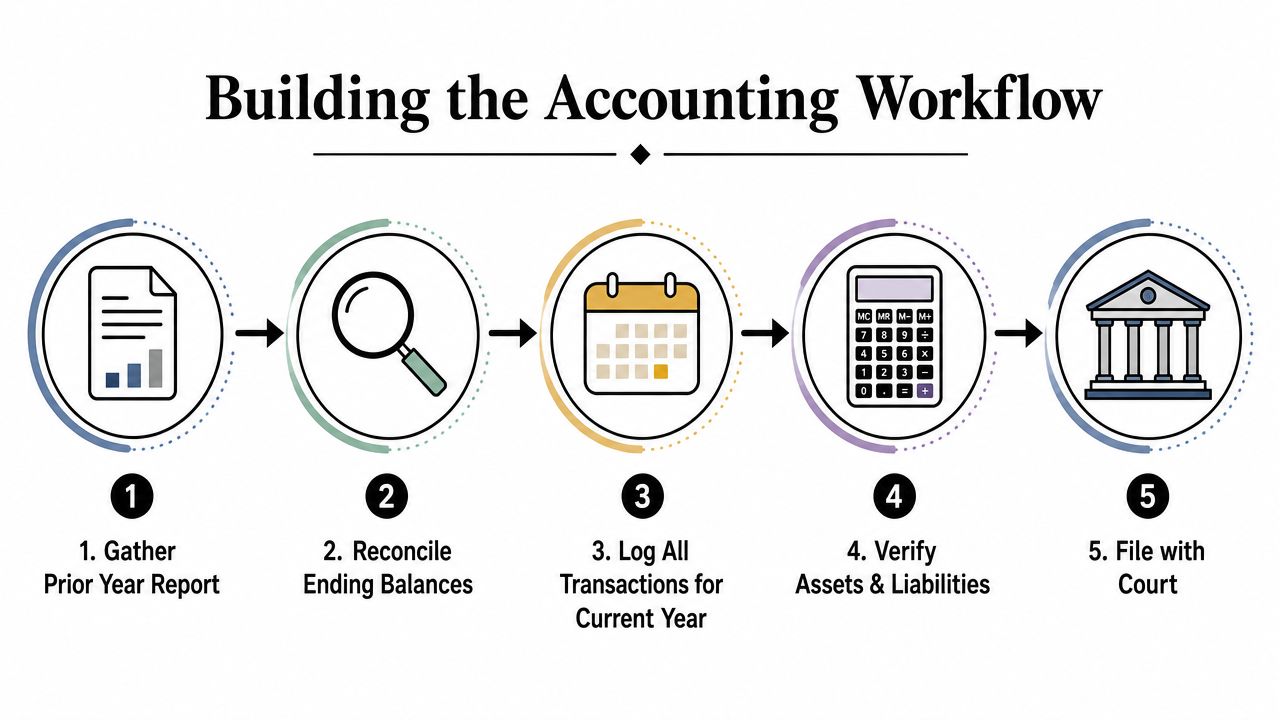
The easiest way to think about the process is gather, reconcile, categorize, verify, and file. That sequence keeps the accounting steady even when the year was messy. It also gives families a repeatable system they can use again next year without starting from scratch.
Common Errors and What Noncompliance Really Costs
Most late or rejected accountings are not caused by one huge mistake. They come from small gaps that add up, like missing receipts, untracked cash, commingled funds, or a balance that never gets explained. Texas courts pay attention to those gaps because an annual accounting is a fiduciary check, not just a paperwork exercise.
Errors that invite scrutiny
One common problem is a chain-of-custody break, where cash activity can't be linked back to statements, checks, invoices, or receipts. Another is filing without the attorney's required review or signature. Families also get into trouble when guardian funds and ward funds are mixed together, because that makes it hard to tell who paid for what. An unexplained ending balance can also trigger questions, even if the guardian believes the spending was justified.
The internal resource on top common Texas guardianship accounting errors to avoid is helpful if you want a second checklist before filing. The point isn't to create panic. It's to catch problems before the court does.
What Texas courts can do about it
Texas guidance and county instructions show that noncompliance can lead to real enforcement action. That can include an order to show cause, revocation of letters, removal, and a fine of up to $1,000 under Section 1163.151. Texas Bar guidance also warns that failure to file can lead to action against the guardian's bond. Those consequences are why families should treat the annual accounting like a true court deadline.
If a guardian discovers the numbers won't reconcile, the answer is usually to slow down, gather better records, and get help before filing something incomplete. A rushed report with unexplained gaps can create more problems than a short delay handled with the court's permission. That's why the accounting deserves the same care as the original guardianship hearing, because the court is still watching for the ward's protection.
After You File, Objections, Approval, and Getting Help
Filing the accounting is not the finish line. The court reviews the report, and if the numbers raise questions, the judge may ask for corrections, additional records, or a hearing. Family members can also object if they think spending was improper or the report leaves out important facts, especially when the guardianship is already strained by disagreement.
What to do once the accounting is submitted
Keep copies of everything you filed, including the final report, supporting schedules, receipts, and any court order approving the accounting. Store those records in the same system you'll use for the next year, because the best time to prepare next year's report is while this year's paperwork is still organized. If the court asks for changes, answer promptly and keep your explanation tied to the documents.
When the accounting is clean and approved, that approval matters. It gives the guardian a clearer record of compliance and helps close the books on that year. When the court pushes back, it usually means the filings need more detail, not that the guardianship has failed.
When legal help makes sense
A Texas guardianship attorney can help when records are incomplete, a family dispute is brewing, a successor guardian has stepped in, or the court is questioning the numbers. The Law Office of Bryan Fagan, PLLC also handles guardianship matters for Texas families who need help connecting the accounting to the broader court process. That kind of support can be useful before a hearing, after an objection, or when the guardian wants to avoid repeating the same filing mistakes next year.
If you're at the point where the notices, deadlines, and records feel heavier than you can manage alone, schedule a free consultation with a Texas guardianship attorney who can review your situation, explain your reporting duty, and help you move forward with confidence. A careful second set of eyes can make the difference between a stressful filing and a report the court can approve.
A CTA for Law Office of Bryan Fagan, PLLC.