Skip to content
A guardianship can start as the right move and still become the wrong fit later. I see this all the time with Texas families. A sister in Houston gets legal authority to help her mother two years ago, then the mother improves, or the paperwork turns into a wall of court dates, fees, and arguments that nobody expected. At that point, the question is simple: does this guardianship still protect the ward, or is it just keeping control in place because nobody has pushed the issue yet?
Texas does not treat guardianship like a private family arrangement you can undo over coffee. If you need to know how to terminate guardianship in Texas, you need the court process, the evidence, and the right fallback options when full termination is not realistic. That is true whether you are in Harris County Probate Court, Dallas, Travis County, or a smaller county where the judge still expects the same basic proof.
Families also get stuck for reasons that have nothing to do with the merits. Maybe the ward cannot afford a lawyer, maybe the guardian will not cooperate, maybe the medical records are hard to get, or maybe the only workable plan is a narrower order instead of full termination. If you're in that spot, keep reading, because the Texas process is workable once you understand the moving pieces. For emotional support while a family is under stress, some people also look to outside resources such as finding support in Penticton when they need help coping with the strain of caregiving and conflict.
For a related overview of when guardianship ends, Texas families can also review when guardianship ends in Texas.
When Texas Families Start Asking About Ending a Guardianship
A guardianship usually ends for one of a few real-world reasons. The ward gets better. A minor turns 18. The guardian can no longer serve. Or the family finally admits the arrangement has become broader than the ward needs. That last reason is common, and it's the one people hesitate to say out loud, even when everyone at the kitchen table already knows it.
The emotional trigger is usually practical, not theoretical
A daughter may have asked for guardianship after her father's stroke, only to watch him recover enough to make his own choices again. A grandparent may have been placed under guardianship when money was going missing, then later stabilized with help from family and a tighter support system. A teen's guardianship may run out when adulthood begins.
That's why families start asking hard questions. They are not trying to be difficult. They are trying to tell the difference between protection and overcontrol. In many homes, the issue is dignity as much as law.
Practical rule: if the ward can make decisions safely with less court control, it's time to look at termination or modification instead of just letting the old order sit there.
Financial strain matters too. Probate filings, medical evaluations, and attorney time add up fast. Under Texas guidance, filing fees for guardianship matters typically fall somewhere between $250 and $400, depending on the county, which is enough to make families pause before they file anything they are not ready to prove (Texas Guardianship Lawyer). That cost does not include professional help, which is why families often wait too long or try to handle everything alone.
A good reality check is this. If your family is asking whether the guardianship is still needed, the court will ask the same thing. The difference is that the court wants evidence, not feelings alone. That means the next step is not guesswork, it is deciding which legal path fits the facts.
Legal Grounds for Ending a Guardianship Under Texas Law
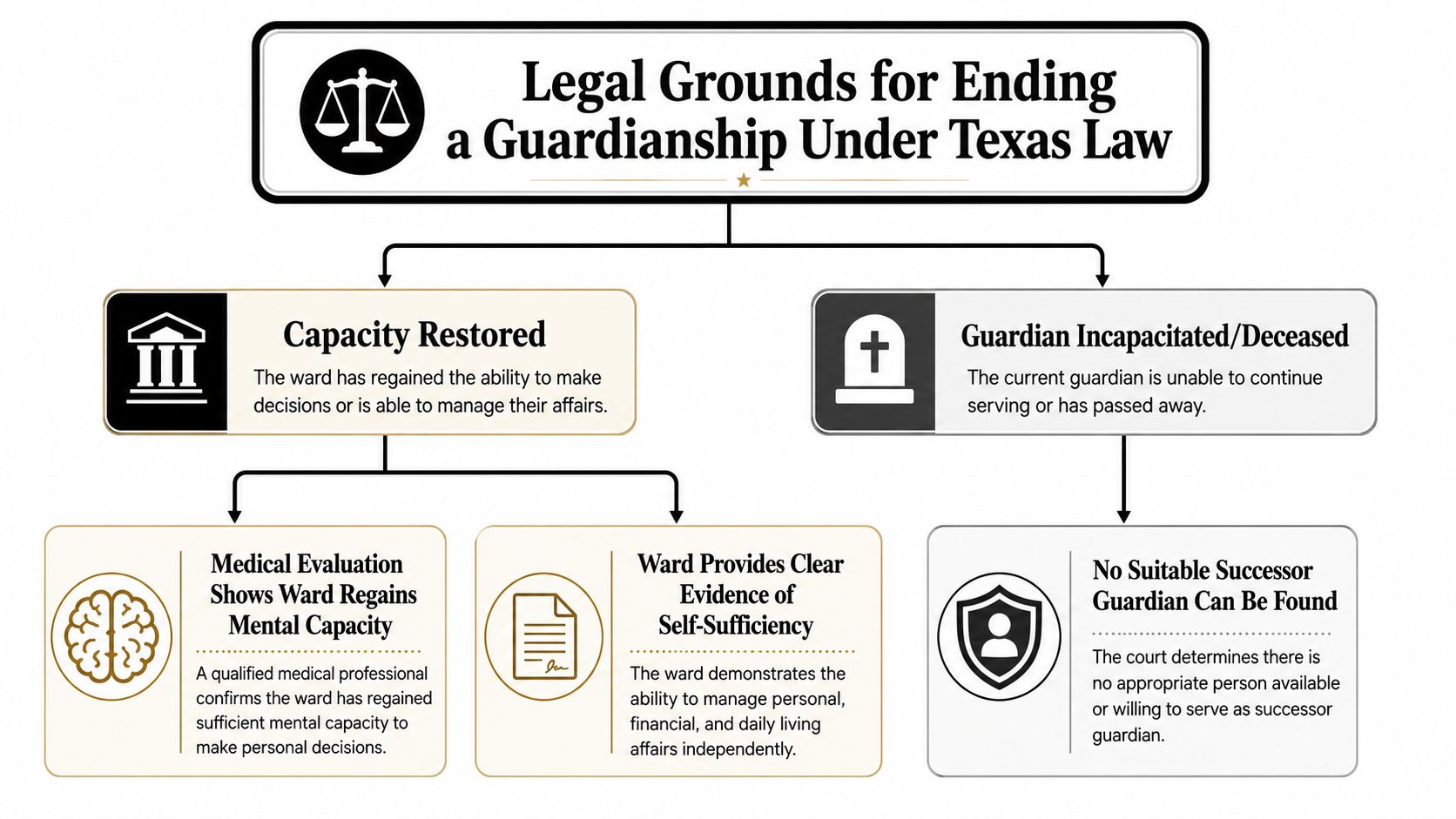
Texas treats termination as a court-controlled change in status, not a private family decision. Under the Texas Estates Code, Title 3, Subtitle G, the important triggers are death, adulthood for a minor, restored capacity, or a finding that the guardianship is no longer needed because support systems can cover the gap. State guidance also says a ward can ask the court to change the guardianship, appoint a different guardian, or restore capacity and end the guardianship (Texas State Law Library).
The main legal grounds in plain English
Restored capacity. This is the classic adult case. A man in Bexar County has recovered after a serious illness, and updated medical evidence shows he can now manage his own personal or financial affairs. That kind of case usually turns on medical records and testimony, not just family hope.
A minor reaching 18. For a child under guardianship, the legal milestone is simple. The guardianship usually ends when the child becomes an adult unless a court ends it earlier because it is no longer needed (Texas Health and Human Services).
Death of the ward. Guardianship ends automatically when the ward dies. The guardian then shifts from making personal decisions to closing the estate and wrapping up court duties (Bryan Fagan blog).
Support now makes guardianship unnecessary. A young adult with Down syndrome may not need full guardianship if a supported decision-making setup and family structure let him function safely. Texas guidance recognizes that less restrictive support can replace full control when it really meets the person's needs (Texas State Law Library).
Guardian cannot or will not continue. If the guardian resigns, Texas law requires a written application to the clerk under the Estates Code, which shows the court, not the family alone, controls the transition (Texas Estates Code).
The burden is not light. Texas guidance says terminating or modifying guardianship generally requires an attorney, a court hearing, and proof by a preponderance of the evidence that the requested change is best for the ward's welfare (Texas Health and Human Services). That is the standard the judge will use to decide whether the order should end, narrow, or stay in place.
Required Forms and Filings in the Texas Probate Court
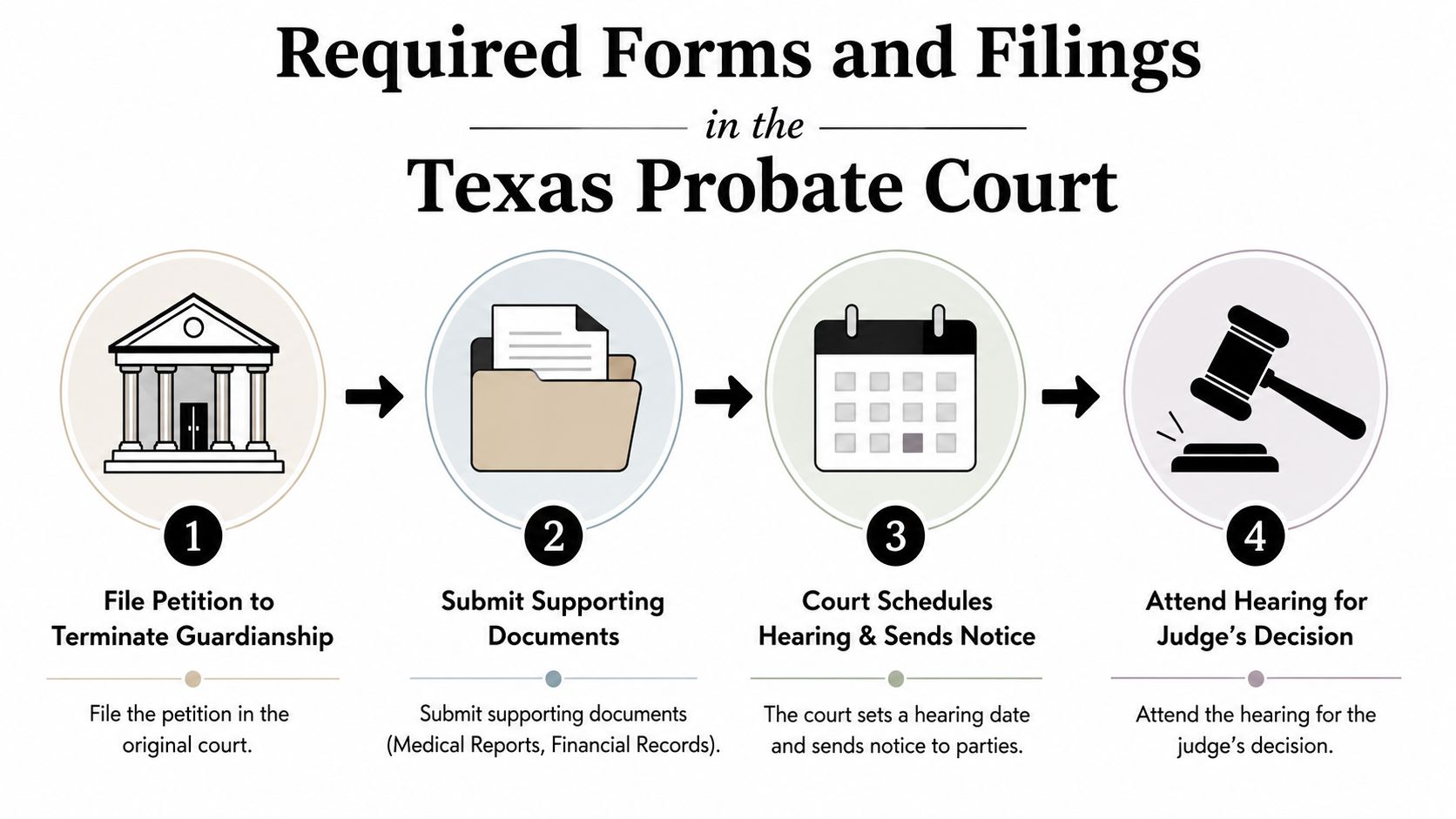
Start in the same probate court that entered the guardianship in the first place. That might be in Harris County, Dallas County, Travis County, Tarrant County, or Bexar County, but the basic rule is the same. The court that created the guardianship usually wants to be the court that ends it.
The filing sequence matters more than families expect
The Estates Code requires a guardian who wants to resign to file a written application with the clerk (Texas Estates Code). For termination, the practical sequence is more involved, and families should expect to do it in order, not all at once. A typical path is petition, service, evidence, hearing, and order.
You can think of it this way.
- File the petition in the original probate court.
- Serve all interested parties.
- Present proof supporting termination.
- Get the court order after the hearing.
That sequence is consistent with Texas guidance and the Estates Code framework (Texas Estates Code).
A petition should explain why the guardianship should end or change. In a death case, the proof may be a death certificate. In a restored-capacity case, the proof may include updated medical records. If the guardian of the estate is being released, families often also need a final accounting and a discharge request so the fiduciary record closes cleanly (How to End a Guardianship in Texas).
For families who want a broader overview of the original setup, Guardianship of an Incapacitated Adult in Texas explains how the court establishes guardianship for an adult who cannot manage their affairs.
A related internal resource on the paperwork side is guardianship forms in Texas. That kind of checklist helps, but don't confuse a checklist with legal sufficiency. Judges care about service, evidence, and clean court records, not just whether a form has a signature line.
A clerk can file paper. Only a judge can end the guardianship.
Choosing Between Termination, Modification, and Supported Decision-Making
Not every case should end with full termination. That's the mistake families make when they assume the only choices are “keep everything” or “end everything.” Texas law and Texas policy both point toward the least restrictive option that still protects the ward (Texas State Law Library).
The better question is what level of control is actually needed
A widow who only needs help paying bills may not need a full guardianship of the person. A stroke survivor who can choose where to live may only need a narrower order. A young man who can understand choices with support may do better with a supported decision-making arrangement than with full termination or continued plenary guardianship.
| Outcome | Best For | Typical Evidence | Effect on Ward |
|---|---|---|---|
| Full termination | Ward has regained capacity or no longer needs court protection | Updated medical records, testimony, proof of self-management | Ward regains legal rights |
| Partial termination | Only part of the guardianship is still needed | Focused evidence showing one area no longer needs control | Some rights return, some remain protected |
| Modification | Guardian should be changed or powers narrowed | Evidence of conflict, relocation, or better support plan | Court order becomes less broad |
| Supported decision-making | Ward can function with help, not control | Agreement, family support plan, provider input | Ward keeps rights and gets help |
The law library's modifying guidance matches what families experience in real life. A ward can ask the court to change the guardianship, appoint a different guardian, or restore capacity and end it, and support systems can replace full guardianship when they meet the person's needs (Texas State Law Library).
That is why a remembers.life template guide can be useful in the background for families thinking through end-of-life planning and decision support, even though it is not a guardianship filing tool. It reminds people that legal planning works best when it matches the person's real needs, not just a court label.
If the ward's needs are already being met through support rather than control, a narrower order may be easier for the judge to accept. That is the kind of strategic choice that often saves time, money, and family resentment.
For more detail on supported decision-making, see supported decision-making agreements in Texas. It is a real option, not a polite suggestion, and in the right case it can keep a loved one out of a heavier court fight.
What to Do When the Process Feels Impossible
Families often get stuck at this point. The ward may want out of the guardianship, but the guardian controls the bank account, the medical records, the transportation, and maybe even the phone bill. Texas law gives people rights, but rights are hard to use when the person who needs them has no practical way to get moving.
Start with the simplest path the court can actually act on
A ward may petition the court or even write a letter asking for restoration of capacity, and the court may order an investigation and medical evaluation (YouTube video). If the person cannot hire an attorney, that letter may be the only filing they can manage at first. That is not ideal, but it is still a starting point.
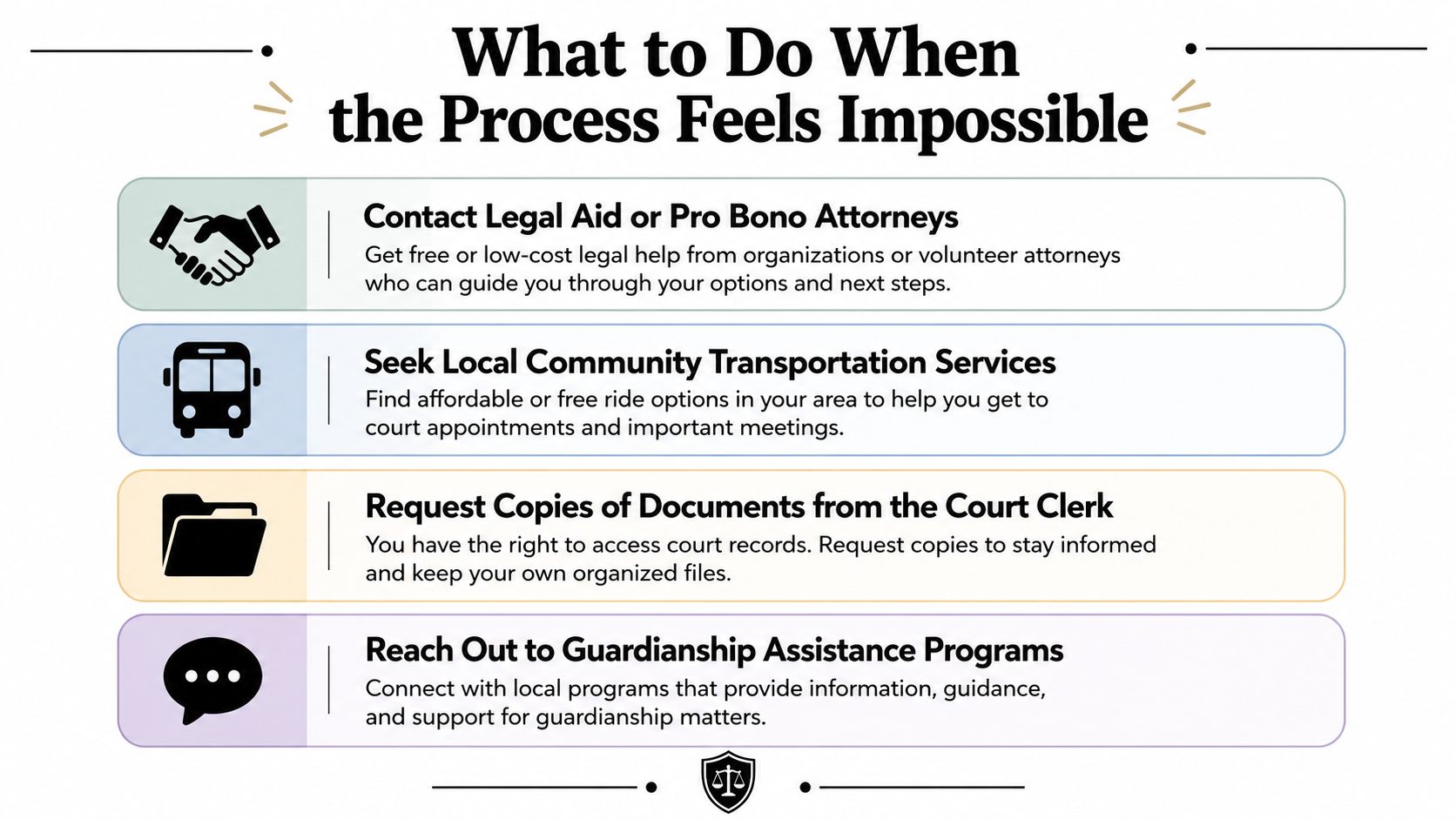
If the guardian refuses to cooperate, do not sit and wait. Ask the probate court for help. Ask for a court-appointed attorney ad litem or guardian ad litem if the facts support it. Ask for an independent capacity evaluation. Ask the clerk what the court needs to open the file if the ward is acting pro se. Those requests are boring, but they can break a stalled case open.
If the guardian blocks access to records, the court needs to know that. A blocked ward is not the same thing as an incapable ward.
Families also need to think about logistics. Transportation to the courthouse matters. Copies of prior orders matter. Medical records matter. If the ward cannot travel, remote participation may be possible depending on the court's process and the judge's preferences. Out-of-state relatives can still help gather records, line up witnesses, and keep the file moving.
This is also where legal aid and disability-rights groups can matter. A family with no money is not out of options just because the first lawyer says no. The point is to build enough of a record that a judge can act on it. If the process feels impossible, the answer is usually not to give up. It is to stop pretending the case is simple and start using every available tool.
A practical first move is often to contact counsel that handles guardianship, probate, and estate planning together. The Law Office of Bryan Fagan, PLLC handles those connected issues, which matters when the problem is not just termination, but access to records, money, and court procedure.
Hearing Day, Capacity Evaluations, and Possible Defenses
Most families have never stood in a probate courtroom before, and that makes hearing day feel worse than it should. The judge is not looking for a speech. The judge is looking for current, credible evidence that the guardianship should end, narrow, or continue. Many cases are also subject to annual review, so the court may already be watching whether the arrangement still makes sense (Bryan Fagan blog).
What the judge wants to see
A clean record beats a dramatic one. Bring updated medical evidence, any court-ordered evaluation, and testimony from people who know the ward's day-to-day abilities. If the ward uses a supported decision-making agreement, that matters because it shows a workable structure, not just wishful thinking. If there is a financial concern, bring proof that the ward can handle money or has support in place.
A court may want a fresh capacity evaluation, especially in an adult termination case. That evaluation helps answer the question the old guardianship order could not answer anymore. Has the person's condition changed enough to justify ending court control?
A short video can help families understand the flow of a termination hearing.
The defenses usually come from safety concerns
A guardian or interested party may argue that the ward is still vulnerable to exploitation. They may say the person still cannot manage medical decisions, still cannot pay bills, or still needs a guardian because there is no stable support system. Those are the kinds of objections the court takes seriously, especially if the guardian has been doing the job and the family is split.
Prepare for that. If the ward's independence will return, explain who will help with transportation, medication, housing, and bills. If the case is about ending one guardian's role, show the court who should replace that person or why a narrower order works better. If the court denies termination, the family can still look at post-hearing options, including a motion for new trial or an appeal, but those steps should be handled with counsel, not guesswork.
Frequently Asked Questions and Next Steps for Texas Families
People ask the same few questions once the paperwork talk is over. How long does this take. What does it cost. Can the ward get fees paid from the estate. What happens to benefits. The honest answer is that timing and cost depend on the county, the evidence, and whether anyone objects. The filing fee alone typically runs $250 to $400 depending on the county (Texas Guardianship Lawyer).
A guardianship also ends automatically when the ward dies, and the guardian's role shifts to closing the estate rather than continuing personal decision-making (Texas Guardianship Lawyer). That automatic end point is important, but it does not excuse the court paperwork that may still be needed to wrap up the file.
If you're asking whether you should keep trying on your own, my advice is blunt. Stop and get help when the ward lacks money, the guardian won't cooperate, the medical evidence is old, or family members are fighting. Those are the cases that turn simple theory into expensive delay.
If you need help ending, changing, or defending a guardianship in Texas, the Law Office of Bryan Fagan, PLLC handles guardianship, probate, and estate planning matters for families across the state. Schedule a free consultation, and get a clear plan for your court, your documents, and your next move before the problem gets harder and more expensive.