A call from a hospital, nursing home, school, or residential program can leave a Texas family frightened and unsure what to do. You may hear that your parent was “held for safety,” your child was placed in a quiet room, or a staff member changed medication after a difficult episode. The words sound clinical, but the experience can be frightening, painful, and confusing.
Restraints and seclusion aren't only discipline matters. They can involve safety, disability rights, medical decision-making, civil rights, and guardianship oversight. The right response depends on what happened, where it happened, how long it lasted, whether anyone faced an immediate danger, and whether staff followed the rules for that setting.
This guide explains the terms in plain English, shows how Texas guardianship law protects a vulnerable person, and gives families practical steps to document concerns. It also explains when a less restrictive option may have been required and how families can prepare for a hearing in a court such as Harris County Probate Court.
When You Worry Your Loved One Was Restrained or Isolated
Maria receives a late-afternoon call from her father's nursing facility. The administrator says her father became upset, struck at a caregiver, and was placed in a chair with a positioning device. Staff also moved him to a room away from other residents. Nobody can explain which device was used, how long it stayed in place, or who approved the intervention.
Her father has dementia and cannot reliably describe what happened. Maria is unsure whether she has authority to request records, whether he has a guardian, or whether the facility needed consent. She also does not know whether staff may act without advance approval during an emergency. These questions often require prompt, careful answers.
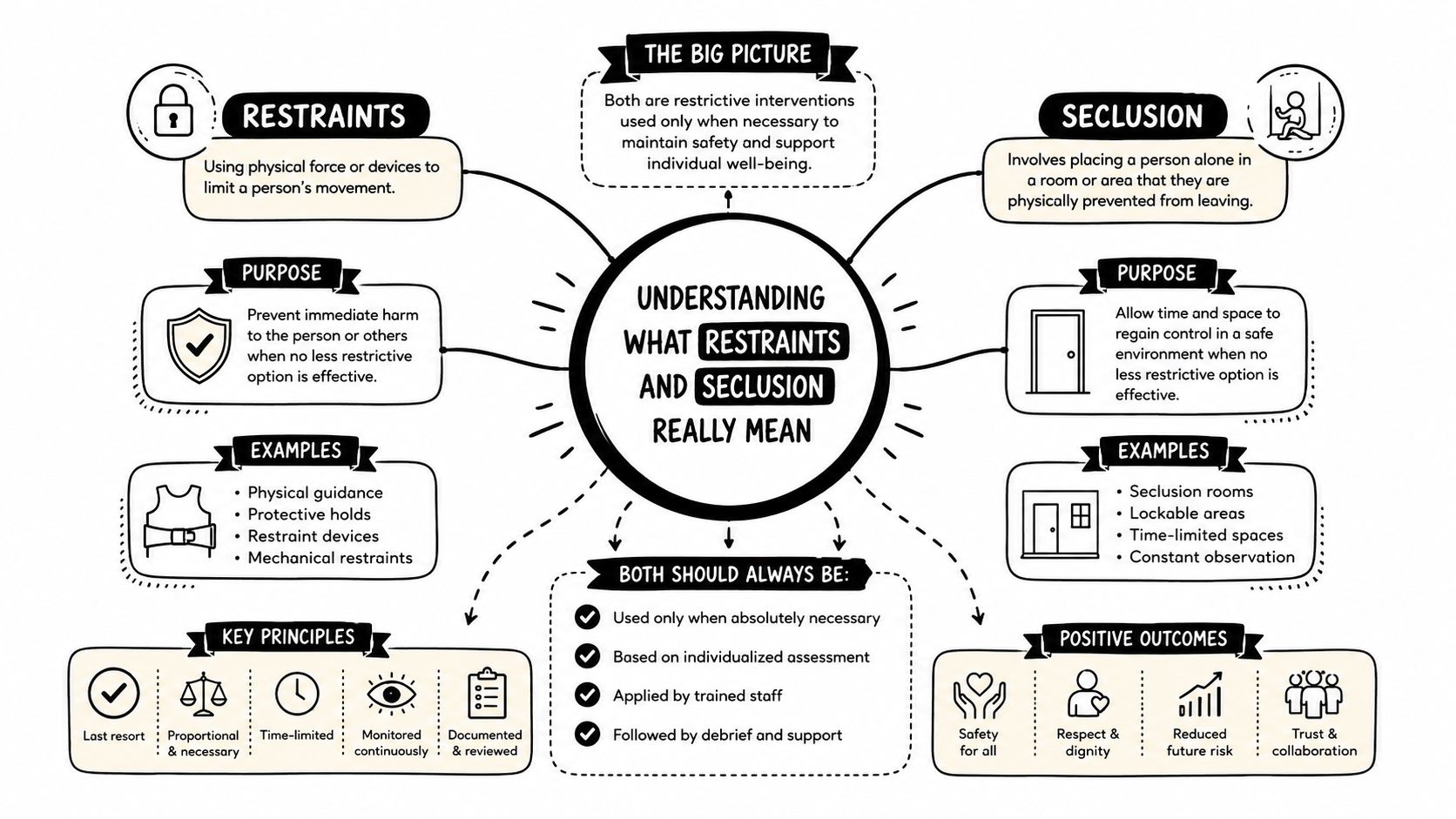
Start with the conduct, not the label. A restraint may limit movement, access to the body, or the ability to leave. Involuntary confinement alone in a space the person cannot leave freely generally describes seclusion. A room called “calming” may still be seclusion if staff prevented the person from leaving against their will.
The numbers show why records and oversight matter. During the 2017–18 school year, 101,990 students in U.S. public schools experienced physical restraint, mechanical restraint, or seclusion, according to the Department of Education's Civil Rights Data Collection. The total included 70,833 physically restrained students, 3,619 mechanically restrained students, and 27,538 students placed in seclusion.
A small percentage can still represent tens of thousands of children. Families deserve records explaining what happened, why it happened, and what will prevent a repeat.
Texas guardianship adds another layer of review. A guardian of the person may help address medical and personal care decisions, while a guardian of the estate handles financial matters. The guardian's authority does not remove the person's dignity, rights, or protection from improper restraint or isolation. Courts may also examine whether the facility used a less restrictive option and followed applicable safety and reporting requirements.
If you are concerned, write down the person's condition, the staff's explanation, the device or room involved, the approximate duration, injuries, witnesses, and any later medication or behavior changes. Request records through the proper guardian or authorized representative. Then compare the facts with the rules for that setting, preserve communications, report concerns when appropriate, and consider whether a Texas guardianship should be established, modified, or challenged.
Understanding What Restraints and Seclusion Really Mean
Start with a simple question: What did staff do that the person couldn't freely undo? That question often gives families a clearer answer than the facility's preferred terminology.
Physical restraint uses bodily force to restrict movement. For example, several staff members may hold a person's arms or shoulders during an emergency. A brief protective action, such as moving someone away from immediate danger, may not be the same as holding the person down after the danger has passed.
Mechanical restraint uses equipment or a device to restrict movement. A belt, vest, wrist device, or other equipment may qualify depending on its purpose and how it prevents movement. A device used for ordinary positioning or treatment isn't automatically a restraint, so families should ask what the device was designed to do and how staff applied it.
Chemical restraint involves medication used to restrict behavior rather than to treat a diagnosed medical condition. A medication change alone doesn't prove misuse. Families should ask who ordered it, the stated medical purpose, the dose, the timing, and whether the person was monitored afterward.
Seclusion is different from physical restraint. It separates a person from others and prevents them from leaving freely. A supervised space that a person can choose to enter and leave isn't necessarily seclusion. A locked room, blocked exit, or staff-controlled confinement may raise serious concerns.
Why the distinction matters
The same event can look different depending on its purpose and duration. A nurse who briefly blocks a person's hand from pulling out a life-support line is responding to a safety risk. Staff who keep that person immobilized after the risk ends may be using a restrictive intervention that needs separate justification, monitoring, and documentation.
Ask for plain answers:
- What happened first? Identify the behavior or danger that led to the intervention.
- What method was used? Ask whether it was physical, mechanical, chemical, or seclusion.
- Could the person leave or move freely? This helps distinguish supervision from confinement.
- When did it start and end? Duration matters because exposure can increase monitoring demands and risk.
- What alternatives were attempted? Look for verbal de-escalation, environmental changes, medical assessment, or additional supervision.
A Guardian of the Person vs. Guardian of the Estate arrangement may affect who manages personal decisions and who manages property, but neither role turns a restrictive intervention into an automatic lawful act. The guardian's authority must be understood alongside the person's rights and the rules of the facility.
How Federal and Texas Rules Decide When Use Is Lawful
A loved one is restrained after becoming upset in a hospital, nursing facility, or Texas school. The facility may describe the intervention as a safety measure. Lawfulness depends on what happened, why staff acted, what alternatives were available, and whether the restriction continued after the danger passed.
A practical review asks five questions:
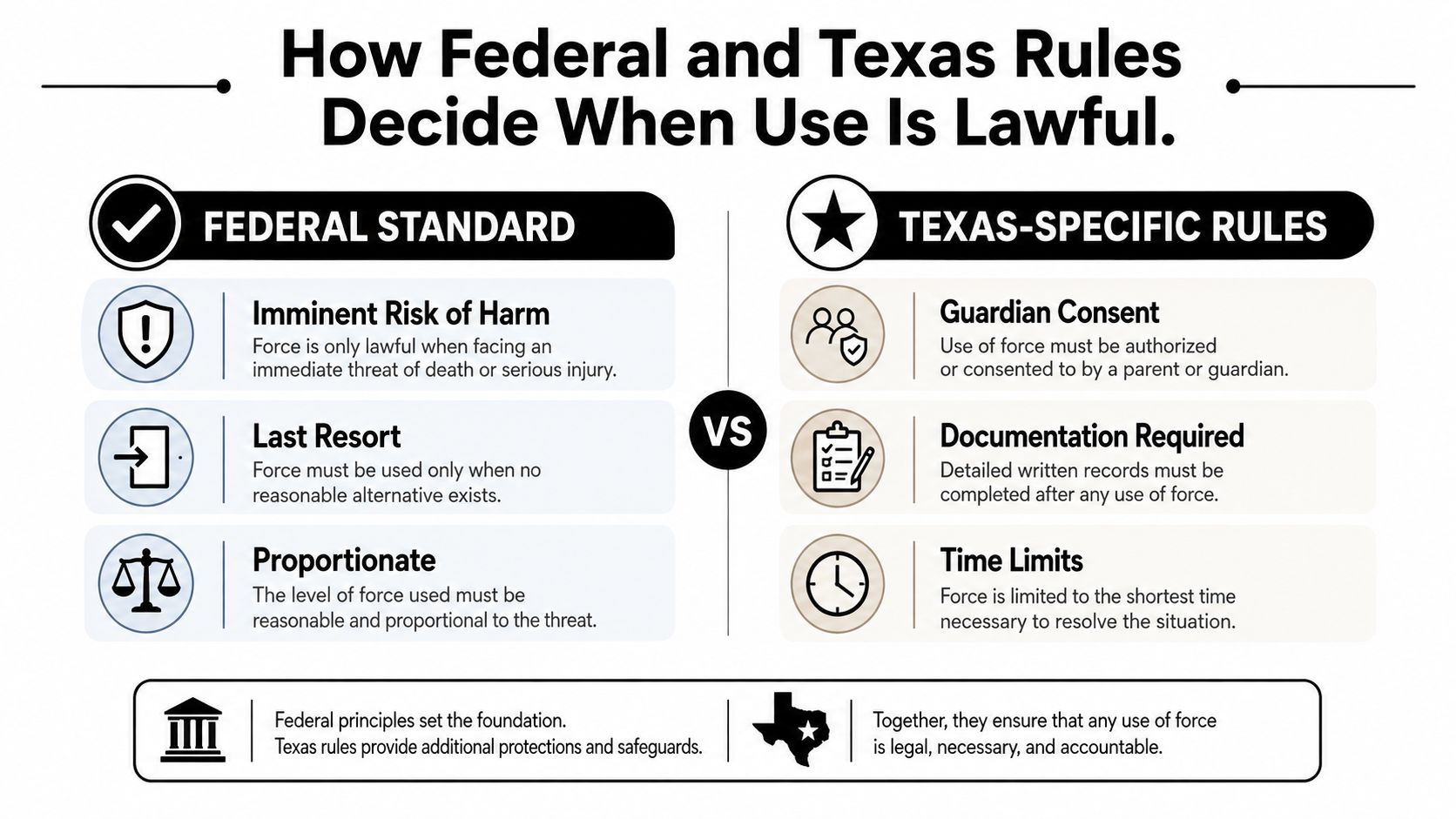
- Was there an imminent risk of harm? The person must face a meaningful, immediate danger. Being inconvenient, distressed, or noncompliant alone does not justify restraint or seclusion.
- Were less restrictive options tried? Staff should consider calm communication, more space, a medical evaluation, sensory support, or additional supervision when those measures could address the risk.
- Was the intervention proportionate? The method should fit the danger. A minor disturbance does not support severe or prolonged restriction.
- Was the person monitored? Staff should watch for breathing problems, injury, distress, medication effects, and other complications.
- Was the event documented? Records should identify the reason, method, duration, staff involved, monitoring, injuries, and follow-up.
Practical rule: A short emergency response may protect someone from immediate harm. Punishment, retaliation, convenience-based confinement, and restrictions that continue after the danger ends do not become lawful simply because a facility uses them.
The setting changes the specific requirements. Hospitals and nursing facilities follow clinical safety rules. Schools must also account for student rights, disability protections, educational duties, and Texas limits. Families can request the incident record, the student's behavior or safety plan, parent notifications, and district-reported data.
Earlier federal review highlighted the need for clearer definitions and more reliable reporting about restraint and seclusion. That history matters because oversight cannot depend only on a facility's explanation of one incident.
Texas guardianship adds court oversight. Under Title 3, Subtitle G of the Texas Estates Code, a court does not appoint a guardian merely because a family is concerned or a person needs support. The court must find incapacity by clear and convincing evidence and consider alternatives before appointing one. A guardian remains subject to court supervision and fiduciary duties.
A guardian appearing before the Harris County Probate Court should be prepared to explain the loved one's needs, the decisions being made, and the steps taken to preserve independence. A court order may address personal care, but it does not give a facility permission to restrain someone for convenience. The same principle applies when a guardian reviews whether staff chose a less restrictive response.
A short educational video can help families recognize the difference between emergency protection and a routine restrictive practice.
Guardianship Protections and Less Restrictive Alternatives in Texas
Texas guardianship law starts with autonomy. Before appointing a guardian, the court must find incapacity by clear and convincing evidence and determine that less restrictive alternatives aren't feasible. This requirement matters when a family is deciding whether a guardian should control medical or personal decisions connected to a restrictive intervention.
A family may need to establish guardianship when a loved one can't make or communicate important decisions and no workable alternative exists. The application, capacity evidence, required notices, and hearing give interested people an opportunity to respond. Before the hearing, collect medical evaluations, medication information, incident records, and documents showing what support the person needs.
A decision path that preserves independence
Texas law recognizes alternatives that may address a specific need without removing every decision from the person's control. Examples include a medical power of attorney, durable power of attorney, declaration for mental health treatment, representative payee arrangement, joint bank account, guardianship management trust, and special needs trust. The right option depends on the person's capacity, the type of decision, and the risks involved.
Consider a hypothetical family in Austin. Their adult daughter has an intellectual disability and becomes distressed in a crowded treatment setting. Her parents first use a medical power of attorney, a written treatment preference, and a support plan that identifies triggers and calming methods. If those tools allow her to participate safely in care, a full guardianship may be unnecessary.
A family in Dallas might reach a different conclusion if a parent cannot understand treatment choices, repeatedly faces unsafe medication decisions, and has no workable alternative decision-maker. The court can still tailor the guardianship rather than treating it as unlimited control.
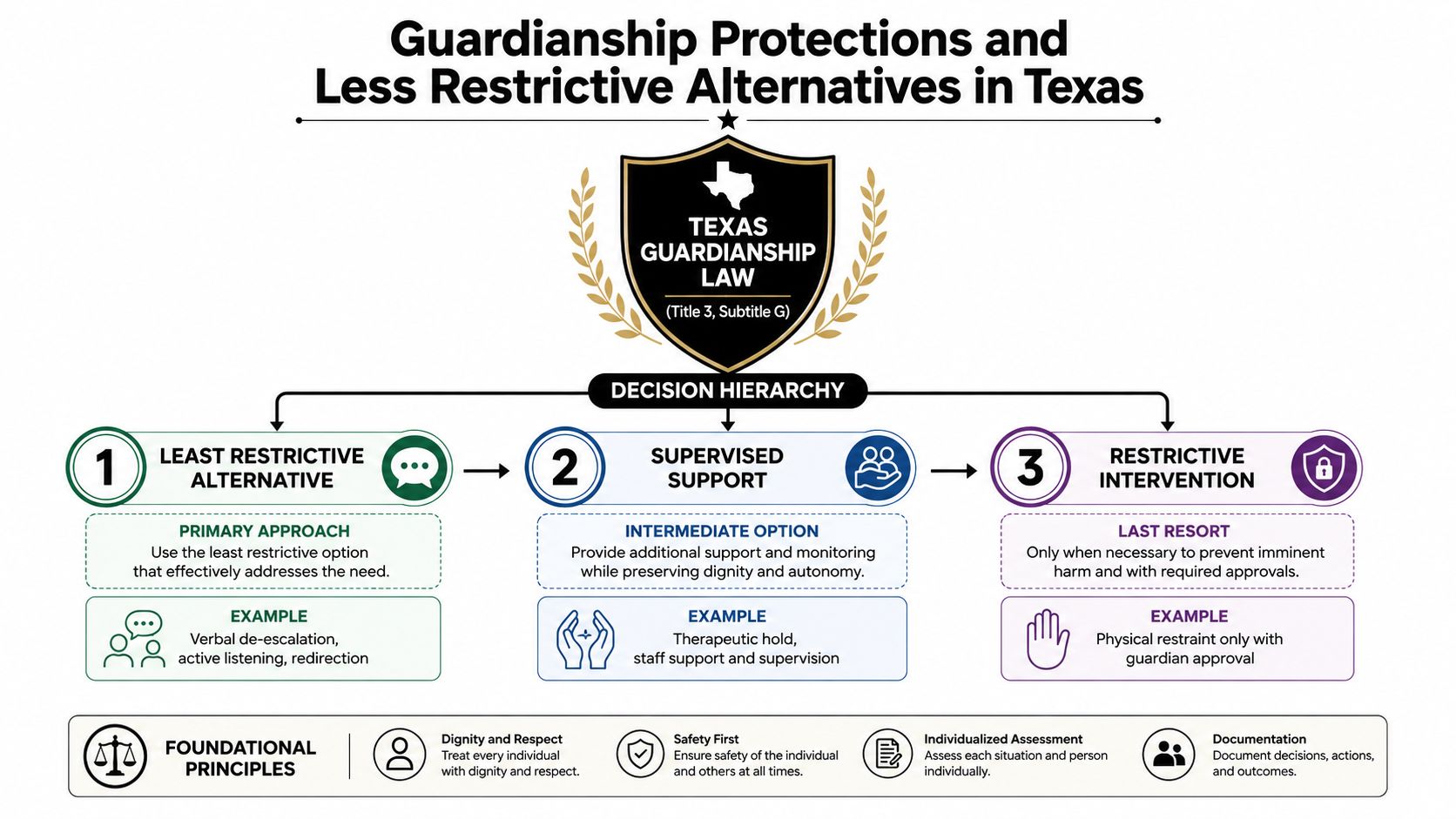
A guardian of the person should ask whether a restrictive intervention was necessary, whether staff followed the care plan, and whether a safer alternative could prevent another incident. A guardian of the estate may need to examine costs tied to treatment, placement, or injuries, while avoiding assumptions about liability until the records are reviewed. Families considering whether guardianship is too broad can also review less restrictive options under Texas law.
Ongoing compliance matters. Under Texas Estates Code Section 1163.101, a guardian of the person must file a sworn annual report each year during the guardianship, including receipts and disbursements for the ward's support and maintenance, as set out in the Texas annual reporting provision. If a temporary guardianship expires, Section 1251.153 requires a final report explaining why it ended and, when the ward is living, whether capacity returned, alternatives were established, or a permanent guardian qualified, according to the temporary guardianship reporting statute.
Warning Signs That Restraints or Seclusion May Be Abusive
A guardian receives a call: staff say a loved one was held briefly after trying to strike someone. The explanation sounds reassuring, but the details matter. One event rarely answers every legal question. A pattern, like footprints showing where someone has been, can reveal more than a single explanation.
If staff release the resident when the danger ends, check for injuries, notify the guardian, and provide a detailed report, the facts may support a genuine emergency response. The family should still compare the record with the care plan and ask whether a safer response was available.
A different pattern raises sharper concerns. The resident has unexplained bruises, fears particular staff, receives a sudden sedating medication change, and is repeatedly isolated without a clear behavior plan. Staff give conflicting explanations, while records omit start and end times. Those facts call for prompt review.
Patterns families should take seriously
- Repeated incidents without prevention planning: Frequent restraints may show that the facility is reacting to crises instead of addressing triggers, staffing, communication needs, pain, or environmental stress.
- Injuries or physical distress: Bruising, breathing problems, falls, skin damage, and emotional withdrawal may indicate that the intervention caused harm.
- Unexplained medication changes: Ask whether medication treated a documented condition or was used mainly to control behavior.
- Missing or inconsistent records: Reports that omit duration, monitoring, reason, or witnesses leave important questions unanswered.
- Punitive language: Statements about “teaching a lesson,” “making the person comply,” or isolating someone for refusal point away from a safety purpose.
- Fear around staff or a particular location: Behavioral changes after an incident may provide important evidence, especially when the person has difficulty communicating.
Facility-level data may help identify an outlier. The California Department of Health Care Services data materials describe a U.S. study in which 67% of hospitals reported relatively low use, while 10% operated at rates five to 10 times higher. That uneven pattern gives families a practical question: why does one unit or facility use restraint or seclusion more often than comparable settings?
Visitation restrictions also deserve careful review. Families can examine whether a Texas guardian can restrict visitors or family access, then compare the decision with the ward's best interests and the guardianship order. A restriction should protect the person, not conceal an incident or cut off safe advocates.
What Families Can Do to Gather Evidence and Report Concerns
Act methodically, especially when emotions are high. Your first goal is to preserve facts before memories change and records become harder to obtain.
Start with the incident record
Ask the facility, hospital, or school for the complete incident report and related records. Request the stated reason, exact intervention, start and end times, staff names or roles, monitoring notes, injuries, medication orders, notifications, and the follow-up plan.
Write your own timeline. Record when you learned about the event, who called, what each person said, where your loved one was taken, and whether witnesses were present. Save emails, portal messages, letters, photographs, voicemails, and text messages in their original form.
If there are visible injuries, photograph them with dates and seek appropriate medical evaluation. Don't coach the person or pressure them to repeat a story. Let a healthcare professional document symptoms and let an attorney advise you about preserving testimony.
Public reporting systems show what meaningful accountability can look like. California requires facilities to report deaths, serious staff injuries, serious patient injuries, incident counts, and the duration of seclusion or behavioral restraint episodes through its public system. Australian national mental health data also tracks both events and duration, reporting 9,964 seclusion events with an average duration of 6 hours, 16,452 physical restraint events, and 1,127 mechanical restraint events in 2022–23 public hospital mental health care, according to the Australian Institute of Health and Welfare's seclusion and restraint data. These examples reinforce why duration and harm belong in every review.
Choose the reporting path
- Nursing home or residential care: Ask Texas Health and Human Services about the appropriate licensing or complaint process, and preserve the facility's response.
- Hospital care: Contact the patient advocate, risk management office, attending physician, and medical records department.
- School incidents: Ask the district for its policy, incident records, parent notices, student plan, and disaggregated reporting. Colorado's 2025–26 collection separates restraint and seclusion from disciplinary events, while California requires district-level posting disaggregated by race, gender, 504 status, and IEP status, as reflected in Colorado's restraint and seclusion reporting guidance.
- Guardianship concerns: Review court reports, communicate with the guardian in writing, and consider the process described in reporting guardianship abuse in Texas.
A guardian should also maintain required reports and accountings. If the concern involves immediate danger, contact emergency services rather than waiting for a records request.
Protecting Your Loved One and How Our Texas Team Can Help
Families may have several legal options after a restraints or seclusion concern. Depending on the facts, those options can include a licensing complaint, a request for a court hearing, a petition to modify or terminate guardianship, a challenge involving fiduciary misconduct, or a civil claim related to injury. The right path depends on the setting, evidence, guardianship order, and applicable deadlines.
A Texas guardianship attorney can help organize capacity evaluations, review incident records, prepare filings, and explain the guardian's duties under the Texas Estates Code. The Law Office of Bryan Fagan, PLLC handles guardianship, probate, and estate planning matters for families in Harris County, Dallas, Austin, San Antonio, and other Texas communities, including temporary guardianships, contested matters, and compliance concerns.
You can also review the firm's related resources on Guardianship, Probate, and Estate Planning. Bring the incident report, medical records, photographs, communications, court orders, and questions about less restrictive alternatives to your consultation.
The Law Office of Bryan Fagan, PLLC offers free consultations to help Texas families evaluate restraints and seclusion concerns, guardianship authority, reporting duties, and possible court action. Visit Law Office of Bryan Fagan, PLLC to schedule a consultation and discuss practical steps for protecting your loved one's safety, dignity, and legal rights.