Skip to content
Deciding to file for guardianship for a loved one is one of the toughest, most emotionally charged choices a family can make. It's a step you take out of love and deep concern, but it also carries immense legal weight. We understand that this journey can feel overwhelming. This guide is designed to walk you through the process with clarity and compassion, helping you understand each step as you navigate Texas guardianship law.
The process involves going to a probate court, providing clear medical evidence of your loved one's incapacity, and ultimately asking a judge to make a life-altering decision. This isn't just about paperwork; it's a formal legal process designed to protect vulnerable adults who can no longer make safe or sound decisions for themselves. Because of what’s at stake, a guardianship in Texas always requires a court's approval.
When Is Filing for Guardianship the Right Choice?
At its core, guardianship is a legal tool for when a person, who becomes the "ward," is found by a court to be incapacitated and unable to manage their own affairs. This entire process is governed by the Texas Estates Code, specifically Title 3, Subtitle G.
We see families grapple with this decision when a loved one is facing challenges such as:
- Advanced dementia or Alzheimer's disease.
- A severe developmental disability they've had since birth.
- A catastrophic injury, like a traumatic brain injury from a serious accident.
- Severe mental illness that prevents them from being able to care for themselves.
We recognize the huge emotional and financial toll this process takes. It’s more than just a legal case; it’s about acknowledging a profound shift in a loved one's life and stepping up to be their protector.

A Real-World Scenario: A Family in Harris County
Let's put this in perspective. Imagine a family in Harris County with an aging mother, Maria. Her adult children notice she’s forgetting to take her critical heart medication. She’s fallen victim to a few phone scams, and her mail is piling up with unopened, unpaid bills. When they try to bring it up, Maria gets confused and defensive.
The real problem? Maria never signed a power of attorney or other advance directives. This means no one has the legal authority to step in and manage her healthcare or her finances. In a situation like this, filing a guardianship petition in Texas isn't just an option—it becomes the only viable path to ensure her safety and well-being.
A Texas court will only grant a guardianship if it is proven by "clear and convincing evidence" that it's in the proposed ward's best interest and that no less-restrictive alternatives are available.
Understanding the Types of Guardianship
As you start down this path, it’s crucial to pinpoint exactly what kind of help your loved one needs. Texas law makes a clear distinction between two main types of guardians. You might need to apply for one, or you might need both.
Guardian of the Person: This guardian is in charge of personal, medical, and residential decisions. They have the authority to decide where the ward lives (like at home with caregivers or in a facility), consent to medical treatments, and oversee their day-to-day care.
Guardian of the Estate: This guardian steps in to manage the ward's financial world. Their job includes paying the bills, managing bank accounts and investments, protecting property from being lost or sold improperly, and even filing taxes on the ward's behalf.
Going back to our example, if Maria has a home, savings, and investments, her children would likely need to petition the Harris County Probate Court for guardianship of both her person and her estate. This ensures every aspect of her life is managed responsibly under the court's supervision.
Exploring Less Restrictive Alternatives First
Texas courts view guardianship as a profound step because it removes a person's fundamental rights to make their own choices. For that reason, it’s considered a last resort. Before a judge will even consider granting a guardianship, you must prove that you’ve looked into less-restrictive options and that they simply won't work for your situation. These alternatives often come from good Probate or Estate Planning tools.
Here are a few examples of those alternatives:
- Durable Power of Attorney: A legal document where someone pre-designates a trusted agent to handle their financial decisions if they become unable to.
- Medical Power of Attorney: Similar to the above, but this document names an agent specifically for making healthcare decisions.
- Supported Decision-Making Agreements: A more collaborative arrangement where trusted advisors help an individual with a disability make their own choices without taking away their rights.
If your loved one already has these documents in place and the person they appointed is acting appropriately, a Guardianship is likely unnecessary. But if those documents were never created, or if the person is now unable to make sound judgments, filing a petition is the next responsible move.
If you are facing this difficult decision and need to understand your options, our firm is here to help. Schedule a free consultation with The Law Office of Bryan Fagan to receive personalized guidance for your family's unique situation.
Getting Your Ducks In A Row Before Filing
Before you even think about stepping into a Texas courthouse to file a guardianship petition, there's some critical homework to do. Proper, thorough preparation is what separates a smooth legal process from a chaotic, delay-filled mess. Taking the time now to get your documents in order and understand your role will build a rock-solid foundation for your case and show the court you’re serious.
Think of it this way: You wouldn't start building a house without a solid blueprint and foundation. In the world of guardianship, that foundation is built with undeniable medical proof, organized financial records, and a complete list of every family member involved.
The Cornerstone Of Your Case: The Physician’s Certificate
The single most important document you will need is the Physician's Certificate of Medical Examination (PCME). This isn't just any doctor's note; it's a specific legal form that a physician must fill out after a recent examination of your loved one.
This certificate is the court's primary window into your loved one's condition. The Texas Estates Code requires it to detail the exact nature and severity of their incapacity. The doctor will evaluate their ability to make sound decisions about their own health, daily activities, and finances.
A guardianship case simply cannot proceed without a correctly completed PCME. Courts rely heavily on this medical evidence to make a finding of legal incapacity. One of the most common reasons we see cases get delayed is an incomplete, outdated, or improperly filled-out certificate.
Coordinating with the doctor is absolutely key. You need to provide them with the correct form, explain its legal importance, and make sure they understand it must be based on an exam conducted within a very specific timeframe before you file. For a deeper dive into this critical form, we've put together a detailed guide on the physician's certificate for guardianship in Texas.
Gathering Your Supporting Evidence
Beyond the PCME, you'll need to compile a file of documents that tells the complete story of your loved one's situation. Having these items organized and ready before you meet with an attorney will make the entire process far more efficient and cost-effective.
Before you file anything, we strongly recommend creating a clear, organized system for your paperwork. Many legal documents are shared as PDFs, and knowing how to track changes in PDF documents can be an incredibly useful skill when collaborating with your legal team and ensuring accuracy.
To get started, we've created a simple table to guide you through the essential pre-filing steps. This isn't just busy work—each item is a crucial piece of the puzzle that will form the basis of your petition to the court.
Essential Pre-Filing Checklist For Texas Guardianship
| Action Item | Why It's Critical for Your Case | A Tip from Our Legal Team |
|---|---|---|
| Obtain a Completed PCME | This is the non-negotiable medical evidence the court needs to establish incapacity. Your case is stalled without it. | Don't just hand the form to the doctor's office. Have a conversation with the physician to ensure they understand the legal weight of the document. |
| Collect Medical Records | Diagnoses, treatment plans, and notes from specialists provide context and support the findings in the PCME. | Focus on records that show a pattern of cognitive decline or inability to manage daily life, not just routine physical health issues. |
| Gather Financial Statements | You must show the court what assets make up the "estate" that needs protection. This includes bank accounts, property deeds, and investment reports. | Create a simple spreadsheet listing all known assets and debts. It will be invaluable for both you and your attorney. |
| Compile a List of Relatives | The law requires you to notify all "interested parties," such as the spouse, children, parents, and siblings. | Double-check addresses! Incorrect or outdated contact information is a common cause of delays in serving notice. |
Completing this checklist before you begin the formal legal process will give you a significant head start and help you feel more in control during a difficult time.
The Difficult Conversation
Talking about guardianship with a loved one is never easy. It requires an incredible amount of sensitivity and compassion. If at all possible, this conversation should be approached with dignity, focusing on safety and support rather than control.
Frame the discussion around your concern for their well-being and your desire to protect them from potential harm or exploitation. Even if they can't fully grasp the legal details, including them in the conversation to the extent they are able shows respect for their autonomy.
Preparing these elements before filing will do more than just streamline the court proceedings; it will bring a sense of order to what can be an emotionally overwhelming chapter. If you're looking at this list and feeling daunted, you are not alone. A free consultation with the Law Office of Bryan Fagan can provide the clarity and direction you need to move forward with confidence.
Navigating the Court: How to File a Guardianship Petition in Texas
You’ve done the hard work of gathering documents and getting a doctor’s support. Now it's time to take the next, and often most intimidating, step: formally filing for guardianship with the court. This is where the process becomes official, moving from your kitchen table to the courthouse. It's completely normal to feel a bit overwhelmed, but understanding what’s coming can make all the difference.
This journey starts by filing the Application for Appointment of Permanent Guardian. Your attorney will file this legal document in the correct court, which is almost always the statutory probate court in the county where your loved one lives, like the Dallas County Probate Court or the Harris County Probate Court.
The image below shows the critical groundwork that needs to be in place before you ever get to the filing stage.
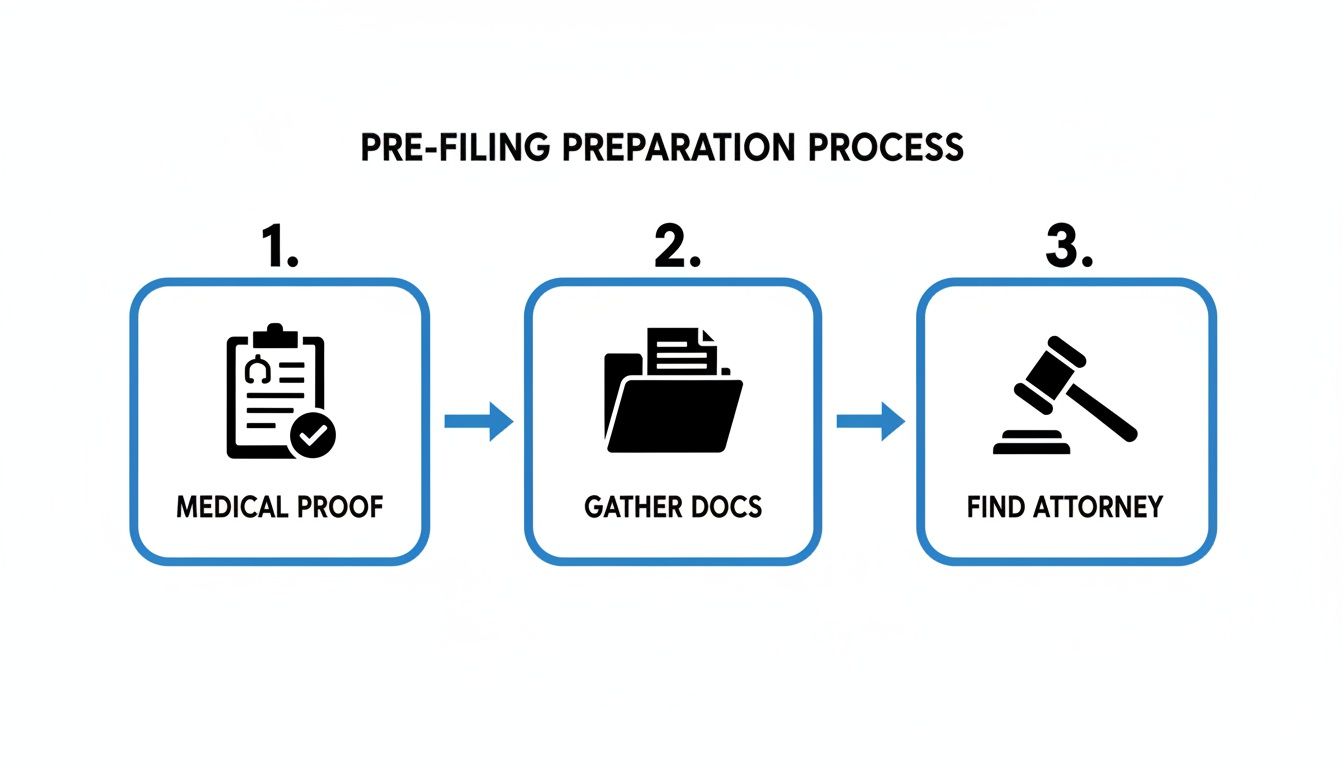
Think of it this way: the medical proof, your document collection, and your attorney consultation are the foundation. The court filing is the first wall you build on top of it.
The Application and Initial Court Actions
Your guardianship attorney will be the one to draft and file the formal application. This isn't just a simple form; it's a sworn legal document that tells the court the "who, what, and why" of your case. Under the Texas Estates Code, it absolutely must include:
- Information about you (the applicant) and your loved one (the proposed ward).
- A clear, factual explanation of why guardianship is necessary.
- A complete list of close relatives who need to be notified.
- The specific type of guardianship you are asking for (of the person, of the estate, or both).
To get a better sense of the paperwork involved, you can review our article on essential sample guardianship application templates for Texas families. This will give you a real-world look at the level of detail the court expects.
Once the application is accepted by the court clerk, a citation is issued. This is the court's official, public announcement of the case. In a traditional but important step, this notice is physically posted at the courthouse. This is called "posting citation," and it ensures the public and any unknown interested parties are put on notice.
Notifying Your Loved One and Family Members
While the public posting is happening, the law demands that your loved one be notified directly. This is called "personal service," and it’s a non-negotiable step.
A sheriff, constable, or a private process server will hand-deliver a copy of the application and citation to the proposed ward. This ensures their fundamental due process rights are respected—they have a right to know that a court case has been started about them.
At the same time, every close relative you listed in the application must also get a formal notice. This gives all immediate family a chance to show up in court, whether it's to support your application or to object to it. Cases can be completely derailed because one required relative wasn't properly notified. The court will halt everything until that mistake is fixed.
The Court's Eyes and Ears: The Attorney Ad Litem
As soon as the case is filed, the judge will appoint an attorney ad litem. This is an independent lawyer whose only client is the proposed ward. Their job is to protect the proposed ward's rights and advocate for their wishes and best interests.
The attorney ad litem’s investigation is thorough. They will:
- Visit your loved one for a private conversation to understand their perspective.
- Review all the medical evidence you submitted.
- Dig into the facts you presented in your application.
- Write a formal report for the judge with their own recommendation about the guardianship.
The attorney ad litem's report is one of the most influential documents in a guardianship case. Judges rely heavily on their independent assessment.
What to Expect on the Timeline
One of the biggest questions we get from families is, "How long will this take?" The honest answer is: it depends.
If the guardianship is uncontested—meaning all family members are in agreement and the facts are clear—you can often get from filing to a final hearing in about 30 to 60 days. However, a more realistic timeline for a smooth, uncontested case is closer to 2 to 4 months from start to finish.
If the case is contested, with family members objecting or other legal challenges, the process can easily stretch to 6 months or longer. These delays are often due to discovery disputes, scheduling conflicts, and the need for more in-depth court hearings.
How to Prepare for Your Guardianship Court Hearing
The court hearing is where everything comes together. This is your chance to stand before the judge and explain, in your own words, why your loved one needs the court’s protection. It's completely normal to feel nervous, but walking in prepared can make all the difference. Knowing what to expect turns that anxiety into confidence.
When you get to the courtroom, you won’t be there by yourself. Your attorney will be right beside you, ready to guide you. You’ll also see the attorney ad litem—the independent lawyer the court appointed to represent your loved one's best interests. Other family members who were notified might also be there, either to support you or to object. And of course, there’s the judge, who will hear all the testimony and make the final decision.
Presenting Your Case With Clear and Convincing Evidence
In Texas, the standard for proving incapacity is high. You have to prove your case by “clear and convincing evidence.” This is a much higher bar than in most civil cases. It means the judge must have a firm belief that what you are saying is true.
Your testimony is the heart of your case. The judge needs to hear directly from you. They will likely ask questions like:
- "Tell me in your own words why you believe your mother is incapacitated."
- "What specific, recent events have made you concerned for her safety?"
- "Why won't a less restrictive option, like a power of attorney, work in this situation?"
- "Why do you believe you are the right person to be her guardian?"
General statements like, "He's just not himself anymore," won't be enough. You need to provide concrete examples. Talk about the time he left the stove on, couldn't remember his own address, or fell for a phone scam that cost him thousands. These specific stories are what truly demonstrate the need for a guardianship.
A single mistake isn't enough to prove incapacity. The court is looking for a consistent pattern of behavior that shows your loved one can no longer make safe decisions for themselves, putting them at real risk.
Organizing Your Testimony and Supporting Evidence
Your attorney will help you prepare and structure your testimony, but it helps to get your thoughts organized beforehand. A great way to do this is to list the key incidents that show your loved one's decline. Grouping them into categories can make your testimony much more impactful.
Categories of Evidence to Present:
- Medical Incapacity: The most important piece of evidence here is the Physician's Certificate of Medical Examination (PCME). The judge will review this document closely. Sometimes, the doctor may even need to testify.
- Financial Vulnerability: Do you have evidence of unpaid bills, stacks of unopened mail, or strange withdrawals from bank accounts? If your loved one has been a victim of financial scams, this is where you detail exactly what happened.
- Inability to Manage Daily Life: Testimony from others can be incredibly powerful. A neighbor who has noticed your loved one wandering, a caregiver who can speak to poor hygiene, or another family member who has seen a lack of food in the house can all help corroborate your story.
A judge in a Harris County Probate Court, for instance, needs to understand the entire picture of the proposed ward's life. Bringing in witnesses who can back up what you're saying strengthens your case immensely. A successful incapacity hearing in Texas is built on this combination of medical proof, your personal testimony, and validation from others.
Walking into that hearing with your evidence organized and your message clear shows the court you are ready for the serious duties of a guardian. It proves you understand the gravity of the situation and are prepared to advocate for your loved one’s safety. If you're getting ready for a hearing and need help putting your case together, the Law Office of Bryan Fagan is here to provide the legal support you need to feel confident in court.
Why Does Guardianship in Texas Take So Long? A Look Inside the Courts
If you’re trying to establish a guardianship in Texas and feel like the process is dragging on, you're definitely not imagining it. It’s incredibly frustrating when you’re just trying to protect someone you love. But before you get too discouraged, it helps to understand what’s happening behind the scenes. The delays usually aren't about your case specifically; they're a symptom of a court system under tremendous pressure.
The simple truth is our probate courts are swamped. More and more families across Texas, from the bustling courts in Harris County to the growing dockets in Travis County, are seeking guardianship to protect vulnerable family members. This isn't a bad thing—it means more people are getting the protection they need. But it has put a massive strain on court resources, and that directly affects how long you'll wait for a hearing.
Overwhelmed Dockets and What It Means for You
The numbers paint a clear picture. One major guardianship study showed that between 2000 and 2013, caseloads shot up by more than 25%. Fast forward to August 2016, and Texas courts were already managing 54,693 active guardianships with an estimated $5 billion in assets. You can dig into the full study on Texas court system performance to see just how dramatic the increase has been.
These aren't just abstract figures. They represent tens of thousands of families, just like yours, waiting for the court’s help. When a single probate judge in a major county is juggling hundreds—sometimes thousands—of these sensitive cases, delays are an unfortunate, but almost inevitable, reality.
This is where having an experienced guardianship attorney really pays off. Someone who knows the local court clerks and understands the judge’s specific procedures can keep your case from getting buried at the bottom of the pile.
How Texas Is Trying to Keep Up
The good news is that the state hasn't been sitting on its hands. The Texas Guardianship Association saw this problem coming and pushed hard for a solution. They successfully championed House Bill 79, which was signed into law by Governor Abbott. This bill was a game-changer, authorizing the creation of specialized courts to deal only with guardianship and protective services cases.
These new courts have made a difference, but the overall system is still playing catch-up. Knowing this from the start can help you set realistic expectations for your own timeline. It also underscores why having a skilled legal advocate is so important. An attorney familiar with the local courts can anticipate roadblocks and proactively manage your case to keep it moving as smoothly as possible.
We know this is a heavy burden to carry when you're already worried about a loved one. You don't have to go through it alone. Schedule a free consultation with The Law Office of Bryan Fagan, and let our experienced team give you the clear guidance and support your family deserves.
Your Responsibilities After Being Appointed Guardian
The judge just appointed you as guardian. You probably feel a huge sense of relief, but it’s important to understand that this is where the real work begins. The court has placed an enormous amount of trust in you, and that trust comes with very specific, legally-mandated responsibilities.
Immediately after the hearing, the Texas Estates Code lays out a few critical steps you must take to formalize your role. These aren't suggestions—they're requirements. You'll need to take an official oath and post a bond if the judge ordered one. From there, the clock starts ticking on your first major reporting duty.

The First 90 Days: Your Initial Reporting Duties
You have exactly 90 days from the date you're appointed to file a document called an Inventory, Appraisement, and List of Claims. This is a sworn, detailed catalog of every single asset and debt that belongs to your loved one’s estate.
Think of this inventory as the financial starting line. It’s the baseline against which all of your future management will be measured, and it’s how the court tracks what you’re responsible for.
From this moment on, you have to be meticulous. Every dollar that comes into the estate and every cent that goes out needs to be tracked with precision. This is what it means to be a fiduciary.
The Ongoing Commitment: Annual Reports and Compliance
Your job doesn't stop after that initial 90-day report. Each year, you’ll be required to file reports with the court to demonstrate how you're managing the ward's affairs and well-being.
- Annual Report on the Condition and Well-Being of the Ward: This report updates the court on your loved one’s personal situation—their physical and mental health, where they're living, and any other significant life changes.
- Annual Account: If you’re the guardian of the estate, this is your yearly financial check-in. It must show all income, every expense paid, and a complete summary of the estate’s current financial health.
These reports are the primary tool that probate courts in counties like Harris or Dallas use for oversight. They exist to ensure you’re always acting in the ward's best interests. Failing to file them on time—or submitting incomplete or sloppy reports—can land you in serious trouble. Among your ongoing duties, managing various administrative tasks is crucial; understanding how delegating legal administrative tasks can support you might be beneficial.
Your role as guardian is defined by a fiduciary duty—the highest standard of care under Texas law. This means you must always act selflessly and solely in the best interests of the ward, avoiding any conflicts of interest.
This is the core principle that should guide every single decision you make, whether you're picking a doctor or simply paying a bill from the ward's account.
The Sobering Reality of Non-Compliance
While the state takes these requirements very seriously, the reality on the ground is that compliance is a major issue. A comprehensive project looking at guardianship cases across multiple Texas counties found some shocking numbers.
An alarming 43 percent of active guardianship cases were found to be out of compliance with court requirements. The same study showed that the all-important Inventory and Appraisement report was filed in only 32 percent of the cases that required it.
We don't share these statistics to scare you, but to underscore just how vital it is to get organized from day one and to seek professional legal help when you need it. The consequences for failing to live up to your duties are no small matter and can include:
- Fines levied by the court
- Being held personally liable for any financial losses
- Having your guardianship powers suspended
- Being removed as guardian entirely
Our goal is to give you the information you need to do this job right. Fulfilling your role correctly protects not only your loved one but also protects you from potential legal headaches down the road. The responsibilities are heavy, but with the right support system, you can handle them with confidence.