Skip to content
Guardianships are established with great care and for critical reasons, but they are not always permanent. Life is dynamic. A person may recover from an illness, a minor grows into an adult, and family situations evolve. Understanding when and how to end a guardianship in Texas is just as vital as knowing when to begin one.
The process of terminating guardianship in Texas is a formal return to court to officially close the guardian's legal authority over a person, known as the "ward." This often occurs when the ward can once again manage their own affairs, a minor ward turns 18, or for other specific reasons outlined in the Texas Estates Code.
When a Guardianship is No Longer the Right Fit
At The Law Office of Bryan Fagan, we frequently guide families who established a guardianship with the best intentions but now find themselves in a new chapter. Perhaps a loved one has made a remarkable recovery, and the legal oversight that was once protective now feels restrictive.
We understand that the thought of returning to court can feel overwhelming. However, ending a guardianship is often a positive, hopeful step. It’s about restoring a person’s independence and acknowledging their incredible progress. It is not a sign that the guardianship failed; in many cases, it’s the ultimate sign of its success.
Common Grounds for Ending a Guardianship
The Texas Estates Code provides a clear roadmap for when a guardianship can be terminated. These aren't just abstract legal rules; they reflect real-life situations we help families navigate every day in courts across Texas.
- The Ward Recovers and Regains Capacity: This is the most hopeful outcome. Imagine someone who was placed under a guardianship after a traumatic brain injury. After months or years of dedicated therapy, they've regained their ability to make sound financial and medical decisions. The guardianship has served its purpose, and it's time to restore their rights.
- A Minor Ward Turns 18: For minors, guardianships have a natural expiration date. Once a child turns 18, they are legally an adult in Texas, and the guardianship of the person and estate are no longer necessary.
- The Guardian Can No Longer Serve: Life changes for guardians, too. A guardian might need to step down due to their own declining health, a move out of state, or other personal reasons. The court can then decide whether to terminate the guardianship or appoint a successor guardian.
- The Ward Passes Away: When the ward dies, the guardianship terminates. The guardian's final duty is to prepare a final accounting for the court and assist in settling the ward’s final affairs, often in conjunction with a Probate process.
Below is a quick-reference table summarizing the most common reasons a Texas court will terminate a guardianship.
Common Reasons for Terminating a Guardianship in Texas
| Reason for Termination | Applicable To | Governing Texas Estates Code | Brief Explanation |
|---|---|---|---|
| Restoration of Capacity | Adults | § 1204.151 | The ward is no longer incapacitated and can manage their own affairs. |
| Reaches Age of Majority | Minors | § 1204.051 | The minor ward turns 18 years old. |
| Death of the Ward | All Wards | § 1204.001 | The guardianship ends upon the ward's death. |
| Estate is Exhausted | Guardianship of the Estate | § 1204.101 | All of the ward's funds have been spent on their care. |
| Resignation of Guardian | All Guardianships | § 1203.051 | The guardian voluntarily steps down (court may appoint a successor). |
| Removal of Guardian | All Guardianships | § 1163.001 | The court removes the guardian for failing to perform their duties. |
Understanding these legal grounds is the first step, but proving them in court is what truly matters. This is especially true when it comes to demonstrating that a ward has regained their capacity.
The Standard for Restoring a Ward's Rights
For an adult guardianship, the most powerful reason for termination is the restoration of capacity. This isn’t just about feeling better; it's a formal legal finding that the ward is no longer incapacitated.
Under Texas Estates Code §1204.152, the person asking for the termination must show the court with "clear and convincing evidence" that the ward is now able to:
- Provide for their own food, clothing, and shelter.
- Care for their own physical health.
- Manage their own financial affairs.
Proving this almost always requires a new, updated evaluation from a physician—a document known as a Certificate of Medical Examination—stating the person is no longer incapacitated. This doctor's letter is a critical piece of evidence the court will rely on heavily.
A Practical Perspective: Ending a guardianship isn't about admitting it was a mistake. It’s a formal recognition that the protective measures are no longer in the person’s best interest. It’s about celebrating a milestone in recovery, a transition to adulthood, or making a responsible change in a care plan.
Whether you are the ward, the guardian, or a concerned family member in Harris County, Travis County, or anywhere else in Texas, understanding the valid reasons for termination is your starting point. You can read more in our detailed guide on when guardianship ends in Texas.
If you believe a guardianship for your loved one has run its course, our team is ready to help. We recognize the emotional and financial challenges involved and are committed to providing clear, empathetic guidance. Schedule a free consultation today to talk through your family's situation and chart a clear path toward restoring independence.
Taking the First Step to End a Guardianship
Deciding to end a guardianship is a major turning point, and initiating the process begins with one critical action: filing the right paperwork with the court. It can feel like a daunting step, but knowing the roadmap makes it far less intimidating. This formal document is usually called a “Motion to Terminate Guardianship” or a similar petition.
This is a formal legal process, to be sure, but it’s one driven by a very human desire—seeing a loved one regain their independence and live life on their own terms again. Let’s walk through who can kick off this process and what the court needs to see in that initial filing.
Who Can Ask the Court to End a Guardianship
Texas law is specifically designed to let anyone with a legitimate interest in the ward’s well-being bring important matters to the court’s attention. This is a key point: you don't have to be the guardian to start the termination process.
According to the Texas Estates Code, Title 3, Subtitle G, several people have the legal standing to file a motion:
- The Ward: The person under the guardianship has an absolute right to ask the court to restore their rights if they believe they’ve recovered.
- The Guardian: The current guardian can file if they believe the guardianship is no longer necessary or if they can no longer serve in that role.
- Any Other Interested Person: This is a broad but important category. It can include a spouse, parent, adult child, or another relative of the ward. It might even be a close friend or a caregiver who has firsthand knowledge of the ward's improved condition.
The following visual shows the most common paths that lead to ending a guardianship.
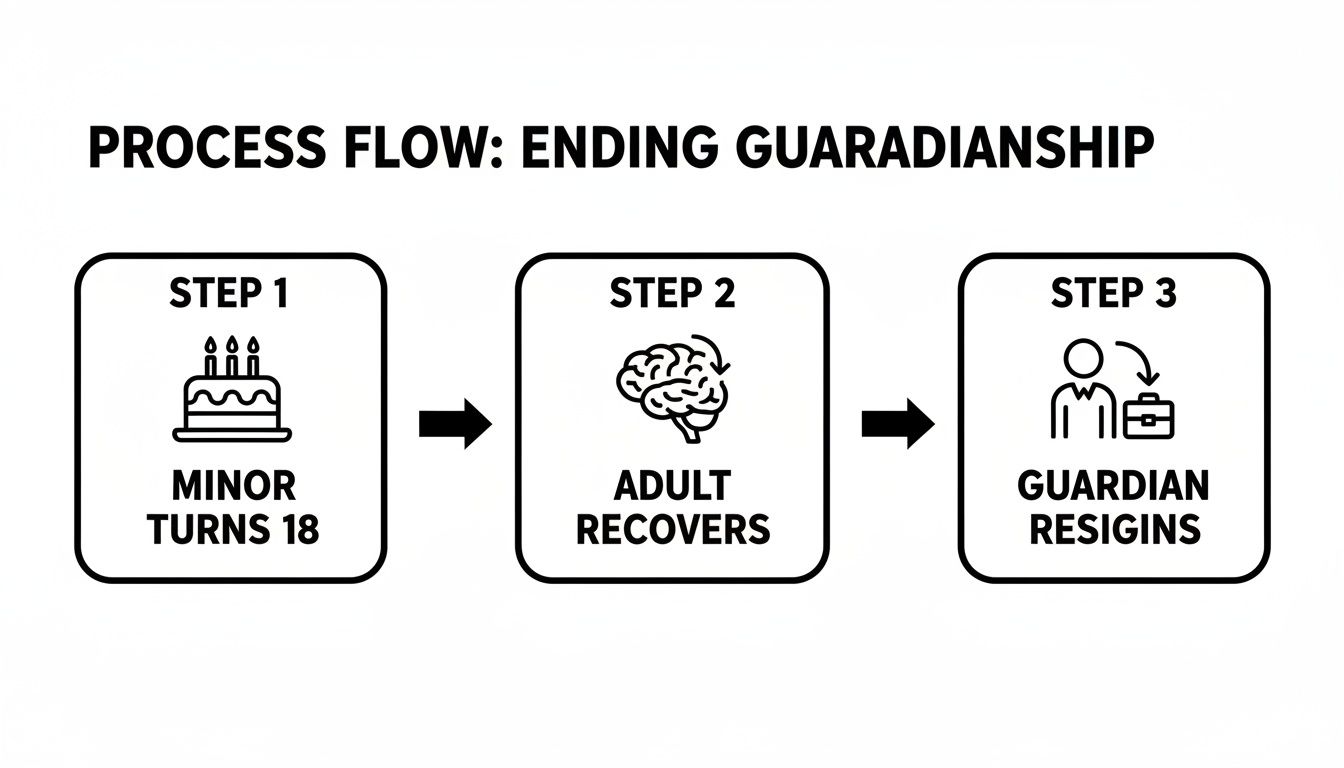
As you can see, terminating a guardianship is a natural part of the lifecycle of care. It can be triggered by a milestone like turning 18, a positive change in health, or a shift in the guardian’s own circumstances.
What to Include in Your Initial Filing
Think of the motion to terminate as your formal request to the judge. It needs to clearly explain who you are, what you’re asking for, and, most importantly, why. While the exact format can vary, a strong motion filed in a Texas probate court, like those in Harris County or Travis County, must clearly state the grounds for termination.
Let’s look at a hypothetical scenario. A family in Austin placed their mother, Sarah, under a Guardianship after a severe stroke. A year later, following extensive rehabilitation, she can communicate clearly, manage her own medications, and wants to handle her small bank account again.
Her son, David, decides to get the ball rolling. His motion would need to lay out:
- The reason for termination: The motion must clearly state that Sarah has regained capacity, making the guardianship unnecessary. It should cite the relevant section of the Texas Estates Code.
- Supporting facts: David would need to briefly explain Sarah's recovery, mentioning her successful rehabilitation and her current abilities as proof.
- Preliminary evidence: While the full evidence comes later, attaching a preliminary letter from Sarah’s doctor is a powerful move. This shows the court from day one that your request is serious and has a real basis in fact.
A Lawyer’s Insight: We always advise clients to gather key documents before filing the motion. Having a recent physician's evaluation in hand when you file demonstrates that your request is serious and well-supported. It sets a positive and professional tone with the court from day one.
Filing this initial motion is what officially starts the process. It puts the court and all interested parties on notice that a change is being requested, setting the stage for the next steps like the formal capacity evaluation and the court hearing.
Navigating these initial filing requirements can be tricky, and a single mistake can cause frustrating delays. If you're considering taking this first step, The Law Office of Bryan Fagan offers a free consultation to help you understand your options and ensure your petition is prepared correctly.
Building Your Case with Compelling Evidence
To successfully end a guardianship in Texas, you can't just tell the judge things have changed. You have to prove it. The court requires "clear and convincing evidence" that the guardianship is no longer necessary. This is a high legal bar, but it’s absolutely achievable when you focus on the two pillars of a solid case.

Let's walk through the essential documents you'll need: the Physician's Certificate of Medical Examination (CME) and the Guardian’s Final Accounting. In our experience, getting these two pieces right is almost always the deciding factor between a smooth termination and a frustrating denial.
The Physician’s Certificate of Medical Examination (CME)
When you're arguing that someone’s capacity has been restored, the single most powerful piece of evidence you can present is the Physician's Certificate of Medical Examination (CME). This is not a simple doctor's note. It's a formal legal document where a physician testifies to the ward's current mental and physical abilities.
A probate judge in any Texas county, from Harris to Bexar, is going to read this document very, very carefully. A vague letter saying the ward "seems better" will not be sufficient. The report must be detailed, conclusive, and speak the court's language.
A strong CME should clearly state:
- A current diagnosis and an explanation of how the ward's condition has improved since the guardianship was created.
- Specific findings on their ability to handle daily life—providing their own food, clothing, and shelter.
- An assessment of their capacity to manage finances, like paying bills and understanding their assets.
- The physician’s expert opinion that the ward is no longer incapacitated and is capable of making their own decisions again.
A Practical Tip from Our Experience: We always work closely with the physician to make sure they understand exactly what the court needs to see. We provide them with the legal standards for capacity so their report directly answers the judge's questions, leaving no room for doubt. This proactive step can prevent the court from ordering a second, independent evaluation, saving significant time and money.
For a deeper look at the type of medical evidence that holds up in court, you might find it helpful to read about proving incapacity in Texas courts, as the same standards apply when proving capacity has returned.
The Guardian’s Final Accounting
The second pillar of your case is the Guardian's Final Accounting. This is a detailed financial report that must be filed with the court, as mandated by Texas Estates Code §1204.001. This document does two very important things.
First, it proves to the court that the guardian has responsibly managed the ward’s money and property. Second, it creates a clean, transparent end to the guardian's financial duties, which helps prevent any future arguments or legal challenges. An inaccurate or incomplete accounting can bring the entire termination process to a dead stop.
We have seen this happen. A guardian in a Dallas County probate court files a motion to terminate with a perfect medical report, but their final accounting is a mess—missing receipts, unexplained withdrawals. This immediately raises red flags for the judge and the court-appointed attorney, who will likely object to the termination until every single penny is accounted for.
Your Final Accounting must be meticulous. It should include:
- A complete list of all income received and all expenses paid for the ward.
- Supporting documentation for every transaction, including bank statements, receipts, and invoices.
- A final inventory of all assets being returned to the ward.
Putting this report together can be exhausting, especially after years of managing someone else's life. It demands patience and a sharp eye for detail. Even honest mistakes can be interpreted as mismanagement, which could jeopardize the termination and even create personal liability for the guardian.
When you build your case with a strong CME and a perfect Final Accounting, you show the court that you are thorough, transparent, and focused on the ward's best interests. It paints the complete picture the judge needs to see: the ward is medically ready for independence, and their finances are in perfect order to make that transition seamless.
What to Expect in the Texas Probate Court
Once you’ve filed the petition to terminate the guardianship and have your evidence ready, the next step is the courtroom. For many families, this is the most intimidating part of the entire process. At The Law Office of Bryan Fagan, we find that a little knowledge goes a long way in replacing that anxiety with confidence.
Knowing what’s coming in a Texas probate court hearing is the key to a smooth and successful outcome.
The first thing that happens after filing is making sure everyone who needs to know, knows. This isn't just a matter of courtesy; it's a strict legal requirement.
Understanding Notice and Service
The court system depends on clear, formal communication. Texas law has a mandatory notification process known as "notice" and "service." This simply means you must legally inform certain people about the date, time, and purpose of the termination hearing.
According to the Texas Estates Code, you are required to serve notice on:
- The Guardian: The current guardian must be officially notified. This allows them to attend the hearing and, most importantly, present their final accounting.
- The Ward: The person under the guardianship has an absolute right to be at the hearing and, if they are able, tell the judge their own wishes.
- Close Relatives: The law specifies which family members must also be notified, giving them a chance to participate if they choose.
- The Attorney Ad Litem: The court appointed an attorney to represent the ward’s best interests, and they must receive notice as well.
This process ensures transparency and gives every interested party a fair opportunity to be heard. Once the court is satisfied that everyone has been properly served, the hearing can move forward.
A Tale of Two Hearings: Uncontested vs. Contested
Guardianship termination hearings typically go one of two ways: uncontested or contested. The path your case follows will dramatically affect the timeline, cost, and emotional toll on your family.
An uncontested hearing is what everyone hopes for. This is when all parties—the guardian, the ward, and the family—agree that the guardianship is no longer necessary. The medical evidence is clear, the final accounting is accurate, and everyone is on the same page. These hearings are usually brief, straightforward, and focused on getting the judge's formal approval.
A contested hearing, on the other hand, is a full-blown disagreement. This can be a form of guardianship dispute where a family member objects, believing the ward hasn't truly regained their capacity. Or perhaps there are serious questions about the guardian's final accounting. These hearings look much more like a trial, with witness testimony, cross-examinations, and legal arguments presented by both sides.
A Lawyer’s Perspective: Even in an uncontested hearing, preparation is critical. A judge in a Harris County Probate Court will still meticulously review the physician's report and the financial accounting. Having every detail in order ensures the judge can confidently sign the order without delay.
What Happens During the Hearing
Let's walk through a typical uncontested hearing, say in a Fort Bend County Probate Court. The ward, their son who filed the petition, the current guardian, and the attorney ad litem are all present.
The judge will start by reviewing the documents you filed: the petition, the physician’s report confirming capacity, and the guardian's final accounting. The judge will likely ask a few direct questions to get a feel for the situation.
- To the ward: "How are you feeling? Do you feel you're ready to manage your own decisions again?"
- To the guardian: "Is this final accounting complete and accurate to the best of your knowledge?"
- To the attorney ad litem: "Have you reviewed the evidence and spoken with the ward? What is your recommendation to the court?"
If all the answers are consistent and the evidence is solid, the judge will almost always grant the petition and sign the order terminating the guardianship. The whole thing might be over in less than 30 minutes.
A special rule applies when the ward is a minor. In Texas, a guardianship of a minor automatically terminates when they turn 18, as mandated by Texas Estates Code §1202.001(a)(1). This law ensures the young adult immediately regains full legal control of their life and finances. It also prompts the guardian to file their final accounting under §1204.001. You can read more about Texas court statistics in their annual report.
Finalizing the Termination and Planning for the Future

Receiving a judge's order to terminate a guardianship is a monumental moment for most families. It brings incredible relief, marking the end of what was likely a long and difficult road. But that signed order isn't the finish line. Think of it more as the green light to start the final, critical process of unwinding the guardianship and officially handing back control.
This last phase is all about the details. It's not just about signing papers; it’s about making sure the transition to independence is smooth, secure, and respectful for your loved one.
The Last Steps to Closing the Guardianship
After the hearing, the guardian still has a few key responsibilities to handle before they can be officially released from their duties. It’s like a final checklist to ensure every loose end is tied up.
The biggest task is transferring control of all assets back to the person who was under the guardianship. This is a hands-on job that goes way beyond just handing over a binder of documents.
Key actions usually involve:
- Retitling Bank Accounts: You'll need to work directly with the bank to remove the guardian's name from the accounts and restore the former ward's sole access.
- Updating Property Deeds: If real estate is involved, you must execute the proper legal documents to transfer the title back into their name.
- Transferring Investments: Any stocks, bonds, or other investments held by the guardianship have to be legally moved back under their control.
Once all these transfers are done and every piece of property has been delivered, the guardian files one last document with the court. This is typically a receipt, signed by the former ward, confirming they've received all their assets.
A Lawyer's Insight: The court won’t just take your word for it. A judge will not close the case until there's clear proof that the ward has their property back. Keeping meticulous records of these final handovers and getting signed acknowledgments is absolutely essential to getting that final discharge order from the court.
The Order of Discharge: The Final Word from the Court
After the court confirms that all assets have been returned and approves the guardian's final report, it will issue an Order of Discharge. This document is incredibly important. It officially releases the guardian from all their duties and liabilities, formally closing the guardianship case in the eyes of the law.
This order is your legal confirmation that you fulfilled your obligations responsibly. For a guardian who may have spent years caring for a loved one, this piece of paper provides critical peace of mind.
This final step also applies in situations where a guardian has to resign for personal reasons or passes away. In Texas, a guardian’s resignation or death doesn't leave the ward unprotected; it triggers specific protocols to find a successor before the outgoing guardian is discharged.
Protecting Future Independence with Proactive Planning
With freedom and control restored, the conversation should immediately turn to the future. How can you help your loved one protect this independence and avoid another guardianship down the road? This is where proactive Estate Planning becomes your most powerful tool.
Now is the perfect time to explore less restrictive alternatives that offer support without removing a person's fundamental rights. These documents empower an individual by letting them choose who they trust to help them, keeping them firmly in the driver's seat.
Consider talking about these powerful options, which are key alternatives to guardianship:
- Durable Power of Attorney: Appoints a trusted agent to help with financial decisions if they're ever needed.
- Medical Power of Attorney: Designates an agent to make healthcare choices if the person is unable to.
- Supported Decision-Making Agreement: A formal agreement in Texas that allows someone to get help from trusted advisors while still being the one to make the final call.
Putting these plans in place is one of the best ways to honor and protect your loved one’s newly restored independence. For a deeper dive into this crucial next phase, take a look at our guide on how to transition from guardianship to independence in Texas.
Common Questions About Terminating Guardianship in Texas
When it’s time to consider ending a guardianship, families understandably have a lot on their minds. It’s a process that mixes complex legal steps with very real human emotions. Here at The Law Office of Bryan Fagan, we’ve walked alongside countless Texas families through this journey, and we find that many of the same questions come up time and again.
Let's clear up some of the most common concerns we hear about terminating a guardianship, giving you the straightforward answers you need to see the path forward.
How Long Does It Take to Terminate a Guardianship in Texas?
The biggest factor influencing the timeline is simple: does everyone agree? If the case is uncontested—meaning the guardian, the ward, and the rest of the family are all on the same page—the process moves much faster. With solid evidence in hand, you can often wrap things up in about 2 to 4 months. This accounts for the time needed to file the petition, serve all the required notices, and get a date for the court hearing.
Things change dramatically if the termination is contested. When there are disagreements, perhaps over whether the ward has truly regained their capacity or disputes about the guardian's final financial accounting, you're looking at a more formal court battle. In busy probate courts like those in Harris County or Dallas County, a contested case can easily stretch from 6 months to over a year.
What Are the Estimated Costs to End a Guardianship?
The cost to end a guardianship can vary significantly, so it’s wise to understand the potential expenses from the start.
- Court Filing Fees: Every courthouse charges a fee just to file the initial motion.
- Physician's Evaluation (CME): The doctor providing the crucial Certificate of Medical Examination will have a fee for their time and the detailed report.
- Court-Appointed Attorney Fees: In most cases, the court will appoint an attorney to represent the ward's best interests. These fees are usually paid out of the ward's estate.
- Your Own Attorney’s Fees: This is often the biggest variable. The cost depends entirely on the complexity of your case.
A clean, uncontested termination might only cost a few thousand dollars. On the other hand, a complex case that goes all the way to a contested hearing will be substantially more expensive. We always offer a free consultation to review your family’s situation and give you a much clearer cost estimate.
We know that finances are a huge part of the equation. Our promise is to be transparent about potential costs so your family can move forward with confidence and no unwelcome surprises.
What Happens if the Court Denies the Termination Request?
If a judge denies the request, it simply means the evidence presented wasn't strong enough to convince the court that the guardianship is no longer necessary. The current guardianship stays in effect, and the guardian continues their duties just as before.
But a denial isn't always the final word. Often, it shines a light on what was missing from your case. If the ward’s health and abilities continue to improve, you can file a new motion down the road, this time with stronger, more up-to-date medical evidence. A skilled attorney can dissect the judge's ruling and help you build a more compelling case for the next attempt.
Can We Replace the Guardianship with Something Less Restrictive?
Absolutely, and in fact, Texas law strongly encourages it. The courts always operate on the principle of using the "least restrictive alternative" possible to support an individual. If a full guardianship is no longer the right fit, but your loved one still needs some level of support, the court has the power to modify the guardianship or replace it with a different tool.
Coming to court with a well-thought-out, less restrictive plan is an incredibly powerful strategy. This could involve things like a Supported Decision-Making Agreement, a special needs trust, a Probate plan, or specific powers of attorney. Presenting these options shows the judge you're focused on empowering your loved one and maximizing their independence, which is always the ultimate goal.
The journey of terminating guardianship in Texas is a major legal and emotional milestone for any family. Having an experienced legal team in your corner can make all the difference. At The Law Office of Bryan Fagan, PLLC, we’re here to provide the compassionate, knowledgeable guidance you need. Schedule a free consultation today to talk about your family’s unique situation and let us help you map out a clear path forward.