Skip to content
A daughter in Texas may start the day by taking her mother to a neurology appointment, spend the afternoon handling Medicaid paperwork, and end the evening paying bills from her mother's account. If a court has appointed her guardian of both the person and the estate, she isn't only providing family care. She's making legally controlled decisions about health, housing, income, property, and court reporting.
That arrangement can provide continuity, especially when a trusted relative already manages most of the loved one's daily needs. It can also create a serious same person guardian of the person and estate Texas conflict when one individual controls medical consent, living arrangements, and the checkbook without enough independent review. The conflict may involve spending, inheritance, an injury settlement, medical care, or missed reports.
Texas law gives courts tools to prevent and correct these problems. The key is understanding what each role requires, what records families should watch, and when a court may divide the roles or replace the guardian.
When One Person Handles Both Care and Money in Texas
Maria's mother suffered a stroke and could no longer manage her own affairs safely. After a guardianship proceeding, Maria became guardian of both her mother's person and estate. Maria arranged doctor visits, made decisions about daily care, completed Medicaid paperwork, paid the mortgage, and used her mother's funds for approved needs.
At first, the arrangement seemed practical. Maria lived nearby and understood her mother's routines. A second guardian might have caused delays or disagreements. By keeping both roles with one person, the family had a single contact for doctors, banks, and the court.
The same structure also placed substantial authority in Maria's hands. She controlled the medical consent forms and the financial accounts. If a sibling questioned a purchase or disagreed with a care decision, the family needed records and court procedures to examine what happened. A good relationship before the appointment didn't guarantee that every later decision would remain clear.
Why Texas permits the combined appointment
Texas recognizes both a guardian of the person and a guardian of the estate. The person guardian generally handles personal needs, including care, living arrangements, and health decisions. The estate guardian manages income, property, expenses, and financial claims. Texas law allows one individual to serve in both capacities, but it also permits the court to separate them when doing so serves the ward's best interest. The Texas Department of Family and Protective Services describes this distinction in its guardianship responsibilities guidance.
That flexibility lets a judge tailor authority to the person's actual needs. A family member may be well suited to coordinate care but not have the experience or neutrality needed to manage a complicated estate.
Efficiency versus oversight
The combined appointment can reduce duplication, but it removes an automatic division between care decisions and financial decisions. That tension drives many disputes. Texas Estates Code duties still apply to both offices when one person holds both roles, so the guardian must meet the separate standards for personal care and estate management at the same time.
Practical rule: Convenience may support one appointment, but convenience never excuses incomplete records, personal use of ward funds, or missed court filings.
How Texas Law Treats Guardian of the Person and the Estate
A family member may be appointed to handle both an older adult's care and finances. That arrangement can work, but the appointment does not create one broad, unlimited power. Texas law treats the two roles as separate offices, with different responsibilities and different records for the court to review.
A guardian of the person makes authorized decisions about the ward's personal needs. Depending on the court's order, those decisions may involve medical care, residence, clothing, food, and daily support. A guardian of the estate protects and manages the ward's assets, income, property, debts, and financial claims.
Chapter 1104 permits one person to serve in both capacities. It also allows the court to separate the roles when that better protects the ward. The order of appointment controls the guardian's authority, so the guardian must read it carefully rather than assume that one appointment covers every personal or financial decision. Texas Estates Code Section 1104.001 provides part of the statutory framework for these appointments.
Two offices mean two annual obligations
The reporting burden often exposes problems in a combined appointment. A guardian of the estate must file an annual account, while a guardian of the person must file an annual report. Texas court guidance states that each filing is due within 60 days after the anniversary of qualification.
The annual account records receipts and expenditures from guardianship funds. The annual report describes the ward's mental and physical condition, social and intellectual functioning, and living conditions. They are separate filings because they answer different questions, even when one guardian prepares both. Families can review a detailed look at how the annual report and annual accounting differ.
| Duty Area | Guardian of the Person | Guardian of the Estate |
|---|---|---|
| Primary focus | Personal care, health, residence, and daily needs | Assets, income, property, expenses, and claims |
| Main annual filing | Report concerning the ward's condition and living circumstances | Account showing guardianship receipts and expenditures |
| Core protection | Safe, appropriate care and respect for remaining abilities | Accurate records, separate funds, and responsible financial management |
| Typical records | Medical information, care details, and living arrangements | Bank statements, receipts, inventories, and transaction records |
Families reviewing the court process can consult How to Get Guardianship in Texas: The Process, which explains how a guardianship is established.
A guardian also owes fiduciary duties, including loyalty and careful management. If an estate is involved, the court may require a bond. Ward funds must stay separate from the guardian's personal funds, and records should allow the court and interested parties to understand each transaction without guessing.
Training and oversight expectations matter especially in guardianships involving older adults. The Texas Judicial Branch materials describe the scale of combined appointments and the reporting systems used to monitor guardianships. They report 15,492 active guardianship cases, including 4,439 involving both the person and estate, about 28.7% of the cases analyzed. The materials also report 4,539 guardianships granted statewide in 2014 and 3,376 in 2021, a 26% decrease. A later Texas Courts annual report states that 8,600 guardianship cases were filed in 2023 and active guardianships increased by 2% from the previous year. These figures appear in the Texas Judicial Branch guardianship materials.
Common Conflicts When One Person Holds Both Roles
Most disputes don't begin with an obvious theft or a dramatic medical emergency. They often begin with a transaction that isn't explained, a family member who can't obtain records, or a guardian who treats the ward's money as household money.
Financial self-dealing
A guardian may face scrutiny if ward funds pay the guardian's personal expenses, support another relative, or purchase property for the guardian's benefit. Even when the guardian believes the expense is reasonable, the transaction can be improper if it benefits the guardian rather than the ward or lacks court approval.
Texas law addresses disqualifying financial conflicts. A proposed guardian generally may not be appointed if the person is indebted to the ward or asserts an adverse claim against the ward or the ward's property, unless the legal requirements for addressing that conflict are satisfied. The statute is discussed in Texas Estates Code Section 1104.354.
Inheritance and family pressure
A guardian who expects to inherit may face questions when deciding whether to sell property, make distributions, settle a claim, or spend down assets. Being a beneficiary doesn't automatically prove misconduct. It does mean the guardian should document the decision, avoid personal benefit, and follow the court's instructions.
A sibling who objects should focus on evidence rather than accusations. Bank records, receipts, court orders, appraisals, and communications can show whether the decision served the ward.
Injury claims and settlements
A personal injury claim creates another layer of risk. The guardian of the estate may need to protect the ward's claim, negotiate with an insurer, or work with counsel. If the guardian has a personal connection to the dispute or seeks an outcome that benefits someone else, the conflict may affect the guardian's ability to act loyally.
Texas judicial standards emphasize accurate accounting, separate estate records, and keeping ward funds segregated from personal funds. A family member who sees unexplained settlement activity should seek the court's review rather than attempt to take control of the account independently.
Mingled funds
Mingling happens when a guardian deposits ward income into a personal account, pays shared expenses without a clear allocation, or uses one debit card for both people. That practice makes the annual account difficult to verify and can create the appearance of concealment even when the guardian intended to help.
The Texas guardian conflict of interest resource can help families identify warning signs. In court, the annual account and separate-account requirement give the judge a way to test whether funds were handled properly. Major transactions, such as selling the ward's home, may also require court approval.
The ward may have rights to participate in hearings, subject to the court's order and applicable law. A concerned relative should preserve records and raise the issue through the probate court instead of withholding information or confronting the guardian in a way that could disrupt care.
How Courts Evaluate and Resolve a Dual Guardianship Conflict
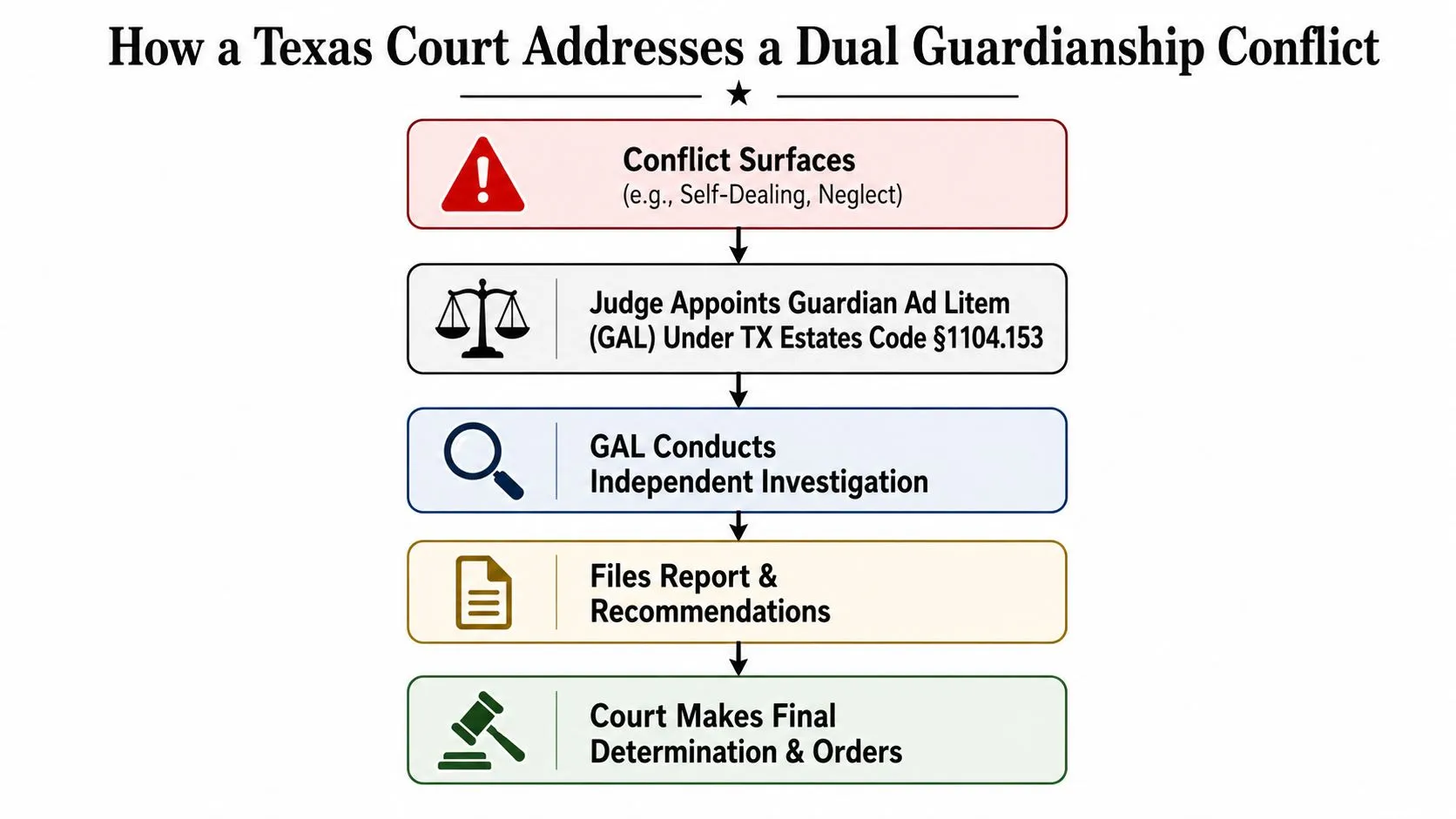
Once a conflict reaches a Texas probate court, the judge focuses on the ward's protection and the reliability of the evidence. The court may set a show cause hearing, require the guardian to answer allegations on the record, and consider testimony, bank records, medical information, annual filings, and other documents.
Independent investigation
One early safeguard is appointment of a guardian ad litem, or GAL, under Texas Estates Code Section 1104.153. The GAL investigates the allegations independently and reports recommendations to the court. A GAL isn't the same as the guardian. The GAL's assignment is to help the court evaluate the ward's interests in the conflict.
Possible court responses
The judge has several options, depending on the evidence and the immediate risk:
- Order a complete accounting: The court may require clearer records of receipts, payments, transfers, and remaining assets.
- Require a personal report: The guardian may need to provide updated information about the ward's health, care, living conditions, and functioning.
- Separate the roles: One person may remain guardian of the person while another manages the estate.
- Require or increase a surety bond: Section 1104.152 addresses bond protection for the estate.
- Restrict specific powers: The court may suspend or narrow authority over a transaction or category of decisions.
- Remove and replace the guardian: Section 1202.052 provides a removal framework when the evidence supports that result.
A visiting judge may hear the matter when assigned by the court. Families may also hear lawyers discuss whether the evidence meets a clear and convincing standard. The exact procedure depends on the pleading, the court, and the facts, so a family shouldn't treat a general courtroom phrase as a substitute for legal advice.
Alternatives Texas Families Should Consider First
Guardianship can protect someone who cannot safely make personal or financial decisions, but it also restricts legal independence. Texas law lists less restrictive tools, including powers of attorney, representative payees, trusts, joint accounts, and supported decision-making. The Estates Code definition of alternatives appears in Section 1002.0015.
A court should consider whether an alternative can adequately protect the proposed ward before imposing a broader guardianship. The right option depends on capacity, the type of help needed, and whether the person can still express informed choices.
| Tool | What It Covers | Key Limitation | Estates Code Reference |
|---|---|---|---|
| Medical power of attorney | Health and medical decisions | It doesn't manage money or property | Chapter 166 |
| Durable power of attorney | Financial and legal matters | It depends on valid execution and appropriate authority | Texas durable power of attorney provisions |
| Supported decision-making | Assistance while the adult keeps legal authority | It may not work if the person can't understand or communicate choices | Chapter 1357 |
| Trust | Management of assets by a trustee | It doesn't automatically resolve every personal-care decision | Trust provisions and applicable estate law |
A medical power of attorney may fit when the main need involves treatment decisions. A durable power of attorney may help with banking, property, and bills if the loved one still has the required capacity when signing. Supported decision-making can let an adult choose trusted helpers without automatically transferring legal authority.
A trust may provide a way to manage assets through a successor trustee. It doesn't replace every guardianship function, especially when personal care or medical authority remains unresolved. Families should also be cautious with joint accounts, because shared access can create its own ownership and misuse disputes.
The Texas resource on when a trust can replace guardianship offers another way to compare trust planning with court-supervised guardianship.
A Realistic Scenario of a Texas Family Catching a Conflict Early
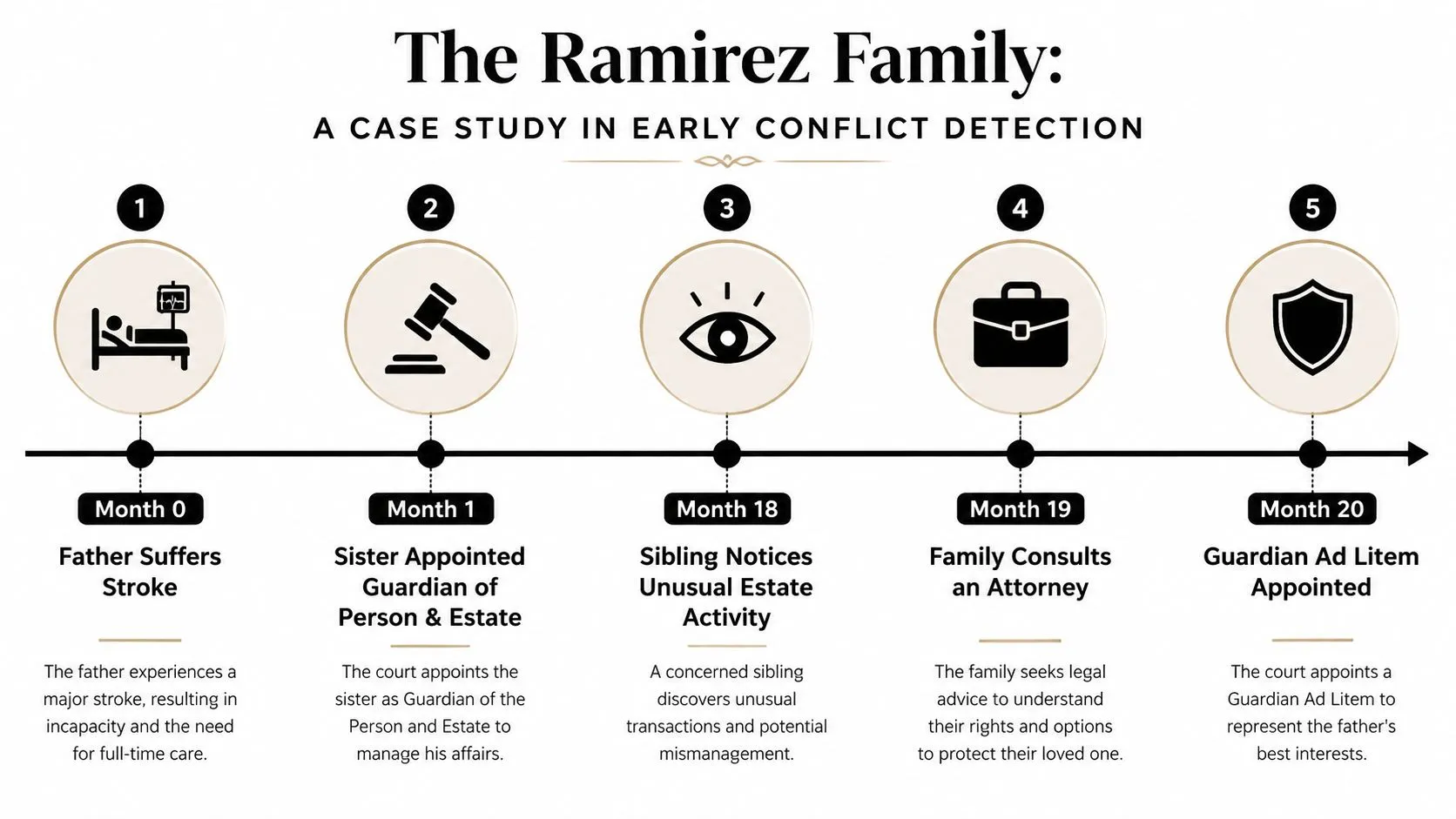
The Ramirez family lived in Bexar County. After their father suffered a stroke, an older sister became guardian of both his person and estate. She coordinated his care and paid expenses from the guardianship account.
Eighteen months later, a sibling reviewed the annual account and noticed recurring charges at a hardware store, a new car payment, and a vacation their father never took. Those entries didn't prove the full story, but they raised specific questions that the family could document.
The first court filings
The sibling requested copies of the annual account and annual report, then compared the listed transactions with available bank and medical records. The family filed a complaint or motion with the probate court and asked for an independent review under Texas Estates Code Section 1104.153.
The filings in this hypothetical included:
- Motion for Accounting: Requesting complete records and explanations for questioned transactions.
- Motion to Appoint Guardian Ad Litem: Asking the judge to appoint a GAL to investigate independently.
- Motion to Remove Guardian if Needed: Seeking removal only if the evidence showed that continued service endangered the ward or estate.
- Request for a show cause hearing: Asking the guardian to respond in court and address the unexplained activity.
The family's lawyer explained that the first hearing might occur within a case-specific period rather than immediately. For this hypothetical, the timeline from filing to the first hearing was 30 to 90 days, depending on the court's schedule and the nature of the requested relief. That timeline is an example of case planning, not a guaranteed Texas deadline.
Early oversight can limit harm
If the evidence supports immediate protection, the court may freeze or restrict access to accounts, require restitution, or divide the guardianship roles. The judge might leave the sister responsible for personal care while appointing another qualified person to manage the estate.
The important point is that the sibling didn't try to cancel the sister's debit card or remove her from the home. The family used records, formal motions, and court supervision. Early attention gave the court a chance to protect the estate while preserving stable care.
Practical Steps to Protect Your Loved One and When to Call a Lawyer
A family facing a proposed or existing combined guardianship needs a plan that protects both the ward and the integrity of the court record. These steps can help organize the process.
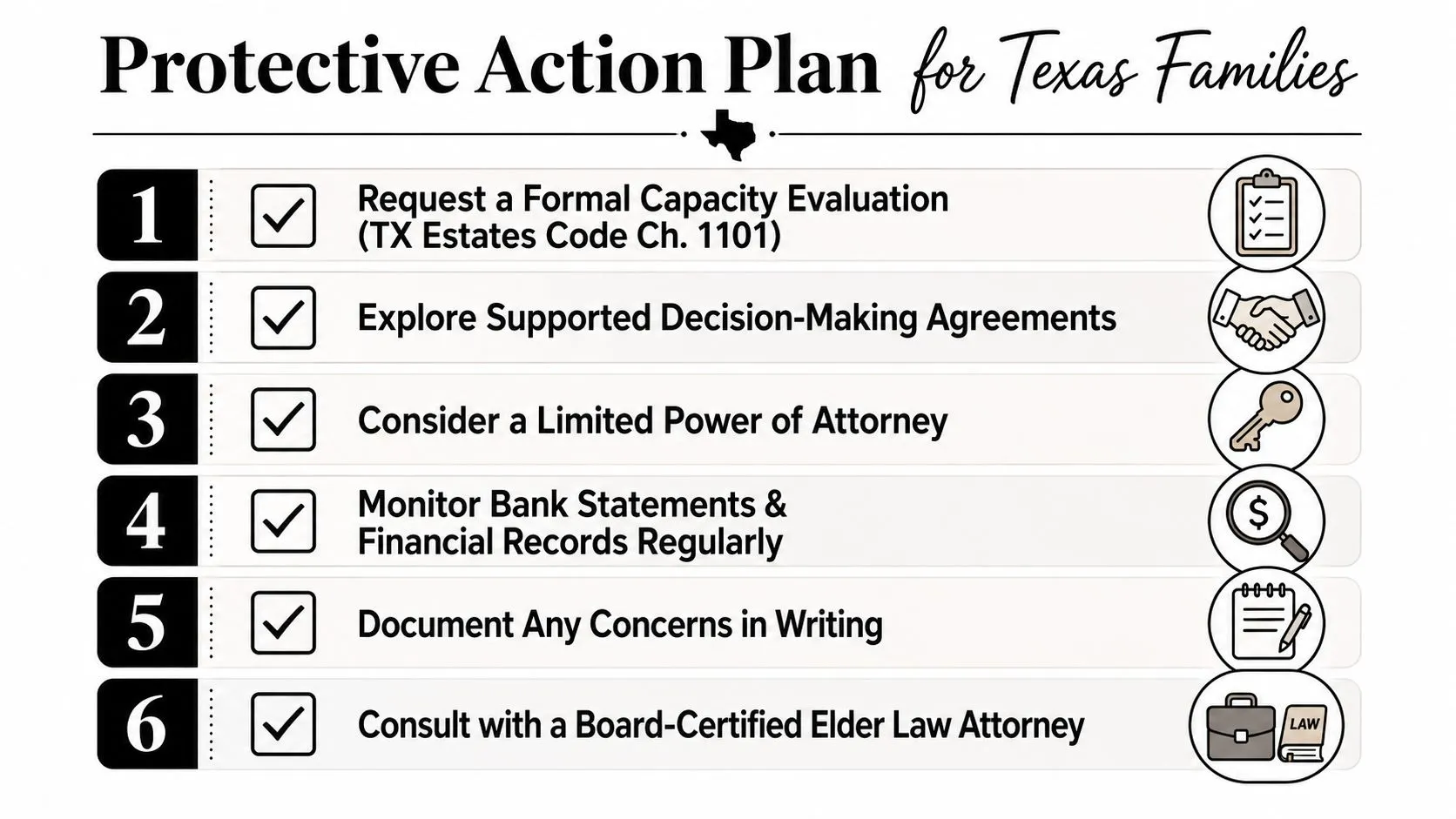
Request a capacity evaluation before filing. Chapter 1101 of the Texas Estates Code provides the framework for determining whether guardianship is necessary. Ask the appropriate medical professional to address the person's functional limitations, not merely a diagnosis. A diagnosis alone doesn't answer every guardianship question.
Consider less restrictive support. Review supported decision-making, a medical power of attorney, a durable power of attorney, trusts, and other available tools. If one option can protect the person adequately, explain that option to the court.
Ask about limited authority. During the hearing, ask whether the court can divide personal and estate responsibilities or grant only the powers needed. A limited order may reduce the risk created by giving one person control over every area of life.
Address the bond and estate safeguards. Ask the court about the bond requirements under Texas Estates Code Section 1104.402 and whether the order requires adequate protection for estate assets. Request separate inventories for the person and estate under Section 1104.053 when appropriate, so the court's records clearly identify personal needs and property.
Track both annual filings. After appointment, calendar the annual report of the person and the annual accounting of the estate. Each is due within 60 days after the anniversary of qualification, as described in the Texas statutory guidance linked earlier. Compare the account with bank statements and receipts, and compare the personal report with medical and care records.
Document every questionable transaction. Keep copies of receipts, reimbursement requests, gifts, transfers, account statements, and communications. If funds were mingled, identify the date, account, amount, and reason instead of describing the concern only as “missing money.”
Use a verified complaint when needed. Texas Estates Code Section 1151.053 provides a procedure for a verified complaint. A verified filing can give the court specific facts to evaluate, especially when a guardian failed to report or refused to explain financial activity.
Prepare for a hearing. Bring organized records, a short timeline, and clear requests. A court responds more effectively to “these three withdrawals lack receipts” than to a general claim that the guardian cannot be trusted.
Temporary guardianship may be appropriate when an immediate danger requires prompt action. Texas law requires a hearing within 10 days after the application is filed, unless the proposed ward or the ward's lawyer agrees to postpone it for up to 30 days, under Texas Estates Code Section 1251.006. A temporary guardianship generally cannot last more than 60 days, and the order must state the reasons and exact powers granted under Section 1251.010.
Training and oversight also matter. Texas provides mandatory training requirements for certain guardians of older adults or people with Alzheimer's disease, dementia, or related disorders under Texas Estates Code Section 1151.004. Families should ask the clerk or court about training obligations that apply to the appointment and should keep proof of completed requirements.
The Law Office of Bryan Fagan, PLLC can help families evaluate a proposed combined appointment, prepare guardianship filings, coordinate capacity information, respond to disputes, and address reporting or fiduciary concerns. Before signing guardianship paperwork or objecting to a same-person appointment in Harris County Probate Court, Montgomery County, or Fort Bend County, schedule a free consultation so you can understand the available options and protect your loved one's care and property.
Guardianship, probate, and estate planning decisions often overlap, so families may need coordinated advice rather than a single form.
The Law Office of Bryan Fagan, PLLC offers personalized guidance for establishing, modifying, or contesting Texas guardianships, including disputes involving combined personal and estate appointments. Visit the firm to schedule a free consultation before a hearing, after a concerning transaction, or when you need help choosing a less restrictive alternative.