Skip to content
Caring for a loved one can shift slowly, then all at once. One month, your mother is paying her bills and keeping her appointments. A few months later, you notice unopened mail, confusion about medications, or a growing fear of leaving the house. For parents of an adult child with disabilities, the change may look different. Graduation is near, adulthood is arriving, and you're wondering how to help without taking away more independence than necessary.
That's where many families start looking for a Guardianship Attorney in Houston. They're not looking for a court battle. They're looking for a safe path, a clear answer, and someone who can explain what Texas law expects.
Guardianship is a serious legal step under Texas Estates Code Title 3, Subtitle G. It can give a responsible adult authority to help with personal decisions, financial decisions, or both when a person can't safely manage those matters alone. It also places the guardian under court supervision, which is meant to protect the person at the center of the case.
Families often feel guilty even asking about guardianship. That feeling is common. So is the confusion. The process involves probate court, medical evidence, notice requirements, hearings, and ongoing reporting duties. But there is a structure to it, and with the right guidance, families can move through it carefully and respectfully.
When Your Loved One Needs Help Navigating Life
Maria first noticed the change when her father began accusing neighbors of taking things that were still in his house. Then he forgot a medical appointment, stopped opening bank statements, and gave money to strangers who called him on the phone. Her family argued for weeks. One sibling said, “He's fine.” Another said, “We have to do something now.”
That's a common Houston family story. The legal issue usually arrives after the emotional one.

When concern turns into a legal question
A loved one may still have good days. They may still recognize family, express preferences, or handle some tasks. That's why families often hesitate. They don't want to overreact. They also don't want to wait until a financial loss, medical emergency, or unsafe living situation forces a crisis.
In Texas, guardianship exists to protect someone who can't manage important parts of life safely. It's not supposed to be a punishment or a shortcut for family convenience. Courts treat it as a last resort because it can limit a person's rights.
That said, the need is far from rare. Texas oversees more than 50,000 active guardianships statewide, with approximately 60% of these cases involving seniors over the age of 65, most directly linked to dementia or Alzheimer's disease (Texas guardianship data for aging families). That tells families something important. You're not alone, and the courts see these situations often.
What families can do right away
Before filing anything, start with practical observations.
- Write down changes: Keep notes about missed medications, wandering, unpaid bills, falls, confusion, or unsafe decisions.
- Gather documents: Collect medical records, contact information for doctors, powers of attorney, and any prior planning documents.
- Look for daily support: Transportation can become an early problem. For medical visits in Houston, some families find community help through Texas Medical Center free rides, especially when getting to appointments has become part of the larger caregiving burden.
Guardianship cases often begin with ordinary warning signs, not dramatic events. The small details matter.
Families also need reassurance on one point. Asking whether guardianship may be needed does not mean you've already decided on full control. It means you're trying to protect someone thoughtfully, which is exactly what the law expects.
The Role of a Guardianship Attorney in Texas Law
When a family first calls about guardianship, the question is rarely, “What form do we file?” It is usually something more human. “How do we keep Mom safe without taking away more independence than necessary?” That is the heart of a Texas guardianship case, and a good attorney helps the family answer that question carefully.
A guardianship attorney serves two jobs at once. The lawyer helps the court follow Texas law, and helps the family understand what the law is trying to protect. In other words, the attorney is not just handling paperwork. The attorney is helping the family sort out risk, capacity, rights, and practical care.
What a guardianship attorney does
A Guardianship Attorney in Houston often starts with one basic issue: is guardianship even the right tool under Texas Estates Code Title 3, Subtitle G? Families are often surprised by this step. They may expect the lawyer to rush into filing. A careful attorney slows the process down enough to ask whether a less restrictive option could solve the problem.
That early review matters because guardianship is one of the strongest remedies a probate court can order. It can shift decision-making power over health care, living arrangements, money, or all three. Texas courts do not treat that lightly, and neither should counsel.
The attorney's work usually includes:
- Reviewing alternatives first: The lawyer should examine powers of attorney, medical directives, representative payee options, and supported decision-making before recommending a court case.
- Defining the scope of the request: Some people need help only with finances. Others need help with personal care decisions too. The court should tailor the order to the person's real limits, not the family's fear.
- Preparing the guardianship application: The filing must give the court clear facts about the proposed ward, the concerns about capacity, and the authority being requested.
- Handling procedure and deadlines: Service, notices, medical evidence, and local court requirements can affect whether the case moves smoothly or gets delayed.
- Preparing the family for the hearing: The judge may ask what risks exist, what alternatives were considered, and why the requested guardianship is no broader than necessary.
- Explaining duties after appointment: A lawyer should also prepare the proposed guardian for the reporting, recordkeeping, and fiduciary duties that continue after the court signs the order.
A useful way to view the attorney's role is this: the lawyer works like both a translator and a guardrail. The attorney translates legal rules into plain language, and helps keep the family from asking the court for either too little protection or too much control.
Two different forms of guardianship
One of the biggest areas of confusion is that Texas guardianship is not a single all-purpose order. The court may appoint a guardian over personal decisions, financial decisions, or both.
| Aspect | Guardianship of the Person | Guardianship of the Estate |
|---|---|---|
| Main purpose | Helps with personal care and daily life decisions | Helps with money, property, and financial management |
| Typical decisions | Medical care, living arrangements, education, support services | Paying bills, protecting assets, handling income, court-approved transactions |
| Who may need it | A person who can't safely manage health or personal needs | A person who can't responsibly manage finances or property |
| Court oversight | Ongoing reporting about the ward's condition and care | Ongoing accounting and asset management oversight |
| Can one person hold both roles | Sometimes, yes | Sometimes, yes |
That distinction shapes the whole case. A young adult with an intellectual disability may make sound personal choices but need help managing benefits or larger financial decisions. An older adult with advanced dementia may need help with medical care, housing, and money. The court is supposed to match the order to the person's remaining abilities.
Plain-English rule: The court should remove only the rights that truly need protection.
This is also why alternatives matter so much. If a loved one can still understand choices with guidance, Supported Decision-Making may preserve more dignity and independence than a full guardianship. A thoughtful attorney should discuss that openly, even if the family came in expecting a court order from day one.
Families often feel guilty during this stage. They worry that asking about guardianship means they are taking over someone's life. In many cases, the legal question is narrower than that. The primary goal is to build the least restrictive structure that keeps the person safe, respects what they can still do, and gives the court enough assurance that someone responsible is in place.
Navigating the Guardianship Process in Harris County
The probate process worries families because it feels formal and unfamiliar. In Harris County, it helps to think of guardianship as a sequence of checkpoints rather than one giant legal event.
Early in the process, many families benefit from seeing the road map in one place.
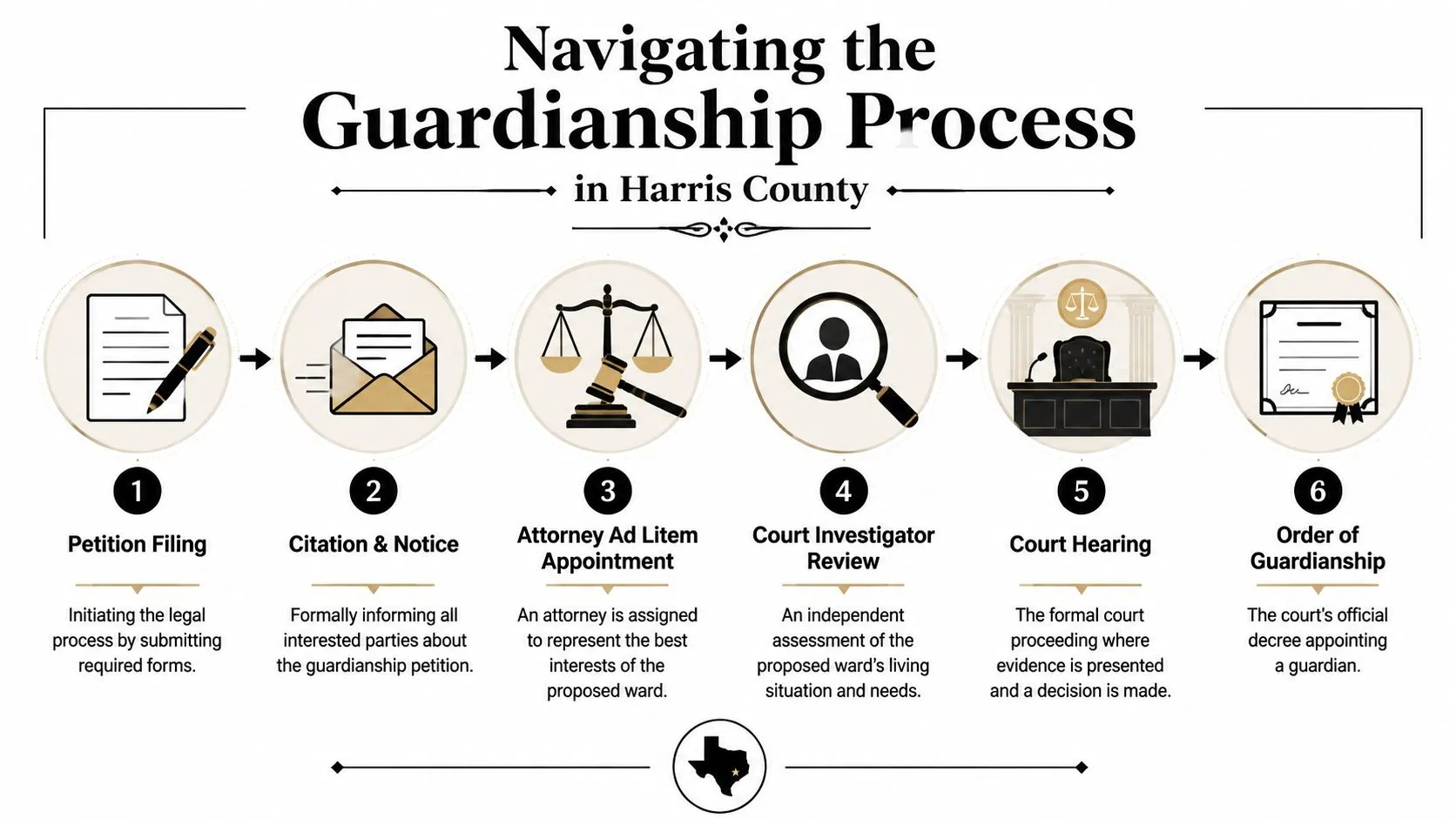
The basic path through probate court
In a typical case, the process often unfolds like this:
The family meets with counsel
The first meeting is about facts. What is happening? What risks exist right now? Is there a power of attorney already in place? Could a less restrictive option solve the problem?
An application is filed
The applicant files a formal request with the probate court. In Harris County, this usually goes through the appropriate probate court handling guardianship matters.
Notice and service happen
The proposed ward and other required parties must receive proper notice. This is a due-process step. The case cannot move forward fairly if the person at the center of it hasn't been informed.
Medical evidence is gathered
The court will expect evidence about the person's capacity. Families often get confused here because concern alone isn't enough. The judge needs proof that legal protection is necessary.
The court appoints an attorney ad litem
This lawyer represents the interests of the proposed ward, not the family member who filed the case.
The court reviews the situation
Depending on the case, the court may require additional review or information about the person's condition and living circumstances.
A hearing is held
The judge hears evidence, considers whether guardianship is the last resort, and decides whether to appoint a guardian and how broad the authority should be.
What Harris County families should expect
A straightforward, uncontested case usually does not end in a week or two. In Texas, a straightforward, uncontested guardianship case typically takes between two and four months from the date the application is filed until the judge signs the final order granting guardianship (Texas guardianship filing timeline). That period can feel long when a loved one is struggling, but it reflects the court's obligation to protect the person's rights.
The same source explains an important point many families miss. A court will not grant guardianship unless it is shown to be the last resort. That means the applicant must show why less restrictive options, such as a Durable Power of Attorney, Medical Power of Attorney, or supported decision-making agreement, won't work.
Temporary and emergency guardianship concerns
Some families don't have months to wait comfortably. A parent may be in immediate medical danger. An adult child may be at risk of exploitation. A vulnerable person may be facing a housing collapse or urgent financial harm.
In those situations, families often ask about temporary or emergency guardianship. The court may allow shorter-term protective relief in some circumstances, but the legal burden is still serious. Judges want specific facts about immediate risk, not just general worry.
If there's urgent danger, don't wait for the situation to fix itself. Document the risk and get legal advice quickly.
A contested case looks very different from an uncontested one. If siblings disagree, if someone questions incapacity, or if another relative claims the applicant is unfit, the hearing can become more involved. The court may hear testimony about caregiving history, family conflict, finances, and the proposed ward's actual abilities.
Families who want a visual explanation often find it easier to understand the court path when they can see it presented step by step.
Practical preparation before the hearing
A few small actions can make a big difference.
- Stay organized: Keep one folder for court papers, one for medical records, and one for financial records.
- Be specific: “Mom is confused” is less helpful than “Mom forgot insulin doses and gave her debit card to a stranger.”
- Prepare respectfully: The person at the center of the case is still a person with rights, preferences, and dignity.
That approach matters in every Harris County Probate Court hearing.
Typical Costs and Timelines for Guardianship in Houston
For many families, cost is the hardest part to ask about. They're already facing medical bills, care expenses, work disruptions, and family stress. Guardianship adds another layer.
Fixed court costs you can plan for
Some costs are set by local procedure. In Harris County, guardianship proceedings involve an initial filing fee of $360 for most new estates, plus a mandatory Attorney Ad Litem deposit of $750.00 to represent the interests of the proposed ward (Harris County probate fee overview).
Those aren't the only possible expenses, but they are important starting points because families can build around them early. The same Harris County fee overview also notes other court-related charges, such as certified-copy fees and possible fees for late filings. Those details matter because guardianship is not only about getting appointed. It's also about staying in compliance after appointment.
Other costs families often encounter
Beyond the fixed court amounts, families should expect possible expenses in areas like these:
- Attorney's fees: Legal fees depend on whether the matter is uncontested, urgent, or disputed.
- Medical evaluation costs: The court process usually requires medical support for the incapacity claim.
- Bond-related costs: If a bond is required, the guardian must qualify before receiving authority.
- Ongoing compliance expenses: Annual filings and administration can create recurring obligations.
A useful background read for budgeting is what families actually pay in Texas guardianship cases. It helps families think in categories rather than guessing blindly.
Time is part of the cost
Money isn't the only burden. Time matters too. Court preparation, document collection, family communication, physician coordination, and hearing attendance all require attention. Even when a case is legally straightforward, caregiving pressure often makes the process feel heavier.
A hypothetical example shows why planning helps. Suppose a daughter in Houston is seeking guardianship over her father after repeated confusion with medications and banking. She may need to gather medical records, coordinate with siblings, pay court costs, respond to the attorney ad litem, and keep her father stable during the process. None of that is impossible. It just works better when the family expects a process rather than a quick signature.
Budgeting advice: Ask early which costs are fixed by the court, which depend on the facts, and which may continue after appointment.
Families usually feel more in control once the unknowns become categories they can prepare for.
Are There Alternatives to Guardianship in Texas?
Guardianship is powerful. It can also be more restrictive than a family needs. That's why Texas courts look closely at alternatives before removing decision-making rights.
A visual comparison can help families sort through the choices.
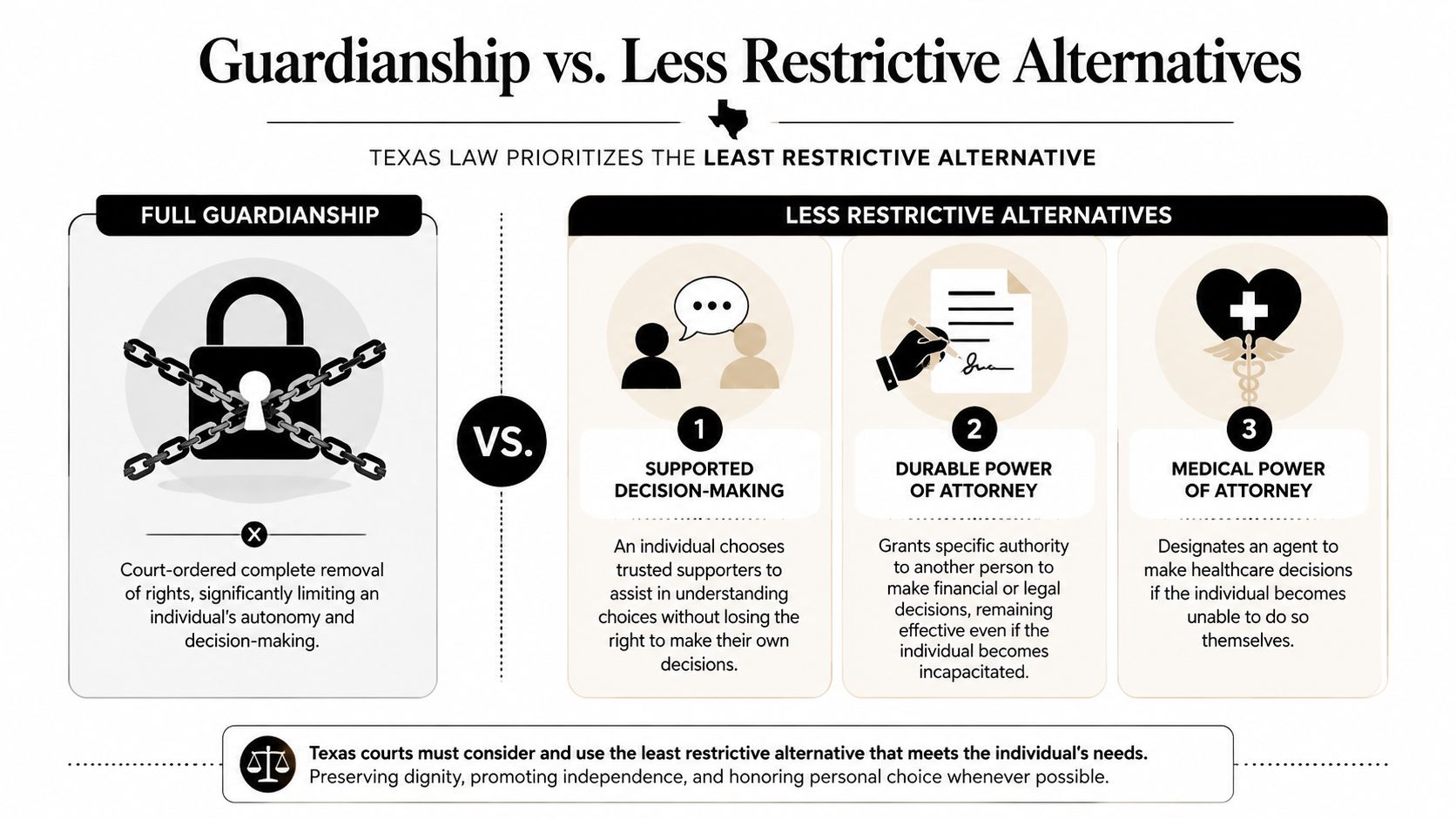
Common less restrictive options
Some families can solve the problem without filing for full guardianship. The right tool depends on the person's current abilities and whether they can still understand and sign legal documents.
| Option | What it does | When it may fit |
|---|---|---|
| Durable Power of Attorney | Lets a chosen agent handle financial or legal matters | When the person can still validly sign and wants to plan ahead |
| Medical Power of Attorney | Lets a chosen agent make health care decisions in certain situations | When medical decision-making support is the main concern |
| Supported Decision-Making | Lets the person keep legal rights while getting help understanding choices | When the person can make decisions with support |
| Full Guardianship | Gives court-supervised authority over personal, financial, or both categories | When other tools won't safely protect the person |
Families who are still learning the difference between planning tools may benefit from a general guide to understanding power of attorney, especially when the concern is authority over health or finances rather than total incapacity.
Supported Decision-Making deserves close attention
Supported Decision-Making, often called SDM, is especially important for families of adults with disabilities. It allows a person to choose trusted supporters who help explain options, review information, and communicate decisions. The person keeps the right to decide.
Texas judges increasingly prefer Supported Decision-Making when an individual can perform some tasks with support. This alternative preserves the person's legal dignity and autonomy without stripping their rights, avoiding the high costs and "loss of control" associated with traditional guardianship (Texas SDM discussion).
That doesn't mean SDM fits every case. If a person cannot understand choices even with support, or is at serious risk of harm or exploitation, guardianship may still be necessary. But courts want families to consider this option seriously.
How families can decide
Try asking these questions:
- Can your loved one understand a choice if someone explains it slowly?
- Can they communicate a consistent preference?
- Is the main problem medical, financial, or both?
- Has planning already been done through powers of attorney or directives?
- Would a narrower legal tool protect them without taking away broad rights?
For a deeper look at this issue, families often review less restrictive options before guardianship.
A simple example shows the difference. A young adult with autism may need help reading contracts, scheduling appointments, and comparing housing options. If that person can understand choices with trusted support, SDM may protect autonomy better than full guardianship. By contrast, an elder with advanced dementia who no longer understands medications, money, or safety risks may need stronger court-supervised protection.
Your Responsibilities After Being Appointed Guardian
Many people think the case ends when the judge signs the order. It doesn't. Appointment is the start of a legal duty, and that duty is ongoing.
This checklist-style view helps new guardians see what comes next.
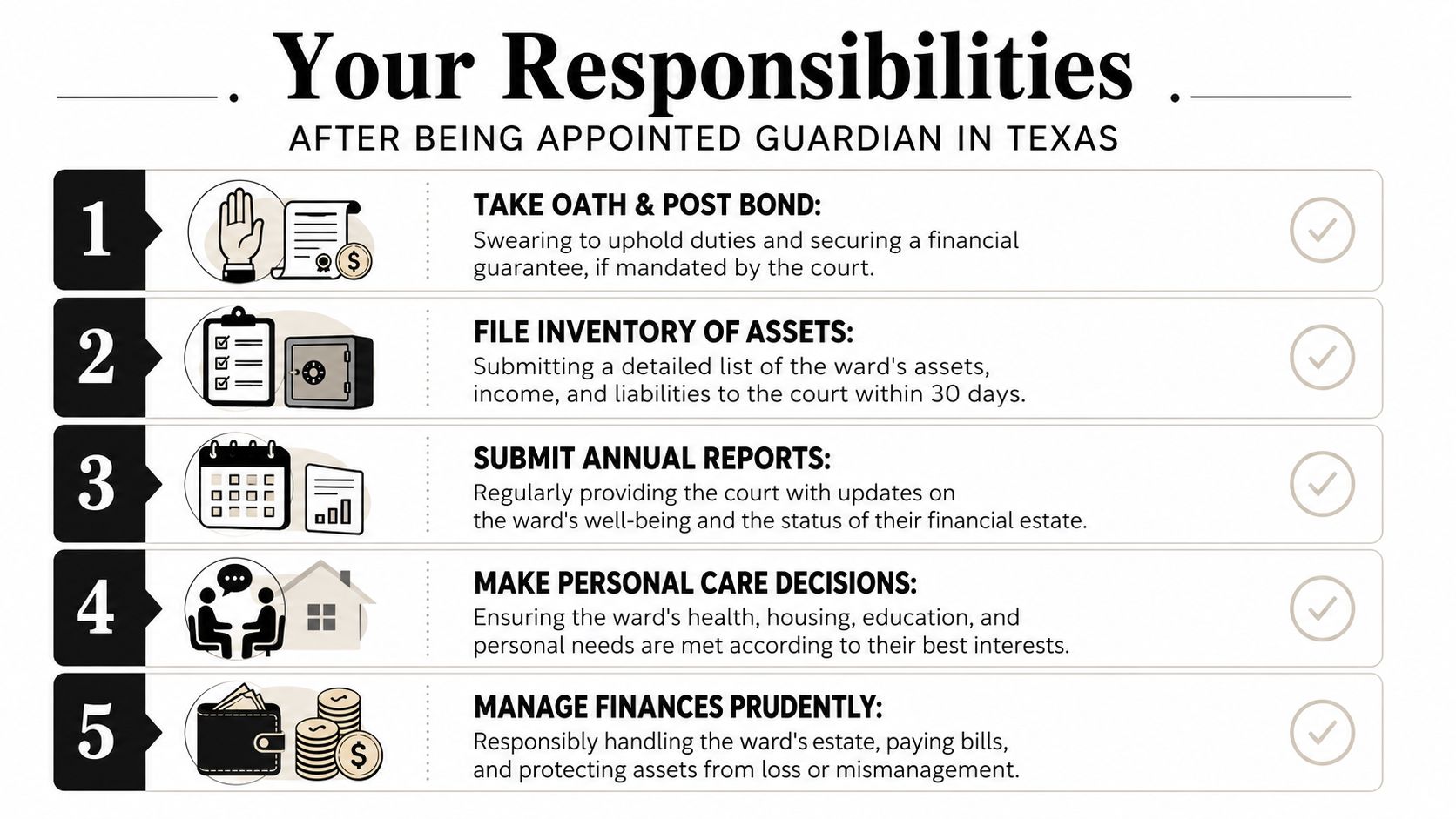
The first tasks after appointment
Texas law expects a guardian to qualify promptly. Once appointed, a guardian in Texas must sign an oath within 20 days and post a bond before receiving "Letters of Guardianship." These Letters expire after 16 months, requiring the guardian to file an annual report and renew the bond to maintain their legal authority (Texas guardianship qualification rules).
That sentence carries a lot of weight. If you don't qualify properly, you may not have effective authority to act. If you let the letters expire, you can create serious problems for yourself and the ward.
Your fiduciary duty
A guardian is a fiduciary. That means the law expects a very high level of honesty, care, and loyalty. You must act in the ward's best interest, not your own. You can't treat the ward's money like a family convenience fund, and you can't make major choices casually.
Here's what that usually looks like in practice:
- Protect the person's well-being: Make reasonable decisions about care, housing, treatment, and daily safety if you are guardian of the person.
- Keep finances separate: If you handle estate matters, maintain careful records and avoid mixing the ward's funds with your own.
- Preserve dignity: Include the ward in decisions as much as their condition allows.
- Watch deadlines: Court supervision continues after the appointment order.
Ongoing reporting and compliance
Another key source on compliance explains that under Texas Estates Code §1104.051 and §1154.051, a guardian of the person and estate must file a Guardian's Bond and Oath within 20 days post-appointment, and a sworn Annual Account no later than 60 days after the anniversary of qualification. It also states that failure to file the Annual Account may result in removal, revocation of letters, or fines up to $1,000 (Texas court instructions on bond, oath, and annual account).
That's why new guardians should build a calendar immediately.
Mark the qualification date
Your annual deadlines run from it.
Keep receipts and statements
Don't try to rebuild the record at the end of the year.
Review your court letters
Banks, doctors, and care facilities may ask for current proof of authority.
Ask before taking unusual action
Some transactions may need court approval.
Good guardianship records protect the ward first. They also protect the guardian from accusations later.
Changes, disputes, and termination
Guardianship can also change. A guardian may need to resign. A family member may ask the court to remove a guardian for misconduct. In some cases, the ward's condition improves enough that a modification or termination should be considered. The court remains involved because the goal is continued protection, not permanent control for its own sake.
How to Choose Your Houston Guardianship Attorney
You may be sitting at the kitchen table with siblings, trying to answer a hard question. Your mother is missing bills, your brother disagrees about what to do, and everyone feels the pressure of making the wrong choice. In that moment, the lawyer you hire matters for more than paperwork. You need someone who can explain the law clearly, slow the process down into manageable steps, and help your family decide whether guardianship is even the right tool.
A guardianship case is part legal procedure, part family crisis management. The right attorney should understand both.
What to look for
Start with experience that fits your problem. Guardianship is its own area of practice. A lawyer may handle probate work and still have limited experience with capacity issues, court investigators, contested hearings, or less restrictive options such as Supported Decision-Making.
It also helps to choose someone who knows how Harris County courts tend to handle these cases. Local practice affects how documents are prepared, what concerns the court may focus on, and how families should get ready for hearings.
As you compare attorneys, look for these signs:
- Focused guardianship experience: Ask how often the attorney handles guardianship applications, disputes between family members, modifications, and terminations.
- Clear teaching style: A good consultation should leave you less confused. The lawyer should be able to explain difficult rules in plain language.
- Respect for limited solutions: Some families need full guardianship. Others may need a narrower approach. A careful attorney should examine both.
- Preparation for the full journey: Guardianship does not end with the appointment. Your lawyer should be ready to explain what comes next and how to avoid common mistakes.
- Calm communication under stress: Families often come in worried, grieving, or in conflict. A steady attorney can help keep decisions grounded in the ward's needs.
Some families also review broader guidance on choosing legal counsel, such as what to look for in a Houston family law attorney, then narrow their list to lawyers with real guardianship experience.
Questions worth asking in a consultation
You do not need to know Texas guardianship law to ask good questions. Your job is to learn how the attorney thinks.
Here are a few useful questions:
- How do you decide whether guardianship is necessary, or whether another option may fit better?
- What types of guardianship matters do you handle, including contested cases?
- How do you prepare families for medical evidence, attorney ad litem involvement, and hearings?
- How do you explain the difference between guardianship of the person and guardianship of the estate?
- What kind of guidance do you give after appointment if problems come up later?
Listen for direct answers. If the lawyer speaks in circles, rushes you, or treats your questions like an inconvenience, that is useful information.
One practical option for Texas families
The Law Office of Bryan Fagan, PLLC represents Texas families in guardianship, probate, and estate planning matters, including applications for guardianship of the person or estate, temporary guardianship issues, contested cases, and post-appointment compliance.
For many Houston families, the best attorney is not the one who promises the fastest result. It is the one who helps the family understand the road ahead, checks whether a less restrictive option could work, and stays available as responsibilities change over time.
The right lawyer cannot erase the emotional strain. A good lawyer can make the process clearer, help your family avoid preventable errors, and protect your loved one with care and dignity.
If your family is facing hard questions about incapacity, safety, finances, or long-term care, a personal legal review can bring real clarity. Schedule a free consultation with Law Office of Bryan Fagan, PLLC to talk through your situation, learn whether guardianship is appropriate, and get guidance designed for your loved one's needs.