Skip to content
A lot of Texas families sit at the kitchen table with the same worry. They want to leave money for a child, sibling, or other loved one with a disability, but they're afraid that help could accidentally cause harm.
That fear is real. A direct inheritance, settlement, or gift can upset public benefits if it isn't handled correctly. Families in Harris County, Dallas County, Travis County, Bexar County, and across Texas often discover that good intentions need legal structure.
A special needs trust can provide that structure. It can also fit into a larger plan that may involve guardianship, probate, estate planning, and less restrictive alternatives under Texas Estates Code Title 3, Subtitle G when a loved one also needs help with personal or financial decisions.
Planning for Their Future Without Risking Their Benefits
Maria and David have an adult son in Texas who depends on public benefits and steady medical care. A grandparent wants to leave him part of an estate. The family's first reaction is gratitude. The second is panic. If he receives money outright, will he lose the support that pays for basic care and keeps his life stable?
That's where many families begin. They're trying to protect a loved one's dignity, therapies, routines, and future, while also honoring a parent's or grandparent's wish to help.

In Texas, a Special Needs Trust is designed to let a person with disabilities keep assets without losing eligibility for means-tested benefits like Medicaid and SSI, and SSI limits countable assets to $2,000 according to this Texas special needs trust and SSI overview. That same source explains that without an SNT, an inheritance or lawsuit settlement could push the beneficiary over that limit and jeopardize benefits. It also notes that approximately 16.7% of Texas residents ages 21 to 64 rely on SSI in that discussion of benefit protection and planning.
Why families get stuck here
Most families don't need more legal jargon. They need a safe path forward.
A special needs trust creates that path by holding funds in a way that supports the beneficiary without handing them the assets directly. If you're still sorting out public benefit programs, this guide on deciphering SSI vs SSDI can help clarify why SSI rules matter so much in trust planning.
Practical rule: If your loved one depends on means-tested benefits, never assume a direct gift is harmless.
Where guardianship may enter the picture
Some families also face decision-making concerns. Their loved one may need help with healthcare choices, housing, or managing day-to-day affairs. That's when trust planning and guardianship planning can overlap.
For background on benefit issues affecting disabled adults, families often also review Social Security benefits for disabled adults in Texas. In some homes, the trust is the financial protection piece, while guardianship or an alternative support arrangement addresses personal or legal decision-making.
What Is a Special Needs Trust and Why Is It Crucial in Texas
A special needs trust in Texas is a legal arrangement that holds money or property for a person with a disability. The beneficiary can benefit from the funds, but the funds aren't treated the same as money placed directly in that person's hands.
Think of it as a protective financial shield. The trust owns the assets. The trustee manages them. The beneficiary receives the benefit of carefully structured spending.
What the trust is meant to pay for
The trust is meant to improve quality of life. In Texas, the trust should be administered so distributions are reasonably necessary for the beneficiary's health, education, support, and maintenance, and the trust is not meant to replace the basic food or shelter public benefits already address under the rules described in the earlier Texas guidance.
That usually means the trust is most helpful for things like:
- Therapy and treatment: Services not otherwise covered
- Mobility and accessibility: Equipment, aids, or modifications
- Education and activities: Classes, support programs, and learning opportunities
- Leisure and personal enrichment: Recreation that supports a fuller life
The sole benefit rule matters
Texas applies a sole benefit rule to both first-party and third-party special needs trusts. In plain English, every dollar must be spent only for the beneficiary's benefit. That's one reason trustee choice matters so much.
This same careful thinking shows up in guardianship law. Courts don't treat control over another person's life or property lightly. Under Texas Estates Code Title 3, Subtitle G, judges look closely at whether a guardianship is necessary, whether a less restrictive option will work, and who should serve.
A permanent guardianship of the person typically requires a court finding based on legal incapacity, and courts also expect evidence, notice, representation, and compliance with ongoing duties. Families dealing with lifelong support issues often look at both trust planning and Guardianship for Adults With Special Needs in Texas when planning for decision-making support for a loved one.
A trust can protect assets. It doesn't automatically give someone authority to make medical or personal decisions.
Why this becomes crucial in guardianship cases
If a loved one may need a guardian, the court process itself takes planning. Families should gather medical records, identify the scope of help needed, and consider whether the issue is financial management, personal care, or both. In counties such as Harris County Probate Court or Dallas probate courts, judges commonly expect families to show why a full guardianship is necessary instead of a narrower solution.
That's one reason a special needs trust often works well as a less restrictive alternative for asset management. It can remove pressure from a guardianship estate and create a long-term plan that is more focused, more private, and easier to tailor.
Comparing the Main Types of Special Needs Trusts
Not every trust fits every family. The biggest differences usually come down to whose money is funding the trust, who creates it, and what happens to money left at the end.

A major Texas distinction is this. A third-party special needs trust funded by parents or other family members does not require Medicaid payback at the beneficiary's death, while a first-party special needs trust funded with the beneficiary's own assets requires the state to recover remaining trust funds equal to the medical assistance provided, as explained in this discussion of Texas rules on first-party and third-party special needs trusts.
Texas Special Needs Trust Comparison
| Feature | First-Party SNT | Third-Party SNT | Pooled SNT |
|---|---|---|---|
| Who funds it | The beneficiary with their own assets | Someone other than the beneficiary, such as parents or grandparents | Usually funded for the beneficiary within a pooled nonprofit structure |
| Common use | Settlement, inheritance already received, or assets in the beneficiary's name | Estate planning by family members | Lower-cost management option for some families |
| Medicaid payback | Yes | No | Depends on the trust structure and administration |
| Irrevocable | Yes, for benefit protection | Yes, for benefit protection | Typically structured for benefit protection |
| Who manages it | Chosen trustee | Chosen trustee | Nonprofit organization managing pooled funds |
| Best fit | When the beneficiary already owns the money | When family is planning ahead | When families want a more accessible administration option |
Three simple family examples
Third-party trust. Parents in Fort Bend County are writing their wills. They want to leave money for their daughter without passing assets to her directly. A third-party trust is often the cleanest fit because the money comes from family, not the daughter herself.
First-party trust. A teenager in Texas receives a personal injury settlement. If that child is a minor or incapacitated person, court-created trusts under Section 142.005 of the Texas Property Code may become part of the planning process in settlement cases. This type of situation often requires coordination among the court, the family, and counsel.
Pooled trust. An adult beneficiary has modest assets and needs a professionally managed option. A pooled trust can be more practical than creating a fully customized private trust.
How this connects to guardianship
If a loved one may need a guardian, families also need to know who controls what. The article on Guardian of the Person vs. Guardian of the Estate explains the two distinct types of Texas guardianship and what each controls. That distinction matters because a trust may handle funds while a guardian of the person addresses care decisions, or a guardian of the estate may still need to coordinate with trust planning.
Guardianship disputes often arise here. One sibling may want full control. Another may prefer a trust plus supported decision-making. Texas courts generally expect the least restrictive arrangement that still protects the proposed ward.
The Process of Establishing and Funding Your Trust
Families often expect trust creation to feel mysterious. In practice, it's a series of decisions made in the right order.
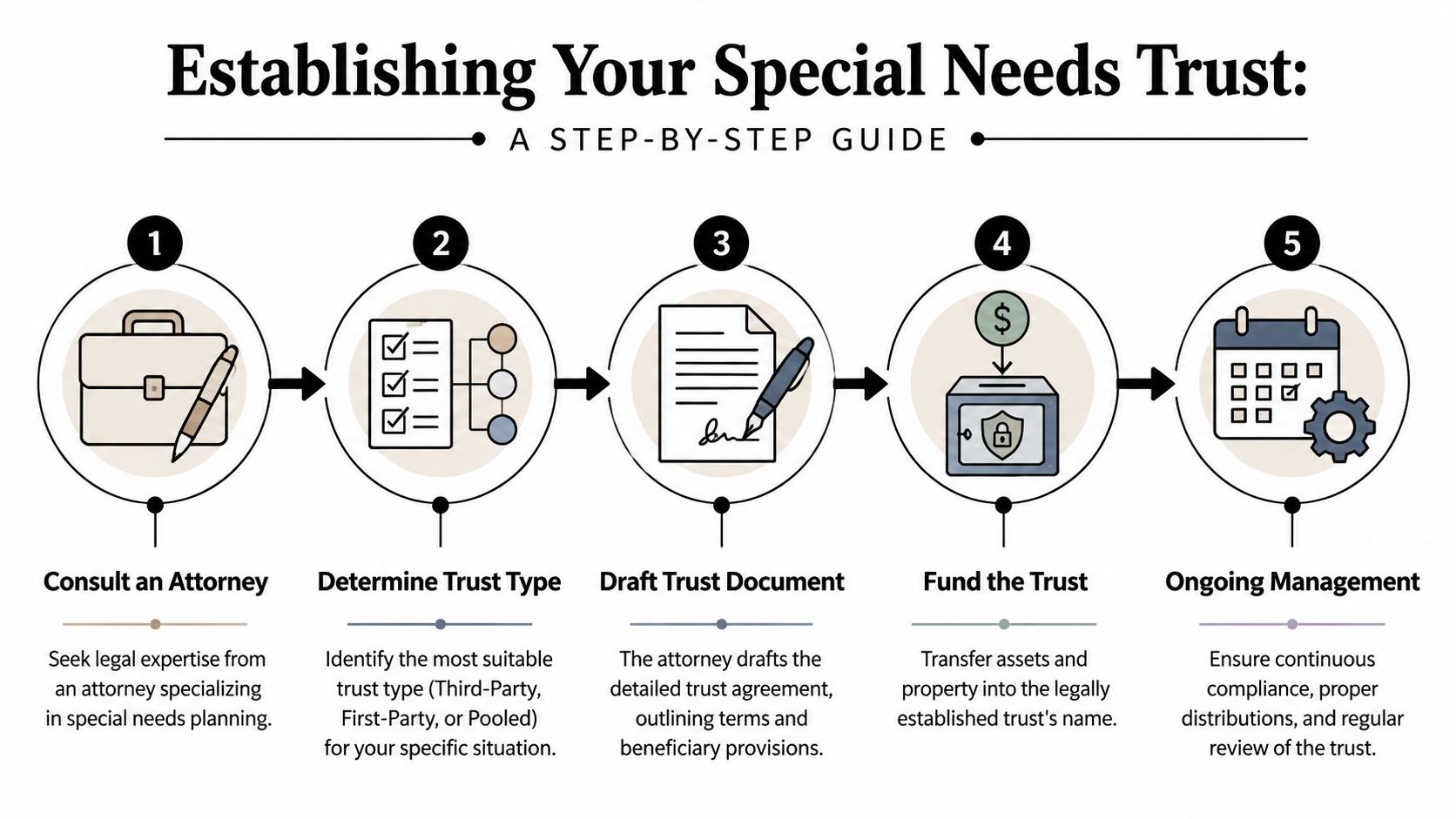
The basic path
Meet with an attorney
You identify the beneficiary's needs, current benefits, family goals, and whether the funds are coming from the beneficiary or someone else.Choose the trust type
The source of the money usually drives this decision.Draft the trust document
The language needs to match benefit rules and the family's long-term plan.Fund the trust
A trust that exists on paper but receives no assets doesn't solve the problem.Manage it over time
The trustee must make careful distributions and keep records.
What it may cost in Texas
Costs vary by trust type and where you live. According to this overview of Texas special needs trust costs and ABLE account limits, third-party SNTs typically cost $2,500 to $5,000, first-party SNTs often range from $3,500 to $7,500+, and pooled trusts may have enrollment fees around $0 to $850, with ongoing management fees. That same source notes fees in cities such as Houston and Dallas are generally higher than in rural areas.
It also explains that Texas allows a lifetime total of $500,000 in ABLE accounts, though SSI benefits are suspended if the account balance exceeds $100,001. For some families, an ABLE account and a trust work together rather than replacing each other.
When courts get involved
Court involvement is common when a minor or incapacitated person receives settlement funds, when a guardianship estate already exists, or when emergency protection is needed. Under Texas Estates Code Title 3, Subtitle G, emergency or temporary guardianship requires a sworn application stating the imminent danger to the person or property, the protection requested, and the supporting facts under Section 1251.003.
For a permanent guardianship, families should prepare for notice requirements, medical evidence, attorney ad litem involvement, and a hearing. Before the hearing, organize records, identify the least restrictive option, and be ready to explain why the proposed guardian is appropriate. After appointment, compliance matters just as much as winning the hearing.
Texas courts must also consider Less Restrictive Alternatives to Guardianship in Texas before granting guardianship. In some cases, a trust is part of that alternative framework.
Some families also review Medicaid waiver programs in Texas while planning, because trust decisions often affect the bigger care picture.
Choosing a Trustee and Their Responsibilities in Texas
The trustee is the person or institution carrying the plan forward after the documents are signed. A strong trust can still fail in practice if the wrong trustee is in charge.
Some families choose a sibling, aunt, or close friend because that person knows the beneficiary's routines, fears, and preferences. Others choose a professional trustee because the rules are technical and the role may last for decades.
What a trustee actually does
A trustee doesn't just write checks. The trustee manages assets, decides whether a distribution fits the trust's purpose, keeps records, handles reporting, and protects the beneficiary from avoidable mistakes.
The standard is serious. In Texas, a permanent guardian of the person must be appointed on clear and convincing evidence that the proposed ward is legally incapacitated, as discussed in this overview of Texas guardianship law and appointment standards. That same seriousness helps families understand why a trustee must act solely for the beneficiary's benefit.
Family trustee or professional trustee
A family trustee may bring compassion and firsthand knowledge. That can be a gift.
But a family trustee may also feel torn. One relative wants the trust to pay for more outings. Another wants to save every dollar. A professional trustee may offer distance, consistency, and technical experience.
Consider these questions:
- Does this person understand boundaries? A trustee must say no when a request could cause problems.
- Can they keep records for years? Good intentions won't replace documentation.
- Will they still be able to serve later? Many trusts outlast the parents who created them.
- Can they handle family conflict? Trustees often become the referee nobody expected.
For a closer look at the legal standard, families can review fiduciary responsibility of a trustee in Texas.
Guardianship duties can overlap
If the beneficiary also has a guardian, roles need to stay clear. A guardian of the person may help with healthcare, living arrangements, and services. A guardian of the estate may manage certain assets under court supervision. The trustee, however, follows the trust terms and benefit rules.
That overlap is why guardianship compliance matters. Guardians must follow court orders, report as required, and keep their authority within proper limits. Trustees need the same discipline, even though the trust is a different legal tool.
Common Pitfalls and How to Avoid Them
Most trust problems don't start with bad motives. They start with confusion.
A parent thinks reimbursing a child in cash is simpler. A trustee pays the wrong bill from the wrong account. A family member mixes trust money with personal money “just for now.” Small missteps can create big headaches.

Mistakes families can prevent
- Giving cash directly to the beneficiary: This is one of the fastest ways to create benefit trouble.
- Ignoring the trust terms: Even helpful spending can become improper if it doesn't fit the document.
- Poor recordkeeping: If the trustee can't show what was paid and why, problems multiply.
- Commingling funds: Trust money should stay separate from anyone's personal accounts.
- Picking an unprepared trustee: Love alone isn't enough for this role.
“The trustee's job is to protect the beneficiary, not to make life easier for everyone else.”
Guardianship pitfalls matter too
If your family is also going through guardianship, don't overlook the court side of compliance. After appointment, a Texas guardian must sign a sworn oath and post a bond within 20 days, and the clerk then issues Letters of Guardianship, which expire after 16 months and must be renewed annually with a new bond and report, according to TexasLawHelp's guardianship process guidance. Missing those steps can create serious legal problems.
Families in probate courts such as Harris County Probate Court often find that the hearing is only the beginning. The actual work comes after appointment. Annual reporting, bond issues, renewal deadlines, and ongoing court oversight don't go away.
A little caution early can save a great deal of stress later.
Frequently Asked Questions About Texas SNTs
Can a special needs trust pay credit card debt
Yes, sometimes. A frequent point of confusion is whether a trust can pay a beneficiary's credit card bill when the card was used for essential items. Recent guidance says an SNT may settle credit card debt for essentials like rent or therapy if the trustee pays the creditor directly, not the beneficiary, as explained in this article on special needs trust spending rules and direct payment limits. Direct cash reimbursement to the beneficiary is not allowed.
What's the difference between a trust and an ABLE account
They serve different purposes. An ABLE account can be useful for some disability-related savings and spending, while a special needs trust usually offers broader planning and more structured management. Families often use both when appropriate, especially when they want flexibility for smaller expenses plus long-term protection.
What if my loved one may need guardianship too
That's common. A trust can handle protected funds, but it doesn't automatically answer questions about medical consent, living arrangements, or legal decision-making. Under Texas Estates Code Title 3, Subtitle G, a court may appoint a guardian when the legal standard is met and less restrictive alternatives aren't enough.
Before a guardianship hearing, gather medical support, identify specific limitations, and think carefully about whether the need involves the person, the estate, or both. During the hearing, expect the court to focus on necessity, scope, and the proposed guardian's fitness. Afterward, stay current on reports, bond requirements, and renewals.
Can guardianship ever end
Yes. Guardianship can be modified or terminated if circumstances change. If a person regains capacity or a less restrictive arrangement becomes appropriate, the court can revisit the order. That's one reason families should avoid asking for broader guardianship than they need.
Where can families get more personalized guidance
Every family's facts are different. A beneficiary's age, county, benefits, existing assets, medical needs, and family dynamics all shape the right answer. Some households need a trust only. Others need probate help after a loved one dies. Others need both estate planning and a guardianship petition in a county probate court.
If your family is weighing a special needs trust in Texas, guardianship, probate, or estate planning, Law Office of Bryan Fagan, PLLC offers guidance on those Texas legal processes, including applications for guardianship, estate-related planning, and protection for vulnerable loved ones. A free consultation can help you sort through the options, understand what Texas law requires, and build a plan that gives your family more security and peace of mind.