Skip to content
A few weeks ago, your mother may have started missing medications. Then the unpaid bills piled up. Maybe your adult son with a disability is about to turn 18, and every doctor's office suddenly starts telling you that you no longer have legal authority to help. Or maybe you live outside Texas, but your father is in Dallas and can't safely manage daily decisions anymore.
Those moments feel heavy because they are. Families usually don't come looking for a guardianship lawyer in Dallas because life is simple. They come because something has changed, and waiting longer may put a loved one at risk.
Guardianship can help, but it's also one of the more serious legal steps a Texas court can take. It can shift decision-making power over health, housing, money, or all three. That's why Dallas County probate courts move carefully. They want proof. They want medical support. They want to know whether a less restrictive option could work first.
If you're trying to protect someone you love, the legal process may feel cold at first. It doesn't have to stay that way. With the right guidance, Texas guardianship law becomes much more understandable. You can see what the court needs, what your responsibilities would be, and what practical steps to take next.
Navigating a Difficult Crossroads
A daughter in Dallas notices her father is repeating the same stories, forgetting meals, and giving money to strangers who call him. Her brother lives in another state and feels helpless because he can't be there every day. Both of them agree on one thing. Their father needs protection. They just don't know whether that means a power of attorney, emergency action, or a full guardianship case in probate court.
That confusion is normal. Families often arrive at this point after months of stress, guilt, and second-guessing. They've tried helping informally. They've arranged rides, reminders, and doctor visits. But there comes a point when “helping out” isn't enough because banks, hospitals, and care facilities need legal authority, not just family concern.
Guardianship cases are legal matters, but they're also family stories. The court sees filings and evidence. You see your loved one's decline up close.
In Texas, guardianship is meant to protect a person who can no longer safely manage important decisions alone. The process is structured for a reason. Courts want to preserve as much independence as possible while still guarding the person's health, dignity, and property. In Dallas County Probate Court, that means families need to prepare carefully and present the right evidence the right way.
Some readers are caring for an aging parent with dementia. Others are preparing for a child with special needs to reach adulthood. Some are dealing with a sudden injury, exploitation, or a sibling dispute over what should happen next. The facts differ, but the core question is the same. Who can legally step in, and how?
That's where a clear roadmap helps. Once you understand the types of guardianship, the Dallas filing process, the emergency options, and the ongoing duties after appointment, the path gets less overwhelming and more manageable.
Understanding the Types of Guardianship in Texas
A Dallas family often reaches this point after a specific moment. The hospital asks who has authority to consent to treatment. The bank refuses to discuss an account. The assisted living facility wants signed legal paperwork, not a daughter's good intentions.
That is usually when the question becomes more focused. Does your loved one need help with personal decisions, financial decisions, or both?
Texas courts separate guardianship into two main categories because those are two different responsibilities. One covers the person's body, safety, medical care, and living arrangements. The other covers money, property, and financial protection.
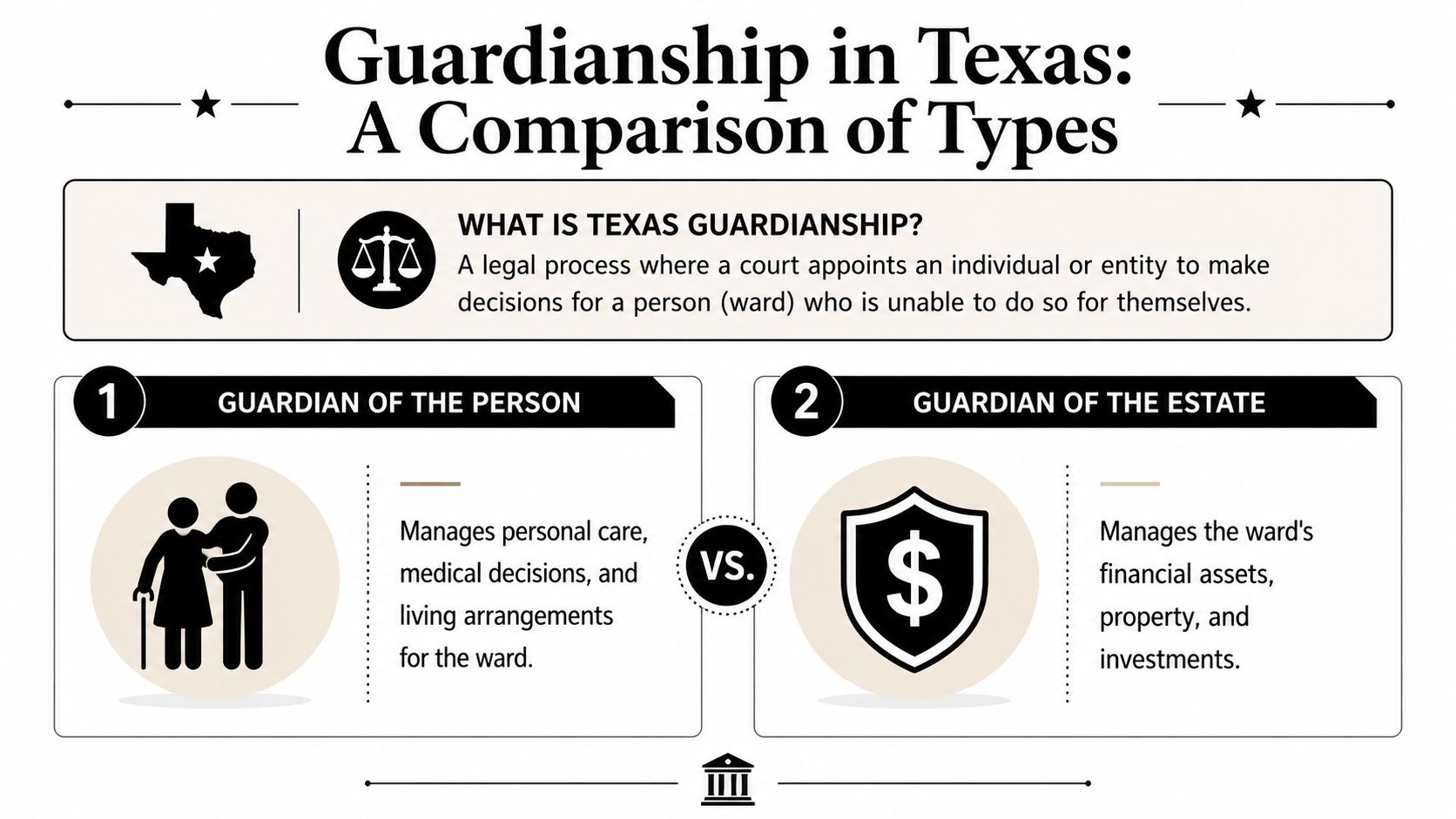
Guardian of the person
A Guardian of the Person is appointed to make personal and medical decisions for the ward. That can include where the person lives, consent to medical treatment, arranging caregivers, and helping protect the person from unsafe situations.
Families in Dallas County often assume this appointment gives them control over everything. It does not. The probate court can limit the guardian's authority to the areas where help is needed. That matters because Texas courts are supposed to preserve as much independence as possible.
A common example is an older parent with dementia who cannot understand medication instructions or recognize when home is no longer safe. In that situation, the court may decide someone needs legal authority over care decisions, even if the parent has little or no property to manage.
Guardian of the estate
A Guardian of the Estate handles finances and property. This role may be necessary if the proposed ward cannot manage bank accounts, income, bills, real estate, or protection against exploitation. If your family is worried about unpaid taxes, suspicious withdrawals, or a relative being pressured to sign documents, this is often the category that needs close attention.
In practical terms, this is the more paperwork-heavy role. The guardian may need to qualify with a bond, safeguard assets, keep records, and file accountings with the court. Dallas County judges expect those duties to be taken seriously. Estate guardianship is supervised fiduciary work, not informal help with a checkbook.
For families trying to understand how the case begins, this guide to filing a guardianship petition in Texas explains the first formal step.
When both are needed
Some cases require both types of guardianship. Some do not.
A young adult with significant disabilities may need help with medical and residential decisions but have no estate that requires active management. An adult recovering from a serious brain injury may need someone to handle both hospital decisions and financial obligations at the same time. An older adult in Dallas who owns a home, receives income, and can no longer make safe decisions may also need both appointments.
Dallas County families should also know about the ongoing court supervision that follows appointment. Letters of Guardianship do not last indefinitely. They must be kept current, and the court expects continued compliance with reporting, training, and bond requirements where applicable. As noted in Dallas Probate guidance on guardianship contests and appointments, these cases do not end when the judge signs the order.
That point surprises many out-of-state relatives. Being named guardian for a parent in Dallas can mean regular court responsibilities in Dallas County, even if you live elsewhere.
Terms families often hear in court
The vocabulary can sound intimidating at first, but the core terms are simple:
- Ward means the person who is under guardianship.
- Proposed ward means the person the court is evaluating before any final appointment is made.
- Incapacitated person usually means a person the court finds unable to manage some or all personal or financial matters.
Practical rule: Guardianship should match the person's actual needs. It does not automatically remove every right.
If you want a plain-language overview of how a court handles these cases for adults, Guardianship of an Incapacitated Adult in Texas explains how a court establishes guardianship for an adult who cannot manage their affairs.
The Dallas Guardianship Process Step by Step
A common Dallas County scenario looks like this. An adult daughter in Arizona gets a call that her father in Dallas has wandered from home again, missed medications, and signed checks he did not understand. She wants to help right away, but the court will not act on worry alone. It needs a clear record, the right filings, and proof that guardianship fits the problem.
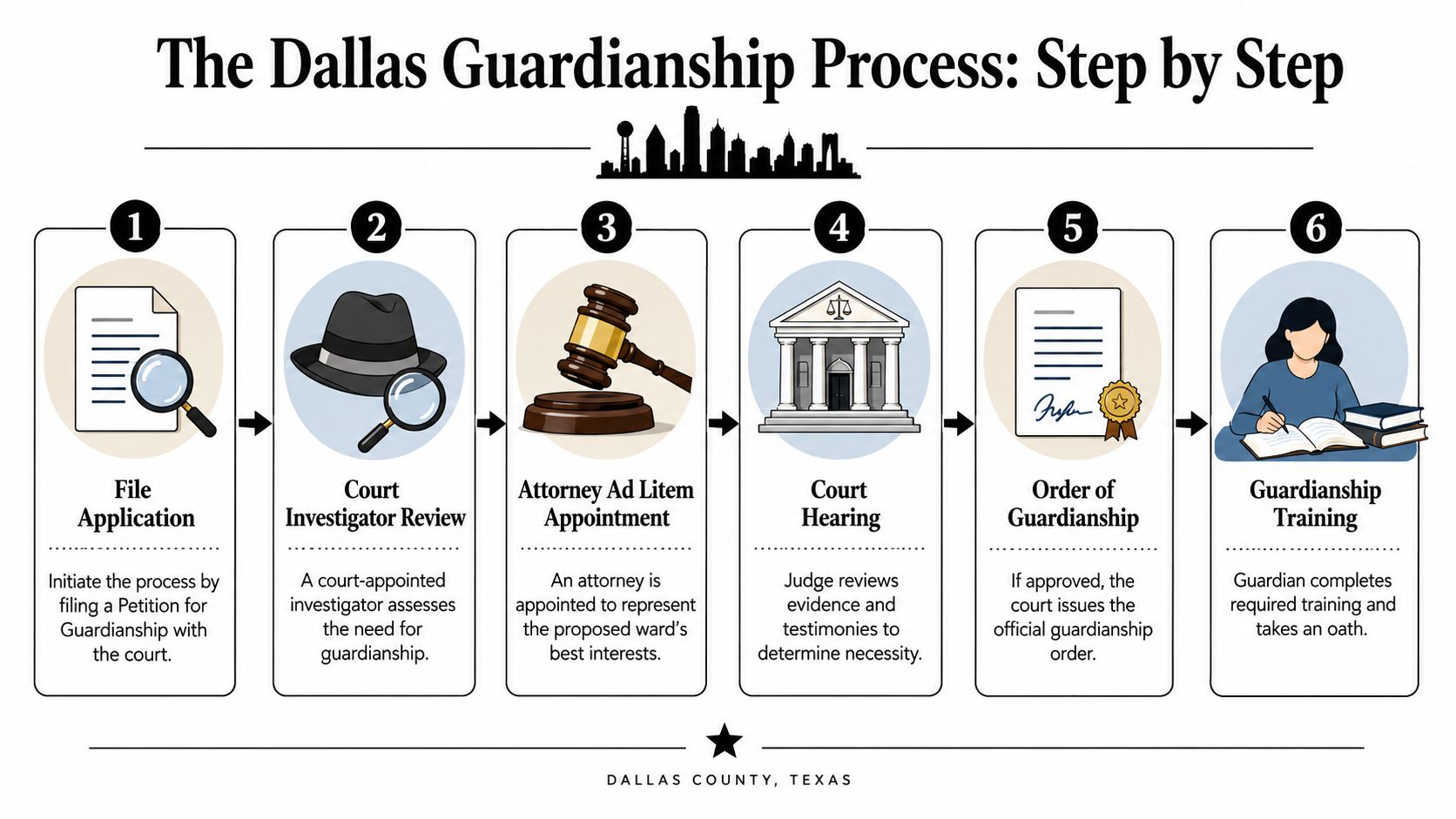
Dallas families usually feel more steady once they can see the process in order. Probate court has rules and deadlines, but there is a sequence to it. If you understand that sequence, the case feels less like a black box and more like a checklist.
Filing the application
The case begins with a sworn application filed in the proper Dallas County probate court. That document does much more than ask the judge for help. It tells the court who the proposed ward is, what kind of guardianship is requested, who the close relatives are, and what facts show a present need for court involvement.
Texas Estates Code Title 3, Subtitle G controls much of this process. Under Texas Estates Code § 1101.001(b)(3-a) and (3-b), the application must also address whether alternatives to guardianship and available supports were considered, and whether those options are workable, as shown in Texas Estates Code § 1101.001.
In Dallas County, details matter early. Incomplete family information, vague descriptions of incapacity, or a petition that asks for broader powers than the facts support can slow the case down fast. For a closer look at what the petition needs, this guide to filing a guardianship petition in Texas is a helpful starting point.
Medical proof and the court's independent review
The court also needs evidence that explains the person's limits in real-world terms. That usually includes the Physician's Certificate of Medical Examination, which describes the proposed ward's condition and decision-making ability. Families sometimes expect a diagnosis alone to be enough. It usually is not. The court wants to know how the condition affects managing money, consenting to medical care, handling housing, and staying safe.
Dallas County judges also look closely at whether a less restrictive option could solve the problem. That may include a power of attorney, supported decision-making, a representative payee, a trust arrangement, or help from family members without a guardianship. The court investigator and the attorney ad litem often play a large role here. Their job is not to rubber-stamp the application. Their job is to test it.
That can feel uncomfortable for families who are already exhausted. It is also one of the protections built into the system.
The hearing and the appointment steps
Once the paperwork, medical evidence, and required reviews are in place, the court sets the matter for hearing. At that hearing, the judge considers the application, the physician's certificate, the investigator's findings, and any position taken by the attorney ad litem. If relatives disagree about whether guardianship is needed, or about who should serve, the hearing can become contested and take longer.
A typical Dallas County case often follows this order:
- Family members gather records such as medical notes, financial concerns, incident reports, and contact information for close relatives.
- The application is filed in the correct probate court with the requested type of guardianship.
- The physician's certificate is prepared and filed to give the court medical support for the request.
- The court completes its review through the investigator, attorney ad litem, and any required notices.
- The judge holds a hearing and decides whether guardianship is necessary and, if so, how limited or broad it should be.
- The proposed guardian qualifies by completing the oath and any bond required before full authority begins.
That last step causes a lot of confusion, especially for relatives coming in from outside Texas. A signed order does not automatically mean you can act the same day in every situation. Under Texas Estates Code § 1002.065, the guardian must sign an oath and post the required bond within 20 days after the order granting letters of guardianship, and authority does not begin until both are completed, as explained by Texas Law Help on guardianship.
A Dallas example makes this easier to see. If a son asks the court to protect his mother after repeated hospitalizations, unsafe wandering, and unpaid bills, the judge will sort the problem into parts. Does she need help with daily care decisions, financial management, or both? If the medical proof supports incapacity and no workable alternative protects her, the court may appoint a guardian of the person, a guardian of the estate, or both, but only to the extent the evidence supports.
That narrower approach matters. Guardianship is more like a customized set of court-approved tools than a blanket transfer of all rights. In Dallas County, families who prepare with that principle in mind often avoid the most common pitfall, asking for more authority than the facts can justify.
When You Need an Emergency Guardianship
It is 9:30 at night. Your father is confused, his medications are missing, and a new acquaintance is answering his phone, refusing to let family speak with him, and using his debit card. If you live in Dallas, or you are trying to help from another state, that moment feels terrifying because the usual court timeline may be too slow for what is happening right now.
In that kind of crisis, families often ask whether the probate court can step in quickly through a temporary, or emergency, guardianship.
What the court means by imminent danger
Dallas County Probate Courts do not grant emergency relief just because a situation is upsetting or unstable. The judge needs sworn facts showing an immediate risk to the person, the property, or both. Under Texas Estates Code § 1251.003, a temporary guardian may be appointed only if a sworn written application specifically alleges imminent danger and states the supporting facts, as explained in Texas Estates Code § 1251.003.
“Imminent danger” helps separate a serious concern from a true emergency. A good way to understand it is to ask: what could go wrong before the court can hear a regular guardianship application?
Examples often include:
- Immediate medical risk, such as a vulnerable adult refusing or missing urgent care because no one has legal authority to consent.
- Active financial exploitation, such as sudden withdrawals, wire transfers, new account access, or pressure to sign documents.
- Unsafe living conditions, such as wandering, lack of food, exposure to heat, or neglect that creates a present risk of injury.
Specific details matter. Dates, names, recent transactions, discharge paperwork, text messages, Adult Protective Services reports, and statements from doctors or facility staff carry more weight than a general statement that someone is “not doing well.”
How Dallas County urgency works in practice
In Dallas County, emergency cases move fast, but they still require careful proof. Families are often surprised by that. Urgent does not mean informal.
A temporary guardianship request is usually handled in the Dallas probate court assigned to the case, and the court will want to see exactly why less immediate options will not protect the person in time. If your loved one is in a hospital, rehab facility, memory care unit, or unsafe home setting, gather records quickly and organize them in a simple timeline. Judges and court staff can follow a clean timeline much more easily than a stack of disconnected papers.
For out-of-state relatives, this is a common stumbling point. You may know something is wrong, but you may not have direct access to doctors, bank records, or the residence. In those situations, local declarations from a physician, social worker, facility administrator, neighbor, or trusted Dallas-area relative can make the emergency easier for the court to assess.
A frequent Dallas example looks like this. An older parent with dementia is suddenly isolated by a new companion. Bills go unpaid, unusual withdrawals appear, and family members are blocked from visits at the very time the parent needs supervision and medical help. That fact pattern often pushes a case out of the ordinary guardianship track and into a request for immediate temporary relief.
If your situation sounds similar, this guide to emergency guardianship in Texas gives a focused look at the faster procedure.
If you believe there is an emergency, write down the last two weeks in order. Who did what, on what date, and what harm is likely to happen next if no one can act. That is often the clearest starting point for both your lawyer and the court.
Temporary guardianship is a short-term safety tool, not a final answer. It works like a court-issued stabilizing order. The immediate goal is to protect the person, stop the bleeding, and preserve options while the larger guardianship case is sorted out. In Dallas County, families who understand that narrow purpose usually present stronger emergency requests and avoid asking for more relief than the facts can support.
Exploring Alternatives to Guardianship
A Dallas County guardianship case often starts with a family member saying, "We need to do something now." That feeling is real. But the first legal question is narrower. Is guardianship the least restrictive tool that will protect your loved one?
Texas courts expect families to consider other supports before asking a judge to remove decision-making rights. In practice, that means your application needs to explain what was tried, what is still possible, and why a lighter option will not solve the problem. Dallas judges and court staff see this issue often, especially in cases involving dementia, intellectual disabilities, brain injury, and an adult child who lives out of state and is trying to help from a distance.
Less restrictive choices families should review
Guardianship works like the court taking over part of the decision-making structure because informal help is no longer enough. Before you get there, it is wise to examine the tools below:
- Durable power of attorney for banking, bills, contracts, and other financial matters.
- Medical power of attorney for health care decisions when the person cannot communicate informed consent.
- Advance directives for treatment preferences and end-of-life instructions.
- Trusts for managing money or property in a more controlled way.
- Supported decision-making agreements for adults who can still make choices if someone helps them understand options and consequences.
- Representative payee or automatic bill pay arrangements when the main problem is monthly income management rather than broad incapacity.
These options are not interchangeable. A medical power of attorney does not fix unpaid property taxes. A trust does not answer who can consent to surgery. A supported decision-making agreement may be appropriate for one adult with disabilities and completely unrealistic for another person with advanced dementia.
Capacity is the hinge point.
If your mother can still understand what she is signing, planning documents may solve the problem with less cost, less conflict, and less court involvement. If she no longer understands the nature and effect of those documents, waiting usually narrows the options. That is one of the hardest parts for families, especially siblings who live in different states and are getting inconsistent reports from a Dallas hospital, rehab facility, or assisted living center.
A practical way to compare the options
| Option | Usually works best when | Main limitation |
|---|---|---|
| Durable power of attorney | The person still has legal capacity to sign | It may be unavailable if capacity has already been lost |
| Medical power of attorney | Health care decisions are the main concern | It does not cover broader financial or personal care issues |
| Trust | Assets need ongoing management | It does not, by itself, address daily care or medical consent |
| Supported decision-making | The person can decide with guidance | It may not protect against serious confusion, exploitation, or wandering |
| Guardianship | The person cannot manage safely and narrower tools are inadequate | It can limit important civil rights and requires court oversight |
Dallas County adds a practical wrinkle here. Judges want to see specifics, not general statements that "nothing else will work." Families are in a stronger position when they can say, for example, that the parent never signed a power of attorney, can no longer understand one, is missing medications, and has already been exploited financially. That gives the court a clear reason to approve a more restrictive remedy.
For parents of a child nearing age 18, this review matters too. Some families assume guardianship is automatic once the child becomes an adult. It is not. In many cases, supported decision-making, limited powers, school-related releases, or benefit-management tools may cover part of what the family needs. In others, full or limited guardianship is still appropriate. The answer depends on present ability, not diagnosis alone.
A good early step is to review how to choose the right guardianship lawyer in Texas so you can sort out which options are still available before time and capacity close the door.
Families often feel guilty when they learn that lighter options no longer fit. Guilt is common. It does not mean you are making the wrong choice. Sometimes court supervision becomes the safest way to stop harm and create a stable plan.
Costs and Choosing Your Dallas Guardianship Lawyer
Your mother is in Dallas. You live in Colorado. The hospital wants a decision, the bank has questions, and a sibling is asking what this process will cost. That is the point where many families feel pulled in three directions at once. They are worried about a loved one, worried about doing something legally correct, and worried about making an expensive mistake.

Cost matters. So does fit. In Dallas County, a guardianship case is not just a set of forms. It is closer to a supervised handoff. The court wants proof, wants the right people notified, and wants to know the proposed guardian understands the job after appointment.
What costs usually come up first
Families often expect one flat number. Guardianship usually works more like a stack of separate items.
There is the court filing cost. There may be charges tied to medical evidence, service of process, attorney ad litem work, bond requirements, and later compliance tasks if a guardianship is granted. The total depends on whether the case involves only personal decisions, financial management, family disagreement, or urgent facts that require faster action.
Dallas County families also run into a timing issue that catches people off guard. If the proposed ward is a minor who will soon turn 18, the case cannot be filed whenever the family chooses. The window is limited, and waiting too long can create a gap between the child's 18th birthday and the parent's legal authority to keep handling medical, school, or benefit-related decisions. That is one reason early planning matters.
A careful lawyer should be willing to break costs into categories and explain which ones are likely, which ones depend on the facts, and which ones continue after the hearing.
What to look for in a lawyer
Choose a lawyer who handles guardianship as an ongoing court relationship, not a one-time filing.
In Dallas County, that means you want someone who understands local probate court expectations, knows how to prepare medical proof that answers the court's real questions, and can spot problems before they turn into delays. A good lawyer should also explain the difference between a guardian of the person and a guardian of the estate in plain English, because the duties, reporting rules, and bond issues are not the same.
Here are practical questions to ask:
- How do you evaluate whether guardianship is the right tool for this family?
- What does Dallas County usually require before a hearing can be set?
- Who helps gather the physician's certificate and supporting records?
- What problems tend to delay approval in this county?
- What reporting, renewal, or accounting duties will I have after appointment?
- How do you handle sibling disputes or objections from other relatives?
If you want a useful checklist before you start calling firms, review this guide on questions to ask when choosing a guardianship lawyer in Texas.
One more point matters here. The right lawyer should make you calmer, not more confused.
Help for out-of-state families
Many Dallas guardianship cases are managed by relatives who do not live in Dallas, and sometimes do not live in Texas at all. That does not prevent a case from moving forward, but it does change the planning.
The county where the proposed ward lives usually controls where the case is filed. So if your loved one is in Dallas County, the case usually stays in Dallas County even if the adult child helping from afar lives in another state. That means documents still need to be prepared correctly for Texas court, hearing attendance has to be planned, and practical details such as signatures, notices, medical appointments, and court deadlines need closer coordination.
For those families, virtual meetings can make the early stages easier. The Law Office of Bryan Fagan, PLLC handles guardianship, probate, and estate planning matters in Texas and offers virtual consultations statewide, which can help out-of-area relatives coordinate a Dallas County case.
This overview may also help as you sort through the practical side of the process:
Don't ignore the ongoing duties
Families sometimes focus so hard on getting through the hearing that they miss the bigger truth. The court order is the beginning of the work.
A guardian may need to make care decisions, protect funds, maintain records, renew letters when required, respond to court notices, and stay current on reporting duties. If a guardian of the estate is appointed, the financial side can feel a lot like serving as a carefully supervised manager. You are handling someone else's money under court rules, not treating the account like a family checking account.
That is why choosing counsel based only on the initial fee can backfire. A lower upfront quote does not help much if the family is left guessing about bond questions, annual filings, or what to do after a change in health, placement, or finances.
The better approach is simple. Ask what the lawyer will do before filing, what the lawyer will do through the hearing, and what guidance the office provides after appointment. In Dallas County, that clarity can prevent expensive delays and a great deal of stress.
Your Next Step Towards Peace of Mind
If you're facing the possibility of guardianship, you're probably carrying two worries at once. You want to protect your loved one, and you don't want to take away more independence than necessary. Texas law is built around that same tension. That's why the process requires medical proof, court review, and serious attention to less restrictive alternatives.
For Dallas families, the path becomes much easier once you break it into parts. First, identify the actual risk. Next, determine whether an alternative can work. If not, prepare the right evidence, file in the proper court, and get ready for the hearing and the duties that follow. If there's immediate danger, act quickly and document the facts.
Guardianship cases can also bring family strain to the surface. One sibling may think the situation isn't bad enough. Another may believe someone is exploiting the parent already. A parent of a child with disabilities may feel grief and urgency at the same time as adulthood approaches. Those reactions are common, and they don't mean you're failing. They mean the decision matters.
A knowledgeable Dallas guardianship lawyer can help you sort through those facts calmly, explain the probate court's expectations, and help you choose the least restrictive path that still keeps your loved one safe. For some families, that will mean filing a case. For others, it will mean planning documents, supported decision-making, or a more limited solution.
If your family needs guidance on guardianship in Dallas or anywhere in Texas, schedule a free consultation with Law Office of Bryan Fagan, PLLC. A conversation about your specific situation can help you understand your options, avoid common mistakes, and take the next step with more confidence and peace of mind.