Skip to content
When a child's parents can't safely care for them, families often end up carrying far more than daily routines. A grandparent may be taking the child to school, aunts and uncles may be handling doctor visits, and family friends may be trying to keep life steady while everyone is grieving, recovering, or in crisis. In that moment, one question usually rises to the top: how do you get legal authority to protect the child?
In Texas, that answer is often guardianship. It isn't just paperwork. It's a court process that gives someone the legal power to care for a child and, when needed, manage the child's property or money. It can also feel intimidating, especially when your family is already under stress.
The good news is that the process is understandable when you know why each step matters. Courts aren't asking for forms and hearings just to make life harder. They're trying to protect the child, preserve due process, and make sure the right person receives legal authority. If you're trying to understand how to get guardianship of a child in Texas, start with that principle. Every step flows from it.
Understanding Child Guardianship in Texas
In Texas, guardianship of a child is a probate court case, not a family court case. That distinction matters. Guardianship proceedings are governed by the Texas Estates Code, including Title 3, Subtitle G, while custody issues are generally handled under the Texas Family Code. If you file in the wrong court or use the wrong legal framework, you can lose time before the case even begins.
That's why a child guardianship case in Harris County, for example, is typically filed in a probate court such as Harris County Probate Court, not in the court where divorces and parent-child disputes are usually heard. Guardianship is used when a child needs legal protection because parents are deceased, incapacitated, or otherwise unable to care for the child.

Guardianship is different from custody
Many families use the word “custody” when they really mean “guardianship.” Texas law treats them differently.
Custody usually deals with parental rights and responsibilities. Guardianship gives a non-parent legal authority over a child when the court decides that arrangement is necessary. The court's focus is whether the appointment protects the child's best interest under the Estates Code.
A simple example helps. A grandmother may already have her grandson living with her. She may feed him, take him to school, and keep him safe. But if she tries to enroll him in school, authorize medical care, or deal with settlement funds from an injury claim, the school, doctor, or bank may ask for proof of legal authority. That's where guardianship becomes necessary.
For a fuller discussion of when a non-parent may need to step in, see minor guardianship in Texas and who steps in when parents can't.
The two roles families should understand
Texas recognizes different forms of authority in a guardianship case. The most common are:
- Guardian of the person: This role covers the child's daily care and major personal decisions.
- Guardian of the estate: This role covers the child's money, property, or financial interests.
Texas guidance explains that the two most common rights a guardian of a minor has are the right to provide child care, including food, shelter, clothing, and nurturing, and the right to manage the child's estate, with one person permitted to serve as both guardian of the person and guardian of the estate under Texas Estates Code provisions in this discussion of minor guardianship rights.
Practical rule: If the child needs daily care authority, financial oversight, or both, identify that at the beginning. Courts want to know exactly what power you're asking for and why.
Why the court process exists
Families sometimes feel frustrated that they cannot readily agree among themselves and move forward. But the court's role is important. A guardianship order can change who makes decisions for a child. The judge wants to know who the child is, why parents can't serve, what authority is needed, and whether a less restrictive option could work.
That is the starting point for how to get guardianship of a child in Texas. You're not only proving you care. You're proving to the court that legal authority is necessary and that your appointment will protect the child.
Preparing Your Case The First Steps
The strongest guardianship cases are usually built before filing day. Families who gather the right records early, identify relatives accurately, and choose the correct court often move with fewer delays. Families who rush in with missing documents often spend weeks fixing avoidable problems.
Start with eligibility and venue
Under Texas Estates Code § 1055.001, a person with knowledge of circumstances requiring protection for the proposed ward has standing to apply for guardianship. In plain English, that means a relative, caregiver, or other person with real knowledge of the child's situation may be able to file.
The application must be filed in the probate court of the county where the child lives. If the child resides in Harris County, the filing typically goes to the probate court there. Filing in the wrong county can create unnecessary motion practice, delay, or dismissal.
Another threshold issue is whether the proposed guardian is legally qualified. A Texas guardianship resource states that the proposed guardian must be at least 18 years old, pass a criminal background check, and complete a mandatory guardianship course, with failure in any of these prerequisites resulting in automatic disqualification in this summary of Texas guardian qualifications.
Build a practical document file
Before contacting the court, gather the papers that explain the child's story. In many cases, that includes:
- Identity records: The child's birth certificate, Social Security information, and current address history.
- Parent information: Death records if a parent has died, or records showing incapacity or inability to provide care when that issue is central.
- Care history: School records, medical records, or other documents showing who has been caring for the child.
- Financial information: Any records tied to inheritance, benefits, settlement funds, or property if estate authority is needed.
- Family contact list: Names, last known addresses, and relationships for parents and other relatives who must receive notice.
If you're having trouble locating relatives for notice, a tool like PeopleFinder's family search guide can help you organize a lawful, practical search before the case stalls over missing addresses.
Missing notice information is one of the most common reasons a case slows down. Courts take notice seriously because relatives have a right to know that someone is asking for legal authority over a child.
Think ahead about the petition itself
The application needs specifics. It should identify the child, explain why guardianship is necessary, and state whether you seek authority over the person, the estate, or both. Under Texas Estates Code § 1101.001(b)(3-a) and (3-b), the application must also state whether alternatives to guardianship were considered and whether those alternatives are feasible, as reflected in the Texas Estates Code text on guardianship applications.
That requirement matters more than many families expect. A judge may want to know why a less restrictive arrangement won't solve the problem.
Helpful samples can make the process easier to understand. A sample guardianship letter can help families see how supporting facts are usually organized. For a broader roadmap, How to Get Guardianship in Texas: The Process gives a factual step-by-step overview of the court process for establishing a guardianship.
Navigating the Texas Court Process
A filed application gives families some relief, but it also starts the part of the case that feels most exposed. The court will now test whether guardianship is truly needed, whether the proposed guardian is suitable, and whether everyone entitled to notice has been treated fairly. That scrutiny is not a formality. It is the reason some cases move steadily and others stall.
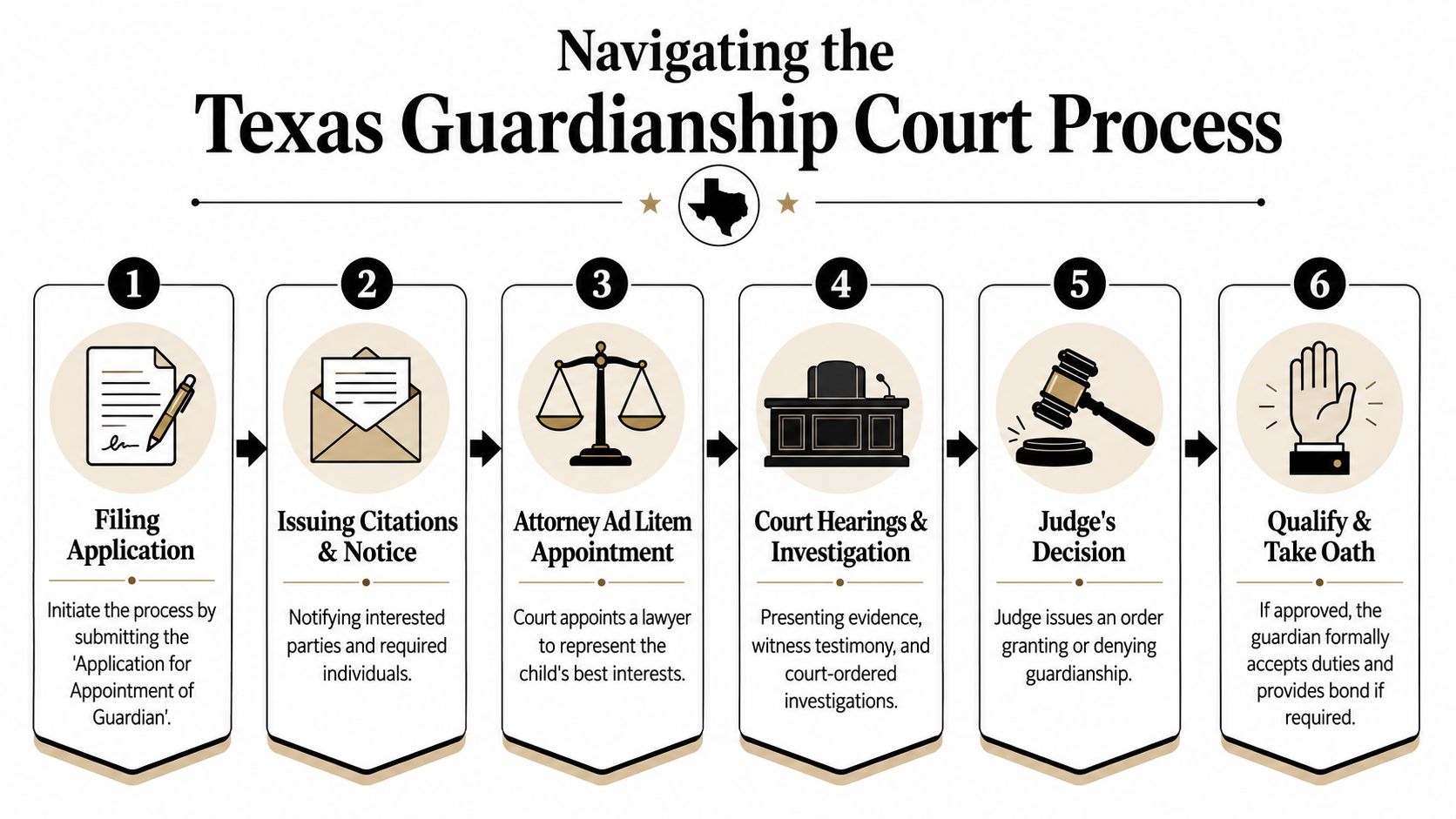
What happens after filing
Texas guardianship cases usually follow a predictable sequence, but the point is not just to check boxes. Each step answers a question the judge must resolve before giving someone legal authority over a child.
The application is filed in probate court.
This opens the case and defines what you are asking the court to grant. If the application is vague, inconsistent, or missing supporting details, problems usually surface later, often when the ad litem starts asking questions.Notice goes out to the required people.
Notice protects due process. Parents and certain relatives have a right to know that someone is seeking court-ordered authority over the child. If notice is defective, the judge may delay the case even when the family situation clearly needs attention.The court appoints an Attorney Ad Litem.
The ad litem represents the child's interests, not the applicant's and not the parents'. That role matters because the judge wants an independent assessment of what arrangement serves the child.Background checks and investigation take place.
Courts want to know more than whether you care about the child. They may look at criminal history, prior CPS involvement, the stability of the home, and whether the proposed guardian can meet the child's day-to-day needs.The hearing is held.
At the hearing, the judge decides whether guardianship is necessary and whether you are the right person to serve. Good cases usually present clear facts, organized records, and a practical explanation of why a less restrictive option will not work.
A short explainer may also help some readers visualize the hearing process:
Why notice causes so many delays
Notice problems are one of the most common reasons a guardianship hearing gets reset. Families often assume that a phone call, a text message, or a relative's verbal confirmation is enough. In court, it usually is not.
The reason is straightforward. A guardianship order can limit a parent's control and give another adult legal authority over the child. Judges take that seriously. If a parent is hard to locate, estranged, or moving from place to place, document every search effort and follow the service rules carefully. Sloppy notice can cost weeks and sometimes much more.
A Texas procedural guide explains that common delay points include defective notice, missing supporting proof, and problems completing the required steps before the hearing, as discussed in this description of Texas filing pitfalls.
What families should expect from the Attorney Ad Litem
The ad litem is usually looking for facts that can be verified. Expect questions about where the child has been living, who has been making medical and school decisions, what the parents' current situation is, and whether another arrangement could protect the child without a full guardianship.
Candor matters here. If there is a prior arrest, a difficult family conflict, a parent with substance abuse issues, or an unstable housing history, address it directly and support your explanation with records, dates, and specific examples. In my experience, families get into more trouble by minimizing a weakness than by explaining it clearly and showing the court how the child will still be protected.
The hearing itself is often less dramatic than families expect. Judges usually want direct answers to practical questions. Why is guardianship necessary now? Why are you the appropriate person? What does the child need that no one else is legally able or willing to provide? The more your evidence stays centered on the child's safety, stability, schooling, medical care, and daily life, the stronger the case usually becomes.
Handling Urgent Needs and Guardianship Disputes
Some situations can't wait for the ordinary court timeline. A child may need immediate medical authority, immediate placement stability, or rapid legal intervention because the current circumstances are unsafe. Other cases become difficult because a parent or relative objects.
Those are different problems, and they require different strategies.

Temporary guardianship versus a standard case
A standard guardianship case is built for lasting authority and full court review. Temporary guardianship is built for urgent protection.
Under Texas Estates Code § 1251.001, a court may grant temporary guardianship for up to 60 days in urgent or emergency situations, as described in this discussion of temporary guardianship authority. The cited source discusses vulnerable adults, but the principle of temporary guardianship helps families understand how Texas handles emergency requests when a full hearing can't happen first.
A simple comparison helps:
| Situation | Standard guardianship | Temporary guardianship |
|---|---|---|
| Purpose | Long-term authority | Immediate short-term protection |
| Court focus | Full evidence and full procedure | Urgent need for immediate legal action |
| Best use | Ongoing caregiving arrangement | Crisis, immediate danger, or unstable access to care |
The court will still expect facts. “We're worried” usually isn't enough by itself. The stronger emergency filings identify the immediate risk and connect it to the child's health, safety, or urgent care needs.
When another family member objects
Objections are common when families disagree about what's best, who should serve, or whether guardianship is needed at all. Some objections are emotional. Some are strategic. Some raise real concerns the judge needs to hear.
If someone contests the case, focus on evidence, not accusations. Helpful proof may include:
- Caregiving history: Who has been caring for the child?
- School and medical stability: Who gets the child to appointments, handles school issues, and responds to emergencies?
- Parent condition: What facts show the parents can't currently provide care?
- Suitability of the proposed guardian: What shows you can provide a stable, lawful, child-centered home?
A contested guardianship is rarely won by the person who talks the most. It's usually stronger for the person who brings the clearest evidence and stays centered on the child's daily needs.
Alternatives deserve a serious look
Texas law favors the least restrictive option. In some families, supported arrangements, voluntary parental paperwork, or custody-related remedies may solve the problem without a full guardianship case. In others, those options fall apart because the parent is unavailable, inconsistent, or likely to revoke consent.
That trade-off matters. A short-term agreement may work for a summer medical recovery. It often doesn't work when a child needs stability over school enrollment, treatment decisions, or long-term financial management.
Your Duties and Responsibilities as a Guardian
The hardest calls often come after court, not before. A child needs to start school, a doctor wants consent for treatment, or money from a settlement has to be protected. At that point, your authority only works if you completed the post-appointment steps and kept the court paperwork current.
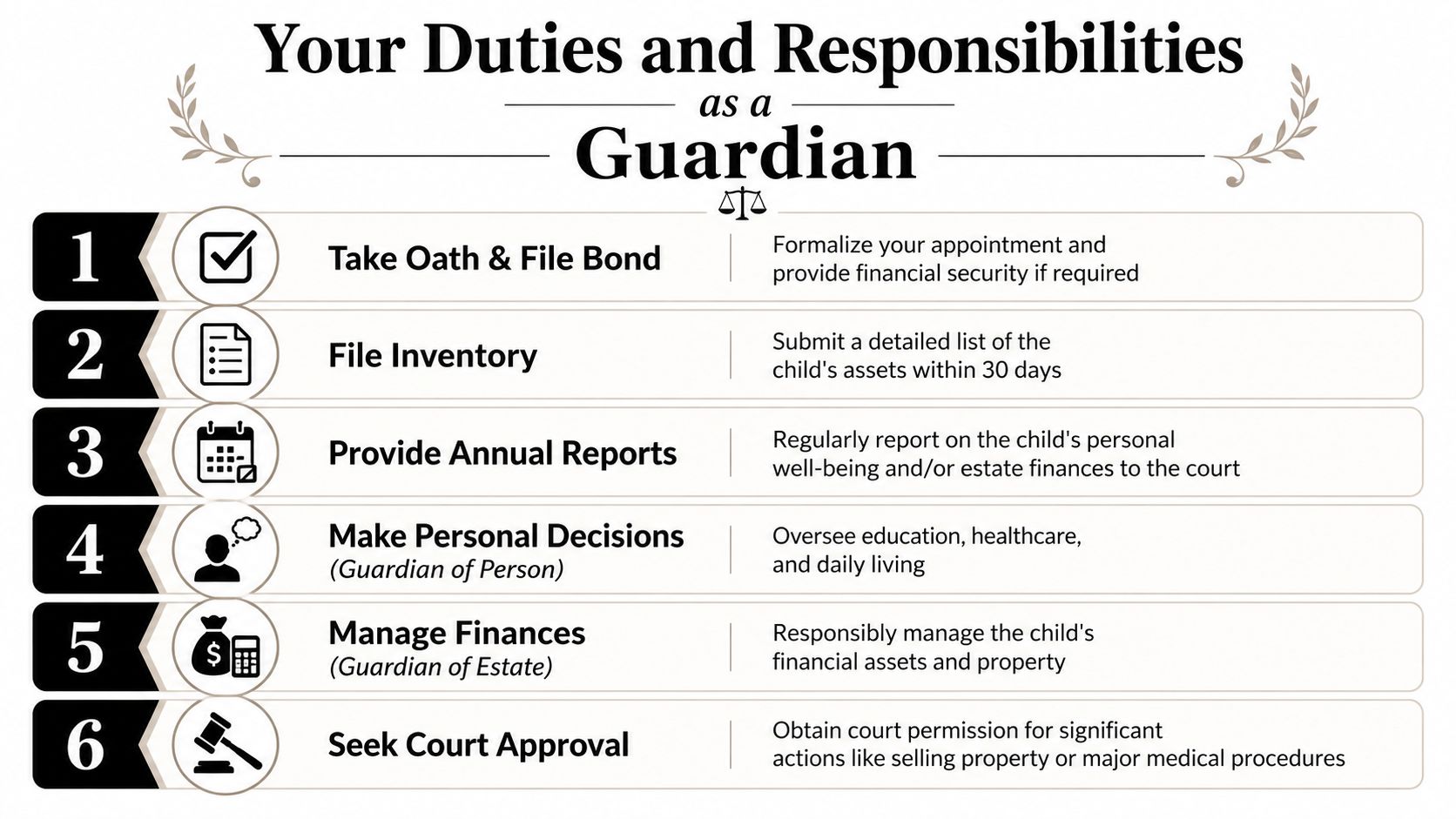
What happens right after the hearing
A signed order does not end the job. You still have to qualify as guardian. In practice, that usually means taking the oath, posting any required bond, and getting current Letters of Guardianship before schools, banks, or medical providers will reliably accept your authority.
Those steps matter for a reason. The oath puts you under a legal duty to act in the child's best interest. The bond protects the child if money or property is mishandled. Letters of Guardianship are the document you will show in real life, and they expire, so families who treat them like a one-time paper often run into avoidable problems months later.
Compliance problems usually start with ordinary life
I see families miss deadlines for practical reasons, not bad ones. They are caring for the child, dealing with a parent in crisis, juggling work, and trying to create stability. The court still expects reports, renewals, and accurate records.
Keep a simple calendar and treat it like part of the guardianship itself. Track:
- Report deadlines: Annual reports and any filings tied to the child's property or funds
- Letter renewal dates: Do not wait until a school or hospital tells you your papers are outdated
- Bond requirements: Check whether a renewal or updated amount is required
- Court approval issues: Some larger financial or legal decisions need permission before you act
This is one of the biggest trade-offs families underestimate. Guardianship gives you legal authority that informal arrangements often do not. In exchange, the court keeps supervising how that authority is used.
Daily care and legal duty are tied together
A guardian of the person handles the child's daily welfare. That includes medical decisions, education, living arrangements, and basic safety. A guardian of the estate manages money, property, or benefits for the child and must keep clean records that can stand up in court.
Those roles can overlap, but the responsibilities are different. A loving caregiver can still get into trouble by mixing the child's money with household funds, failing to document expenses, or making a major decision without checking whether court approval is required first. Good intentions do not fix a bad paper trail.
For day-to-day caregiving practices, families sometimes also benefit from child supervision resources outside the courtroom. A practical example is Superstar Nannies' child safety guide, which can help caregivers think through safety habits and screening issues that matter in real homes.
Good guardians document first and decide carefully
Keep copies of medical records, school records, benefit notices, receipts, and every court filing. If the child receives money, open the right account structure and avoid informal shortcuts. If a question feels significant, such as relocating, handling a settlement, or responding to a challenge from a parent or relative, get legal advice before acting.
Families who want a clearer sense of what strong legal guidance looks like can review this guide on choosing the right guardianship lawyer in Texas. The right lawyer helps you avoid the common mistakes that happen after appointment, not just get the order signed.
Guardianship is ongoing court-supervised responsibility. The families who handle it well stay organized, protect the child's money and records, and ask questions before a small mistake becomes a legal problem.
When You Need a Guardianship Lawyer
Families often ask whether they can avoid court altogether. Sometimes they're looking at an Authorization Agreement or another informal arrangement because it seems faster, cheaper, or less confrontational. In the right short-term setting, that may help. For long-term stability, it often falls short.
A Texas family law source explains that Authorization Agreements last six months and are renewable, but parents can revoke them at any time, leaving the non-parent caregiver with zero legal standing to prevent the child's return if a parent changes their mind in this discussion of non-court guardianship options in Texas. That's the central trade-off. Informal authority may be convenient. It may also disappear overnight.
A lawyer becomes especially important when the case involves any of the following:
- A missing or uncooperative parent
- A dispute between relatives
- A child with settlement funds, inherited money, or property
- Questions about whether a less restrictive option is enough
- A need for emergency relief
- Concerns about compliance after appointment
The legal work isn't just filling in blanks. It includes choosing the proper court, drafting the application under the Texas Estates Code, handling notice correctly, preparing for the Attorney Ad Litem's investigation, presenting evidence, and preventing post-appointment compliance problems. For families comparing counsel, this guide on how to choose the right guardianship lawyer in Texas is a useful starting point.
The Law Office of Bryan Fagan, PLLC handles guardianship, probate, and estate-planning matters for Texas families, including applications for guardianship of the person or estate, contested matters, and court compliance issues. That kind of support matters when the facts are emotional and the procedure is unforgiving.
If you're trying to protect a child and need clear legal guidance, schedule a free consultation with Law Office of Bryan Fagan, PLLC. A guardianship case can affect where a child lives, who makes medical and school decisions, and how the child's finances are protected. Getting personalized advice early can help you avoid filing mistakes, prepare for court, and move forward with confidence and care.