Maria expected a difficult conversation when she visited her father at a Houston nursing home. She didn't expect staff members to tell her that she couldn't take him to his grandson's birthday. Maria asked to see the paperwork, but she still wasn't sure what it allowed, what it restricted, or who could correct the problem.
Families often face this gap between what a guardianship seems to permit and what the court order says. The Texas guardianship ward bill of rights and how it is enforced matters because a guardianship doesn't automatically erase a person's legal and personal rights. Texas law preserves those rights unless a court order specifically limits them, and the law gives families several ways to respond when someone ignores that rule.
When a Family Notices Something Is Wrong
Maria's first instinct was to argue with the nursing home. Her father had always loved family gatherings, and the birthday party was important to him. But the staff explained that his guardian had directed them not to release him for visits outside the facility.
That answer raised more questions. Had the guardian restricted his visits? Had a judge approved that restriction? Was the facility following a valid court order, or following a guardian's broad instruction?
Those questions matter because a guardian's authority comes from the guardianship order and Texas law. A guardian may have authority over the ward's person, estate, or both, but the ward keeps rights unless the court has specifically limited them. A family member who hears “the guardian said no” should ask a more precise question: Where does the order say that?
Maria also needed to separate a disagreement from a rights violation. A guardian may make difficult decisions about care, safety, medical treatment, housing, or finances. The fact that a family member dislikes a decision doesn't automatically make it unlawful. But a guardian still has to act within the authority granted by the court and fulfill fiduciary duties.
The practical response begins with records. Ask for the guardianship order, write down what staff members said, note the date and names of people involved, and preserve messages or visitation policies. If the order doesn't clearly support the restriction, the family may need court clarification or modification.
A calm, written record gives a judge something concrete to review. Anger explains why a dispute matters, but documentation helps produce a remedy.
Maria's situation is the starting point for understanding the law. Her father's rights, the language of the order, and the enforcement tool available to the family all fit together.
What the Texas Ward Bill of Rights Actually Says
Texas Estates Code Section 1151.351 places the rights of wards in one location. The statute also provides the foundation for enforcement by recognizing that a ward keeps constitutional and statutory rights unless a court order specifically limits them. The Texas legal rights of a ward in guardianship cases can be easier to understand when you compare the statute directly with the order in your loved one's case.
A guardianship order should be read as a set of specific powers and limits, not as a general declaration that the ward can no longer make choices. The statute recognizes rights that include the following:
- A copy of the guardianship order: The ward has the right to receive a copy of the order that explains the guardianship and any restrictions.
- Information about complaint agencies: The ward has the right to be told about agencies that receive and investigate complaints.
- Voting: The ward has the right to vote unless a court order limits that right.
- Marriage: The ward has the right to marry unless the court has specifically restricted it.
- A driver's license: The ward has the right to obtain a driver's license unless restricted by court order or otherwise disallowed under applicable law.
- Private visits: The ward has the right to enjoy private visits unless the visits would be harmful.
- Communication and personal dignity: The ward's care should respect personal privacy, safety, and the ability to participate in decisions to the extent the person can do so.
- Review of restrictions: The ward and interested family members can examine whether a claimed limitation appears in the court's order.
- Access to complaint information: The ward should know where to raise concerns about treatment, care, or the guardian's conduct.
- Rights not specifically removed: The ward retains other constitutional and statutory rights unless the court order identifies a limitation.
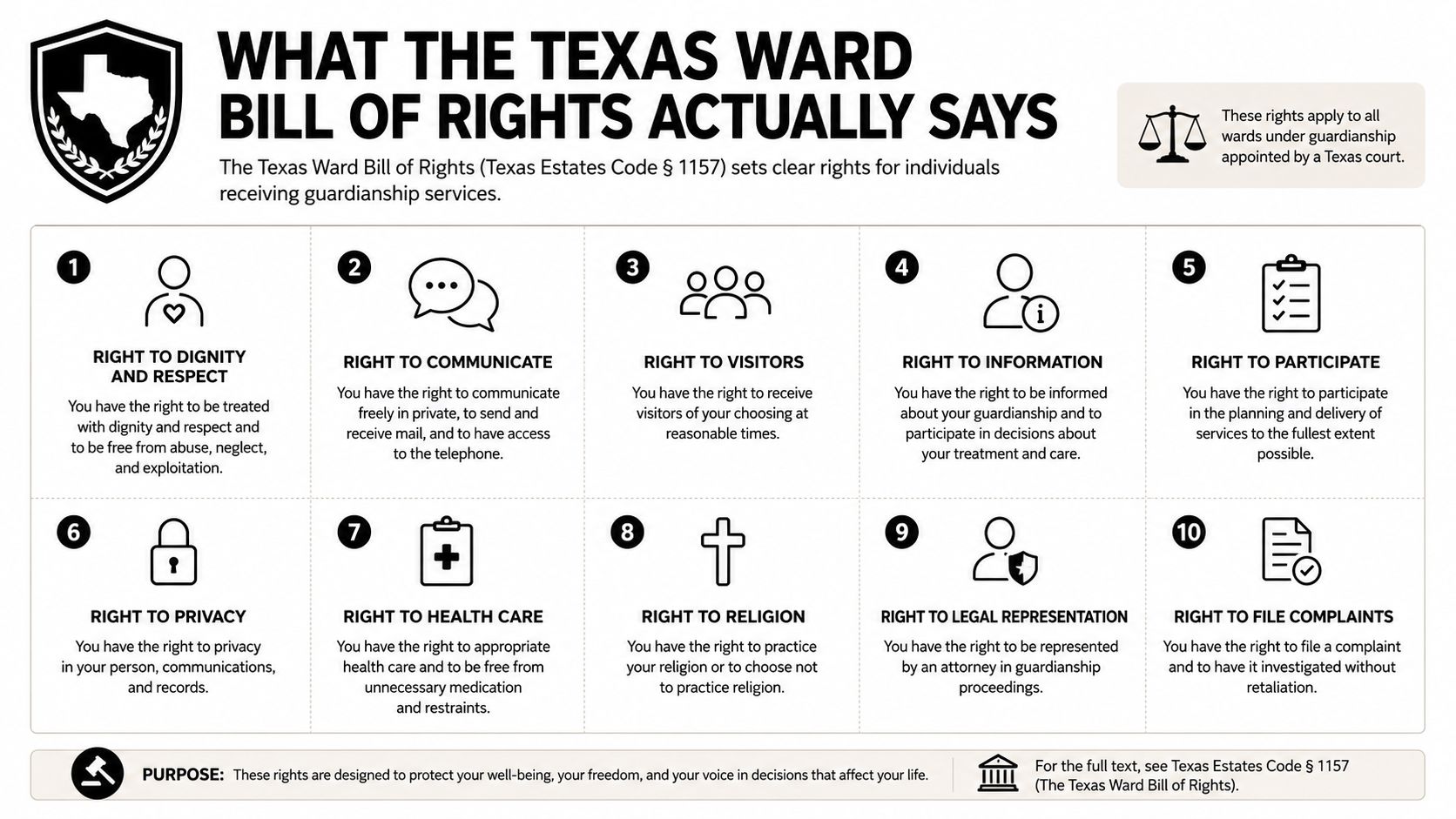
The list doesn't mean every ward can make every decision independently. A court may assign decision-making powers to a guardian when incapacity is established. The important point is that a restriction should be identifiable. If a guardian controls financial contracts, the order should address that authority. If visits are limited for safety, the order or a later court ruling should provide a basis for the limitation.
A family may work with a Texas Guardianship Lawyer for representation in guardianship of the person and estate under the Estates Code. The immediate task remains practical: obtain the order, locate the restriction, and ask whether the guardian's action matches the language the judge approved.
Why the 2015 Change Matters for Texas Families
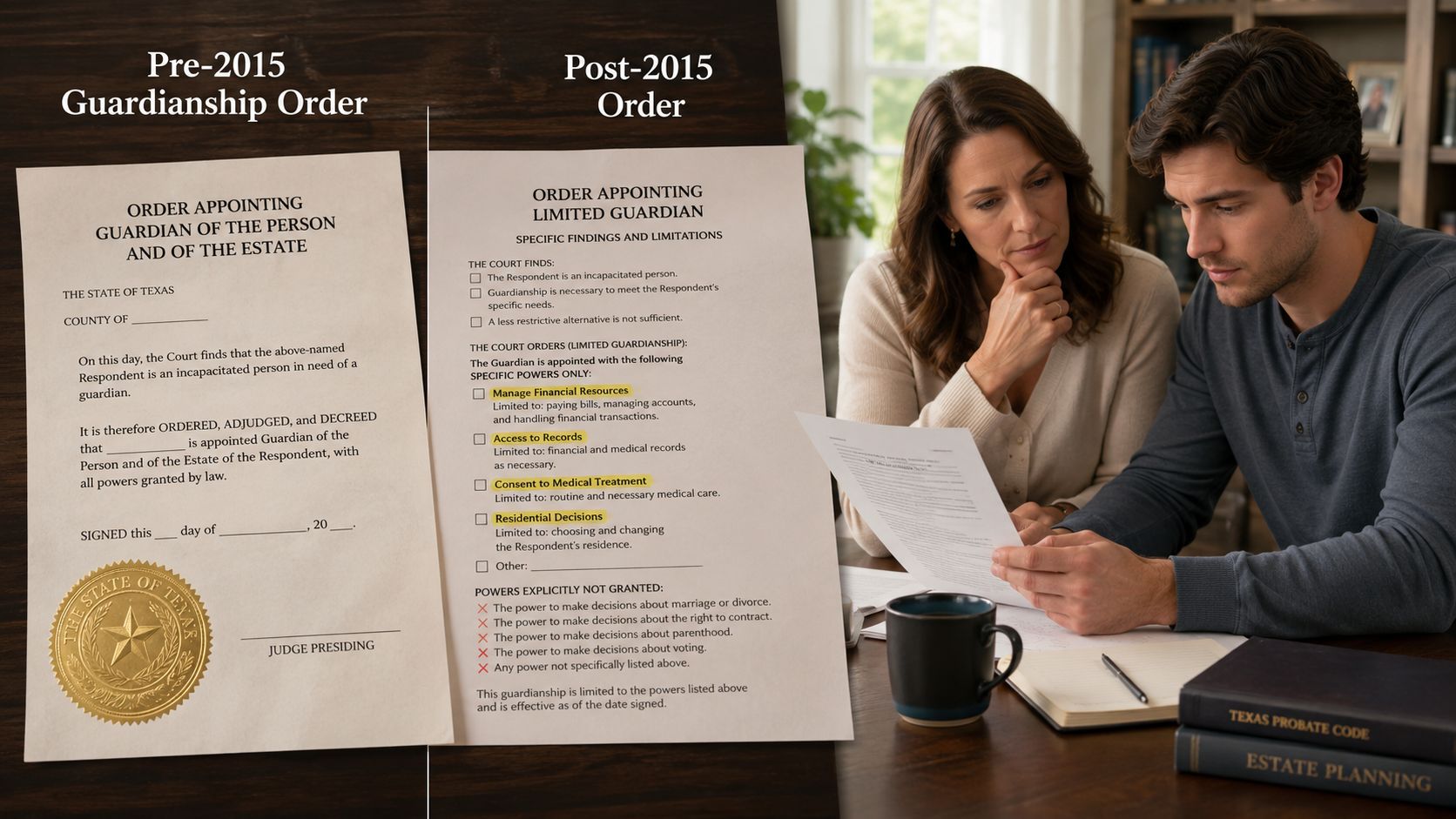
Texas significantly strengthened the ward bill of rights in 2015, when the Legislature added Estates Code Section 1151.351. The provision collected ward rights in one place and required that a ward retain constitutional and statutory rights unless a court order specifically limits them. The Texas State Law Library explanation of guardianship rights and responsibilities describes the rights-preserving structure created by this change.
Before this approach, families could experience guardianship as sweeping authority. A broad understanding of guardianship might lead a guardian, facility, or relative to assume that the ward had lost control over nearly every personal choice. The modern rule asks a narrower question: What did the court take away, and what authority did it specifically grant?
That distinction affects ordinary life. A daughter may want to take her father to church. A son may want to understand whether the guardian can manage a small savings account. A spouse may want to keep private access to a phone or enjoy a private visit. The answer depends on the guardianship order, the type of guardianship, and any later order modifying the ward's rights.
How the rule changes court orders
In Harris County Probate Court and other Texas probate courts, the wording of an order matters. A court should identify the powers granted to the guardian and the rights restricted for the ward. An order that appears broader than the court's findings may need clarification or modification.
This approach gives families a useful enforcement vocabulary:
- Identify the right.
- Find the specific limitation.
- Compare the guardian's conduct with the order.
- Ask the court for a targeted remedy if the two don't match.
The 2015 change didn't eliminate guardianship disputes. It gave courts, wards, advocates, and families a clearer way to define the dispute. A guardian can't rely only on the existence of guardianship. The guardian must point to the authority granted and exercise it within the limits of the law.
The Enforcement Toolbox Texas Courts Actually Use
A bill of rights has value only when someone can act after a violation. Texas uses court supervision, required filings, investigative appointments, emergency protections, and remedies against guardians who fail to perform their duties.
Start with the order
A court order is the first enforcement tool. It should identify the guardian's powers and the restrictions placed on the ward. If the problem involves visitation, communication, medical decisions, housing, or finances, compare the disputed conduct with the exact language of the order.
Use this tool when: the parties disagree about what the guardian is authorized to do.
Texas law can make some guardianship orders more concrete. A guardian of the person may have the ward's physical possession or establish the ward's legal domicile. Under the applicable Estates Code language, the order may notify Texas peace officers that they may use reasonable efforts to enforce that right. This is different from a general statement of authority because the order itself gives officers a specific directive to review and enforce.
Use this tool when: someone is withholding the ward from a guardian who has a court-ordered right to physical possession or domicile.
Use reporting requirements as oversight
A guardian of the person must file a sworn annual report for the duration of the guardianship. The report covers receipts and disbursements for the ward's support and maintenance, necessary education, and, when authorized by the court, support for dependents. The 12-month reporting period means records should be maintained continuously, not reconstructed at the last moment. The Texas Estates Code reporting provisions provide the statutory framework.
A guardian of the estate must file an annual account with the county clerk. The judge can't consider the account until it has remained on file for 10 days, and the court may not approve it unless required cash, listed securities, or other safeguarded assets are proven to be held as the law requires. See the Texas Estates Code annual account requirements.
Use these tools when: the concern involves missing records, unexplained spending, or possible loss of estate property.
Ask for investigation and representation
An attorney ad litem may represent the ward's interests in a guardianship proceeding. A court visitor may investigate the ward's situation and report information to the court. These roles can help when the ward has difficulty explaining concerns, when relatives provide conflicting accounts, or when the court needs information from outside the immediate dispute.
Adult Protective Services may be appropriate when the concern involves abuse, neglect, or exploitation. APS involvement doesn't replace a court filing, especially when the family needs a judge to change an order or restrict a guardian's powers.
For practical background on court oversight, families can review information about court monitoring of a Texas guardian.
Use these tools when: the court needs an independent investigation or the ward may be unsafe.
Seek court remedies
A court may respond to noncompliance through orders compelling action, restrictions on guardian powers, sanctions, or removal when the facts support it. A party may also need to pursue an appeal when a court enters an order that improperly limits rights or resolves a dispute incorrectly.
Use this tool when: informal requests have failed, the guardian won't comply, or an order requires review by a higher court.
The right remedy depends on the harm. A missing filing may call for a motion to compel. An immediate safety threat may require emergency action. A disagreement about a visit may need clarification instead of punishment. The goal is a court-directed solution that protects the ward without creating unnecessary conflict.
How Reporting Gaps Become Rights Problems
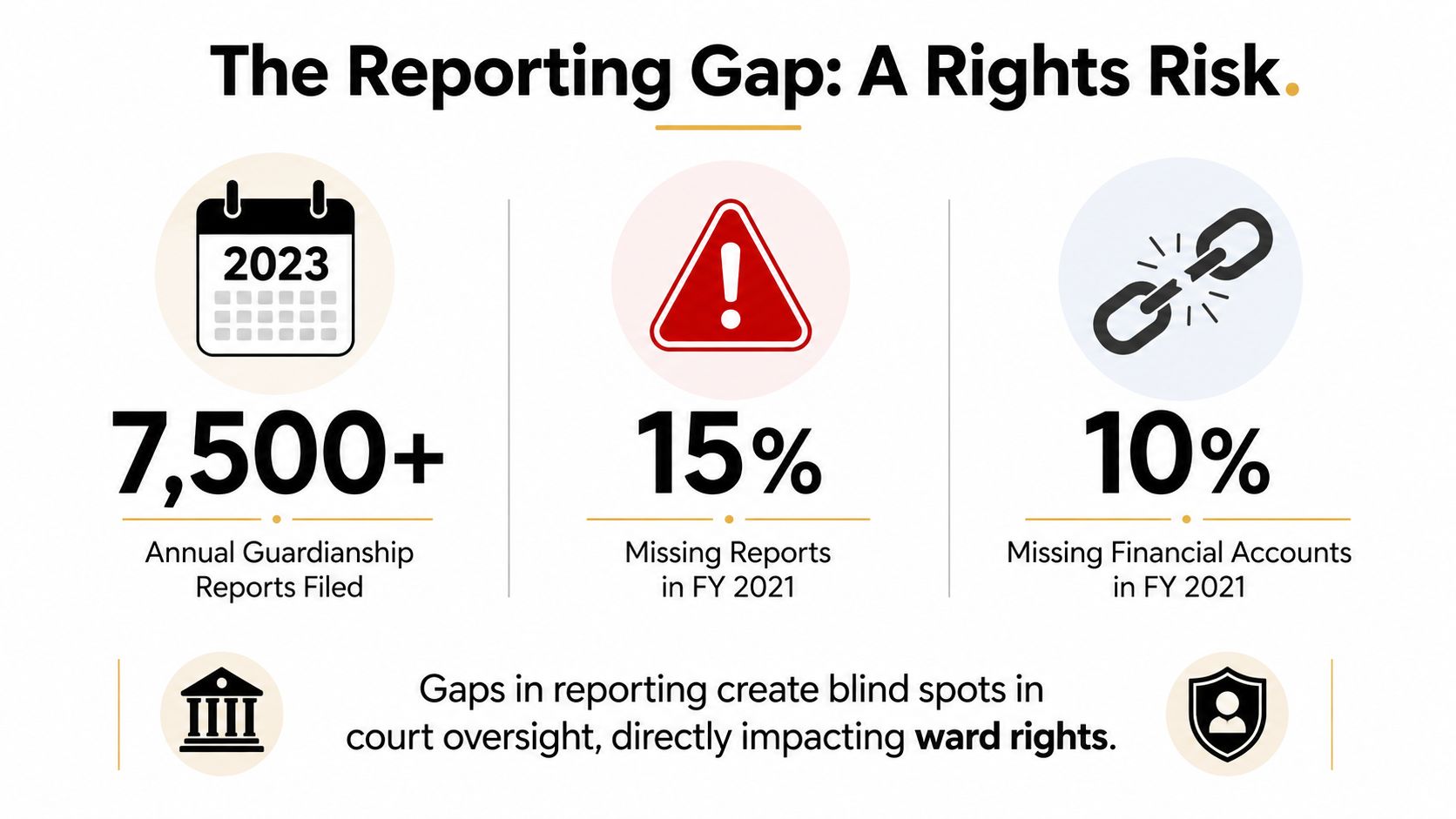
Court oversight works like a dashboard: judges and interested family members can respond only to information that reaches the court. Missing annual reports or accounts can therefore turn a statutory right into a problem that remains hidden. A report may reveal whether the guardian is addressing care, housing, medical decisions, and communication with the ward. An account may show whether money and property are being protected.
Texas courts reported 8,277 guardianship-of-person reports in FY 2023, according to Texas judicial reporting data. The same source reports that a Texas guardianship compliance review found 27% of cases were missing annual reports and 27% were missing annual accounts in FY 2021. These figures do not establish abuse in every case. They do show why an absent filing deserves a prompt records check.
What to ask the clerk
Contact the county clerk or guardianship clerk handling the case. Ask whether the most recent annual report and annual account were filed, whether the judge approved either filing or left it pending, and how to inspect or request copies. Ask whether the clerk has a local request form, records-access procedure, or docket sheet that identifies the filing deadline and current status. Keep the response, request date, and case number with your records.
The 10-day filing period for an estate account gives interested parties time to review it before the judge considers approval. That window can expose missing transactions or unanswered questions while the court can still address them. If the concern involves abuse, neglect, or exploitation, families can review guidance on how to report guardianship abuse and contact APS when immediate protective action may be needed.
A Realistic Family Scenario and What It Produces
Maria begins by asking the guardian for a copy of the guardianship order. She keeps the request polite and puts it in writing. When she reviews the order, she doesn't find language limiting her father's right to receive visitors, except for a general statement about safety.
That wording may not answer the entire question. Maria documents the denied birthday visit, asks the guardian to explain the safety concern, and requests a workable visitation plan. She also keeps the nursing home's written response and records the names of staff members who described the restriction.
When the guardian won't respond, Maria can ask the court to clarify or modify the order. Her request should identify the right involved, describe the specific conduct, attach supporting records, and explain the remedy she wants. She may also ask the court to appoint an attorney ad litem for her father so his interests have a separate voice in the proceeding.
Later, Maria learns that the guardian has stopped filing annual reports. She contacts the clerk to confirm the missing filing, raises the issue with the court, and consults Adult Protective Services because she's concerned that the lack of oversight may hide a care problem. Each step produces something useful: a written request, a documented incident, a clerk record, a court filing, or an investigative referral.
The process may feel slow when a family is worried. Still, enforcement is often built from small, verifiable steps rather than one dramatic confrontation.
Judges act on evidence. A dated log, a copy of the order, written communications, and filing history can become the clearest account of what the ward is experiencing.
Triage Guide for When to Use Each Tool
Use the response that matches the risk. A blocked visit may begin with clarification, while suspected exploitation calls for protective action without waiting for a routine reply. The goal is a usable record and the right decision-maker at each stage.
| Problem you notice | First step and timing | Useful document or wording | Who to contact |
|---|---|---|---|
| Visitation or communication is blocked | Review the order, then send a written request promptly | Include the requested visit, the restriction, and the safety reason requested. Keep the order and facility notes | Guardian, then the court if no workable response |
| Guardian will not respond | Send one follow-up and preserve delivery proof before escalating | Tell the clerk, “I need to confirm how to raise an unanswered guardianship concern in this case.” Keep emails and call records | Guardianship attorney or court clerk |
| Financial activity is unexplained | Preserve records and seek legal review rather than arguing informally | Gather statements, receipts, property records, and filed account materials | Attorney and guardianship court |
| Abuse, neglect, or exploitation is suspected | Contact protective authorities immediately; do not wait for the next routine filing | State who may be at risk, what happened, where, and when. Keep photos, medical records, and witness names | Adult Protective Services and the court |
| An annual report appears missing | Ask the county clerk to verify the docket status | Say, “Please confirm whether the annual report was filed, accepted, or remains pending.” Provide the case number | County clerk and court |
| An annual account appears missing or incomplete | Confirm whether it was filed and whether review remains pending | Ask which filing is missing and what record the clerk can release. Keep account papers and supporting records | County clerk, court, and attorney |
| The order seems too broad | Compare the restriction with the court's findings before requesting a change | Mark the exact language and gather the certified order, medical evidence, and hearing records | Guardianship attorney and court |
A clerk can explain filing status and procedure, but cannot give legal advice or change an order. A court order is the tool for clarifying or modifying rights. A visitor report can give the judge an independent account, while an APS referral addresses possible immediate danger. These tools serve different purposes, like separate lanes leading to the same protection.
The Law Office of Bryan Fagan, PLLC handles guardianship matters involving establishment, modification, disputes, temporary guardianships, and compliance. Families can also review an autism guardianship collaboration guide when caregivers, relatives, and professionals need a shared process for supporting an adult with disabilities.
Your Practical Enforcement Checklist and Next Step
If your father's rights seem restricted, use this checklist with the guardianship records:
- Obtain the order: Request a certified copy from the court.
- Compare rights: Read Estates Code Section 1151.351 against each restriction.
- Calendar filings: Track annual report and annual account deadlines.
- Log incidents: Record dates, people involved, requests, responses, and harm.
- Check the docket: Ask the county clerk whether filings are missing or pending.
- Get advice early: Arrange a consultation when a right is limited without a clear order.
These records turn a concern into something a judge, visitor, APS investigator, or attorney can evaluate. Asking questions does not mean you are failing your loved one. It helps create the oversight Texas law expects.
Call the county clerk today to check whether the guardian's latest annual report has been filed, then preserve what you learn and seek legal guidance if the record shows a gap. Families coordinating caregivers and professionals may also review an autism guardianship collaboration guide for a shared support process.