Skip to content
You may be holding a hospital discharge folder in one hand and your phone in the other, trying to explain that you're your mother's daughter, that you pay her bills, that you've been taking her to appointments, and that none of that is enough for the bank or the clinic to talk with you. Families across Texas run into this wall every day. Love and responsibility feel obvious inside the family, but outside the family, institutions need legal authority.
That's where Letters of Guardianship in Texas come in. Think of them as the court's official key. They don't replace your relationship with your loved one. They give you the legal proof to act when a doctor, social worker, banker, or care facility needs to know who can make decisions.
For many families, this moment is emotional. You may feel guilty for even considering guardianship. You may worry that going to court means you've failed somehow. In truth, guardianship often starts because someone is trying to protect a parent, an adult child with disabilities, or another vulnerable family member from harm, confusion, or financial trouble. The process is legal, but the reason behind it is usually personal.
The Moment You Realize You Need Help
Maria had been helping her father for months. She organized his medications, drove him to appointments, and noticed unpaid bills stacked on the kitchen table. When he was admitted to the hospital, she assumed she could speak with the care team and sort out his insurance paperwork. Instead, she was told the staff needed legal authority before sharing details or taking instructions from her.
That kind of moment hits hard. You know something isn't right. You know your loved one needs support. But the nurse, the hospital billing office, and the bank manager all have the same basic answer: “We need the right documents.”

When family help stops being enough
A lot of people think being next of kin automatically gives them decision-making power. It often doesn't. A spouse, adult child, sibling, or caregiver may be the person doing the daily work, but hospitals and financial institutions usually need formal legal proof before they can rely on that person's instructions.
That's why families start looking into guardianship. If you're also thinking about long-term planning for younger family members, a resource on protecting your children can help frame how legal tools protect the people who depend on you.
You're not overreacting if you feel stuck. The legal system often requires paperwork before it recognizes the caregiving role you're already carrying.
Some families discover that less restrictive options are still available. Others learn that the situation has reached the point where court involvement is necessary. If you're trying to sort out whether that line has been crossed, this discussion of when guardianship is the only option in Texas is a useful next step.
Why the letters matter so much
Letters of Guardianship are the document people usually mean when they say, “How do I prove I'm allowed to do this?” They are what you carry into real life after the hearing. They're what the hospital asks for when treatment decisions must be made. They're what a bank may ask to see before discussing account access.
In other words, the letters are not just legal paperwork sitting in a file. They are the working document that travels with you from the courthouse into daily life.
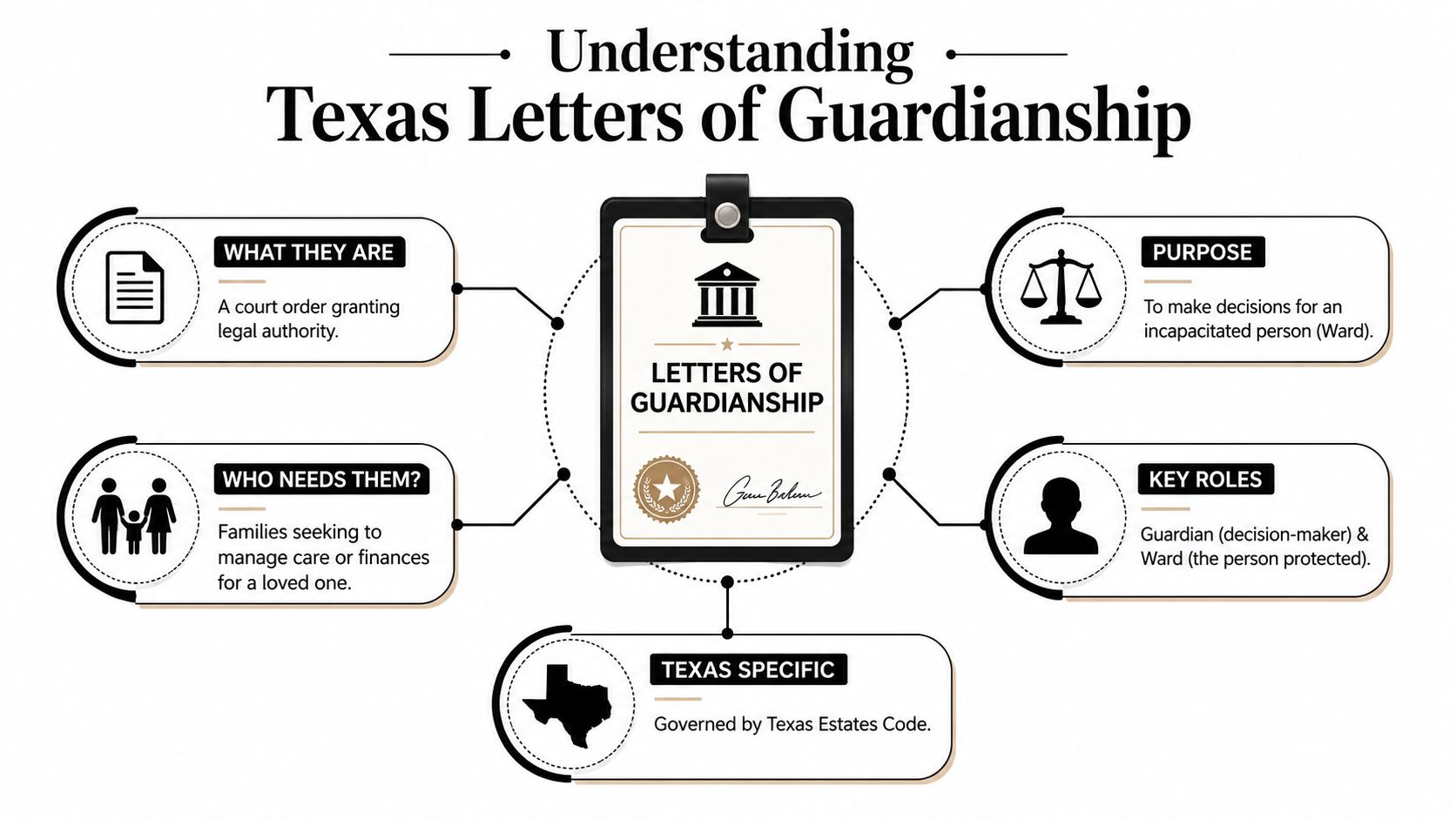
What Are Texas Letters of Guardianship
Letters of Guardianship are the court papers that carry your authority out into the world. The judge signs an order in the courtroom, but the letters are the document you present later, at the bank counter, in a doctor's office, or with a care facility administrator. If the order is the court's decision, the letters are the proof other people rely on in day-to-day situations.
What the letters actually prove
These letters do not appear automatically, and they do not come from a form you print at home. A Texas court issues them only after a guardianship case has been filed, heard, and approved, and after the guardian has completed the required qualification steps. As noted earlier, Texas guidance treats the letters as the legal proof that the appointment has been made and that the guardian has authority to act.
That authority can cover different areas of life, depending on what the judge approved.
- Guardian of the person has authority over personal matters such as care, residence, and medical decisions.
- Guardian of the estate has authority over financial matters such as managing money, property, and bills under court supervision.
- Limited guardianship means the court granted only certain powers, not every power a guardian could possibly have.
This part is easy to miss. The letters do not give unlimited control. They show only the authority the court granted.
Why the letters are time-sensitive
Many families assume that once the letters are issued, they stay good forever. Texas guardianship does not work that way. The letters have an expiration date, and the court expects the guardian to stay current with ongoing duties before updated letters are issued.
A simple way to understand this is to picture the letters as current proof of active authority. They are closer to a current credential than a one-time trophy you frame and forget. If the letters expire, practical problems can show up fast. A bank employee may refuse to discuss an account. A doctor's office may ask for updated paperwork before accepting your consent.
That system reflects how Texas handles guardianship. The court continues supervising the arrangement because the goal is protection, not just appointment.
What families often misunderstand
The most common point of confusion is the difference between the order and the letters. Families often leave court focused on the judge's ruling, which makes sense. But in everyday use, the letters are usually what third parties ask to see because they are shorter, easier to review, and designed to confirm current authority.
Another misunderstanding is the idea that a power of attorney, a notarized family agreement, or a handwritten statement can do the same job. They cannot create Letters of Guardianship. Only the court can issue them.
That distinction matters for a very practical reason. When you are standing in front of a banker or hospital staff member, the question is usually not whether your family knows you are helping. The question is whether you can place a current court-issued document on the desk that confirms you have authority right now. The letters are the document built for that moment.
They are powerful papers, but they are also narrow papers. Their force comes from the court, and their limits come from the court too.
The Path to Obtaining Your Letters of Guardianship
A lot of families expect the process to end when the judge says, “Application granted.” In real life, that is closer to the moment your car is approved for pickup from the shop. The repair is done, but you still have to get the keys before you can drive anywhere.
That same idea helps with Letters of Guardianship. The court case leads to the letters, but the letters themselves do not exist at the start. They are created near the end of the process, after several specific steps are completed in the right order.
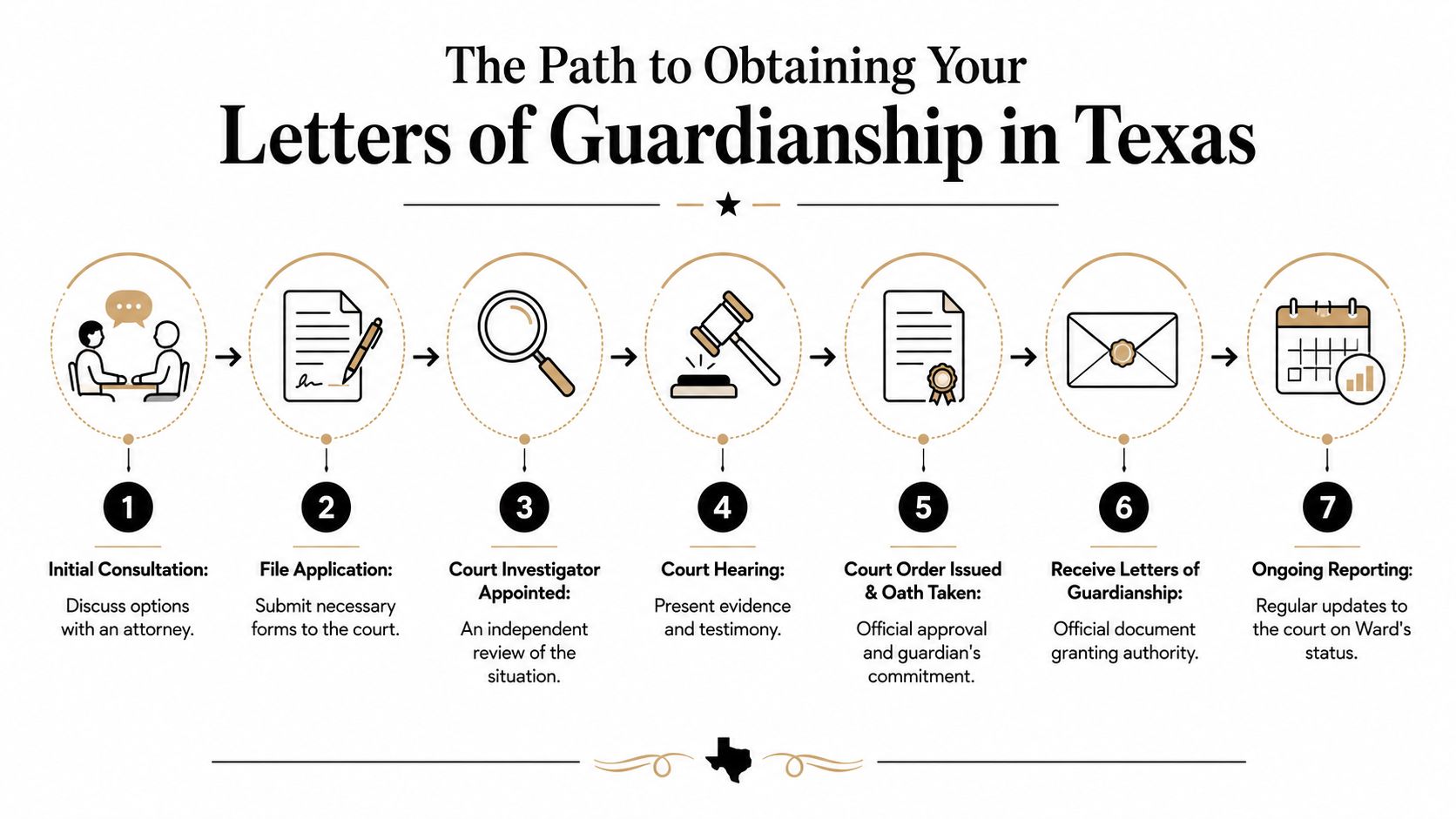
A visual overview can help if the process feels abstract.
The process starts with a file, not with the letters
To ask for a permanent guardianship in Texas, the applicant files a sworn Application for Appointment of Permanent Guardian in the probate court for the county where the proposed ward lives. The filing usually includes a Certificate of Medical Examination completed by a licensed Texas physician within the required time period, as explained in this explanation of Texas guardianship law.
Families sometimes find this frustrating. They are already living the problem every day. They see missed medications, unsafe spending, confusion, or wandering. But the court still needs the concern translated into legal proof. The application begins that translation.
The medical certificate matters because it gives the judge more than a family description of what is going wrong. It connects the day-to-day problems to a professional evaluation of capacity.
The court examines need, scope, and alternatives
A diagnosis alone does not automatically produce a guardianship. The judge also wants to know what type of help is needed and whether a less restrictive option could work.
That part can feel personal for families. You may be trying to protect a parent or adult child, yet the court is asking careful questions instead of automatically approving the request. That is normal. Guardianship removes some decision-making rights, so the court has to be careful before handing someone else that authority.
It helps to picture the court as checking three things at once:
- Is the person legally incapacitated for the decisions at issue?
- What powers does the proposed guardian need?
- Would a less restrictive option protect the person well enough?
That middle question matters more than families often expect. The letters that eventually come out of the clerk's office reflect the authority the court approved. If the judge limits the guardianship, the letters will reflect those limits too.
The hearing pulls the story together
By the time of the hearing, the court has more than a stack of forms. It has a developing record. The judge reviews the application, the medical evidence, and input from any court-appointed participants.
At this stage, the future letters begin to take shape in a practical sense.
The judge is deciding who needs protection, what kind of protection is justified, and who should hold that authority. If relatives disagree, if someone questions the proposed guardian's fitness, or if there is a real dispute about capacity, the hearing can take more time and require more evidence.
Families often do better when they prepare for the hearing with the end use of the letters in mind. Ask yourself a simple question: “What will I need this document to let me do once I am standing in a bank, doctor's office, or care facility?” That question helps focus the proof on real-world needs instead of vague worry.
For a step-by-step overview of the court side of the case, How to Get Guardianship in Texas: The Process can help.
The judge signs the order, then you still have work to do
This is the point where many families get tripped up.
The signed order appointing a guardian is a major milestone, but it is not yet the document you usually carry to third parties. Before the clerk issues Letters of Guardianship, the guardian must qualify by completing the post-appointment requirements. That usually includes signing an Oath of Office and filing any bond the court requires.
If those steps are not completed on time, the appointment can be at risk. So from a practical standpoint, the judge's signature opens the last gate. It does not put the letters in your hand that same moment.
A simple timeline looks like this:
- File the guardianship application in the proper probate court.
- Gather and file the required medical support and other initial paperwork.
- Attend the hearing and present the evidence showing why guardianship is needed.
- Receive the appointment order if the judge approves the request.
- Qualify as guardian by taking the oath and filing the bond, if one is required.
- Request certified Letters of Guardianship from the clerk after qualification is complete.
That last step is where the document enters its working life. Until then, the letters are still waiting in the court process, even if the case has already gone well.
Local practice can affect how quickly the letters reach your hands
Texas guardianship law applies statewide, but each county court has its own workflow. Timing, scheduling, clerk procedures, and hearing availability can vary in places like Harris County, Dallas County, Travis County, and Bexar County.
Contested cases also slow the path. A sibling may object. The court may need more evidence. Questions may come up about finances, living arrangements, or whether the proposed guardian is the right person. None of that means the case is failing. It means the court is making a careful record before releasing a document that third parties will rely on.
When the case involves an adult who can no longer manage personal or financial affairs, Guardianship of an Incapacitated Adult in Texas explains that type of proceeding in more detail.
One practical tip here is simple. Once you qualify, ask the clerk how certified copies are issued, how long they remain current, and what to do if an institution questions them. Families often run into trouble later because no one explained what happens after the letters are printed. If that issue comes up, this guide on what happens when a bank refuses to recognize your authority in Texas can help you understand the next step.
The main point is easy to miss when emotions are high. Your Letters of Guardianship have a lifecycle. First, the court evaluates the need. Then the judge signs the order. Then you qualify. Then the clerk issues the letters. Only after that do those papers begin doing their real job out in the world.
Using Your Letters Effectively with Banks and Doctors
The first time you present your letters at a bank or hospital can feel awkward. You may expect everyone to know exactly what to do. Sometimes they do. Sometimes the employee in front of you has never handled Texas guardianship papers before.
Start with certified copies and a calm script
Ask the clerk for certified copies of your letters. In real life, one may go to a bank, another to a medical provider, and another to a care facility. Keeping a set organized in a folder saves time when a new issue comes up unexpectedly.
A simple script often helps:
“I'm the court-appointed guardian. These are my certified Letters of Guardianship from the Texas probate court. I'm requesting that you update your records so you can speak with me within the authority listed in these letters.”
That script works because it does three things. It identifies your role, names the document, and asks for a concrete action.
A bank example
Suppose James has been appointed guardian of his aunt's estate. He goes to the bank to address missed mortgage payments and suspicious withdrawals. The branch manager asks for proof of authority.
James hands over a certified copy of the letters and asks the bank to review the scope of his authority. If the staff member hesitates, James should stay polite and ask whether the bank has a legal or compliance department that reviews guardianship documents. Many delays happen because the front-line employee doesn't know where the paperwork goes.
If a bank refuses to recognize valid authority, families often need a practical next step. This discussion of what happens when a bank refuses to recognize your authority in Texas addresses that problem directly.
A doctor or hospital example
Now take the medical side. Denise arrives at a specialist's office for her brother's appointment. The front desk says privacy rules prevent staff from discussing treatment with her.
Denise can respond calmly: she is the guardian, she has the court's certified letters, and she'd like the office to place those papers in the chart and note who can consent to care. If the office needs time to scan and review the paperwork, that's normal. Most conflicts ease once the right person reads the letters.
- Bring photo ID: Staff often want to match the guardian's identity to the name on the letters.
- Ask for a supervisor: Front-desk confusion doesn't always mean a final refusal.
- Keep copies together: A binder with the letters, the appointment order, and contact information is easier to use under stress.
Some institutions don't reject your authority. They just need time to route unfamiliar documents to the right desk.
Use the letters within their limits
The letters are powerful, but they aren't a blank check. If you are guardian of the person, that doesn't automatically mean you have estate authority. If you are guardian of the estate, medical decisions may still be outside your role unless the court granted that power too.
That's why reading the document closely matters. The safest approach is to assume that your authority is exactly what the court says it is, no more and no less.
Keeping Your Guardianship Authority Active
The judge's signature gets the letters into your hands. Keeping up with the court is what keeps those letters usable in real life.
A good way to picture it is this: the letters are like a current ID card for your authority. If the court file falls behind, the paper in your binder may still exist, but the confidence behind it starts to fade. That is when simple tasks, like speaking with a bank or confirming treatment decisions, can suddenly slow down.
Ongoing filings keep the letters current
Texas guardianship does not end when the hearing ends. The court continues to watch over the case and expects regular updates. Those updates show that the ward is being cared for and that the guardian is carrying out the job the court assigned.
The filing depends on the kind of guardianship you have. A guardian of the person usually files an Annual Report. A guardian of the estate usually files an Annual Accounting. If those filings are late or incomplete, the court can raise concerns, delay renewal of active authority, or require the guardian to fix the problem before current proof can be issued.
That matters for a practical reason. The letters have a life outside the courthouse. They move from the clerk's office to your file folder, then from your folder to a bank desk, a doctor's office, or a care facility. If the court record is not current, that journey can stall right when you need the document most.
Build a routine before there is a problem
Families usually are not struggling because they do not care. They are busy caring for someone, working, driving to appointments, and trying to keep daily life together. A simple system helps.
- Mark your qualification anniversary on the calendar. Set more than one reminder so deadlines do not sneak up on you.
- Keep records as you go. Notes about care, account activity, and major decisions are much easier to gather month by month than all at once.
- Separate your roles. If you serve as guardian of the person and guardian of the estate, treat those as two lanes with different reporting duties.
- Ask questions early. Court reporting is much easier to fix in advance than after a deadline passes.
If you are responsible for estate reporting, this guide on annual accounting requirements in Texas guardianship cases can help you understand what the court usually expects.
One missed deadline can create a chain reaction. Your letters may no longer work as smoothly at the very places where you rely on them.
If papers are lost or life changes
Certified copies get misplaced. That happens. If one is lost, contact the clerk and ask how to obtain another certified copy. What matters is having current court-certified proof available when a third party asks to see it.
Life can change after the guardianship begins, too. A ward's condition may improve. A guardian may become ill, move away, or need to resign. Relatives may disagree about how things are being handled. In each of those situations, the court remains the place where authority is reviewed and, if needed, changed.
That is the steady theme with letters of guardianship in Texas. They are not a one-time trophy from the hearing. They are active working documents, and keeping them active requires steady attention behind the scenes.
Guardianship Letters vs Other Legal Documents
A lot of confusion starts at the point of use, not at the courthouse. A family member is standing at a bank counter or talking with a hospital staff member, holding a document that sounds official, and still hearing, "This does not give you that authority."
That usually happens because several legal documents can look similar from a distance while doing very different jobs. The easiest way to sort them out is to ask a simple question first: who gave the authority, and for what purpose?
Texas legal authority documents compared
| Document | Who Grants Authority? | When is it Effective? | Key Purpose |
|---|---|---|---|
| Letters of Guardianship | Texas probate court | After court appointment and qualification | To authorize a guardian to act for a ward |
| Durable Power of Attorney | The individual while they have capacity | According to the terms of the document | To let an agent handle financial or legal matters |
| Medical Power of Attorney | The individual while they have capacity | According to the terms of the document | To let an agent make medical decisions |
| Letters Testamentary | Probate court | After appointment in an estate case | To authorize an executor to act for a deceased person's estate |
The biggest difference
Letters of Guardianship are court-issued proof of current authority over a living person who needs legal protection. They work like a badge issued by the court. The bank, doctor, care facility, or title company is not being asked to trust a family story. They are being shown a document that traces back to a judge's order.
A power of attorney starts somewhere else. The person signs it for themselves while they still have enough legal capacity to choose an agent. That distinction matters because a signed power of attorney may avoid guardianship in some cases, while in other cases it is no longer available because the person can no longer legally sign.
Letters Testamentary belong in a different lane entirely. They deal with the estate of someone who has died. They do not let an executor manage the affairs of a living parent, even if that parent is very ill or unable to handle money.
Temporary guardianship is different too
Temporary guardianship is narrower and faster than a standard guardianship case. It is designed for urgent situations where a person or property faces imminent danger.
Under Texas Estates Code Section 1251.003, the application must be sworn and must state the specific danger, the type of temporary appointment requested, and the facts supporting that request. In plain English, the court wants more than worry or family disagreement. The court wants a clear explanation of the immediate risk.
That matters because temporary orders and full Letters of Guardianship are not interchangeable. One is built for emergency protection. The other is the working document families usually present in day-to-day life after the regular guardianship process is completed.
Why families get tripped up
The names sound similar. The authority is not.
A daughter may have a medical power of attorney and believe that gives her access to bank accounts. It usually does not. A son may have Letters Testamentary from a probate case and assume he can use them for a living mother's property. He cannot. A relative may believe an emergency at home automatically creates authority to consent, transfer funds, or sign admission papers. Texas law still looks for the right legal document.
If you keep the lifecycle of the letters in mind, the comparison becomes clearer. Letters of Guardianship begin with a judge's appointment, become active after qualification, and then travel outward into the world where third parties ask, "Do you have current authority?" Other documents answer different questions. They may be valid, helpful, and important, but they are not substitutes for guardianship letters when a court-appointed guardian must prove authority for a living ward.
A Path Forward with Confidence and Clarity
Families usually find guardianship at a hard moment. Someone they love is vulnerable, systems are asking for paperwork, and every decision feels heavy. The good news is that the process has a clear path. The letters begin as a court order, become active after qualification, and then travel with you into the everyday places where your loved one needs protection.
The most helpful way to think about Letters of Guardianship in Texas is as a living legal tool. They aren't just issued. They must be earned through the court process, used carefully, and kept current through ongoing compliance. That structure can feel demanding, but it exists to protect the ward and to make your authority clear to everyone else.
If your family is facing questions about incapacity, emergency risk, disputes between relatives, or whether an alternative to guardianship would work better, clear guidance can make the next step feel manageable.
If you're dealing with a parent's declining capacity, a child's settlement-related guardianship, a temporary emergency, or a dispute in probate court, Law Office of Bryan Fagan, PLLC offers free consultations for Texas families seeking personalized guidance on guardianship, probate, and estate planning issues.