Skip to content
Planning for the future of your family and property can feel overwhelming, but a Lady Bird Deed is one of the most powerful and flexible tools Texas homeowners have. It allows you to decide who gets your property when you pass away, but with a crucial benefit: you give up zero control during your lifetime. It's an empathetic and practical way to help your loved ones bypass the emotional and financial strain of probate court while keeping your options completely open.
What Is a Texas Lady Bird Deed and How Does It Work?

When families here in Texas start thinking about passing on their homes, two big worries usually surface: losing control of their property and getting tangled in the probate court system. A Lady Bird Deed—also known as an enhanced life estate deed—is designed to solve both problems with clarity and care.
Think of it as splitting ownership into two distinct pieces.
First, you, as the current owner (legally called the "grantor"), keep a "life estate." This is simply a formal way of saying you have the absolute right to live in, use, and profit from your home for the rest of your life. It’s still your house, period.
Second, you name who will inherit the property when you’re gone. This person or people are called the "remainderman." The moment you pass away, ownership automatically transfers to them without any court involvement. This simple transfer saves your loved ones a ton of time, stress, and money during an already difficult time.
The Power of "Enhanced" Control
What truly makes a Texas Lady Bird Deed special is the "enhanced" part of that life estate. A traditional life estate deed would lock you in—you’d need your beneficiary’s permission to do anything major with the property. That’s not the case here.
With an enhanced life estate, you hold all the cards. You can:
- Sell the Property: Feel like downsizing or moving to a new city? You can sell your home to anyone, anytime, for any price, without even telling your beneficiary.
- Mortgage or Refinance: If you need to take out a new loan or refinance an existing one, you can do it on your own. No need for your beneficiary’s signature.
- Change Your Mind: Life happens. If your circumstances change, you can cancel the deed or name a different beneficiary whenever you want.
Imagine a homeowner in Harris County signs a Lady Bird Deed naming her two children as the beneficiaries. Five years down the road, she decides to sell the house and move to a smaller place in Dallas County. She can sell it without a problem. The deed simply becomes irrelevant because she no longer owns the property, and all the money from the sale is hers to use as she pleases.
Bypassing the Probate Process
This clever approach to transferring property is a cornerstone of smart Estate Planning. For decades, Texans have used Lady Bird deeds to avoid probate because the transfer to the remaindermen happens automatically upon death. All the while, the owner keeps full control and all their homestead rights during their lifetime. This completely sidesteps the time and expense of Probate, a process that can easily drag on for months and cost thousands in legal fees.
This automatic transfer is the secret to staying out of probate court. Because the property isn’t technically part of your estate when you die, it doesn't need a judge to distribute it. For a grieving family, that’s a huge relief.
Getting a handle on how a Lady Bird Deed works is the first step toward protecting your biggest asset and making things simple for your family later on. Whether you're looking for alternatives to Guardianship or just want to secure your legacy, it’s a flexible and potent solution. To see if a Lady Bird Deed is the right fit for your family’s situation, we invite you to schedule a free consultation for personalized guidance.
Essential Language for a Valid Lady Bird Deed
The real power of a Lady Bird Deed doesn't just happen automatically—it all comes down to very specific legal language. Unlike a standard deed you might use to sell a house, the words in a lady bird deed form texas have a special job to do. They must spell out, without any ambiguity, the owner's (or grantor's) absolute right to control the property for the rest of their life.
If that language is weak or incorrect, the deed could completely fail, stripping away the flexibility and probate avoidance it's famous for.
At its most basic level, the deed needs to name two parties. First, the grantor, who is the current owner. Second, the remainderman—the person (or people) you’ve chosen to inherit the property when you pass away. So far, this is pretty standard stuff for most deeds.
But it’s the "enhanced" part of the life estate that makes all the difference. That requires some very particular clauses that reserve all your powers as the owner.
Granting the Life Estate with Reserved Powers
The most critical language is right in the granting clause. This section comes after you've identified yourself as the grantor and provided the property's legal description. Here, the deed must grant a life estate but also explicitly hold back certain rights for you.
You’ll often see phrasing that looks something like this:
"Grantor grants to Grantor a life estate in the property, to have and to hold for the term of Grantor's life. Upon the death of Grantor, the property shall pass to and vest in [Remainderman's Name]."
This sentence does two things: it creates the life estate for you and names the person who gets the property later. But stop there, and you've only created a traditional life estate. With that, you’d be stuck needing your remainderman’s permission to sell or even get a mortgage. The next piece of the puzzle is what adds the "enhanced" powers and gives you total control.
The Magic Words Preserving Your Control
To turn a standard life estate into a true Lady Bird Deed, you have to add language that explicitly reserves your right to do whatever you want with the property without needing your beneficiary's signature. This is the clause that delivers total flexibility and peace of mind.
Think about a homeowner in Tarrant County who wants to leave her home to her son. She's worried she might need to take out a home equity loan down the road if a medical emergency pops up. For her plan to work, her deed must include specific wording similar to this:
"HOWEVER, Grantor reserves for Grantor and Grantor's successors and assigns, the full power and authority, without the consent or joinder of the remainderman, to sell, gift, convey, lease, mortgage, or otherwise encumber and dispose of the property in fee simple."
This paragraph is the legal engine that makes a Lady Bird Deed work. It's a clear statement that you can do practically anything with your property, including selling it and walking away with the cash, and your beneficiary has zero say in the matter. This ensures the deed is a powerful tool for Estate Planning instead of an accidental trap that limits your rights.
Here’s a quick breakdown of what that "magic" clause really gives you:
- The Right to Sell: You can sell the property to anyone you choose and keep 100% of the money.
- The Right to Mortgage: Need a loan? You can borrow against the property without asking your beneficiary to sign anything.
- The Right to Change Your Mind: You can revoke the deed entirely or just create a new one naming different beneficiaries.
Getting this language exactly right is not a DIY weekend project. One small mistake or omission can cause huge title problems down the line, potentially forcing your loved ones into the very Probate court you were trying so hard to avoid. To make sure your deed is drafted correctly and actually protects you, schedule a free consultation with our team. We can walk you through the specifics and give your family the clarity it deserves.
How to Properly Execute and Record Your Deed in Texas
You’ve done the hard work of creating a lady bird deed form texas with the right legal language to protect your home. That’s a huge step. But the document itself is just paper until it’s properly executed and recorded. This final stage is what breathes life into your wishes, making them legally binding and ensuring your property transfers smoothly without the headache of probate court.
Think of it as a simple, three-part flow: the owner (grantor) creates the deed, defines their powers to control the property, and names who will receive it (the remainderman).
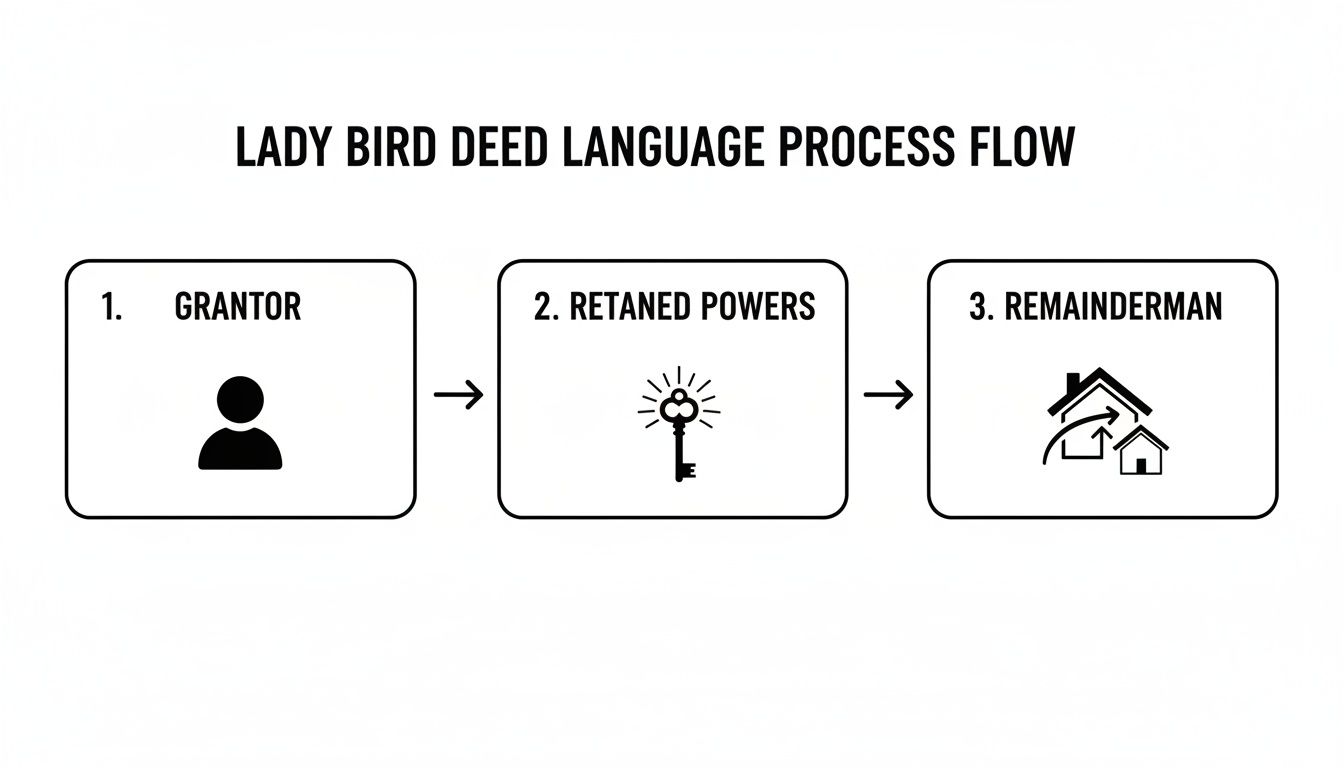
The grantor’s retained powers are the heart of the Lady Bird Deed. They allow you to maintain complete control over the property for the rest of your life.
Signing and Notarization: A Non-Negotiable Step
First things first: you must sign the deed in the presence of a notary public. In Texas, a deed that transfers real estate isn't valid unless it's properly signed and acknowledged before a notary. This isn't just a suggestion; it's a legal requirement that proves your identity and confirms you signed the document of your own free will.
You can't just sign the deed at home and bring it to the notary later. You have to physically sign it while the notary is watching. They'll then fill out their section, affix their official seal, and make an entry in their logbook. This notarized signature is what makes your document ready for the next, equally crucial, phase.
Filing Your Deed with the County Clerk
Once your Lady Bird Deed is signed and notarized, it's still not legally effective. An unrecorded deed is like a well-kept secret—it doesn't provide public notice of the transfer and leaves your beneficiaries unprotected.
To make it official, you must file the original, notarized deed with the county clerk’s office in the county where the property is located. If your house is in Harris County, you file it there. If it's in Dallas County, you file with the Dallas County Clerk.
The process is straightforward:
- Bring the original, signed, and notarized deed to the clerk's office.
- Pay the recording fee, which can vary from county to county.
- The clerk’s office will scan the document into the public record, stamp it as "filed," and usually return the original to you.
Once recorded, the deed becomes a public document that cements your intentions and solidifies the future transfer of your property.
Recording the deed is what puts the world on notice about your estate plan for the property. It prevents disputes, secures the transfer against other potential claims, and ensures a clean title for your beneficiaries when the time comes.
A Checklist for Avoiding Common Mistakes
The execution and recording process is simple on the surface, but tiny errors can create massive problems down the road. We’ve seen families get tangled in unnecessary legal knots because of simple oversights. Understanding how to change a deed on a house is already complex, so it’s always best to get it right the first time.
Use this checklist to make sure your Lady Bird Deed is finalized correctly:
- Correct Property Description: Double-check that the legal description of the property on the deed is an exact match with official records. A single typo can invalidate the document.
- Accurate Names: Are the names of the grantor (you) and the remaindermen (your beneficiaries) spelled correctly and listed clearly?
- Proper Notarization: Is the notary's seal clear and their signature legible? Is the date of notarization correct?
- Recording Fee: Have you called the county clerk’s office to confirm the current filing fee? They can change, and sending the wrong amount will get your filing rejected.
- File in the Right County: It sounds obvious, but people get this wrong. You file the deed in the county where the property is located, which may not be the county where you live.
Taking a few extra minutes to run through these details can save your family a world of emotional and financial stress. If you need personalized guidance on drafting, executing, and recording your Lady Bird Deed, our team is here to help you protect your legacy with clarity and care.
Unlocking Key Tax and Medicaid Benefits

While bypassing probate is a huge plus, the real financial genius of a Texas Lady Bird deed form truly comes to light in two other areas: taxes and Medicaid planning. For most Texas families, their home is their biggest asset. Protecting it isn't just about sidestepping court—it’s about preserving a family legacy and guarding against the staggering costs of long-term care. This is where a Lady Bird Deed really proves its worth.
One of the most powerful advantages is something called a "stepped-up basis." This isn't just legal jargon; it's a concept that can save your heirs a massive amount in capital gains taxes.
Let's say you bought your Collin County home decades ago for $100,000. Fast forward to today, and it's now worth $400,000. If you simply gifted the house to your children while you're alive, they would also inherit your original $100,000 cost basis. If they turn around and sell it for its current value, they're looking at a $300,000 profit—and a hefty capital gains tax bill.
With a Lady Bird Deed, though, the story is completely different. The property legally stays in your estate until your passing. This means your beneficiaries inherit it at its fair market value on your date of death. In this scenario, their new basis is $400,000. If they sell it right away for that price, their taxable gain is zero. That simple move could save them tens of thousands of dollars.
The Power of Stepped-Up Basis
This tax benefit is an absolute game-changer for preserving family wealth. The property's value is literally "stepped up" to its current market price, effectively wiping out any taxable appreciation that built up over all the years you owned it.
This is a critical distinction from making an outright gift, which not only transfers your original cost basis but can also trigger complicated gift tax issues. The stepped-up basis is a clean, efficient way to pass on your home's full value.
Lady Bird Deed vs Outright Gift Key Financial Differences
To see the financial impact side-by-side, it helps to compare a Lady Bird Deed with the alternative of gifting the property during your lifetime. The differences are significant, especially when it comes to the tax burden passed on to your beneficiaries.
| Financial Aspect | Lady Bird Deed | Outright Gift |
|---|---|---|
| Tax Basis for Heirs | Stepped-up to fair market value at death. | Carry-over of your original purchase price. |
| Capital Gains Tax on Sale | Typically $0 if sold soon after inheritance. | Taxable gain is the sale price minus your original cost. |
| Medicaid Eligibility | Does not count as a gift; no penalty period. | Counts as a gift; triggers a 5-year look-back period. |
| Control Over Property | You retain full control to sell, mortgage, or change your mind. | You lose all control; the property belongs to the new owner. |
As the table shows, the Lady Bird Deed offers superior financial advantages and flexibility, making it a far more strategic choice for most families looking to protect their home.
Protecting Your Home from Medicaid Recovery
For families grappling with the potential costs of long-term care, the Medicaid Estate Recovery Program (MERP) is a very real threat. If you receive Medicaid benefits to help pay for nursing home care, the state of Texas has the right to seek reimbursement from your estate after you die. Since the family home is often the most valuable asset, it's the primary target for MERP.
A Lady Bird Deed provides a powerful shield against this. Because the deed transfers your home to your beneficiaries automatically upon death, the property is not considered part of your "probate estate." MERP can only make claims against your probate estate. This simple but effective strategy lets you qualify for the care you need without forcing your loved ones to sell the family home to pay the state back.
By keeping the home out of your probate estate, a properly executed Lady Bird Deed can be the single most effective tool for protecting it from a MERP claim, ensuring your legacy passes to the next generation intact.
This protection is especially crucial for families who are planning ahead. Using a Lady Bird Deed for asset protection works perfectly alongside other long-term care strategies, like finding reliable in-home support to avoid nursing home care so you or your loved ones can age in place. For those navigating the complexities of state benefits, our guide on the Medicaid waiver program in Texas offers more helpful information.
These tax and Medicaid benefits show that a Lady Bird Deed is much more than a simple transfer document—it’s a cornerstone of any thoughtful Estate Planning strategy.
Comparing Your Options: Transfer on Death Deed and Living Trust
A Lady Bird Deed is a fantastic tool for many Texas families, but it’s just one piece of the estate planning puzzle. To really figure out the best move for your situation, you have to see how it stacks up against other popular options: the Texas Transfer on Death Deed (TODD) and the Revocable Living Trust. Each has its own strengths and is built for different needs.
Understanding these differences is key to choosing the path that truly protects your legacy and serves your family’s goals. Let's break down how they compare on important factors like cost, flexibility, and creditor protection.
Lady Bird Deed vs. Transfer on Death Deed
At first glance, the Lady Bird Deed and the Transfer on Death Deed (TODD) look almost identical. Both are designed to let you name a beneficiary to get your property automatically when you die, completely sidestepping the probate process. But a few critical distinctions set them apart, especially when you start talking about Medicaid planning and where their legal authority comes from.
While both avoid probate, the Lady Bird Deed usually offers stronger protection against a claim from the Medicaid Estate Recovery Program (MERP). Because the transfer is structured as part of a life estate you retain, the property often falls outside the scope of what MERP can legally claim back. In contrast, a home passed down with a TODD can sometimes be snagged by creditor claims against the estate, which could include MERP.
It’s also crucial to know that Lady Bird Deeds aren't created by a specific Texas statute like the TODD (found in the Texas Estates Code); they’re governed by decades of court decisions and accepted legal practice. While they are widely used and recognized, this means you’re relying on careful drafting by an experienced attorney to make sure all your powers are preserved and that probate is successfully avoided.
The Revocable Living Trust
A Revocable Living Trust is a much more comprehensive and powerful estate planning tool, but that power comes with more complexity and higher upfront costs. Instead of just dealing with a single piece of property, a trust is a legal container you create to hold and manage all of your assets—your house, bank accounts, investments, you name it.
You typically act as the trustee during your lifetime, keeping total control. After you pass away, a successor trustee you've chosen steps in to manage and distribute everything according to the detailed instructions you laid out. This gives you far more control than a simple deed, as you can set specific conditions for when and how your beneficiaries receive their inheritance.
While a trust offers the most control and comprehensive management, a Lady Bird Deed provides a simpler, more affordable solution specifically for transferring your home. The best choice really depends on the complexity of your assets and your long-term goals.
When you’re weighing a Lady Bird Deed against a Living Trust, it's helpful to understand the scope of trustee responsibilities after death that a trust involves. This role is far more involved than the straightforward property transfer a deed provides. To dig deeper, check out our guide that helps you decide if you should put your house in a trust.
Comparing Texas Estate Planning Tools
To help you see which tool might be the right fit for your family, here is a side-by-side comparison of the three options across several key features.
| Feature | Lady Bird Deed | Transfer on Death Deed | Revocable Living Trust |
|---|---|---|---|
| Probate Avoidance | Yes, for the specific property. | Yes, for the specific property. | Yes, for all assets held in the trust. |
| Control During Life | Full control to sell or mortgage. | Full control to sell or mortgage. | Full control as the trustee. |
| Cost to Set Up | Low; typically just attorney and filing fees. | Low; similar costs to a Lady Bird Deed. | High; involves significant legal work. |
| Complexity | Simple; a single legal document. | Simple; a statutory form is available. | Complex; requires ongoing management. |
| Medicaid Protection | Strong protection against MERP. | Limited protection; can be subject to claims. | Strong protection if structured properly. |
Ultimately, choosing the right tool is a personal decision that requires you to balance simplicity, cost, and the amount of control you want to maintain.
Common Questions About the Texas Lady Bird Deed
Even with a good grasp of the benefits, it's completely normal for families to have practical, real-world questions about using a lady bird deed form texas. It’s a big decision. To help clear up any lingering confusion, we’ve put together answers to the most common questions we hear from clients in Harris County, Dallas County, and all across the state.
Our goal is to give you the confidence you need to take the next step in your estate planning.
Can I Sell My House If I Have a Lady Bird Deed?
Yes, absolutely. This is probably the single biggest advantage of the "enhanced" life estate. As the current property owner (the grantor), you keep 100% control. You can sell, lease, gift, or even mortgage the property without getting permission from the beneficiaries you’ve named. You don’t even have to tell them.
If you decide to sell your home, the Lady Bird Deed essentially disappears because you no longer own the property. The sale proceeds are all yours, to do with as you please. This unmatched flexibility is exactly why so many Texans choose this tool over other options that might tie their hands.
Does This Deed Protect My Home from My Children’s Creditors?
It does, but only during your lifetime. While you are alive, your home is completely shielded from any financial troubles your beneficiaries (often called remaindermen) might run into. Since they have no legal ownership interest in the property until the moment you pass away, their creditors can't slap a lien on your home. It’s simply not their asset.
This keeps your property safe from their potential lawsuits, bankruptcies, or messy divorce settlements. Legal ownership only transfers upon your death. From that point on, the property becomes their asset and could be subject to their creditors, but your ownership is fully protected for your entire life.
This protection is a huge relief for parents who want to ensure their legacy isn't tangled up in a beneficiary's future financial problems. The asset remains yours and yours alone until you're gone.
What Happens If One of My Beneficiaries Dies Before Me?
This is a critical question and highlights why professional legal drafting is so important. A well-written Lady Bird Deed will always tackle this "what if" scenario head-on, right in the document itself. You get to specify what happens to a deceased beneficiary's share.
A couple of common options include:
- Per Stirpes: This means the share automatically passes down to the deceased beneficiary's children.
- Surviving Beneficiaries: This option divides the share equally among the other living beneficiaries you named.
If the deed says nothing about this, Texas inheritance laws will decide the outcome. That could lead to outcomes you never intended, like unintended heirs or legal headaches for your family. Working with an experienced Estate Planning attorney ensures your exact wishes are clearly spelled out, leaving no room for doubt.
Is It Safe to Use an Online Lady Bird Deed Form?
While the promise of a cheap, quick online form is tempting, it comes with serious risks. Lady Bird Deeds in Texas aren't based on a specific state law; they’re built on decades of case law and legal precedent. This means the precise wording of the deed is absolutely critical for it to work as intended.
A generic or poorly drafted online form can create a nightmare scenario:
- Failing to Avoid Probate: The wrong language can make the deed invalid, pushing your property right into the Probate process you were trying to skip.
- Title Problems: Vague terms can create a "cloud on the title," making it a huge hassle for your beneficiaries to sell the property later.
- Losing Control: You might accidentally create a standard life estate, which would strip you of your right to sell or mortgage the home without your beneficiary's written consent.
Investing in professional legal help to draft your lady bird deed form texas is a small price to pay to protect your most valuable asset and make sure your wishes are carried out smoothly.
Navigating the details of estate planning can feel overwhelming, but you don’t have to figure it all out on your own. At the Law Office of Bryan Fagan, PLLC, our experienced attorneys are here to provide Texas families with clear, compassionate guidance. We can help you decide if a Lady Bird Deed is the right move for your unique situation and ensure it’s drafted and recorded perfectly to protect your legacy. Schedule a free, no-obligation consultation with us today to get the clarity and peace of mind you deserve. https://texasguardianshiplawyer.net