Skip to content
A Texas Lady Bird Deed, known in legal circles as an enhanced life estate deed, is a surprisingly straightforward but incredibly effective tool for transferring real estate to a beneficiary without getting tangled up in probate court. Planning for the future can feel overwhelming, but this powerful document offers peace of mind. The real magic of this deed is that it lets the current property owner keep complete control over the property for their entire life, including the right to sell or mortgage it without ever needing the beneficiary's permission.
Understanding the Power of a Lady Bird Deed
Planning for what happens after you're gone can be a heavy topic, especially when it comes to your home—often your biggest asset. Many Texas families share a common dread of the probate process. It’s a court-supervised ordeal that can drag on for months, rack up significant costs, and make private family matters public record. A family in Houston, for example, might be desperate to spare their children from navigating the Harris County Probate Court just to inherit the house they grew up in. This is exactly where a Texas Lady Bird Deed can offer tremendous relief and clarity.
At its heart, a Lady Bird Deed cleverly splits property ownership into two distinct parts:
- The Life Estate: This is your piece. As the current owner (the "grantor"), you have the absolute right to live in, use, and manage the property for the rest of your life.
- The Remainder Interest: This belongs to the person you've chosen to inherit the property (the "beneficiary" or "remainderman"). They only get full ownership after you pass away.
This unique structure is what makes the Lady Bird Deed so powerful. It effectively turns the property into a non-probate asset, allowing it to bypass the court system altogether. You can learn more about how non-probate assets streamline estate administration and save families time and money in our detailed guide.
Retaining Full Control During Your Lifetime
The most important feature of an "enhanced" life estate deed is the total control you keep. A traditional life estate deed would lock you in, requiring your beneficiary’s signature to sell or even refinance the property. A Lady Bird Deed, however, gives you the freedom to adapt as life changes, which is a source of great comfort for many families.
This complete control is what sets the Lady Bird Deed apart. You can sell the property, take out a new mortgage, lease it to a tenant, or even cancel the deed and name a different beneficiary, all without needing anyone's signature but your own.
This kind of flexibility is priceless. If you suddenly need to tap into your home's equity to cover medical bills or simply decide to downsize in retirement, the power to do so remains entirely in your hands, offering security during uncertain times.
A Proven Tool for Texas Homeowners
The Lady Bird Deed isn't some new, untested gimmick. It became a go-to estate planning tool in Texas by the 2010s after its unique benefits were repeatedly validated by courts and legal experts. It allows an owner to hold onto a life estate and every power of ownership—including the right to sell, mortgage, or tear up the transfer—while designating a beneficiary who receives the property automatically upon their death. This simple document sidesteps probate filings that can take months and cost thousands in legal fees.
To help you see how a Lady Bird Deed stacks up against other common estate planning methods, we've put together a simple comparison.
Lady Bird Deed vs Traditional Will vs Revocable Living Trust
| Feature | Lady Bird Deed | Traditional Will | Revocable Living Trust |
|---|---|---|---|
| Probate Avoidance | Yes, property transfers automatically. | No, the will must go through probate. | Yes, assets in the trust avoid probate. |
| Owner Control | Total control. Owner can sell, mortgage, or change beneficiaries at any time. | Total control during lifetime. No control after death. | Total control. Owner (as trustee) can manage assets freely. |
| Cost | Low. Typically a one-time fee for drafting and recording. | Moderate. Involves legal fees for drafting and significant probate costs later. | High. More expensive to create and requires ongoing management. |
| Simplicity | Very simple to create and record. | Relatively simple to create, but the probate process is complex for heirs. | Complex to set up and requires funding (transferring assets into the trust). |
| Privacy | High. The transfer happens privately without court involvement. | Low. Probate is a public court proceeding. | High. Trust administration is a private process. |
As you can see, each tool has its place, but for the straightforward transfer of real estate, the Lady Bird Deed offers a unique blend of simplicity, control, and cost-effectiveness.
Ultimately, using a Texas Lady Bird Deed is about creating a smooth, private, and efficient transfer of your property. It’s a practical and compassionate way to protect your legacy and spare your family from unnecessary legal headaches during an already difficult time. If you want to explore whether this tool is the right fit for your family, schedule a free consultation for personalized guidance with our experienced team.
How to Correctly Fill Out the Deed Form
Turning your intention to protect your property into a legally sound document really boils down to careful attention to detail. We understand that filling out a Texas Lady Bird Deed form can look intimidating at first glance, but when you break it down into its core parts, the process is much more manageable. The key here is accuracy—one small error can create massive title headaches for your loved ones down the road.
Let's walk through the essential fields, using a common scenario to bring it to life.
Imagine Maria, a homeowner in Travis County. She wants to make sure her daughter, Sofia, inherits the family home without the probate court's delays and costs. She has the blank Lady Bird Deed form in front of her. Here's how she should tackle it, piece by piece.
Identifying the Parties Involved
First things first, you have to clearly name everyone involved in the transfer. The form requires two key parties:
- The Grantor: This is you, the current property owner creating the deed. In our example, Maria is the Grantor. It's absolutely critical that her full legal name is used, exactly as it appears on the current deed to her property.
- The Grantee Beneficiary: This is the person (or people) who will inherit the property when you pass away. Here, Sofia is the Grantee Beneficiary. Her full legal name must be used as well.
Let me be clear: there's no room for shortcuts here. Using nicknames or incomplete names is a recipe for confusion and potential legal challenges later. Maria must double-check that both her name and Sofia’s are spelled correctly and match their official IDs.
This simple diagram shows how a deed directly transfers property from an owner to an heir, completely bypassing the court system.
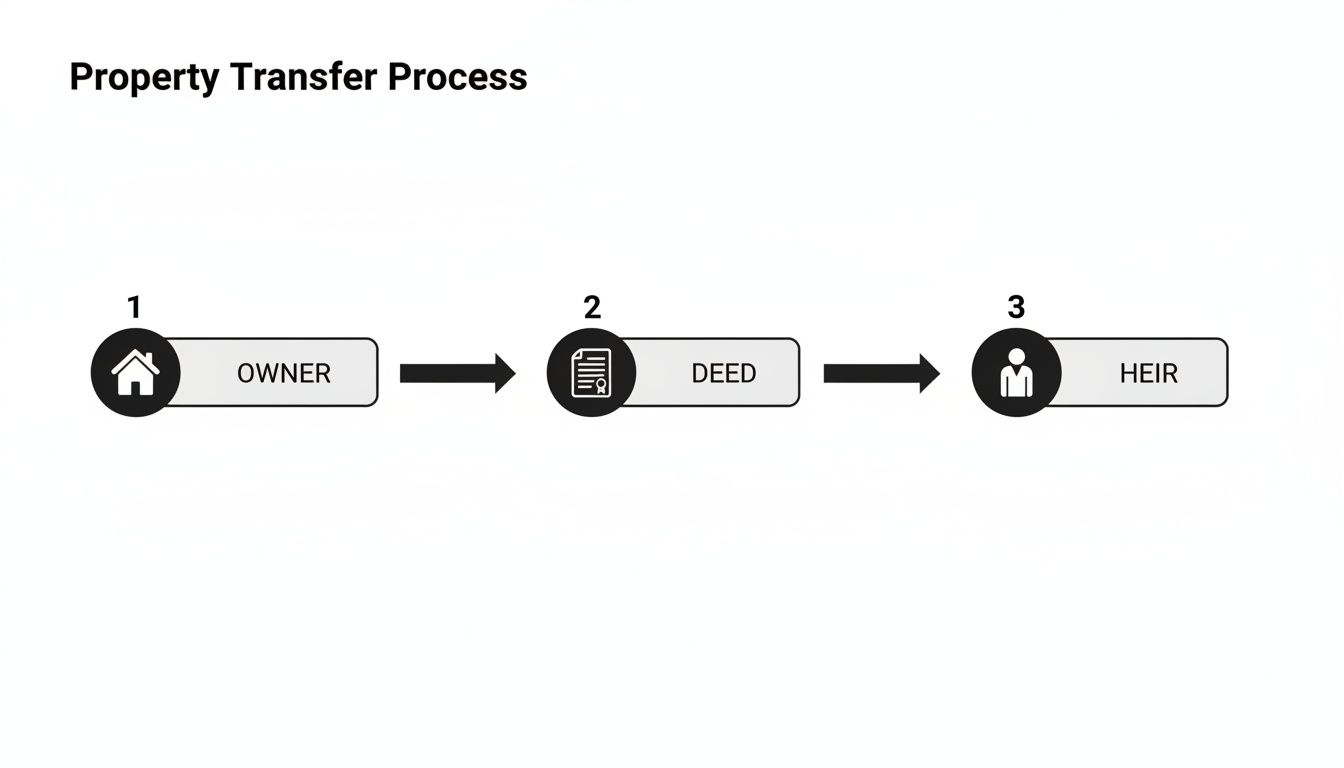
This visual gets right to the heart of the Lady Bird Deed's main benefit: a direct, private transfer that avoids the probate maze.
The Property's Legal Description
This is easily the most misunderstood—and most critical—part of the deed. A street address simply won't cut it. You must include the property's official legal description. This isn't just an address; it's a precise, formal identification that legally distinguishes your property from every other piece of land on the planet.
So, where does Maria find this? The easiest place is usually on the existing deed she received when she bought the house. She could also find it on her local county appraisal district's website, like the Travis Central Appraisal District (TCAD) or the Harris County Appraisal District (HCAD.org). This description typically includes details like the lot, block, and subdivision name.
Crucial Tip: The legal description has to be copied exactly as it appears in the official records. I've seen cases where a minor typo—a wrong lot number or a misspelled subdivision name—invalidates the deed or creates a "cloud on the title." Fixing that mistake can cost your heirs thousands in legal fees.
Adding the Enhanced Life Estate Language
Next up is the magic ingredient: the specific language that makes this an "enhanced" life estate deed. This clause is what explicitly reserves your complete power to control the property. While the exact wording might vary slightly, it must clearly state that you, the Grantor, keep the right to sell, gift, mortgage, lease, or do anything else with the property during your lifetime—all without needing your beneficiary's permission.
A typical clause might read something like this:
"Grantor reserves an enhanced life estate in the property, including the full power and authority, without the joinder of the remainderman, to sell, convey, mortgage, lease, and otherwise dispose of the property in fee simple and to retain the proceeds from the conveyance."
This powerful sentence is what sets a Lady Bird Deed apart from a standard life estate deed and preserves Maria's total control over her home. It gives her the flexibility she needs while still planning for Sofia's future. Keep in mind that changing or revoking a deed involves specific legal steps. If you're ever considering making changes, it's helpful to understand the general procedures for how to change a deed on a house in Texas.
Taking the time to get the names, legal description, and special clauses right is a profound act of care for your family. You're paving a smooth path for them during a difficult time. And while this guide breaks down the steps, every family's situation is unique. A quick consultation with an experienced attorney can give you the personalized assurance that your Texas Lady Bird Deed is buttoned up correctly, protecting both your legacy and your loved ones.
Making Your Lady Bird Deed Legally Binding
You’ve carefully filled out your Texas Lady Bird Deed form, and that’s a fantastic start. But a perfectly drafted deed tucked away in a desk drawer has absolutely no legal power. It’s a plan on paper, nothing more.
To truly protect your property and ensure it passes to your beneficiary without a hitch, you have to make it legally binding. This involves two final, non-negotiable steps: execution and recording. Think of it this way: the completed form is the blueprint, but signing and filing are the actions that actually build the bridge from your ownership to your beneficiary's. If you skip these steps, the bridge is never built, and your property will almost certainly get stuck in probate court.
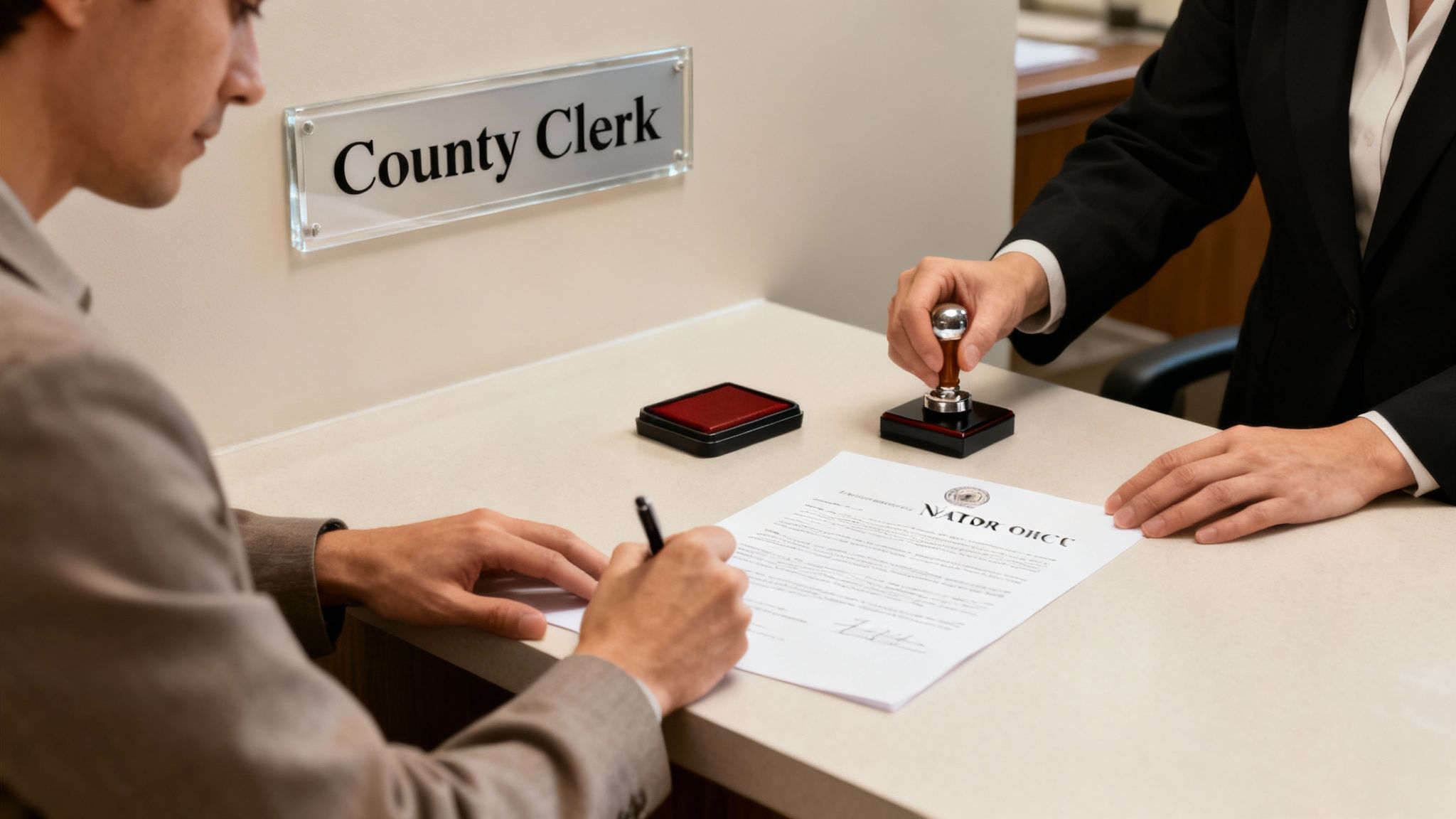
First, You Need a Notary
Before you can even think about filing the deed, you have to execute it properly. In Texas, this means you, the Grantor, must sign the document in the presence of a notary public.
The notary's job is simple but crucial: they verify your identity and witness your signature, confirming you signed the document willingly. This official acknowledgment is what authenticates the deed and gets it ready for the public record. It's a critical safeguard against fraud and future arguments over whether the deed is valid.
Your Notarization Checklist:
- Wait to sign! Do not sign the deed before you are physically in front of the notary.
- Bring a valid photo ID, like a driver’s license or passport.
- The notary will watch you sign, then complete their section of the document with their own signature and official seal.
Once notarized, your deed is considered "executed." Now, you're ready for the final, and arguably most important, step.
Next, File Your Deed with the County Clerk
An executed deed is still legally powerless if it isn't recorded. To make the transfer official, you must file the original, notarized Lady Bird Deed with the County Clerk’s office in the county where the property is located. If your home is in San Antonio, you’ll file it with the Bexar County Clerk. If you're in Fort Worth, it's the Tarrant County Clerk.
This filing process is called recording, and it makes the deed a part of the official public property records. It serves as public notice that you have officially designated a beneficiary to receive your property the moment you pass away.
Why Recording Matters: Recording is what breathes legal life into the deed. If it is not recorded before your death, it is void. Your property will not transfer automatically to your beneficiary. Instead, it becomes part of your estate and gets dragged into the very probate process you were trying to avoid.
The Real-World Risk of Not Recording
Let's look at a real-world example we've seen play out before. Imagine David, a Dallas County resident, who carefully prepares a Lady Bird Deed leaving his home to his son, Mark. He gets it notarized and puts the original document in his safe deposit box, planning to drop it off at the county clerk's office "sometime next week."
Tragically, David passes away unexpectedly before he gets around to it.
Mark finds the notarized deed and assumes it's all he needs. He's wrong. Because the deed was never recorded, it has no legal effect. David’s home is now part of his probate estate. Mark has to hire an attorney and go through the lengthy and expensive Dallas County Probate Court process just to inherit the property—the exact headache David wanted to prevent. This mistake costs Mark months of his time and thousands of dollars in legal fees.
This scenario shows why recording your Texas Lady Bird Deed isn't just a good idea—it's an absolute must.
How to Complete the Recording Process
Filing the deed is a pretty straightforward administrative task. You’ll take the original notarized document to the correct County Clerk's office and pay a recording fee. The fees are usually modest, often somewhere between $25 to $50, though they vary by county.
After you pay, the clerk will:
- Stamp the document with the exact date and time it was filed.
- Assign it an official recording number (sometimes called an instrument number).
- Scan the document to make it part of the permanent public record.
The clerk’s office will typically mail the original document back to you within a few weeks. It’s always a good idea to call them after a week or two to confirm it has been recorded and ask for the instrument number. You can often use this number to look it up online for your own peace of mind. Taking this final step is what solidifies your planning and ensures your wishes are honored without fail. Understanding the nuances of different estate planning documents can also provide a fuller picture of how the Lady Bird Deed fits into a comprehensive plan.
Protecting Your Assets with a Lady Bird Deed
Beyond just sidestepping the probate court, a Texas Lady Bird Deed packs some powerful financial protections that can be a real lifeline for your family's future. We know that thinking about long-term care and its staggering costs is stressful. A Lady Bird Deed can bring significant peace of mind by acting as a critical tool in Medicaid planning, helping you safeguard your most valuable asset—your home.

Shielding Your Home from Medicaid Recovery
One of the biggest fears we hear from clients is the possibility of losing the family home to pay for long-term nursing care. Texas has the Medicaid Estate Recovery Program (MERP), a federally mandated program that lets the state seek reimbursement from a deceased person's estate for the care costs Medicaid covered.
This is where the Lady Bird Deed truly shines. Because the property transfers to your beneficiary automatically the moment you pass away, it's generally not considered part of your probate estate. This simple fact means the home is typically shielded from MERP's reach, allowing it to pass to your loved ones just as you intended.
A key reason this works so well is that the transfer is not considered a gift under Medicaid's strict rules. When you apply for Medicaid, there's a five-year "look-back" period for any gifts you've made. Giving away a significant asset during this time can trigger a penalty period, delaying your eligibility for benefits. Since you keep complete control over the property with a Lady Bird Deed, it's not a completed gift, and you avoid that penalty.
The potential for protecting assets from nursing home costs is one of the most significant benefits of using a Lady Bird Deed.
Big Tax Advantages for Your Beneficiaries
Another huge financial win that comes with a Texas Lady Bird Deed involves capital gains taxes. When your beneficiary inherits your home this way, they receive what’s known as a "stepped-up basis" in its value.
Let's break that down with a simple, real-world example.
Imagine you bought your home in a Dallas suburb years ago for $80,000. That's your "cost basis." Over the decades, its value has shot up. At the time of your passing, the home's fair market value is now $400,000.
- Without a Stepped-Up Basis: If your child were to sell the home, they would owe capital gains tax on the profit, which would be a staggering $320,000 ($400,000 sale price – $80,000 original cost). That could mean a massive tax bill.
- With a Stepped-Up Basis: Thanks to the Lady Bird Deed, your child’s cost basis is "stepped up" to the fair market value at the time of your death—$400,000. If they turn around and sell the home for that price, their taxable gain is $0. This one feature alone can save your loved ones tens of thousands of dollars.
This tax advantage is a powerful gift to the next generation. It ensures that the value you built in your home over a lifetime passes to your family, not to the IRS.
These financial protections aren't just abstract legal ideas; they have a real, lasting impact on your family’s security. By shielding your home from Medicaid recovery and slashing your beneficiary’s tax burden, the Lady Bird Deed acts as a guardian for your legacy.
Navigating the intersection of estate planning, Medicaid rules, and tax law can feel overwhelming. You don't have to figure it all out on your own. Our compassionate team at The Law Office of Bryan Fagan is here to answer your questions and help you decide if a Lady Bird Deed is the right move to protect what you've worked so hard for. Schedule a free consultation with us today for personalized guidance.
Common Mistakes and When to Get Legal Help
A Texas Lady Bird Deed is an incredibly powerful estate planning tool, but all that power comes from getting the details exactly right. As attorneys, we’ve seen too many well-meaning families in Fort Bend County and beyond try a DIY approach, only to discover a simple error has created a "cloud on the title" for their loved ones.
What does that mean? A clouded title is a legal red flag questioning who truly owns the property. It’s a problem that often costs far more to fix than it would have to prepare the deed correctly from the start, turning a tool for peace of mind into a source of stress and unexpected expense. Our goal is to help you sidestep these common pitfalls so your legacy is protected exactly as you envisioned.
Incorrect Legal Descriptions
One of the most frequent and damaging errors we see is an incorrect legal description of the property. A street address or a parcel number from the county appraisal district just won’t cut it. The deed must contain the full, official legal description—often referencing the lot, block, and subdivision—copied precisely from the previous deed.
Imagine this real-world scenario: a family’s DIY deed had a single typo in the lot number. Years later, when the beneficiary tried to sell the home, the title company flagged the error. The sale was delayed for months while they hired an attorney to file a corrective deed and clear the title, racking up legal fees that dwarfed what professional guidance would have cost initially.
Execution and Recording Failures
Another common landmine is failing to finalize the deed correctly. It’s not enough to just fill out a form and sign it. For a Texas Lady Bird Deed to be legally binding, it has to be:
- Signed by the Grantor in front of a notary public. The signature must be officially notarized—no exceptions.
- Recorded with the County Clerk in the county where the property is located, like the Harris County Clerk's office for a home in Houston.
If you sign and notarize the deed but it’s never filed before your death, it is legally worthless. The property won't pass to your beneficiary. Instead, it falls right back into your probate estate, creating the exact legal headache you were trying to avoid.
The upfront cost of having an attorney prepare and file your Lady Bird Deed isn't just a fee—it's an investment in certainty. It ensures every detail is handled correctly, preventing costly and emotional complications for your family down the road.
When Professional Guidance Is a Necessity
While a Lady Bird Deed can seem straightforward, certain situations absolutely demand the experience of an estate planning attorney. Going it alone in these cases can lead to serious, unintended consequences for your family.
You should always seek legal help if your situation involves:
- Multiple Beneficiaries: Naming more than one person to inherit the property requires precise legal language to define how they will own it together (for instance, as "tenants in common" or with "rights of survivorship"). Getting this wrong can spark family disputes.
- An Existing Mortgage: A Lady Bird Deed doesn’t wipe out a mortgage. An attorney can help you understand how the deed interacts with your lender's "due on sale" clause and plan accordingly.
- Complex Family Dynamics: If there is any potential for disagreement among your heirs, a professionally drafted deed provides a strong, clear defense against future legal challenges.
The cost of creating a Lady Bird Deed varies, but it is a fraction of the expense of probate. Legal surveys from sources like this helpful guide show that attorney-prepared deeds can range from several hundred to a few thousand dollars. In contrast, average probate expenses often climb into the mid-four or even five figures once all the court costs and fees are totaled.
Navigating these complexities is what we do. If your family’s situation involves any of these factors, schedule a free consultation with The Law Office of Bryan Fagan. We are here to provide the clarity and care needed to protect your home and your loved ones.
Your Top Questions About Texas Lady Bird Deeds, Answered
When it comes to estate planning, tools like the Texas Lady Bird Deed often bring up a lot of specific questions. Getting into the details is the best way to feel confident about the plan you're putting in place for your family. Here are some of the most common questions our office gets, along with straightforward, practical answers.
Can I Name More Than One Beneficiary?
Yes, you absolutely can. It's quite common for a parent to name all their adult children as beneficiaries to inherit the property together.
When you do this, it’s critical that the deed specifies how they will take title—for example, as "tenants in common." This detail dictates what happens if one of your children passes away before you, and getting it right can prevent future ownership headaches for your loved ones.
What If My Beneficiary Passes Away Before I Do?
This is a smart and important question. If your only beneficiary dies before you, the Lady Bird Deed essentially becomes void. The property would remain in your name and, upon your death, would have to go through the probate process.
The best way to prevent this is by naming a contingent (or alternate) beneficiary in the deed. This creates a clear line of succession, ensuring that if your first choice can't inherit, your backup beneficiary receives the property automatically, keeping it out of probate court.
A well-drafted Lady Bird Deed should always account for life's uncertainties. Naming alternate beneficiaries is a simple step that provides an essential layer of protection for your estate plan.
Will This Deed Impact My Texas Homestead Exemption?
No, creating and recording a Lady Bird Deed will not affect your Texas homestead exemption. Because you keep complete control and ownership of the property during your lifetime, you continue to receive all related property tax benefits.
This includes the valuable homestead exemption and any over-65 exemptions you currently have. From the tax assessor's point of view, nothing changes until you pass away. This is a huge advantage, as it means your estate planning doesn't increase your current cost of living.
How Do I Revoke or Change a Recorded Lady Bird Deed?
One of the best things about an enhanced life estate deed is its flexibility. Life changes, and your estate plan should be able to change with it. If you need to revoke or modify the deed, you can.
You would simply execute and record a new document, such as:
- A new Lady Bird Deed that names a different beneficiary.
- A formal revocation document that officially cancels the original deed.
- A traditional deed that sells or gifts the property to someone else, which automatically overrides the Lady Bird Deed.
This flexibility ensures your plan can adapt as your life and relationships evolve. It's also worth noting that while Lady Bird deeds are common in Texas, their recognition is not nationwide. In fact, only a handful of states, including Texas, Florida, and Michigan, widely accept them. This limited use highlights the importance of state-specific advice, as title insurers and Medicaid programs treat these deeds differently across state lines.
Many questions also arise regarding the financial implications for beneficiaries, including how the capital gains tax on inherited property might apply after the transfer.
Your family's peace of mind is too important to leave to chance. At The Law Office of Bryan Fagan, PLLC, we can help you navigate these questions and create an estate plan that protects your legacy. Schedule your free consultation today at https://texasguardianshiplawyer.net.