Skip to content
When you search for a guardianship lawyer in Houston, the legal issue usually isn't abstract. It's personal. A mother is forgetting her medications. A father is signing papers he doesn't understand. An adult child with disabilities is turning 18, and the family is unsure whether support can continue informally or whether court authority is needed.
For out-of-state families, the stress is different but just as sharp. You may be getting phone calls from a hospital, a care facility, or a worried sibling in Harris County while you're trying to help from another state. You want to protect your loved one, but you also don't want to rush into a process that takes away rights unnecessarily.
Texas guardianship law is built around that tension. Courts can grant real authority to protect a vulnerable person, but they also expect families to prove why guardianship is necessary and why a less restrictive option won't work. That's why choosing the right Houston lawyer matters. Good counsel doesn't just file papers. Good counsel helps you decide whether guardianship is the right tool, prepares the medical and court record carefully, and helps you avoid mistakes that turn a manageable case into a contested one.
Navigating a Difficult Crossroads
A common Houston scenario begins subtly. A daughter notices her father's utility bills are unpaid. His refrigerator is empty, but he insists everything is fine. At a doctor visit, he can't explain what medicines he takes or why. The family starts covering emergencies one by one until someone asks the question no one wanted to ask. Do we need guardianship?
Another family faces the same question from much farther away. A son in Colorado learns his mother in Harris County has been admitted to the hospital after a fall. The hospital needs a decision-maker. Her finances are exposed. He can't drive to court that afternoon, and he has no idea what Harris County Probate Court expects from a non-resident applicant.
Those are different fact patterns, but the emotional core is the same. Families are trying to protect someone they love without stripping away more independence than necessary.
Why this moment feels so heavy
Guardianship cases often arrive after months of caregiving strain, family disagreement, or medical decline. People feel guilt for waiting and guilt for acting. They worry about cost, conflict, privacy, and whether the proposed ward will feel betrayed.
Guardianship isn't a judgment about a person's worth. It's a legal response to a functional problem the court needs to understand clearly.
That's also why the search for a Guardianship Lawyer Houston families can trust is so important. You need someone who can translate Title 3, Subtitle G of the Texas Estates Code into plain English, identify alternatives when they fit, and move efficiently when a court order is needed.
What helps at the start
Before anyone files, it helps to gather the basic story:
- What decisions are failing: Is the problem medical consent, money management, unsafe living conditions, or all three?
- Who is involved: Family support can help a case, but conflict changes strategy quickly.
- What authority already exists: Powers of attorney, beneficiary arrangements, and care directives may solve part of the problem.
- Where the loved one lives: Local court practice matters, especially in Harris County probate proceedings.
When families come in with those facts, the conversation gets clearer. So do the options.
Understanding Texas Guardianship Options
Texas doesn't treat every guardianship the same way, and it shouldn't. The law asks what authority is necessary, who should hold it, and whether something less restrictive can work.
The main forms of guardianship
A Guardianship of the Person deals with personal decisions. That can include medical care, living arrangements, and daily support needs.
A Guardianship of the Estate deals with finances. That can include bank accounts, property, income, and protecting assets from misuse.
Some cases need both. Others don't. If an aging parent can still express medical preferences but can't manage bills or recognize financial exploitation, the family may focus on estate issues. If the money is modest but the medical decisions are urgent, guardianship of the person may be the main concern.

Temporary guardianship for urgent situations
Some families don't have time to wait for a standard path. If there's an emergency involving treatment, placement, or immediate safety, temporary guardianship may be the proper vehicle. Under Texas Estates Code Chapter 1251, a relative who wants to challenge a treatment decision made for an incapacitated person must apply specifically for a temporary guardianship. That's a separate legal mechanism for urgent situations before a permanent guardianship is established.
That distinction matters. Families sometimes assume a general filing will solve an immediate hospital dispute. It usually won't. The emergency facts and requested relief must match the legal tool.
The law requires alternatives to be considered
Texas law does not start from the assumption that guardianship is inevitable. Under Texas Estates Code § 1101.001, the sworn application must state whether alternatives to guardianship and available supports were considered, and whether those alternatives are feasible.
That requirement changes how a careful lawyer approaches the case. The first question isn't “How fast can we get guardianship?” It's “What problem are we solving, and is guardianship the least restrictive answer?”
A power of attorney can sometimes prevent the need for guardianship, which is why Guardianship vs. Power of Attorney in Texas is an important comparison for families to review before filing.
For adult children with disabilities, supported decision-making may also be part of the conversation. In cases involving medical capacity questions, families and lawyers often benefit from an effective medical record review so the court sees a clear picture of function, diagnosis, and practical needs.
Practical rule: Ask for no more authority than the facts support. Narrow requests are often easier to defend and easier for courts to trust.
A simple example
If Mrs. Reyes can still choose where she wants to live and understands her medical care, but she repeatedly wires money to scammers and forgets to pay taxes, a full guardianship over every aspect of life may be too broad. A more focused legal response may fit better.
That's one reason Texas guardianship work is so fact-specific. The right solution depends on capacity, risk, and what support systems already exist.
For related guidance, families often also need to think about Guardianship, Probate, and Estate Planning, because these issues frequently overlap in real life.
How to Find and Vet the Right Houston Lawyer
A daughter in Colorado may be trying to help her father in Houston after a hospital discharge, while her brother in Harris County disagrees with her plan. By the time she starts calling lawyers, the legal question is only part of the problem. She also needs someone who knows the local probate courts, can manage the attorney ad litem process, and can tell her what must be handled in person and what can be done remotely.

Guardianship is a probate court matter with its own habits, deadlines, and evidentiary expectations. A lawyer who handles divorce, custody, or general estate documents may still be the wrong fit if that lawyer rarely appears in Houston-area guardianship cases. Local practice matters, especially in Harris County, where procedure and preparation often decide whether a case moves cleanly or stalls.
What to look for first
Start with the lawyer's actual guardianship work, not branding. A useful website or consultation should explain the difference between guardianship of the person and guardianship of the estate, discuss less restrictive alternatives, and describe the reporting and court oversight that continue after appointment.
Listen for practical judgment. A careful lawyer will ask about diagnosis, daily functioning, family conflict, finances, and whether the proposed ward has signed any prior legal documents that may affect the case. In guardianship cases, details drive outcomes.
It also helps to ask how the office handles communication. Out-of-state relatives often need video meetings, secure document sharing, clear checklists, and realistic guidance about travel to Houston. Families comparing firms sometimes look at broader standards for responsiveness and client communication through resources such as what to look for in a family law attorney in Houston, then narrow the search to lawyers who handle probate and guardianship matters.
Questions worth asking in a consultation
Direct questions usually tell you more than polished marketing copy.
- How often do you handle guardianship matters in Houston-area probate courts? A good answer includes recent, relevant experience, not vague references to “probate work.”
- How do you decide whether guardianship is necessary at all? Good counsel should discuss alternatives before recommending a filing.
- What tends to slow these cases down? Look for honest answers about medical records, service issues, family objections, and court scheduling.
- How do you work with out-of-state family members? The lawyer should explain remote meetings, document collection, and whether the court is likely to require an in-person appearance.
- Who communicates with the attorney ad litem and other court-appointed participants? That coordination affects timing, cost, and the tone of the case.
- What will you need from me in the first two weeks? Strong lawyers usually have a concrete intake process.
Why out-of-state families need targeted guidance
General guardianship articles often miss the hardest part for non-resident applicants. The law may let you file, but distance creates practical problems fast. Medical records may be in Houston. The proposed ward may live in a facility that will only speak freely once the right releases are signed. A sibling or neighbor on the ground may control access, information, or both.
Court expectations do not loosen because the petitioner lives elsewhere.
That is why I tell out-of-state family members to ask very specific process questions early. Can the initial consultation be done by video? How are signatures handled? Which documents need originals? What local rules affect hearing attendance, proposed orders, or coordination with the attorney ad litem? A lawyer who works in these cases regularly should be able to answer those questions in plain English.
Virtual meetings help, but they do not solve everything. The right lawyer will use remote planning efficiently while being candid about the points in the case that may still require a Houston appearance or fast local coordination.
For a non-resident petitioner, convenience is not the main issue. Clarity is the issue. If you miss a local procedural requirement, the court will not excuse it because you live elsewhere.
Red flags that deserve attention
A few warning signs appear again and again:
| Concern | Why it matters |
|---|---|
| Vague answers about probate court procedure | Guardianship is procedural, and uncertainty creates delay and risk. |
| No discussion of less restrictive alternatives | Texas courts expect that analysis before granting broad authority. |
| No clear plan for medical evidence | Weak capacity proof can derail the case. |
| Dismissive attitude toward family disputes | Conflict can change strategy, cost, and timing immediately. |
| Unclear fee structure or task division | Families need to know who is doing the work and what it will cost. |
The Law Office of Bryan Fagan, PLLC is one Texas firm families may contact for guardianship, probate, and estate planning matters, including virtual consultations for relatives helping from outside Houston. The better question is not which name sounds familiar. It is whether the lawyer can explain the process plainly, prepare the file carefully, and handle the local court requirements without creating avoidable problems.
The Guardianship Timeline in a Texas Court
A daughter in Colorado gets a call that her father in Houston has stopped paying bills, missed medical appointments, and let a neighbor into the house to "help" with his finances. She can book a virtual consultation quickly, but the court process still runs on Harris County procedure, not on her travel schedule. That is the point at which families need a realistic timeline.
Families usually feel steadier once they know what happens first, what the court controls, and where delay tends to appear. No two cases move at the same speed, especially if the proposed ward lives alone, medical records are incomplete, or relatives disagree about who should serve. The calendar is driven less by hope than by preparation.
What happens in order
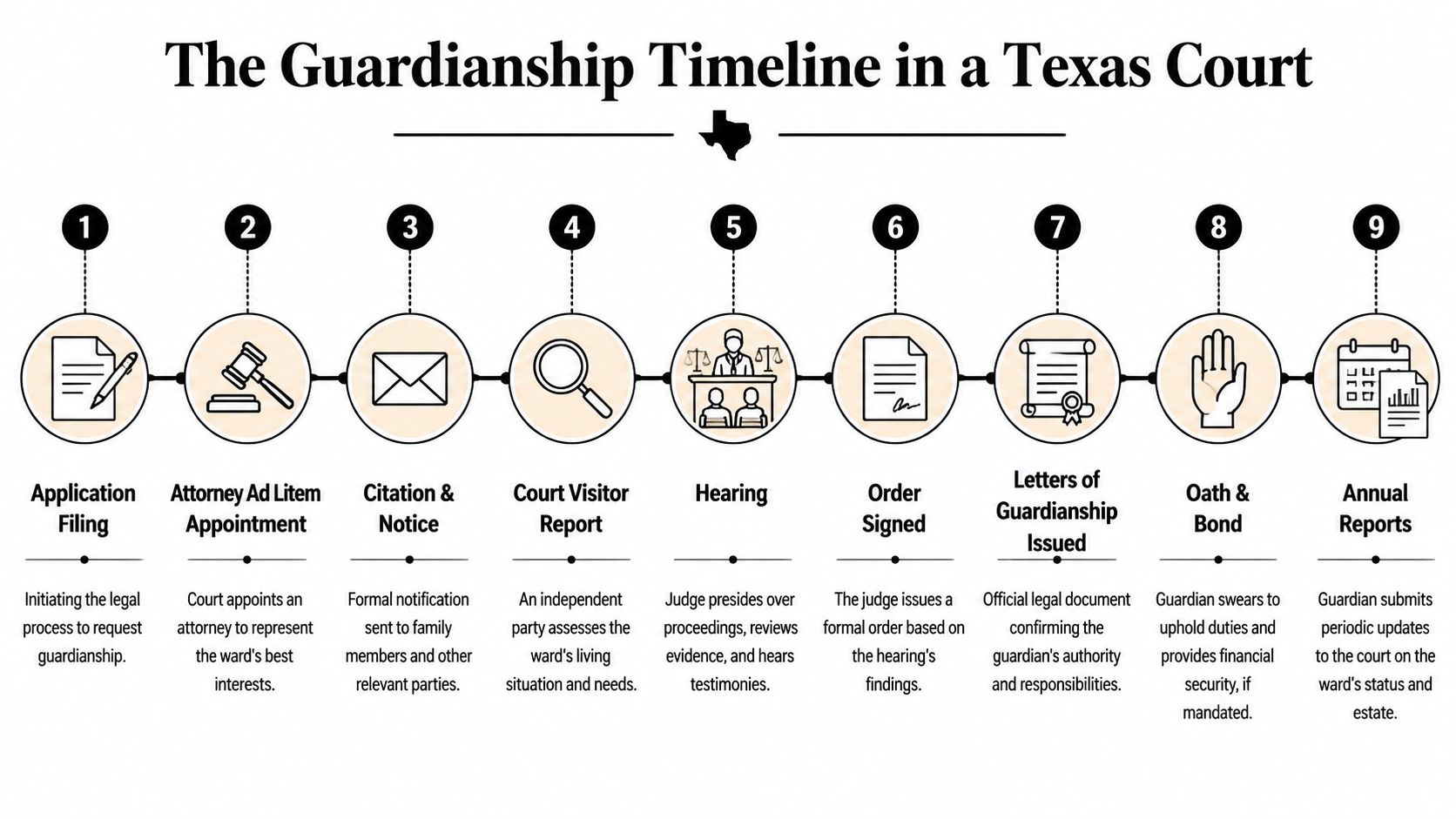
The first meaningful step is usually the medical evidence. In most adult guardianship cases, the court needs current medical support that addresses the person's condition and functional limits in a way that matches the legal standard. If the physician's certificate is vague, outdated, or disconnected from the powers requested, the case slows down before it really starts.
Next comes the application and the filing package. For out-of-state family members, this is often where preventable problems begin. Signatures, verifications, supporting records, and local filing expectations need to line up the first time. A practical review of common filing requirements in these Texas guardianship forms and supporting documents can help families understand what the court expects to see.
After filing, the proposed ward must be personally served. The court also appoints an attorney ad litem for the proposed ward. Depending on the case, the court may require additional review or investigation. Those participants are there to test whether guardianship is necessary, whether the requested powers are too broad, and whether the proposed guardian is appropriate.
Then the case is set for hearing when the file is ready and the court's requirements have been met. In a clean, uncontested matter, the hearing itself may be brief. Most of the work is done before that date.
Later in the process, it helps to hear a court-focused explanation from another format. This short video gives useful context on how guardianship proceedings work in practice.
What turns a short case into a long one
Delay usually comes from three places. Weak medical proof. Notice or service problems. Family conflict.
I see out-of-state cases run into a fourth problem more often than local ones. The person asking to serve has the best intentions but no local system for getting papers signed, getting the proposed ward to appointments, or responding quickly when the court-appointed attorney needs information. Virtual meetings help, but they do not replace local follow-through.
Common trouble spots include:
- Medical record gaps: The court needs specific information about capacity and limitations, not broad conclusions.
- Service and notice defects: If the right people are not notified correctly, the court may not move forward.
- Overbroad requests: Asking for more authority than the evidence supports invites closer review.
- Poor local coordination: Out-of-state relatives often need a Houston-based plan for records, access, and scheduling.
- Unresolved family disputes: Objections about necessity, scope, or who should serve can change the pace and cost of the case fast.
What a well-managed file looks like
A well-managed file is organized early. Medical support is gathered before filing, not chased afterward. The requested authority is suited to the actual need. Everyone who must receive notice is identified correctly. The proposed guardian is ready to explain, in practical terms, how the ward's care, finances, and living situation will be handled.
That preparation matters even more when the petitioner lives outside Texas. Harris County courts will not lower the procedural bar because a daughter lives in Arizona or a son is flying in from Florida. Good planning makes those distance issues manageable. It does not erase them.
The smoother cases are prepared cases.
Your Checklist for the Guardianship Hearing
A hearing date often creates a new kind of stress for out-of-state family members. The flight is booked, work has to be covered, and everyone worries about saying the wrong thing in front of the judge. Good preparation lowers that pressure. It also helps the court see a clear, well-supported request instead of a family scrambling at the last minute.
What to confirm before you walk into court
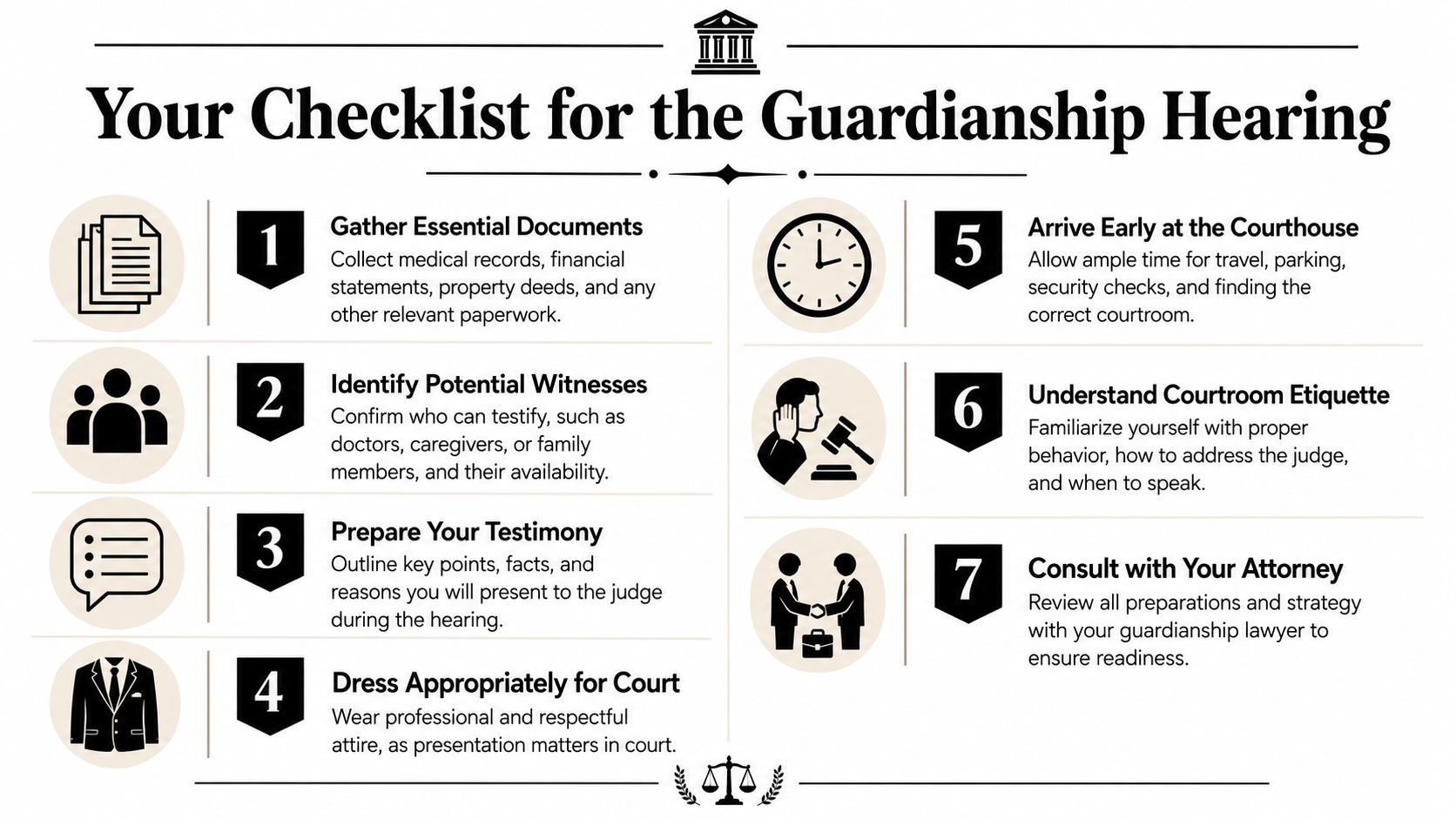
By the hearing, the paperwork should already tell a consistent story. The application, medical evidence, proposed powers, and your expected testimony should all point in the same direction. If one part says your father can manage daily decisions and another asks for full authority over every aspect of his life, the judge is likely to ask why.
For families living outside Texas, I tell them to prepare in two layers. First, confirm the legal file is complete. Second, confirm the practical details for a Harris County appearance, including who will attend in person, whether any part can be handled virtually, and how original or signed documents will get to Houston if the court wants them. If you need a starting point for the paperwork, Texas guardianship forms can help you see what documents are commonly part of the file.
A practical hearing checklist
- Read the application again: Your testimony should match the facts, dates, and requested authority in the filed pleading.
- Know the medical basis: Be ready to explain the diagnosis, the functional limits, and the specific risks that led to the guardianship request.
- Be prepared to address alternatives: The court will expect a clear explanation of what other options were considered and why they do not protect your loved one well enough.
- Understand the exact scope requested: Know whether the case seeks guardianship of the person, the estate, or both, and why that level of authority is being requested.
- Confirm attendance and logistics: Ask your lawyer who must appear, what time the court expects check-in, and whether local court procedures require anything beyond the usual docket call.
- Bring a workable care plan: The judge may want to hear where the proposed ward will live, who will help with medical care, and how money will be managed.
- Stay measured in court: Speak respectfully to the attorney ad litem, court staff, and relatives, even if tensions are high.
What judges usually listen for
Judges want specifics tied to real limitations. They are deciding whether a legal restriction is justified, so broad labels do not help much. “He has dementia” is only the start. “He forgets to take insulin, cannot explain recent bank withdrawals, and signed papers he did not understand” gives the court facts it can act on.
Out-of-state applicants should also be ready for a practical question that general guides often miss. If you live in another state, how will you carry out the job from there? A solid answer might include a Houston care facility already identified, a local physician involved, online access to financial accounts, and a plan to return to court when required. Distance does not bar appointment, but the court will want to know the arrangement is realistic.
Common mistakes on hearing day
The biggest problems are usually avoidable. A petitioner overstates the condition of the proposed ward. A family member raises a dispute in the hallway that counsel should have known about earlier. Someone assumes appearing by phone is acceptable without confirming the court's procedure first.
Accuracy carries more weight than emotion. Calm, specific testimony usually does more good than a long account of family history.
Nervousness is normal. Preparation helps.
After the Ruling Your Duties as a Guardian
Many families feel relief when the judge signs the order. Then the next reality sets in. Appointment creates responsibilities, deadlines, and ongoing court oversight.
The first deadline is strict
Per Texas Estates Code § 1002.065, a guardian must sign an oath and post a bond with the court within exactly 20 days of appointment. If that doesn't happen on time, the court cannot issue Letters of Guardianship.
That deadline catches families off guard because they assume the signed order is the final step. It isn't. The order authorizes the appointment, but the guardian still has to qualify properly.
What daily responsibility looks like
Guardianship of the person usually means ongoing decisions about care, placement, services, and medical coordination. Guardianship of the estate adds fiduciary duties, recordkeeping, and court accountability around money and property.
For estate matters, Texas imposes extra compliance duties. Under the court instructions tied to Texas Estates Code §§ 1204.151 to 1204.152, an attorney must file a written application for court approval of an investment plan for estate assets within 180 days of the guardian qualifying, unless the funds are invested through another approved mechanism, and natural parents cannot spend guardianship corpus or income without a court order, as described in these guardian of the estate instructions.
Compliance is part of protection
Texas guardianship isn't a one-time grant of power. It's supervised authority. Courts expect reports, updates, and careful handling of the ward's interests. Families who understand that early tend to avoid the most stressful compliance problems later.
If you've already been appointed and want a practical overview of next steps, what happens after guardianship is granted in Texas is a useful place to start.
Some guardians later discover that the arrangement should be modified or even terminated. That can happen when a ward regains capacity, gains better support systems, or no longer needs the same level of intervention. Guardianship should remain tied to actual need, not habit.
A good guardian keeps two ideas in mind at the same time. Protect the ward fully, and preserve the ward's remaining independence wherever possible.
The role can feel like a second job for family members who are already caregiving. That doesn't mean it's the wrong step. It means the legal authority should come with a plan for compliance, support, and periodic reassessment.
If your family is considering guardianship in Houston, facing an emergency, responding to a dispute, or trying to help a loved one from out of state, Law Office of Bryan Fagan, PLLC offers free consultations to discuss your options. A clear legal plan can help you protect your loved one, satisfy Texas court requirements, and move forward with more confidence.