Skip to content
When a loved one can no longer make safe, sound decisions for themselves, it's a heartbreaking and often overwhelming reality to face. In Texas, the legal system provides a powerful safeguard called guardianship. This is a court-supervised process where a judge appoints a responsible person—a guardian—to manage the personal or financial affairs of someone who has become incapacitated, who is then known as the ward.
We understand the emotional and financial challenges that come with this journey. The purpose of guardianship is always to protect the ward, acting in their best interests while preserving as much of their dignity and independence as possible. Our goal is to guide you through Texas guardianship law with clarity and care.
Understanding When Guardianship Is Necessary in Texas
Watching a parent struggle with dementia, caring for a spouse after a traumatic accident, or planning for the future of an adult child with special needs—these are some of life’s most profound challenges. The weight of responsibility is immense, and you’re often left wondering, "What's the right thing to do?" This is where a clear understanding of Texas guardianship law becomes not just helpful, but essential.

It’s easy to think of guardianship as taking away someone’s freedom. In reality, it’s a legal safety net designed for situations where a person has truly lost the capacity to protect themselves from harm. The law, as outlined in the Texas Estates Code, Title 3, is structured to intervene only when it's absolutely necessary, making the vulnerable person's well-being the number one priority.
The Legal Standard for Incapacity
In Texas, a court can’t just grant a guardianship on a whim. The law sets a high bar. A judge in a Harris County Probate Court, for instance, needs "clear and convincing evidence" that a person is legally "incapacitated." This goes far beyond making a few bad decisions or having quirky habits.
Under the Texas Estates Code, "incapacitated" means the person, due to a physical or mental condition, can no longer:
- Provide for their own food, clothing, or shelter.
- Take care of their own physical health.
- Manage their financial affairs in a responsible way.
This isn't a judgment call made by family members alone. The court requires a formal medical opinion from a physician, submitted in a specific document called a Certificate of Medical Examination. This step ensures the decision is grounded in objective medical fact, providing a compassionate but thorough basis for such a significant life change.
Guardianship is fundamentally a measure of last resort. Texas courts, from Harris County to Dallas County, are required by law to consider if less restrictive alternatives could work before appointing a guardian.
When Alternatives Are Not Enough
So, what are those "less restrictive alternatives"? Often, proactive Estate Planning can head off the need for a court-ordered guardianship entirely. Tools like powers of attorney and medical directives allow an individual to choose who makes decisions for them before they become unable to do so.
But guardianship becomes the only viable option when those tools aren't in place or are failing. For example, a Durable Power of Attorney is a fantastic tool, but it's completely useless if your loved one is already incapacitated and lacks the mental capacity to legally sign it. In other heartbreaking cases, the person they appointed as their agent might be abusing that power, and a guardianship is needed to step in, remove them, and protect the vulnerable adult.
Deciding whether to pursue guardianship is a complex decision, and we know it's an emotional one. This guide can help clarify when it might be the right path.
Is Guardianship the Right Path? Key Considerations
This table can help you weigh your options by comparing guardianship to common alternatives.
| Situation | Guardianship May Be Needed If… | An Alternative Might Work If… |
|---|---|---|
| Sudden Medical Crisis | The person is unconscious or otherwise unable to communicate, and there are no existing medical directives or POAs. | They have a valid Medical Power of Attorney or Directive to Physicians (Living Will) in place. |
| Cognitive Decline (e.g., Dementia) | Incapacity is advanced, and they can no longer understand the legal documents required to appoint an agent. | They are still lucid enough to sign a Durable Power of Attorney and other estate planning documents. |
| Financial Exploitation | An agent under a Power of Attorney is stealing money, or a stranger is taking advantage of the person's confusion. | A trusted person already has POA authority and can step in to protect assets and report the abuse. |
| Disability from Birth | An individual with lifelong special needs is turning 18 and cannot manage their own affairs independently. | A Supported Decision-Making Agreement is sufficient to help them make choices with guidance. |
Ultimately, every family's situation is unique. The best path forward depends on the specific facts, the available legal tools, and the loved one's condition.
We understand the emotional and financial weight that comes with this process. The path forward can feel unclear and overwhelming. At The Law Office of Bryan Fagan, our compassionate attorneys are here to guide your family through every step with clarity and care. For personalized guidance on your specific situation, schedule a free consultation with us today.
The Different Types of Guardianship in Texas
When you start looking into Texas guardianship law, you'll quickly realize it's not a one-size-fits-all situation. The legal system in Texas is designed to be flexible, offering different types of guardianship to fit specific needs. The goal is to use only the authority absolutely necessary to protect your loved one, preserving as much of their independence and dignity as possible.
The biggest distinction is between managing someone's personal well-being versus their financial affairs.
Guardianship of the Person
A Guardianship of the Person is all about the day-to-day well-being of the individual, who is called the "ward." As the Texas Estates Code, Title 3, Subtitle G explains, a guardian of the person steps in to make critical personal decisions, like:
- Healthcare: Choosing doctors, consenting to medical procedures, and, if it comes to it, making tough end-of-life decisions.
- Living Arrangements: Deciding where the ward will live—whether that's at home with help, in an assisted living community, or a nursing home.
- Daily Needs: Ensuring they have nutritious food, clean clothes, transportation, and social engagement.
Think of this as stepping into the role of a protector for someone's physical and emotional health when they simply can't do it for themselves anymore.
Guardianship of the Estate
On the flip side, a Guardianship of the Estate is strictly about the money. A guardian of the estate is put in charge of protecting and managing all of the ward's property and financial assets. This is a huge responsibility, and the court expects the guardian to handle these duties with the highest level of care, much like a trustee.
Some of the key duties include:
- Paying the ward's bills and managing any income they receive.
- Making sure any money owed to the ward gets collected.
- Wisely investing assets and managing any real estate.
- Filing extremely detailed financial reports with the court, known as "annual accounts," so a judge can review everything.
It's common for a judge to appoint the same person as guardian of both the person and the estate. However, if the finances are particularly complex, a family member might be named guardian of the person while a professional, like an accountant or a bank, is appointed to manage the estate. Our firm has deep experience with Probate matters and can help you make sense of these complex financial duties.
Full vs. Limited Guardianship
One of the most important principles in Texas law is that courts must impose the least restrictive option available. This isn't just a suggestion—it's the law. Because of this, a judge will always look at a limited guardianship first before ever considering a full guardianship.
A limited guardianship is custom-fit to the person's specific challenges. For example, if someone can still cook their meals and enjoy their hobbies but can't keep track of their bills, a court could grant a guardianship that is limited only to their finances. All their other personal rights would remain untouched.
A full guardianship, where the guardian has broad decision-making authority, is only ordered when there’s overwhelming proof that the person is completely unable to care for themselves or manage their affairs in any meaningful way.
Temporary or Emergency Guardianship
Life doesn't wait for the court's schedule. Sometimes, a crisis hits, and you need to act now. Imagine an elderly parent in Harris County has a sudden stroke and can't communicate. If critical medical decisions need to be made immediately and there's no Medical Power of Attorney in place, you can't afford to wait weeks for a standard guardianship hearing.
For these urgent situations, the Texas Estates Code provides for a Temporary Guardianship. This is an emergency tool that gives a guardian authority for a very short time—usually no more than 60 days—to handle the immediate crisis. A judge can grant this quickly if there's substantial evidence that the person or their property is in immediate danger.
Figuring out which of these paths is right can feel overwhelming, and we know the emotional and financial toll this takes on families. The Law Office of Bryan Fagan is here to help you understand these different types of guardianship and find the most supportive way forward. For a compassionate, no-cost review of your case, please schedule a free consultation with our experienced team today.
The Step-by-Step Process for Establishing Guardianship
Stepping into the court system can feel overwhelming, especially when you’re already shouldering the emotional weight of a loved one's declining health. But having a clear roadmap of the Texas guardianship law process can bring a real sense of clarity and control. Think of it not as one giant hurdle, but as a series of manageable, practical steps, each one moving you closer to giving your family member the protection they need.
This guide will walk you through the key stages, from filing that very first document to the final court hearing. Knowing what to expect in a Dallas County or Harris County Probate Court can make the entire journey feel far less intimidating.
Stage 1: Filing the Initial Application
Your journey starts with a formal document called an "Application for Appointment of Permanent Guardian." This is the official petition that gets the ball rolling and asks the court to consider a guardianship. It must be filed in the probate court located in the county where your loved one (the "proposed ward") lives.
The application itself is quite detailed. It requires specific information about the proposed ward, the person asking to be guardian (the applicant), and a clear explanation of why guardianship is necessary. You'll need to spell out exactly why less restrictive options just won't work for your loved one's situation.
Throughout this process, accurately preparing and reviewing all the legal paperwork is essential. For those new to this, learning some basic methods for effective document analysis can be incredibly helpful for building a strong case.
Stage 2: Obtaining Medical Evidence of Incapacity
This is perhaps the single most important piece of the puzzle. A judge cannot grant a guardianship based on your word alone, no matter how sincere. The court needs objective, professional proof that your loved one is legally incapacitated.
This proof comes from a specific form called a "Certificate of Medical Examination." A licensed Texas physician must complete it after examining your loved one within the last 120 days before you file the application. This signed letter gives the court a doctor's expert opinion on the person's condition and their ability to handle their own affairs, forming the medical basis for the court's decision.
The infographic below shows the main types of guardianship you might apply for, which really depends on what kind of help your loved one needs.
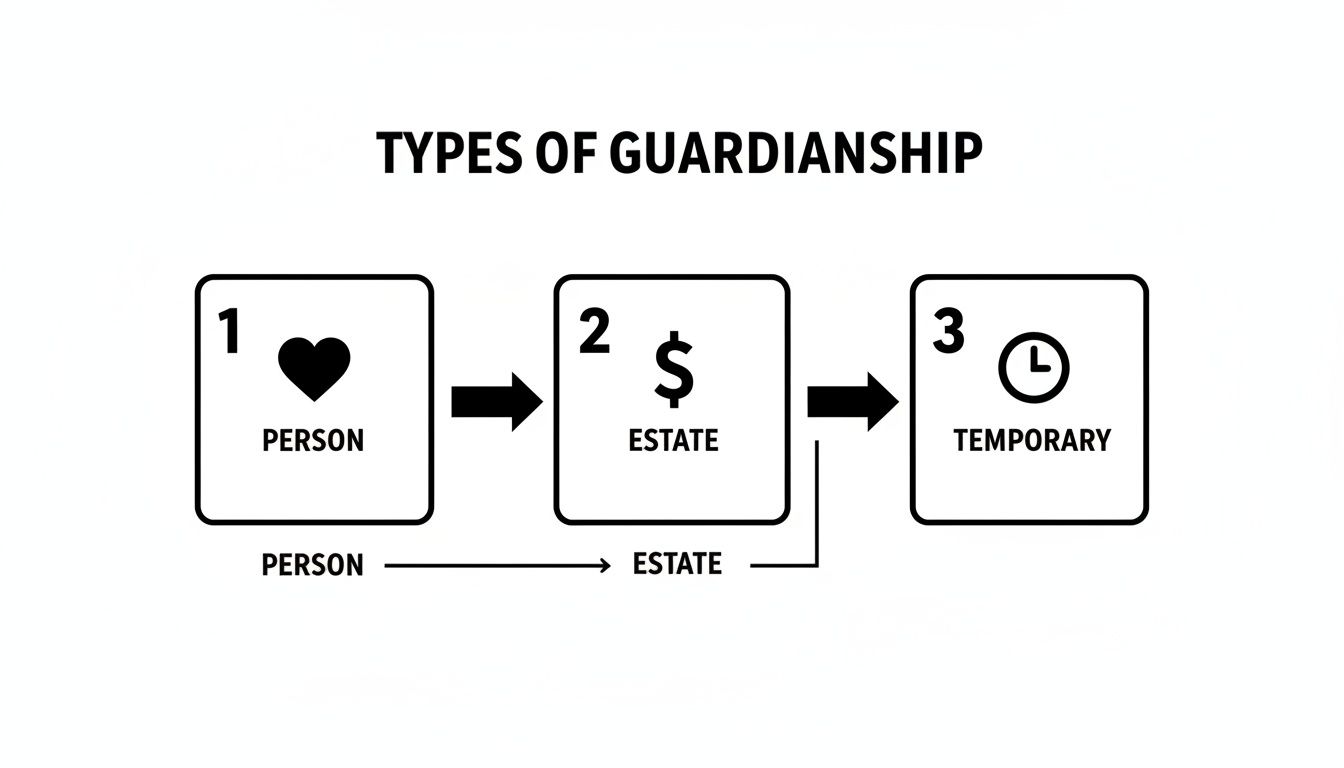
This helps clarify if you need to manage personal decisions (Guardianship of the Person), financial matters (Guardianship of the Estate), or an urgent crisis (Temporary Guardianship).
Stage 3: The Role of the Attorney Ad Litem
As soon as the application is filed, the court's main focus becomes protecting the rights of the proposed ward. To do this, the judge will immediately appoint an attorney ad litem. This is an independent lawyer whose only client is your loved one and whose only job is to advocate for their best interests.
The attorney ad litem will:
- Meet privately with your loved one to explain what’s happening in simple terms.
- Interview you, other family members, doctors, and caregivers.
- Review all the medical records and legal documents filed.
- Write a formal report for the judge with their professional recommendation.
This person is a critical safeguard in the system, making sure your loved one’s voice is heard and their rights are fiercely defended throughout the process.
Stage 4: Cooperating With the Court Investigator
Besides the attorney ad litem, the court will also bring in a court investigator. You can think of this person as the judge’s eyes and ears on the ground. Their job is to run a background check on the person who wants to be guardian and to visit your loved one’s home to see the living situation for themselves.
The investigator is there to verify that you are a suitable choice and that the proposed home is a safe and appropriate place. Working with them openly is key to keeping the case moving forward. We offer more detailed guidance on how to apply for guardianship that covers what to expect during these interactions.
Stage 5: Preparing for the Court Hearing
The final step is the court hearing. This is where everyone comes together for a formal proceeding so the judge can hear the evidence and make a final decision. You, your attorney, and the attorney ad litem will be there, and sometimes the proposed ward will be as well, if they are able.
The judge will look over all the paperwork and reports and might ask a few questions to confirm the details. To grant the guardianship, the judge must be convinced by "clear and convincing evidence" that your loved one is incapacitated and that appointing a guardian is truly in their best interest.
We know the emotional and financial toll of this process can be immense. At The Law Office of Bryan Fagan, we are dedicated to guiding Texas families through it with clarity and compassion. For help with your unique situation, we invite you to schedule a free consultation with our team.
Understanding a Guardian's Rights and Responsibilities
Taking on the role of a guardian for a loved one is a huge act of service and love. But it's also a serious legal commitment with very real duties attached. Once a Texas court appoints you, you’re stepping into a position of incredible trust, all of it guided by what the law calls a fiduciary duty.
This isn't just legal jargon; it's the guiding principle for every decision you'll make. Fiduciary duty means you must always act in the best interests of the person you're protecting—the ward. No exceptions. It demands loyalty, care, and complete transparency as you manage their life and finances, holding you to the highest ethical standard.

Core Duties of a Texas Guardian
Your day-to-day responsibilities will depend on whether you’re appointed as Guardian of the Person, Guardian of the Estate, or both. These are not just suggestions; they are strict legal obligations laid out in the Texas Estates Code, Title 3, Subtitle G, and the court will hold you accountable.
Here’s a look at what this means in the real world:
- Making Healthcare Decisions: You'll be the one consenting to medical treatments, choosing doctors, and making sure the ward gets the care they need. This requires being their strongest advocate.
- Managing Living Arrangements: A huge part of the job is determining where the ward will live to keep them safe and comfortable. This could mean arranging in-home care, finding the right assisted living facility, or transitioning them to a nursing home.
- Handling Financial Affairs: If you're the Guardian of the Estate, you become their financial manager. You'll pay bills, handle their income and investments, and protect their property. This demands careful, detailed record-keeping.
- Avoiding Conflicts of Interest: Your personal needs must be completely separate from your duties. You cannot use the ward's money for yourself or make a decision that benefits you instead of them.
These are significant, often emotionally draining tasks. To get a clearer picture of everything involved, it helps to dive deeper. You can learn more about the responsibilities of a legal guardian in our detailed guide.
The Importance of Court Reporting and Compliance
To ensure guardians stay on the right track, Texas law demands regular and strict reporting to the court. This isn't just more paperwork; it's a critical safety measure to protect your loved one from neglect or financial abuse.
Within 60 days of your appointment, a Guardian of the Estate must file a detailed report with the court.
This first report is called the Inventory, Appraisement, and List of Claims. Think of it as a complete financial snapshot of everything the ward owns—bank accounts, real estate, personal items—and any debts they have. It creates a solid baseline for all future financial management.
The reporting doesn't stop there. Every year, you’ll submit an Annual Account to the court, which breaks down every single dollar that came in and went out of the ward's estate. A Guardian of the Person files a similar yearly update, the Annual Report on the Condition and Well-Being of the Ward, which covers their health, living situation, and overall care.
Following these rules and meeting deadlines is non-negotiable. Courts in Harris County, Dallas County, and all across Texas take these requirements very seriously. Failing to comply can lead to your removal as guardian and other legal consequences. The role of a guardian is both a privilege and a heavy responsibility, and we are here to provide the legal support you need to fulfill your duties with confidence and care.
When Guardianship Turns Contentious: Disputes and Court Oversight
Even in the closest families, the strain of a loved one's declining health can bring disagreements to the surface. When it comes to guardianship, these disputes can be particularly painful, often stemming from different ideas about who should be in charge or what "best care" really looks like. It's important to know that Texas guardianship law anticipates these conflicts and has strong systems in place for resolving them and keeping a watchful eye on every guardian.
These challenges aren't a sign that your family has failed. They're a natural reflection of the immense emotional and financial weight of the situation. Whether you're worried that the appointed guardian isn't the right fit or you have concerns about how money is being handled, the law provides a clear path to protect the person who matters most—the ward.
Common Areas of Guardianship Disputes
Disputes can flare up right at the beginning, when someone first applies for guardianship, or they can surface long after a guardian has been appointed. Families often find themselves at odds over a few key issues.
Here are some of the most common points of conflict:
- Who Should Serve as Guardian: It’s not unusual for siblings to disagree on which of them is best suited for the role. This can lead to a contested hearing where a judge in a Harris County court has to make the final call based on the evidence presented.
- Allegations of Misconduct: A family member might get the feeling that the current guardian isn't acting in the ward's best interest. This could involve suspicions of mismanaged funds, neglect, or simply not providing the right level of care.
- Disagreements Over Care Decisions: Major life decisions can cause deep rifts. Family members might clash over sensitive topics like specific medical treatments or whether it’s time to move the ward into a long-term care facility.
When these situations arise, Texas law allows any interested person to take formal action. You have the right to contest an initial application for guardianship. If a guardian is already in place, you can file a motion with the court to have them removed and replaced. In these hearings, the judge has one and only one priority: the safety and well-being of the ward.
The Power of Court Oversight and Accountability
A cornerstone of the Texas guardianship system is constant, robust court supervision. A guardian isn't just appointed and then left to their own devices. They are legally considered an officer of the court and are accountable to a judge for every single action they take. This oversight is a powerful, built-in safeguard against neglect, abuse, and financial exploitation.
As guardianship filings have increased, Texas courts have strengthened their monitoring systems. State initiatives help courts in major counties like Harris and Dallas better track cases and ensure compliance. You can learn more about Texas's data-driven response to growing guardianship caseloads and how these efforts are shaping court administration.
"A guardian must account to the court for all actions taken on behalf of the ward. This includes filing detailed annual reports and seeking court permission for significant decisions, ensuring a high level of transparency and accountability."
This ongoing judicial review means that if a guardian fails to live up to the strict duties laid out in the Texas Estates Code, Title 3, Subtitle G, the court can—and will—step in.
Practical Steps to Take When a Dispute Arises
If you genuinely believe a guardian is failing in their duties or that a change is critical to protect your loved one, you have legal options. The first practical step is to organize your concerns. Document everything with specific dates, examples, and any evidence you have. From there, the next move is to file a formal motion with the probate court that is overseeing the guardianship.
Depending on the situation, this could be a motion to:
- Compel an Accounting: This forces the guardian to provide a detailed financial report, which is crucial if you suspect funds are being mismanaged.
- Modify the Guardianship: You can ask the court to change the guardian's specific powers or duties to better suit the ward's needs.
- Remove the Guardian: This is a serious step where you petition the court to remove the current guardian entirely and appoint a successor.
Trying to navigate these disputes on your own is legally complex and emotionally draining. The compassionate attorneys at The Law Office of Bryan Fagan are here to guide your family with clarity and care. For personalized advice on your specific situation, schedule a free consultation today.
Exploring Powerful Alternatives to Guardianship
Taking control of your future is the single best way to protect your independence and ensure your wishes are followed. While guardianship is a necessary tool in some situations, Texas guardianship law correctly treats it as a last resort. Why? Because it involves a court taking away a person's most fundamental rights.
The good news is that Texas law offers several powerful, less intrusive alternatives that can often avoid the need for a formal guardianship altogether. These tools allow you to decide for yourself—while you still have the capacity—who you want managing your affairs if you ever need help. This proactive approach is one of the most compassionate things you can do for your family.
Essential Estate Planning Documents
The most common and effective alternatives are legal documents that form the foundation of any solid estate plan. Think of them as creating a personal safety net for your future, with each document serving a specific, vital purpose.
These key documents include:
- Durable Power of Attorney: This document lets you appoint a trusted person (your "agent") to handle your financial matters if you become unable to. This authority can be as broad or as limited as you want, from simply paying bills to managing complex investments.
- Medical Power of Attorney: This empowers an agent you choose to make healthcare decisions for you if you can't communicate them yourself. It's absolutely crucial for making sure your medical care aligns with your personal values.
- Directive to Physicians (Living Will): This document clearly states your wishes for end-of-life medical care, giving you direct control over what treatments you do or do not want to receive.
For example, imagine a woman in Harris County who signs a durable power of attorney naming her son as her agent. Years later, she develops dementia and can no longer keep up with her bank accounts. Her son can step in seamlessly to pay her bills and manage her finances without ever needing to go to court. That's the power of planning ahead.
Supported Decision-Making Agreements
A more modern approach recognized in Texas is the Supported Decision-Making Agreement. This is an incredibly empowering tool, especially for adults with disabilities who might need some assistance but are perfectly capable of making their own decisions.
This agreement allows an individual to choose trusted advisors—like family members or close friends—to help them understand information, weigh their options, and communicate their own choices.
The core idea behind a Supported Decision-Making Agreement is that the individual keeps all their legal rights to make their own choices. The supporter is there to help, not to take over.
Sometimes, the root issue isn't incapacity but family conflict. Addressing underlying dynamics and improving communication through methods like family therapy can build a collaborative support system, making court intervention unnecessary. You can learn more about how supported decision-making and advance directives empower individuals to see how these powerful tools work together.
The Law Office of Bryan Fagan can help you explore these alternatives. Schedule a free consultation to learn how proactive planning can protect your independence.
Common Questions We Hear About Texas Guardianship
When you're considering a step as significant as guardianship, practical questions are often the first to come to mind. What will this really cost? How long will my family be tied up in court? We understand. These are the real-world concerns that matter most. Here are some straightforward answers to the questions we hear every day from families just like yours.
How Long Does It Take to Establish Guardianship in Texas?
The timeline can really vary, depending mostly on the court’s own schedule and the complexity of your situation. If everyone is on the same page and the guardianship is uncontested, you might see the process wrap up in about one to three months in a Harris County or Dallas County Probate Court.
However, if the case becomes contested—for instance, if another family member or the proposed ward decides to challenge the guardianship—the process will take longer. The court will need to schedule additional hearings to resolve the dispute, which can extend the timeline significantly.
What Are the Costs Involved in a Guardianship Case?
This is a major concern for most families, and it's important to be prepared for the financial aspect. The costs for setting up a guardianship in Texas can be significant. You should generally plan for:
- Court Filing Fees: These are the initial fees to get your case on the court's docket.
- Attorney Ad Litem Fees: The court will appoint an independent lawyer to represent the proposed ward. It's their job to protect that person's rights, and their fees are usually paid by you or from the proposed ward's estate.
- Your Attorney’s Fees: This is the cost for the legal expert guiding you through the process.
- Guardian’s Bond: In many cases, especially when managing assets, the court will require you to purchase a bond. This acts as an insurance policy to protect the ward's finances.
All in, these costs can range from a few thousand dollars to a much higher figure, particularly if the case becomes contested and requires more court time.
Who Can Be Appointed as a Guardian in Texas?
According to the Texas Estates Code, almost any qualified adult can serve as a guardian. That said, courts have a natural order of preference, typically looking first to a spouse, an adult child, or another close relative who is ready and willing to step up.
If your loved one had the foresight to create a Designation of Guardian as part of their Estate Planning, the court will give that document serious weight. The most critical requirement for any potential guardian, though, is passing a criminal background check and convincing the judge that they are the right person to act in the ward’s best interests.
At The Law Office of Bryan Fagan, PLLC, our mission is to provide your family with the clarity, care, and support you need during a challenging time. If these questions have sparked more of your own, we’re here to help. Reach out and schedule a free, no-obligation consultation with our experienced legal team today by visiting us at https://texasguardianshiplawyer.net.