Skip to content
When a loved one passes away, the term ‘probate court’ often surfaces, usually bringing a wave of confusion and stress during an already difficult time. We understand the emotional and financial challenges families face in these moments. To put it simply, probate court is a specialized legal venue that oversees the process of settling a deceased person's estate. Its main job is to make sure your loved one’s final wishes are honored, their debts are paid, and their property is legally transferred to the right people. At The Law Office of Bryan Fagan, our mission is to guide Texas families through this process with clarity and care.
Understanding the Role of Probate Court in Texas

Think of a Texas probate court, like the Harris County Probate Court, as a kind of "financial referee." After someone passes, a lot of financial and legal loose ends need to be tied up. The court provides a structured, supervised environment to ensure everything is done correctly and fairly. This entire process, known as probate, is what brings legal and financial closure for your family.
The court’s involvement isn’t arbitrary; it’s guided by a specific set of laws found in the Texas Estates Code. This is the official rulebook for how assets are managed, wills are proven valid, and heirs are officially recognized. Whether your loved one left behind a detailed will or passed away without one, the probate court offers a formal path to getting things settled.
Key Functions of a Texas Probate Court
The responsibilities of a Texas probate court are very specific and absolutely essential. Getting a handle on what they do can make the whole process feel much less mysterious and intimidating. Beyond probate, these courts also handle critical matters like establishing or terminating a Guardianship for minors or incapacitated adults.
Here’s a quick look at the core duties of a Texas probate court. Understanding these functions can help clarify what to expect as your family navigates the process.
| Function | What It Means for Your Family |
|---|---|
| Validating the Will | The court's first job is to confirm if the will is legally valid. If it meets all legal requirements, the judge will "admit the will to probate," making it official. |
| Appointing a Representative | The court legally appoints someone to manage the estate. This person is called an "Executor" if they were named in the will, or an "Administrator" if there was no will. |
| Overseeing Debt Settlement | Before anyone inherits anything, the court makes sure that all legitimate debts and taxes owed by the deceased are paid using the estate's assets. |
| Resolving Disputes | If family members disagree about the will or how property should be divided, the probate court acts as a neutral ground to resolve these disputes legally. This also applies to guardianship disputes. |
| Authorizing Distribution | Once all debts are paid and any arguments are settled, the court gives the final green light to legally transfer the remaining assets to the beneficiaries (from the will) or heirs (as determined by state law). |
This table simplifies the court’s main jobs, but each step is designed to protect the estate and ensure a fair, orderly conclusion for everyone involved. The probate process is designed to provide certainty and finality.
To get started with probate, you'll need to gather several official documents. One of the very first is the death certificate, and you can get a better sense of its importance by Understanding the Texas Death Certificate.
While the court system can seem daunting, its role is fundamentally supportive—to guide your family through these necessary steps with legal clarity. It's also important to know what assets actually need to go through this process. You can learn more in our guide to probate and nonprobate assets.
The Key People Involved in Texas Probate

Stepping into probate court can feel a bit like watching a play where you don't know the characters. There are a lot of formal titles and specific roles, but once you understand who’s who, the entire process feels much more grounded and less intimidating.
Think of it as a small cast of characters, each with a specific job to do, all working to wrap up your loved one's final affairs according to the rules of the Texas Estates Code. Let's meet the key players.
The Estate Representative: The Executor or Administrator
At the center of it all is the Executor or Administrator. This person is the boots-on-the-ground manager of the estate. If your loved one named someone for the job in their will, they are the Executor. If there was no will, the court steps in to appoint someone for the role, and they are called an Administrator. In a guardianship case, this person would be known as the Guardian, who has specific rights and duties to protect the ward.
This is a big job with serious legal responsibilities. Their duties are pretty extensive and include:
- Rounding up all the estate assets, everything from bank accounts and investments to real estate and personal belongings.
- Notifying all the beneficiaries and creditors about the probate case.
- Paying off any legitimate debts and taxes using the estate's funds.
- Distributing what's left to the people who are legally entitled to it.
Basically, this person is the legal face of the estate until every last detail is settled.
The Heirs and Beneficiaries: The People Who Inherit
You’ll often hear the terms heirs and beneficiaries used as if they mean the same thing, but in the eyes of Texas law, there's a key difference. Beneficiaries are the people or organizations specifically named in a will to receive property. Heirs, on the other hand, are the people entitled to inherit property under state law when someone dies without a will (a situation known as "intestate succession").
For example, let's say Mr. Garcia from Harris County passes away. His will names his wife and two kids as beneficiaries. They are the chosen recipients of his property. But if he had died without a will, Texas law would still identify that same wife and two kids as his legal heirs.
These are the folks with a direct stake in how the probate process plays out. They have a right to be kept in the loop about how the estate is being managed and to receive their inheritance after all the bills are paid.
The Court and Its Officers: The Judge and Attorneys
The Probate Judge acts as the referee, overseeing the entire process to make sure everything is done by the book. They are the ones who officially validate the will, appoint the executor or administrator, and step in to resolve any fights or disagreements that pop up. Their job is to ensure the process is fair and legal for everyone involved.
Your attorney is your personal guide and advocate through this legal maze. An experienced probate lawyer, like the team at The Law Office of Bryan Fagan, handles the heavy lifting. We prepare and file all the necessary court documents, represent you at hearings, and offer critical advice when you need it most. We translate the complex legal jargon into plain English and make sure your interests are protected every step of the way. A good lawyer can be the difference between a stressful, drawn-out ordeal and a well-managed process.
Understanding the Different Paths of Texas Probate
When it comes to settling an estate in Texas, there's no single, one-size-fits-all process. The law actually provides several different avenues for probate, and each one is designed for a specific set of circumstances. Picking the right path from the start can make a world of difference, saving your family time, money, and unnecessary stress.
The route you'll take hinges on a few key factors: Is there a valid will? How large and complex is the estate? Are there outstanding debts? And just as importantly, are all the family members on the same page? Let's break down the most common options you'll encounter.
Independent Administration: The Preferred Path for Most Families
For most Texas families, Independent Administration is the goal. It's the most common and efficient form of probate, designed for situations where a will specifically requests it, or when all the beneficiaries agree to it. The defining feature here is minimal court supervision, which is a huge advantage.
Once the court officially appoints an Independent Executor, that person is empowered to handle the estate's affairs—paying off creditors, selling property, and distributing assets—without having to run back to the judge for permission at every turn. It’s the go-to method for straightforward estates where everyone is cooperating.
For Example: Maria’s father passed away in Dallas, and his will named her as the Independent Executor. After a single court hearing to validate the will and her appointment, Maria was able to sell his car, pay his final bills, and divide the remaining bank account funds among her siblings, all without returning to court for approval.
Dependent Administration: When Court Oversight Is Necessary
On the other end of the spectrum is Dependent Administration, which involves close and continuous court supervision. This path is generally reserved for messier situations, like when there's no will, the will doesn't allow for an independent executor, or there are serious disputes among the heirs that require a judge's guidance.
In this scenario, the Administrator must get the court's green light for almost every single action, from selling a house to settling a credit card bill. While this definitely makes the process longer and more expensive, that judicial oversight provides a critical layer of protection when there's conflict or a real risk of the estate being mismanaged. According to the Texas Estates Code, Title 3, this structured process is there to protect everyone involved.
Muniment of Title: A Shortcut for Transferring Property
A Muniment of Title is a unique Texas probate proceeding that works like a legal shortcut. It’s perfect for one specific situation: there's a valid will, and the only debts are secured by real estate, like a home mortgage. Essentially, you're just asking the court to formally recognize the will as the legal document that transfers ownership of the assets.
There’s no executor or administrator appointed. The court holds a hearing, confirms the will is valid, and issues an order that acts as the official proof of transfer for the property. If the main goal is just to get a house into a beneficiary's name and there aren't other loose ends, this can be an incredibly fast and cost-effective option. You can learn more about Muniment of Title in our comprehensive guide.
Small Estate Affidavit: An Alternative to Formal Probate
For estates with very limited assets, Texas law offers a way to avoid the formal probate process entirely. A Small Estate Affidavit can be used if the person passed away without a will and the value of their probate estate (not counting their primary home) is $75,000 or less.
This is a sworn legal document filed with the court clerk. Once a judge reviews and approves it, the heirs can use the approved affidavit to collect assets directly from banks, financial institutions, or anyone else holding the deceased's property. It’s a simplified, cost-effective tool built for families with modest estates and no complicated legal fights.
Comparing Texas Probate Proceedings
The table below breaks down the key differences between these probate paths to help your family better understand which one might be the right fit.
| Type of Probate | Best For | Level of Court Involvement | Typical Timeline |
|---|---|---|---|
| Independent Administration | Estates with a valid will and cooperative beneficiaries. | Minimal. Initial hearing and final inventory. | 3-9 Months |
| Dependent Administration | Estates with no will, family disputes, or complex debts. | High. Court approval needed for most actions. | 12+ Months |
| Muniment of Title | Simple estates with a will, no unsecured debts, and the main goal is transferring property. | Very Low. One court hearing to validate the will. | 1-2 Months |
| Small Estate Affidavit | Very small estates (under $75,000) with no will and no real estate other than a homestead. | Minimal. Judge's signature on the affidavit. | 1-2 Months |
Choosing the right legal path is the most important first step in settling an estate efficiently and with the least amount of friction.
Navigating these different paths can feel overwhelming, but you don't have to do it alone. The right legal guidance ensures you choose the most efficient and appropriate process for your family's needs. Schedule a free consultation with The Law Office of Bryan Fagan today to get clear, compassionate direction on your next steps.
A Step-by-Step Guide to the Texas Probate Process
When you're grieving, the last thing you want to face is a winding, unclear legal road. Understanding the probate journey, however, can bring a surprising sense of control and clarity. Let's break down the Texas probate process into a straightforward roadmap, so your family knows exactly what to expect at each turn.
We get that every step carries not just legal weight, but emotional weight, too. Our goal is to walk you through this with compassion, turning a complex legal procedure into a series of manageable actions. Knowing the path forward is the first step toward finding some peace of mind.
This diagram shows the main routes probate can take in Texas. As you can see, it ranges from the more streamlined Independent Administration to the court-supervised Dependent Administration.
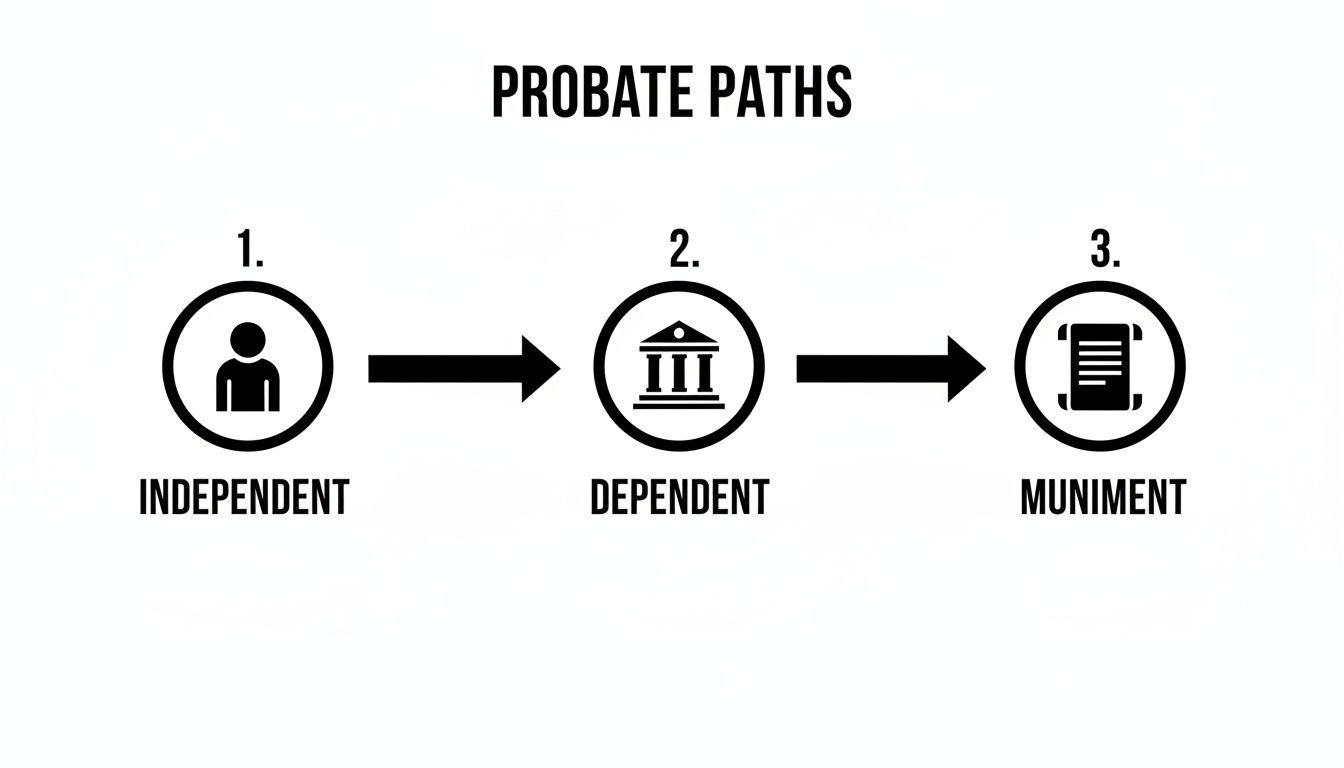
The key takeaway here is that the level of court involvement and family cooperation really dictates which path an estate will follow.
Filing the Initial Application
The whole process kicks off when an "Application for Probate" is filed with the right court. In Texas, this is usually the probate court in the county where the person lived, like the Tarrant County Probate Court or the Bexar County Probate Court.
This legal document lays out all the essential information: the date of death, their last known address, who the heirs are, and whether they left a will. If there is a will, the original has to be filed right along with the application. This filing officially asks the court to open the estate and, if there’s a will, to legally recognize it as valid.
The First Court Hearing
After the application is filed, there's a mandatory waiting period before a hearing can be scheduled. This first hearing is typically pretty straightforward. The judge’s main goal is to legally validate the will (if there is one) and officially appoint the person who will be in charge of the estate.
The person named as the executor in the will must show up to this hearing. They'll be asked to confirm the facts in the application and take an oath, promising to carry out their duties according to Texas law. Once the judge is satisfied, they sign an order admitting the will to probate and appointing the executor.
Appointing the Executor and Getting Started
Once the judge signs that order, the executor gets their official authority to act for the estate. This power is formally documented in a court-issued paper called Letters Testamentary.
Think of Letters Testamentary as the executor's official credentials. It's the legal document they will show to banks, financial institutions, and others to prove they have the right to manage the deceased’s assets.
With these letters in hand, the executor can finally start the real work of settling the estate. This is a huge step that unlocks their ability to access accounts, gather property, and move everything forward.
Notifying Creditors and Settling Debts
One of the executor's most important jobs is handling any of the deceased's final debts. Texas law requires the executor to publish a notice in a local newspaper to let any unknown creditors know what's going on. They also have to send a direct, formal notice to any creditors they already know about.
Creditors then have a set amount of time to submit a formal claim against the estate. The executor is responsible for reviewing these claims, checking if they're valid, and paying off the legitimate debts using funds from the estate. This step is crucial for making sure all financial loose ends are tied up before any property gets passed on to the heirs.
Inventorying Estate Assets
Within 90 days of being appointed, the executor has to compile a detailed report for the court called an "Inventory, Appraisement, and List of Claims." This document is exactly what it sounds like: a complete list of all property the person owned when they died, along with its estimated value.
This inventory needs to be thorough and include everything from:
- Real estate (like homes and land)
- Bank accounts and investment portfolios
- Cars and other personal property
- Any money that was owed to the estate
This step creates a clear, transparent record of what the estate is worth, which is essential for managing it properly and, eventually, distributing it fairly.
Final Expenses, Taxes, and Distribution
Once the creditor claim period is over and all the debts have been paid, the executor handles the final administrative tasks. This usually involves paying for funeral expenses out of the estate and filing any required final income or estate tax returns.
With all obligations finally settled, the executor's last big duty is to distribute the remaining assets to the beneficiaries named in the will or the heirs determined by state law. This is the moment everything has been leading up to—when the loved one's legacy is formally passed on. Successfully probating a will in Texas ensures this final, important step is handled correctly and legally.
Navigating these steps requires careful attention to detail and a close eye on legal deadlines. For personalized guidance, schedule a free consultation with The Law Office of Bryan Fagan, PLLC.
Navigating Common Challenges in Probate Court
Even when a loved one leaves behind a clear will and the family is generally on good terms, the probate process can unearth unexpected and emotionally charged roadblocks. Grief is still fresh, and that's often when disagreements over property or the validity of a will can quickly escalate, causing painful friction between relatives. It’s important to know that these challenges are common and, with the right legal guidance, entirely manageable.
The Texas probate court exists to provide a structured, fair environment to resolve these disputes. While nobody wants a family conflict to end up before a judge, the court’s role is to ensure that all decisions are made according to the law—protecting the deceased’s final wishes and the rights of everyone involved.
Understanding Will Contests
One of the biggest hurdles you might face is a will contest. This isn’t just a simple disagreement; it's a formal legal objection claiming that a will is invalid for very specific reasons. Under the Texas Estates Code, a will can be challenged on several key grounds:
- Lack of Testamentary Capacity: The person who made the will wasn't of sound mind when they signed it.
- Undue Influence: Someone manipulated or coerced your loved one into creating or changing the will for their own personal gain.
- Improper Execution: The will wasn't signed or witnessed according to the strict legal standards required in Texas.
- Fraud or Forgery: The document itself is a fake, or the person was tricked into signing something they didn't understand.
A will contest immediately turns the probate case into a more complex legal battle. One party has to file a lawsuit, and from there, the court will hear evidence from both sides before making a final ruling on whether the will stands.
Conflicts Over Assets and Debts
Disagreements don't always have to challenge the entire will. Sometimes, the conflict is much more focused, boiling down to specific assets or how debts should be handled. Beneficiaries might argue over who gets sentimental items, what the family home should sell for, or whether a particular creditor's claim is even legitimate and should be paid from the estate.
Scenario in Travis County:
Imagine two siblings in Austin, Sarah and Ben, are co-executors of their mother's estate. The main asset is the family home. Sarah, who lives out of state, wants to sell it quickly for whatever the current market will bear. But Ben, who has lived in the home for years, thinks it’s worth more and wants to wait, or maybe even buy out his sister's share at a lower price. This kind of disagreement can bring the probate process to a grinding halt. A probate court in Travis County would provide the venue to resolve this, perhaps by ordering a neutral appraisal to set a fair price and establishing a clear timeline for the sale or buyout.
These situations are emotionally draining, but they are precisely why probate court exists—to provide an impartial referee who can enforce a fair resolution when family members simply can't agree.
The Rise in Probate Disputes
If it feels like these disputes are more common now, you're not wrong. The probate system has seen a dramatic surge in conflicts, with applications to block probate hitting an all-time high. A recent study revealed that nearly four in ten people (38%) would consider disputing a will if they felt their inheritance was unfair.
This trend is often tied to complex modern family structures, financial pressures, and the pitfalls of poorly drafted DIY wills, which often leave too much room for ambiguity and disagreement. You can learn more about the factors driving estate disputes.
Facing these challenges alone can feel completely overwhelming. Having a skilled probate attorney isn’t just about navigating legal procedures; it’s about having an advocate who can work toward a fair resolution while trying to preserve family relationships. At The Law Office of Bryan Fagan, we provide the compassionate, firm guidance you need to get through these difficult moments. Schedule a free consultation with us today to discuss your family's situation and find a clear path forward.
How Our Firm Guides Families Through Probate
Losing a loved one is hard enough. The last thing you should have to deal with is a mountain of confusing legal paperwork and court dates, especially while you're grieving. This is where we come in. At The Law Office of Bryan Fagan, we see it as our job to lift that legal weight from your shoulders. We’re here to turn a confusing, stressful process into a clear, manageable path forward.
Think of us as your partners in this process. We’re here to make sure your loved one’s final wishes are honored and your family’s interests are protected every step of the way. It all starts with a simple conversation to get you pointed in the right direction.
Your Partners in the Probate Process
Our first goal is to figure out the most direct and efficient way to settle the estate. We’ll help you prepare and file the initial probate application, making sure every detail is correct for the specific court you’re dealing with, whether that’s in Harris County, Dallas County, or Bexar County. Getting this right from the beginning saves a lot of time and money down the road.
We’ll then walk you through each critical phase of the probate journey:
- Representing you at court hearings to get the will validated and have an executor or administrator officially appointed.
- Handling all the required legal notices that must be sent to beneficiaries and creditors, as spelled out in the Texas Estates Code.
- Helping you create a detailed inventory of all estate assets, ensuring everything is accounted for transparently and correctly.
- Providing practical advice on settling debts and navigating any claims filed against the estate.
Resolving Disputes with Compassion and Strength
Unfortunately, disagreements can sometimes pop up between family members, or someone might contest the will. When that happens, our role becomes even more important. We always aim to find a fair solution that, whenever possible, keeps family relationships intact.
However, if a firm hand is needed to protect your rights, we are fully prepared to be your strong advocate in court. Our extensive experience in Texas probate litigation means we know how to handle these complex disputes and fight for a favorable outcome for you and your family.
We believe every family deserves peace of mind during such a difficult chapter. Our team is committed to handling the legal details with precision, so you can focus on what really matters—taking care of each other.
You don’t have to go through the probate process alone. We’re here to shoulder the legal burden for you.
To get personalized guidance and a clear idea of your next steps, we invite you to schedule a free consultation with our experienced probate attorneys. Let us help you find the best path forward for your family.
Answering Your Top Texas Probate Questions
When you're dealing with the loss of a loved one, the last thing you want is a confusing legal process. We get a lot of questions about probate, so we've put together some straightforward answers to the most common concerns families face.
How Long Does Probate Take in Texas?
This is usually the first question on everyone's mind. The truth is, it depends. A very straightforward, uncontested probate, like a Muniment of Title, might wrap up in just a couple of months.
However, a more standard process like an Independent Administration typically takes somewhere between six months to a year. If the situation gets complicated—say, there are disputes among family members or complex assets to sort through—it can certainly stretch out longer. It’s one of the most common questions, and you can get a more detailed look into what a realistic timeline looks like by understanding how long does probate take.
What Does Probate Court Cost?
Costs can vary quite a bit from one case to another. Generally, you're looking at expenses like:
- Court filing fees
- Fees for formally notifying creditors
- Attorney's fees
If the court appoints an executor to manage the estate, they're also entitled to be paid for their work. The good news for most families is that these costs are paid directly from the estate's assets, not from your personal bank account.
Can Probate Be Avoided in Texas?
Absolutely. With some smart planning ahead of time, many assets can be transferred to your loved ones completely outside the probate system. This is where alternatives to guardianship, such as supported decision-making agreements or powers of attorney, also play a crucial role.
Things like living trusts, payable-on-death (POD) bank accounts, and naming beneficiaries on retirement accounts and life insurance policies are all powerful tools for a direct transfer. Our firm provides comprehensive Estate Planning services to help families set up these very effective alternatives.
What Happens if There Is No Will?
When someone passes away without a will, the legal term is "intestate." In these cases, Texas law has a specific set of rules, called intestate succession, that dictates exactly how the person's property gets divided among their relatives.
The probate court steps in to oversee this distribution, making sure each heir gets their legally defined share. The court will appoint an administrator to manage the estate according to these state laws.
Trying to figure all this out on your own can feel like a heavy burden. You don’t have to do it alone. The experienced and compassionate attorneys at The Law Office of Bryan Fagan, PLLC are here to bring clarity and guidance to your family during this difficult time.
Schedule a free, no-obligation consultation with us today. Just visit https://texasguardianshiplawyer.net to get started.