Skip to content
Navigating the legal world when a loved one can no longer care for themselves can feel overwhelming. In Texas, families often hear terms like "guardian" and "conservator" and wonder what the difference is. The distinction is simpler than you might think and boils down to the area of law being discussed.
You will almost always hear the term guardian used in probate court when an adult becomes incapacitated and needs someone appointed to make decisions for them. The word conservator, on the other hand, is used almost exclusively in Texas family law for child custody cases.
When we talk about an adult who can no longer make safe or sound decisions for themselves due to age, illness, or injury, the conversation in Texas is entirely about guardianship. Here, the role of a guardian is split into two very distinct categories to protect both the person and their finances.
Guardian of the Person vs. Guardian of the Estate
When a loved one can no longer manage their own affairs, Texas families are often thrown into a world of confusing legal terms. The most critical distinction isn't between "guardian" and "conservator," but between the two types of guardianships recognized under the Texas Estates Code (Title 3, Subtitle G).
This deliberate separation of duties ensures that both the personal well-being and the financial stability of an incapacitated person—known legally as the "Ward"—are protected with focused, specialized care. A court, like one of the Harris County Probate Courts, can appoint one person to handle both roles, or it might assign different people to each job, depending on what best serves the Ward's interests. We understand that facing this process is not just a legal challenge but an emotional one, and our goal is to bring clarity and support to your family during this difficult time.

Key Responsibilities at a Glance
Understanding these two roles clarifies exactly who is responsible for what. One role is entirely about the person's daily life and health decisions. The other is strictly about managing their money and property. This clear division helps prevent potential conflicts of interest and ensures an expert eye is on each critical area of your loved one's life.
To make this simple, here’s a quick breakdown of how these roles differ in practice.
Quick Guide: Guardian of the Person vs. Guardian of the Estate
| Area of Responsibility | Guardian of the Person (Personal Care) | Guardian of the Estate (Financial Management) |
|---|---|---|
| Primary Focus | The Ward's physical and emotional well-being. | The Ward's financial assets and property. |
| Key Decisions | Healthcare, medical treatments, living arrangements, daily care. | Paying bills, managing bank accounts, selling property, filing taxes. |
| Court Reporting | Files an annual "Report on the Condition and Well-Being of the Ward." | Files a detailed annual "Accounting" of all financial transactions. |
| Practical Example | Deciding for a parent with Alzheimer's to move into a memory care facility that provides specialized support. | Managing that parent's retirement funds and paying their property taxes to ensure their home is secure. |
This table shows the clear line the law draws between caring for the person and managing their money. It's a system designed for accountability and your loved one's protection.
The core principle here is protection. The law separates these duties to create a system of checks and balances, ensuring that one person's authority over personal care doesn't improperly influence financial decisions, and vice versa.
While you'll hear "conservator" used in other states for financial management, Texas law is very specific. If you're dealing with a child custody situation, you will definitely encounter the term, and you can learn more about that in our guide on sole managing conservatorship. For incapacitated adults, however, the legal focus remains squarely on guardianship.
Facing these decisions is emotionally draining and legally complex. Understanding these specific roles is the first crucial step toward building a protective legal shield for your loved one.
The Scope of Authority: Who Decides What?
Figuring out the specific legal powers a guardian will have is one of the most critical steps for any family in Texas. The real difference between a guardian for personal needs and one for financial matters boils down to this scope of authority. While you might hear the term "conservator" used in other states for financial roles, Texas law splits these duties between two distinct types of guardianships, each with its own rulebook laid out in the Texas Estates Code.
This separation isn't just a legal technicality; it’s a practical way to ensure every part of a loved one's life—from their daily care to their long-term financial health—is managed with focused, expert attention. A probate judge, whether in Dallas County or Travis County, will look closely at the proposed Ward's situation before granting any powers, making sure the guardian's authority is only as broad as absolutely necessary. This is called creating a "limited guardianship" when possible, to preserve the Ward's independence.
The Guardian of the Person: Powers and Limits
The Guardian of the Person is the one entrusted with the Ward's physical and emotional well-being. This is a deeply personal role, involving the kind of day-to-day decisions most of us take for granted. The authority is significant, but it comes with a strict legal and ethical duty to always, always act in the Ward's best interest.
Here’s what that typically looks like:
- Medical Decisions: Giving consent for medical, psychiatric, and surgical treatments for the Ward.
- Residential Choices: Deciding where the Ward will live—whether it's at home with caregivers, in an assisted living community, or a nursing home.
- Daily Welfare: Overseeing the Ward’s essential needs like food, clothing, and personal safety.
What a Guardian of the Person cannot do is make financial decisions, sell property, or touch the Ward's bank accounts. That is, unless they've also been appointed as the Guardian of the Estate. This clear line in the sand helps prevent conflicts of interest and protects the Ward from financial mismanagement.
The Guardian of the Estate: Financial Authority
On the flip side, the Guardian of the Estate has authority only over the Ward’s financial life. This is a highly regulated role that demands meticulous records and total transparency. A judge in a place like the Bexar County Probate Court will expect this guardian to manage the Ward's assets with the same care a prudent investor would.
The powers of a Guardian of the Estate usually include:
- Asset Management: Taking control of the Ward's bank accounts, investment portfolios, and retirement funds.
- Property Oversight: Managing, maintaining, or selling real estate—but only with the court's permission.
- Financial Obligations: Paying the Ward’s bills, filing their tax returns, and applying for benefits like Social Security or Medicaid.
This division of duties is a cornerstone of the system. A report from the National Center for State Courts highlighted just how critical this distinction is, noting that courts across the U.S. oversee roughly 1.3 million active adult guardianship or conservatorship cases. Together, these cases control about $50 billion in assets. In Texas, where The Law Office of Bryan Fagan, PLLC, practices, this structure keeps things clear: guardianships of the person handle non-financial needs like healthcare, while guardianships of the estate manage the money. You can explore more data on national guardianship trends to see the sheer scale of these responsibilities.
A Guardian of the Estate acts as a fiduciary, which means they are legally bound to protect and grow the Ward’s assets. They have to post a bond and file a detailed inventory of assets with the court, which is then followed by annual accountings that a judge must approve.
A Real-World Scenario in Harris County
Let's imagine an elderly father in Houston who has just been diagnosed with advanced dementia. His financial situation is complex; he owns a family business, several rental properties, and has a varied investment portfolio. At the same time, he needs round-the-clock medical supervision.
His two adult children step up to seek guardianship. His daughter, a registered nurse, is the natural choice to manage his healthcare and living situation. His son, a CPA, has the financial chops to handle the estate.
In a situation like this, a Harris County Probate Court would very likely appoint:
- The daughter as Guardian of the Person, giving her the authority to make medical decisions and find a suitable memory care facility.
- The son as Guardian of the Estate, empowering him to manage the business, collect rent, and oversee the investments, all under the watchful eye of the court.
This setup plays to each sibling's strengths while creating a natural system of checks and balances. The daughter can focus completely on her father's health and comfort, while the son works to protect his financial legacy. It’s a structure that helps keep the family on the same page and provides total protection for their father.
Understanding these different roles is fundamental. It allows your family to build a guardianship that truly serves your loved one's unique needs. If you’re facing this difficult journey and need some guidance, schedule a free consultation with our team. We can help you navigate these critical decisions with clarity and confidence.
How Texas Courts Appoint Guardians
Trying to protect a vulnerable loved one through the Texas legal system can feel like an uphill battle. But when you understand how the appointment process for a guardian actually works, it brings a sense of clarity and control. Establishing a guardianship isn't a casual affair; it's a formal legal journey laid out by the Texas Estates Code and watched over by a probate court to make sure the proposed ward's rights and best interests are protected every step of the way.
This process is about more than just paperwork. It demands solid evidence, strict adherence to legal procedures, and ultimately, a judge's approval. For families in places like Dallas or Travis County, knowing what's coming can make a world of difference during an emotionally taxing time.
The Initial Application and Required Evidence
It all starts when someone who cares, usually a family member, files an "Application for Appointment of Guardian" with the local probate court. This has to be the court in the county where the proposed ward lives. The application is a detailed legal document that must clearly explain why a guardianship is needed and who should be appointed to serve.
But the application itself isn't enough. To prove that someone is legally incapacitated, Texas law requires one critical piece of evidence.
- Physician's Certificate of Medical Examination: This is a sworn statement from a doctor who has seen the proposed ward within the last 120 days. The certificate must detail the nature and severity of the person's incapacity and give a professional opinion on whether they can still make responsible decisions for themselves.
When Texas courts appoint guardians, the process often involves submitting various legal documents. For families where language barriers exist, using professional legal document translation services is essential to ensure all paperwork meets the court's stringent requirements.
The Role of Court-Appointed Advocates
Once an application is on file, the court moves quickly to protect the proposed ward’s rights. The judge will appoint an attorney ad litem—a neutral lawyer whose only job is to represent the proposed ward. This attorney meets with them, explains what's happening and what their rights are, and then advocates for their wishes in court.
The attorney ad litem is a crucial safeguard in the system. Their role, as outlined in the Texas Estates Code, is to ensure the proposed ward has a voice in the proceedings, preventing a guardianship from being imposed unjustly or against their will.
The court might also bring in a court investigator to do an independent review. This person will interview everyone involved—the proposed guardian, the proposed ward, and other family members—to give the judge an unbiased report on the whole situation.
This diagram breaks down the fundamental roles a guardian might take on, from personal care to legal and financial oversight.
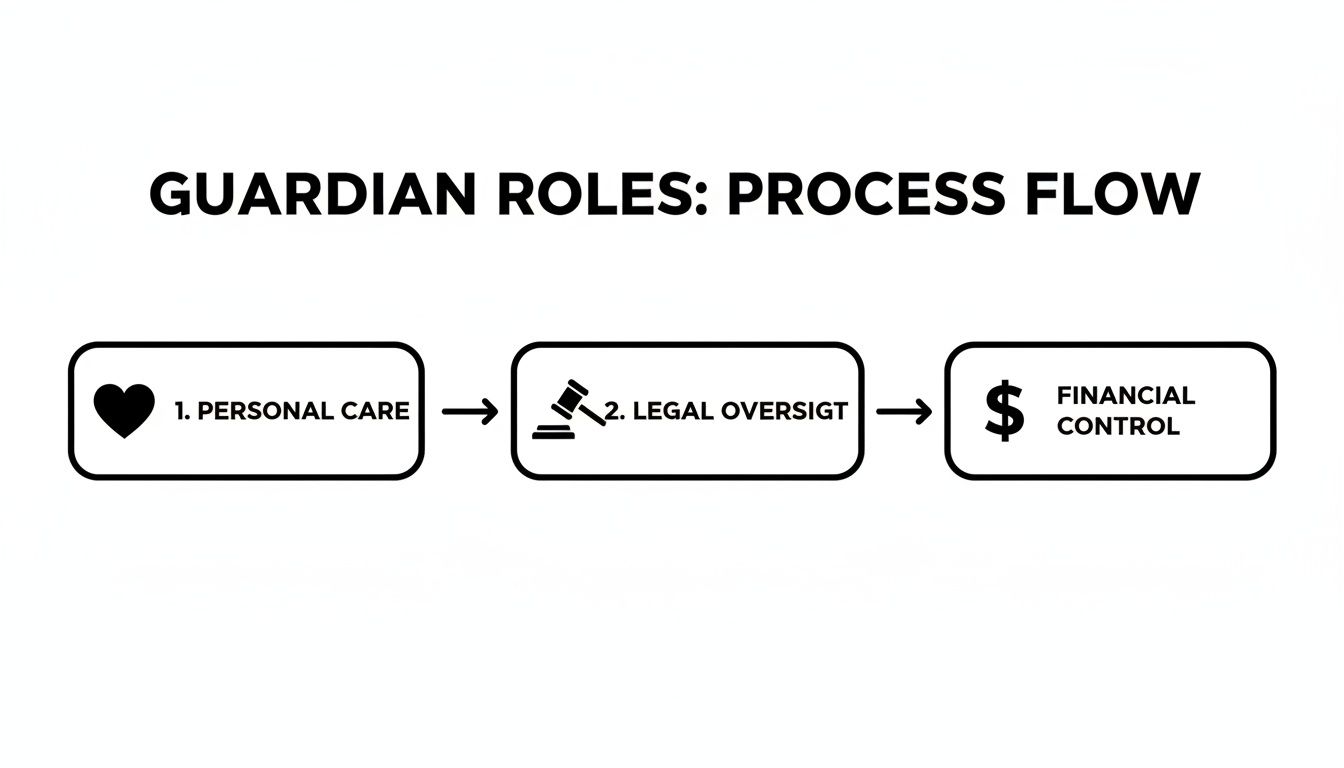
The flow from personal well-being to legal and financial duties highlights the comprehensive responsibility a guardian undertakes for the ward.
The Guardianship Hearing and Court's Decision
The final step is the guardianship hearing, where the judge puts all the evidence under a microscope. The person who filed the application has to prove with "clear and convincing evidence" that the proposed ward is incapacitated and that appointing a guardian is truly in their best interest.
At the hearing, the judge will weigh:
- The physician's certificate.
- The report from the attorney ad litem.
- Testimony from the applicant, the proposed ward (if able), and other witnesses.
If the judge is convinced that a guardianship is necessary, they will sign a court order and issue "Letters of Guardianship." This is the official document that gives the guardian the legal authority to start making decisions.
In truly urgent situations, like a sudden medical crisis or an immediate financial threat, a family can seek a temporary guardianship. This process moves much faster, often taking just a few days, and provides a short-term solution while the permanent guardianship application is processed. At The Law Office of Bryan Fagan, we have extensive experience handling these emergency situations, ensuring we can act swiftly to protect your loved one when every moment counts.
When Does Someone Actually Need a Guardian?
Understanding the legal definition of a guardian is one thing, but seeing how it applies in real life is what truly matters for Texas families. The first, and often hardest, step is recognizing the signs that a loved one needs this kind of legal protection. These situations are never easy, but knowing when to act can prevent heartache, financial loss, and further distress.
Let's walk through some common scenarios we see at The Law Office of Bryan Fagan, where guardianship becomes a necessary tool for protection. Each case is different, and we must carefully determine if a Guardian of the Person, a Guardian of the Estate, or both is the right path.
Scenario 1: An Aging Parent with Dementia
Imagine your mother, who lives in Harris County, has been diagnosed with Alzheimer's. At first, the signs were subtle—misplaced keys, forgotten names. But now, things have gotten serious. She's forgetting to pay bills, and she recently fell for a phone scam, losing a significant chunk of her savings. On top of that, she's refusing to go to her doctor's appointments and can't manage her medications safely anymore.
- Guardian of the Estate: In this situation, a guardian for her finances is critical. This person would step in to protect her from more financial exploitation by taking control of her bank accounts, paying her bills, and managing her assets under the court's watch. This ensures her life savings are secure.
- Guardian of the Person: A guardian for her personal needs is just as important. This person would have the legal authority to make medical decisions, ensure she's taking her medication correctly, and decide on the best living situation, whether that means arranging for in-home care or moving her to a specialized memory care facility.
For a case like this, a judge would almost certainly appoint a guardian for both the person and the estate to provide complete, wrap-around protection.
Scenario 2: An Adult with a Developmental Disability
Think about a young man in Dallas with a severe developmental disability. He’s about to turn 18, which means his parents' legal authority as his natural guardians is coming to an end. He’s happy and well-cared-for, but he simply doesn't have the capacity to make his own medical or financial decisions.
To continue making medical decisions and manage any government benefits he receives, his parents will need to be appointed as his legal guardians. For his lifelong well-being, a Guardian of the Person is absolutely essential. If he has few personal assets, a full Guardian of the Estate might not be necessary, though one could be appointed if he receives an inheritance or other funds.
Scenario 3: A Minor Who Receives a Large Inheritance
This is a tragic but common scenario. A car accident leaves a 14-year-old in Austin an orphan, but she is also the beneficiary of a substantial life insurance policy. A relative steps in to raise her, but the law requires a formal structure to manage those funds until she's an adult.
The court would appoint a Guardian of the Estate whose sole job is to prudently invest and manage her inheritance. This guardian protects those assets, files annual accountings with the probate court, and ensures the money is used for the child's benefit—like education and care—until she turns 18. This financial oversight is completely separate from the person who has physical custody and cares for her day-to-day.
Scenario 4: A Sudden, Incapacitating Stroke
Consider a 50-year-old business owner in San Antonio who suffers a massive stroke, leaving him unable to communicate or handle his personal and business affairs. The problem? He never put any power of attorney documents in place. His spouse is now in a terrible position—she needs immediate authority to pay bills, manage his company's payroll, and make critical medical decisions.
This is a crisis where an emergency guardianship for both the person and the estate is vital. The court can act incredibly fast to grant temporary powers, allowing the spouse to stabilize the situation while the permanent guardianship process moves forward. It's a lifeline that protects his health and financial stability without delay.
As these examples show, the need for a guardian often arises from life's most unexpected and challenging moments. The goal is always to create a legal shield tailored precisely to the individual's specific needs, preserving their dignity and protecting their future.
Statistics bring these roles into sharper focus, highlighting the difference between a guardian (handling personal decisions) and what some states call a conservator (handling financial decisions). For example, 34% of individuals on the autism spectrum have guardians, a higher rate than the 27.4% without. On the financial side, conservatorships oversee an estimated $50 billion in assets across 1.3 million cases in the U.S. Unfortunately, poor data tracking can make it incredibly difficult for courts to monitor for problems like elder abuse. To get a better sense of the national scope, you can explore more about the assets managed under U.S. conservatorships.
If your family is facing a situation like one of these, you are not alone. These are complex, emotional journeys, and you don't have to figure them out by yourself. We invite you to schedule a free consultation with our experienced attorneys to talk through your family's unique circumstances and find the best path forward.
Understanding Fiduciary Duties and Court Oversight
Stepping into the role of a guardian in Texas isn't just about getting a title; it's a profound legal and ethical commitment. This responsibility comes with a strict set of rules known as fiduciary duties, which legally bind you to act only and entirely in the ward's best interest. You're not just helping out a loved one—you're taking on a formal role that a Texas probate court will watch over to ensure every decision protects the vulnerable person you’ve agreed to serve.
This court supervision isn't a suggestion; it's a mandatory safeguard. For families in counties like Harris or Dallas, this oversight brings peace of mind, knowing a judge is actively monitoring the guardian's actions to prevent mismanagement, neglect, or exploitation. The entire system is built on accountability.

Fiduciary Duties for a Guardian of the Person
A Guardian of the Person looks after the ward's physical and emotional well-being. The duties feel personal, but the reporting requirements are formal and taken very seriously.
- Annual Report: The Texas Estates Code requires the guardian to file an "Annual Report on the Condition and Well-Being of the Ward." This is a sworn document that details the ward's current living situation, health status, and any major changes from the past year.
- Best Interest Standard: Every single decision, from picking a new doctor to approving a medical procedure, must be made with the ward's best interests as the sole focus. A guardian's personal convenience or what other family members think cannot legally factor into these choices.
This consistent reporting keeps the court in the loop and confirms the guardian is fulfilling their duties with care and diligence.
Fiduciary Duties for a Guardian of the Estate
When it comes to money, the rules for a Guardian of the Estate are even tighter. This role is less about personal care and all about meticulous financial management, with the court essentially acting as a financial watchdog.
The law has evolved to keep personal and financial duties separate to prevent abuse, which is why the financial oversight is so strict. Today, there are around 1.3 million guardianship and conservatorship cases in the U.S. managing assets totaling approximately $50 billion. However, data gaps are still a challenge, which makes robust court oversight here in Texas all the more critical.
A Guardian of the Estate has to meet several key requirements:
- Post a Bond: Before they can do anything, the guardian usually has to buy a surety bond. Think of it as an insurance policy that protects the ward's estate from financial losses if the guardian mismanages the funds or engages in misconduct.
- File an Inventory: Within 30 days of qualifying, the guardian must file a sworn "Inventory, Appraisement, and List of Claims." This document gives the court a complete, detailed list of all the ward's assets and what they're worth.
- Submit Annual Accountings: Every year, the guardian files a detailed "Annual Accounting" that tracks every single dollar that came into and went out of the estate. This includes bank statements, receipts, and explanations for all spending, all of which a judge must approve. Our guide on a guardian's roles in managing the ward's finances under Texas law breaks down these financial duties even further.
Beyond this general oversight, a guardian may also have to manage the ward's contracts and legal agreements. Looking into contract management best practices can offer some valuable insights for handling these obligations effectively.
A Fiduciary’s Promise: The core of a fiduciary duty is the promise to place the ward’s interests above all others, including your own. It is the highest standard of care recognized by law, demanding absolute loyalty, transparency, and prudence.
The strict oversight from Texas probate courts isn't meant to be a burden. It's a protective shield, giving families reassurance that their loved one's well-being and life savings are protected by a strong system of checks and balances.
Common Questions About Texas Guardianship
When you're trying to protect a vulnerable loved one, it’s natural to have a lot of questions. The legal system can seem like a maze, and unfamiliar terms like "guardian" and "conservator" only add to the confusion. Our goal here is to give you clear, straightforward answers that cut through the legal jargon and help you feel more confident about the path ahead.
We’ve gathered the questions we hear most often from families across Texas. Each answer is designed to give you practical insight, but remember, every family's situation is unique, which is why personalized legal advice is always the best next step.
Does Texas Use the Term "Conservator" At All?
Yes, but the context is absolutely critical. In Texas, you'll almost exclusively hear the term "conservator" in family law courtrooms, specifically during child custody cases. It’s the legal word used to describe a parent's rights and responsibilities for their child.
But when the conversation shifts to protecting an incapacitated adult, the law uses entirely different language. The Texas Estates Code, which is the rulebook for these situations, doesn't use "conservator" for adults at all. Instead, it defines two distinct roles: the "Guardian of the Person" who handles personal and healthcare decisions, and the "Guardian of the Estate" who manages finances.
While people might casually use "conservator" to talk about managing money, using the correct legal terms in court documents is non-negotiable. An application with the wrong terminology could easily get delayed in a probate court, whether you're in Harris County, Bexar County, or anywhere else in the state.
Can One Person Serve as Both Types of Guardian?
Absolutely. In fact, it’s quite common for a Texas probate court to appoint one qualified and trusted person—often a spouse, an adult child, or another close relative—to serve as both Guardian of the Person and Guardian of the Estate. This creates a single point of contact, which can streamline decision-making and ensure seamless, consistent care for the Ward.
That said, the court's number one job is to protect the Ward. If the estate is especially large or complex, or if there's a history of family conflict, a judge might decide it's safer to split the roles. For instance, one sibling could be appointed to manage personal care while a neutral professional, like a corporate fiduciary or a bank, is named to manage the estate. This structure creates a built-in system of checks and balances, reducing the risk of disputes or mismanagement.
The decision to appoint one or two guardians always comes down to the specific facts of the case. The court will look at what arrangement truly serves the Ward’s best interests, weighing family dynamics, the complexity of the finances, and the skills of the proposed guardian.
What Are the Alternatives to Guardianship in Texas?
Because guardianship involves taking away a person's fundamental right to make their own choices, Texas courts consider it a last resort. The law strongly prefers less restrictive options whenever they are available and effective. The single best way to avoid a court-imposed guardianship is through proactive Estate Planning.
Several powerful legal tools allow someone to name their own decision-makers in advance, while they still have the capacity to do so. These include:
- Durable Power of Attorney: This document lets you appoint a trusted "agent" to handle your financial affairs if you become unable to manage them yourself.
- Medical Power of Attorney: This lets you name an agent to make healthcare decisions for you if you can't communicate your own wishes.
- Living Trust: A trust is a fantastic tool for managing assets, both during your lifetime and after, often avoiding the need for any court involvement.
If these documents are already in place and working as intended, a guardianship might not be necessary at all. Our firm is a huge advocate for this kind of forward-thinking planning, as it keeps control in the hands of the family and helps avoid the courthouse altogether.
How Can Your Law Firm Help with This Process?
At The Law Office of Bryan Fagan, we offer compassionate and comprehensive support for families navigating the Guardianship process. We know you're dealing with a heavy emotional and financial weight, and our mission is to lift the legal burden from your shoulders so you can focus on what matters most: caring for your loved one.
We're with you at every step of the journey, from the first conversation to helping you with your duties after the appointment. Our services include:
- Evaluating your family’s situation to determine if guardianship is the right path forward and exploring less restrictive alternatives.
- Preparing and filing all necessary legal paperwork with the correct Probate court.
- Coordinating with doctors to get the required medical examinations and reports.
- Representing you at all court hearings, advocating for your loved one’s best interests.
- Advising you on your ongoing responsibilities and fiduciary duties as a guardian.
We are committed to making this tough process as clear and supportive as we can, giving your family the professional guidance and empathetic care you deserve.
Protecting a vulnerable family member is one of the most important actions you can take. If you are considering guardianship or just need advice on the best way forward for your family, the experienced attorneys at The Law Office of Bryan Fagan, PLLC are here to help. Schedule a free, no-obligation consultation today to talk through your situation and learn how we can protect what matters most.